Overview
Watch
Read
Next Steps
Read
Central Angles and Proofs: Unlocking Circle Geometry
Understanding Inscribed Angles
Let's dive into the fascinating world of inscribed angles! Imagine you're drawing a circle, and you decide to connect three points on that circle with lines. The angle formed at one of those points, with its vertex touching the circle, is what we call an inscribed angle. It's like the circle is giving that angle a big hug!
Inscribed angles have some really cool properties that make them special. First, let's talk about how they're formed. You need three key ingredients: a circle, a point on the circle (which becomes the vertex of your angle), and two more points on the circle that you connect to your vertex point. The lines connecting these points are called chords, and they form the sides of your inscribed angle.
Now, here's where it gets interesting. The size of an inscribed angle is directly related to the arc measure it "opens up" on the circle. In fact, an inscribed angle is always half the measure of the central angle that subtends the same arc. That's a fancy way of saying if you drew a line from the center of the circle to the two points where your inscribed angle touches the circle, that central angle would be twice as big as your inscribed angle.
Let's look at an example. Imagine you have an inscribed angle that opens up a 90-degree arc on the circle (that's a quarter of the circle). The inscribed angle itself would measure 45 degrees exactly half of 90. This relationship holds true for any inscribed angle and its corresponding arc.
Here's another cool fact: if you have multiple inscribed angles that open up the same arc on a circle, they're all equal to each other! It doesn't matter where on the circle you place the vertex of your inscribed angle. As long as it's opening up the same arc, it will have the same measure as any other inscribed angle opening that same arc. It's like magic, but it's just geometry!
When we talk about arcs, we usually distinguish between minor arcs (less than half the circle) and major arcs (more than half the circle). An inscribed angle always measures half of the minor arc it subtends. If you're dealing with a major arc, you'd need to subtract it from 360 degrees first to find the minor arc, then halve that.
Inscribed angles in construction have practical applications too. They're used in construction, engineering, and even in designing stadiums where you want everyone to have a good view of the field. Understanding inscribed angles can help you see the world in a new, more circular way!
To sum up, inscribed angles are angles formed when their vertex is on a circle and their sides are chords of that circle. They're always half the measure of the central angle that subtends the same arc, and all inscribed angles on the same arc are equal. Whether you're solving geometry problems or just appreciating the mathematical beauty around you, inscribed angles are a key concept to understand in the world of circles and angles.
Central Angles and Their Properties
Central angles are a fundamental concept in geometry, particularly in the study of circles. A central angle is an angle formed by two radii of a circle that intersect at the circle's center. This unique position at the heart of the circle gives central angles special properties that distinguish them from other types of angles, such as inscribed angles.
The key difference between central angles and inscribed angles lies in their vertex position. While central angles have their vertex at the circle center, inscribed angles have their vertex on the circle's circumference. This distinction leads to important differences in their properties and relationships to other circle elements.
One of the most significant properties of central angles is their direct relationship to arcs. The measure of a central angle is always equal to the measure of the arc it intercepts on the circle's circumference. This one-to-one correspondence makes central angles particularly useful in arc length calculation and sector areas.
For example, if a central angle measures 90 degrees, it will intercept a quarter of the circle's circumference, creating an arc that also measures 90 degrees. This relationship holds true for any central angle, whether it's 30 degrees, 180 degrees, or any other measure.
Central angles also have a special relationship between central angles and chords. A chord is a line segment that connects two points on a circle's circumference. When a central angle intersects a chord, it bisects that chord, dividing it into two equal parts. This property is particularly useful in solving geometric problems involving circles and chords.
Furthermore, the perpendicular line from the circle's center to a chord always bisects the central angle formed by the radii to the chord's endpoints. This reciprocal relationship between central angles and chords provides a powerful tool for analyzing circular geometries.
Another important property of central angles is their role in defining sectors of a circle. A sector is the region of a circle enclosed by two radii and an arc. The central angle formed by these radii determines the size of the sector, which is proportional to the angle's measure.
In practical applications, central angles in navigation are used extensively in navigation, astronomy, and engineering. For instance, in navigation, the angles between celestial bodies are measured as central angles from the observer's position at the center of an imaginary celestial sphere.
Understanding central angles and their properties is crucial for solving a wide range of geometric problems involving circles. Whether calculating arc lengths, determining chord relationships, or analyzing circular motion, the concept of central angles provides a powerful framework for geometric reasoning and problem-solving in both theoretical and applied mathematics.
Relationship Between Inscribed and Central Angles
In geometry, the relationship between inscribed angles and central angles that intercept the same arc is a fundamental concept that helps us understand the properties of circles. This relationship is encapsulated in a crucial theorem that states: a central angle is twice the measure of the inscribed angle that intercepts the same arc. Let's explore this concept in depth and provide clear examples to illustrate its significance.
First, let's define our terms. An inscribed angle is an angle formed by two chords of a circle that intersect on the circle's circumference. A central angle, on the other hand, is an angle whose vertex is at the center of the circle. The arc of a circle is any continuous portion of the circle's circumference.
The theorem we're focusing on can be stated as follows: If an inscribed angle and a central angle intercept the same arc on a circle, the measure of the central angle is always twice the measure of the inscribed angle. This relationship holds true regardless of where the inscribed angle is positioned on the circle's circumference.
To visualize this, imagine a circle with its center point O. Draw a central angle AOB, where A and B are points on the circle's circumference. Now, choose any point C on the circle's circumference (except points A and B) and draw the inscribed angle ACB. The theorem states that angle AOB (the central angle) will always be twice the measure of angle ACB (the inscribed angle).
Let's consider a specific example. Suppose we have a central angle that measures 120°. According to our theorem, any inscribed angle that intercepts the same arc will measure exactly half of that, which is 60°. You can test this by drawing various inscribed angles along the circle's circumference they will all measure 60° as long as they intercept the same arc as the 120° central angle.
This theorem has several important implications and applications in geometry:
- It allows us to calculate unknown angles in circle problems more easily.
- It helps in understanding the properties of cyclic quadrilaterals (quadrilaterals inscribed in a circle).
- It's crucial in proving other theorems related to circles and angles.
The proof of this theorem involves considering three cases based on the position of the center of the circle relative to the inscribed angle. However, the underlying principle remains the same in all cases: the central angle spans twice the arc of the inscribed angle.
This relationship between inscribed angles and central angles also leads to other interesting properties. For instance, all inscribed angles that intercept the same arc are equal to each other, even if they're at different points on the circle's circumference. This is because they're all half the measure of the same central angle.
Another fascinating application of this theorem is in the case of an inscribed angle that intercepts a semicircle. Since a semicircle corresponds to a central angle of 180°, the inscribed angle in this case will always be 90° a right angle. This property is used in constructing right angles and in proving the right-angle theorem in cyclic quadrilaterals.
Understanding the relationship between inscribed angles and central angles is crucial for solving many geometric problems involving circles. It provides a powerful tool for analyzing circular shapes and their properties, making it an essential concept in both theoretical and applied geometry.
Special Cases: Inscribed Angles in a Semicircle
In the realm of geometry, inscribed angles in a semicircle present a fascinating special case that has intrigued mathematicians for centuries. This unique property states that any angle inscribed in a semicircle is always a right angle in semicircle, measuring exactly 90 degrees. This concept is not only elegant in its simplicity but also incredibly useful in various geometric applications.
To understand why this phenomenon occurs, let's consider the structure of a semicircle. A semicircle is formed when a circle is divided exactly in half by its diameter. Any point on the semicircular arc can be used to create an inscribed angle in a semicircle by drawing lines to both ends of the diameter. Remarkably, regardless of where this point is chosen on the arc, the resulting angle will invariably be a right angle in semicircle.
The proof of this property relies on fundamental principles of circle geometry. Consider an inscribed angle in a semicircle with its vertex at point A on the arc, and the endpoints of the diameter at points B and C. The angle BAC is inscribed in the semicircle. We can prove that this angle is always 90 degrees by recognizing that the triangle ABC is inscribed in a circle where BC is a diameter. In any circle, an angle inscribed in a semicircle is half the central angle that subtends the same arc. Since the central angle in a semicircle is always 180 degrees (a straight line), half of this is 90 degrees, thus proving our theorem.
This property has numerous practical applications in geometry and real-world scenarios. In construction and architecture, it provides a simple method for creating right angles without the need for complex measuring tools. Surveyors and engineers can use this principle to establish perpendicular lines in semicircle in field work. In mathematics education, it serves as an excellent tool for teaching concepts of circle geometry, angles, and proofs.
Problem-solving in geometry often benefits from this property. For instance, when dealing with complex figures involving circles and triangles, recognizing an inscribed angle in a semicircle can immediately provide information about right angles in the figure, simplifying calculations and proofs. It's particularly useful in problems involving tangent lines to circles, as the radius at the point of tangency is always perpendicular to the tangent line, forming a right angle in semicircle with it.
In conclusion, the property of inscribed angles in a semicircle being right angles is a powerful and elegant concept in geometry. Its simplicity belies its significance in both theoretical mathematics and practical applications. By understanding and utilizing this principle, students, professionals, and enthusiasts alike can approach a wide range of geometric problems with greater insight and efficiency.
Proofs and Theorems Related to Central and Inscribed Angles
In geometry, central and inscribed angles play crucial roles in understanding circle properties. Two key theorems that students should master are the Central Angle Theorem and the Inscribed Angle Theorem. Let's explore these proofs and theorems in detail.
Central Angle Theorem
The Central Angle Theorem states that the measure of a central angle is equal to the measure of the arc it intercepts. This fundamental theorem forms the basis for many circle-related proofs.
Proof of the Central Angle Theorem:
- Consider a circle with center O and a central angle AOB.
- The central angle AOB intercepts an arc AB on the circle's circumference.
- By definition, the measure of the central angle is the angle formed at the center of the circle.
- The measure of the arc is defined as the angle subtended at the center by the arc.
- Therefore, the measure of the central angle AOB is equal to the measure of the arc AB.
Inscribed Angle Theorem
The Inscribed Angle Theorem states that the measure of an inscribed angle is half the measure of the central angle that subtends the same arc. This theorem is essential for solving problems involving angles in circles.
Proof of the Inscribed Angle Theorem:
- Consider a circle with center O and an inscribed angle ABC.
- Draw a line from the center O to point B, creating two triangles: OAB and OBC.
- Since OA and OB are radii, triangle OAB is isosceles, and angles OAB and OBA are equal. Let's call this angle x.
- Similarly, triangle OBC is isosceles, and angles OCB and OBC are equal. Let's call this angle y.
- The exterior angle of a triangle is equal to the sum of the two remote interior angles. Therefore, angle ABC = x + y.
- The central angle AOC is equal to 2x + 2y (sum of angles in triangle AOB and BOC).
- Thus, the inscribed angle ABC (x + y) is half of the central angle AOC (2x + 2y).
Applications and Implications
These theorems have numerous applications in geometry:
- Calculating arc lengths and angle measures in circles
- Solving problems involving tangent lines to circles
- Understanding relationships between chords, secants, and tangents
- Proving other circle-related theorems
Special Cases of the Inscribed Angle Theorem
There are some notable special cases of the Inscribed Angle Theorem:
- Inscribed angle in a semicircle: When an inscribed angle intercepts a diameter, it always forms a right angle (90 degrees).
- Angles inscribed in the same arc: All angles inscribed in the same arc are equal to each other.
- Opposite angles in a cyclic quadrilateral: The opposite angles in a quadrilateral inscribed in a circle are supplementary (sum to 180 degrees).
Practice and Application
To master these theorems, students should practice solving various problems involving central and inscribed angles. Some exercises might include:
- Calculating the measure of an inscribed angle given the central angle
- Finding arc lengths using central and inscribed angles
- Proving relationships
Applications and Problem-Solving
Central and inscribed angles are fundamental concepts in geometry that have numerous practical applications in the real world. Understanding these concepts can help solve various problems in fields such as architecture, engineering, and navigation. Let's explore some practical applications and problem-solving examples to demonstrate how to apply these concepts.
One common application of central and inscribed angles is in the design of circular structures. Architects and engineers often use these principles when planning buildings with circular or semi-circular features. For example, when designing an amphitheater, the seating arrangement can be optimized using the properties of inscribed angles to ensure that all spectators have a good view of the stage.
Problem-solving example 1: Designing a circular fountain
An architect is designing a circular fountain with eight equally spaced water jets around its circumference. What is the central angle between each jet, and what would be the inscribed angle if viewed from the edge of the fountain?
Step 1: Calculate the central angle
Central angle = 360° ÷ number of jets
Central angle = 360° ÷ 8 = 45°
Step 2: Calculate the inscribed angle
Inscribed angle = ½ × Central angle
Inscribed angle = ½ × 45° = 22.5°
Another practical application of these concepts is in navigation and surveying. Sailors and surveyors use the relationship between central and inscribed angles to determine distances and positions. For instance, the angle of elevation to a landmark can be used to calculate the distance to that landmark using trigonometry.
Problem-solving example 2: Determining the distance to a lighthouse
A ship's captain observes a lighthouse at an angle of 30° from the ship's bow. After sailing 5 nautical miles perpendicular to the original line of sight, the angle to the lighthouse is now 45°. How far is the ship from the lighthouse after sailing?
Step 1: Recognize that this forms a right triangle with the lighthouse at one vertex
Step 2: Use the tangent function to set up an equation
tan 30° = x / 5 and tan 45° = x / (x - 5), where x is the distance to the lighthouse
Step 3: Solve the equations
x = 5 × tan 30° 2.89 nautical miles
x = (x - 5) × tan 45°
x = x - 5
5 = x(1 - tan 45°)
x = 5 / (1 - tan 45°) 8.54 nautical miles
Central and inscribed angles also play a crucial role in optics and lens design. The principles of these angles are used to calculate how light rays bend when passing through lenses, which is essential for designing cameras, telescopes, and other optical instruments.
Problem-solving example 3: Calculating the angle of refraction in a lens
A light ray enters a semicircular lens at an angle of 60° to the normal. The lens has a refractive index of 1.5. What is the angle of refraction inside the lens?
Step 1: Use Snell's Law
n1 × sin θ1 = n2 × sin θ2
Where n1 = 1 (air), n2 = 1.5 (lens), θ1 = 60° (incident angle), and θ2 is the angle of refraction
Step 2: Solve for θ2
1 × sin 60° = 1.5 × sin θ2
sin θ2 = (sin 60°) /
Conclusion
In this exploration of central angles and inscribed angles, we've delved into fundamental geometric concepts crucial for understanding circular relationships. The introduction video provided a solid foundation, illustrating how central angles are formed at the center of a circle and their relationship to inscribed angles. We've learned that the measure of an inscribed angle is always half that of the central angle subtending the same arc. This key principle forms the basis for many geometric proofs involving circles. The proofs we've examined demonstrate the logical reasoning required in geometry and how to apply theorems to solve complex problems. As you continue your geometry journey, remember to practice these concepts regularly. Explore more challenging problems involving central and inscribed angles to deepen your understanding. The skills you've developed here will be invaluable in tackling advanced geometric topics and real-world applications. Keep questioning, proving, and discovering the beautiful world of circular geometry!
Example:
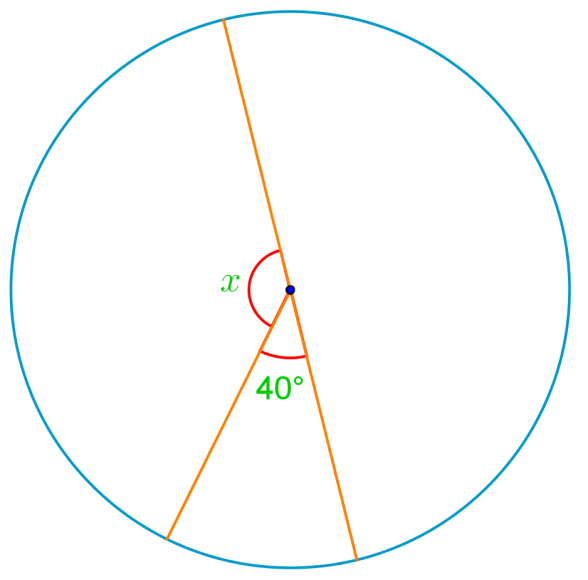
Find x
Step 1: Understand the Given Information
In this problem, we are given a circle with a central angle and a diameter. The central angle is marked as 40 degrees. The diameter of the circle is a straight line that passes through the center of the circle, dividing it into two equal halves. This information is crucial for solving the problem.
Step 2: Recognize the Properties of a Diameter
The diameter of a circle is a straight line that passes through the center of the circle, creating a straight angle. A straight angle measures 180 degrees. This property is essential because it helps us understand that the total angle formed by the diameter is 180 degrees.
Step 3: Identify the Relationship Between the Given Angle and the Diameter
Since the diameter forms a straight angle of 180 degrees, and we are given a central angle of 40 degrees, we can use this information to find the unknown angle, x. The central angle and the unknown angle together form the straight angle of 180 degrees.
Step 4: Set Up the Equation
To find the unknown angle, x, we need to set up an equation that represents the relationship between the given angle and the total angle formed by the diameter. The equation is as follows:
180 degrees (total angle) = 40 degrees (given angle) + x (unknown angle)
Step 5: Solve for x
To solve for x, we need to isolate x on one side of the equation. We can do this by subtracting the given angle from the total angle:
x = 180 degrees - 40 degrees
By performing the subtraction, we find that:
x = 140 degrees
Step 6: Verify the Solution
To ensure that our solution is correct, we can verify that the sum of the given angle and the unknown angle equals the total angle formed by the diameter. In this case, 40 degrees (given angle) + 140 degrees (unknown angle) = 180 degrees (total angle). Since the sum is correct, our solution is verified.
Conclusion
By following these steps, we have successfully found the unknown angle, x, using the properties of the diameter and the given central angle. This method can be applied to similar problems involving central angles and diameters in circles.
FAQs
-
What is the difference between a central angle and an inscribed angle?
A central angle has its vertex at the center of the circle, while an inscribed angle has its vertex on the circle's circumference. The measure of a central angle is always twice that of an inscribed angle that subtends the same arc.
-
How do you calculate the measure of an inscribed angle?
The measure of an inscribed angle is half the measure of the central angle that subtends the same arc. Alternatively, it's half the measure of the arc it intercepts on the circle.
-
What is the inscribed angle theorem?
The inscribed angle theorem states that an inscribed angle is half the measure of the central angle that subtends the same arc on a circle. This theorem is fundamental in solving many circle geometry problems.
-
Why is an angle inscribed in a semicircle always a right angle?
An angle inscribed in a semicircle is always 90 degrees (a right angle) because it intercepts a diameter, which subtends a central angle of 180 degrees. Since an inscribed angle is half the measure of the central angle, it must be 90 degrees.
-
How are central and inscribed angles used in real-world applications?
Central and inscribed angles have numerous practical applications, including architecture (designing circular structures), navigation (determining distances and positions), optics (lens design), and engineering (circular motion analysis). They're also used in surveying, astronomy, and many other fields requiring precise angular measurements.
Prerequisite Topics for Central Angles and Proofs
Understanding central angles and proofs is a crucial aspect of geometry and trigonometry. To fully grasp this concept, it's essential to have a solid foundation in several prerequisite topics. One of the most fundamental prerequisites is radian measure and arc length, which provides the basis for measuring angles in a circular context.
Another important concept to master is angles in a circle. This topic helps students understand how angles are formed within circular shapes and how they relate to central angles. Additionally, knowledge of tangent properties is crucial, as it allows for a deeper understanding of how lines interact with circles, which is often a key component in central angle proofs.
When dealing with more advanced problems involving central angles, students may need to apply arc length calculation techniques. This skill is particularly useful when working with complex geometric figures or in calculus-related problems. Understanding the relationship between central angles and chords is also vital, as it forms the basis for many theorems and proofs in this area.
For students tackling problems involving right angles, knowing how to use tangent ratios to calculate angles and sides can be incredibly helpful, especially when dealing with right angles in semicircles. This knowledge ties directly into the broader concept of central angles and their properties.
While not directly related, understanding the central limit theorem can provide valuable insights into the concept of centrality in mathematics, which can be beneficial when studying central angles. Lastly, familiarity with the angle of elevation and depression can enhance a student's spatial reasoning skills, which are crucial when visualizing and solving problems related to central angles and their proofs.
By mastering these prerequisite topics, students will be well-equipped to tackle the challenges presented by central angles and proofs. Each of these concepts builds upon the others, creating a comprehensive understanding of circular geometry and its applications. As students progress through these topics, they'll find that their ability to solve complex problems and construct rigorous proofs improves significantly, setting a strong foundation for advanced mathematical studies.