AP Calculus BC Help — Video Lessons & Practice
Get clear, step-by-step explanations for every AP Calculus BC topic and build exam-ready confidence.
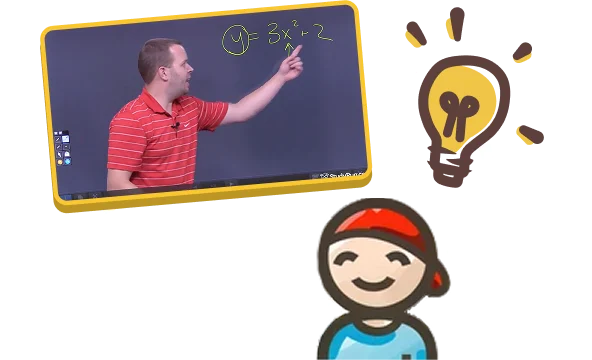
Certified-Teacher Concept Videos
Watch step-by-step AP Calculus BC lessons made by certified teachers — not AI. Learn the method behind every integration technique and series problem so you can tackle anything on the ATAR exam.
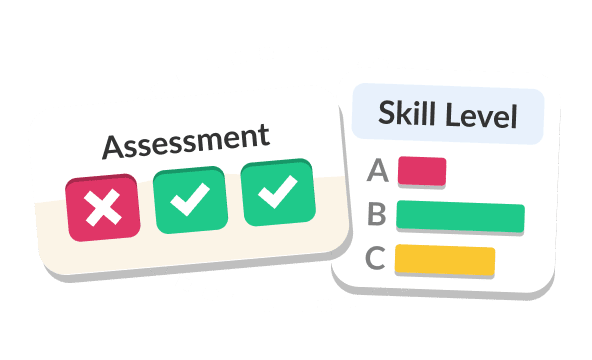
Diagnostic Assessment That Finds Your Gaps
A quick diagnostic pinpoints exactly which AP Calculus BC topics need attention — so you study smarter, not harder, and spend zero time on what you already know.

Adaptive Practice for Every Topic
Practice problems adjust to your performance level, keeping you challenged on limits, polar curves, and Taylor series until each concept is genuinely solid.
Try It Now
Test your knowledge
Our approach aligns with the evidence
Exam Scores
Better Recall
Less Anxiety
AP Calculus BC Topics
1. Limits & Continuity
2. Derivatives
3. Derivative Applications
4. Integrals
5. Integration techniques
6. Integral Applications
7. Differential Equations
8. Sequence and Series
8 Chapters · 68 Topics · 454 Videos
Discover Our Learning Areas
Explore key subjects and start learning with interactive content.






What Is AP Calculus BC?
AP Calculus BC is a College Board Advanced Placement course and exam that covers the equivalent of a full first-year university calculus sequence. It builds on the content of AP Calculus AB — limits, derivatives, and integrals — and extends it with more advanced integration techniques, infinite series, parametric and polar calculus, and a deeper treatment of differential equations. For Australian students at international schools or those applying to US universities, AP Calculus BC is among the most valued and challenging mathematics qualifications available at the senior secondary level.
What Topics Are Covered in AP Calculus BC?
AP Calculus BC is broad and rigorous. The course is structured around several major topic areas:
Limits and continuity form the foundation — understanding how functions behave as inputs approach a value, and what it means for a function to be continuous. These skills underpin everything that follows.
Derivatives and their applications include the product rule, quotient rule, chain rule, implicit differentiation, related rates, and optimisation. Students explore how derivatives describe rates of change and the shape of curves.
Integration techniques go well beyond the basic antiderivative. AP Calculus BC adds integration by parts, partial fraction decomposition, trigonometric substitution, and improper integrals — tools essential for any science or engineering degree.
Infinite series and sequences are often cited as the most conceptually demanding section. Students learn to test series for convergence using the ratio test, root test, integral test, comparison tests, and the alternating series test, and to represent functions as power series, Taylor series, and Maclaurin series.
Parametric, vector, and polar calculus extend differentiation and integration to curves expressed in parametric or polar form, including arc length and polar area calculations.
Differential equations cover separation of variables, slope fields, and Euler's method, with applications to exponential growth and decay models.
Is AP Calculus BC Hard?
AP Calculus BC is widely regarded as one of the most demanding AP courses. The difficulty comes not just from the volume of content — which is substantial — but from the depth of conceptual reasoning required. Memorising procedures is not enough; the free-response section of the AP exam requires students to set up problems, justify conclusions, and communicate mathematical reasoning clearly.
The topics students struggle with most are consistent: infinite series convergence testing (selecting the right test and applying it correctly under time pressure), Taylor series error bounds, polar area integrals, and the subtleties of improper integrals. Students who approach these topics with deliberate practice — working problems from multiple angles and reviewing where their reasoning breaks down — make the strongest progress.
The good news is that AP Calculus BC rewards structured study. Because the AB topics are prerequisites, students who have a firm handle on derivatives and basic integration before they encounter the BC-specific material tend to find the extension content much more manageable.
Why Use StudyPug for AP Calculus BC Help?
StudyPug is built for students who need more than a textbook explanation. Here is what sets it apart for AP Calculus BC:
A diagnostic assessment that eliminates wasted revision time. Before you watch a single video, StudyPug's diagnostic identifies your exact weak spots — whether that is series convergence, parametric derivatives, or integration by parts. You get a clear study plan instead of working through topics you already understand.
Certified-teacher video lessons that teach the method. Every AP Calculus BC lesson on StudyPug is created by a certified teacher. The videos do not just show you an answer — they walk through the reasoning so you understand how to approach any variation of the problem on the actual AP exam. This is the difference between recognising a solution and being able to produce one yourself.
Adaptive practice that keeps you progressing. As your performance improves, StudyPug's practice system adjusts the difficulty of problems. You are always working at the right level — not bored by questions that are too easy, not demoralised by questions that are too hard.
Practice tests based on real exam-style questions. The AP Calculus BC exam has a very specific format. StudyPug's practice tests mirror that format — timed multiple-choice sets and free-response questions — so you build both knowledge and exam technique before May.
Access anytime, on any device. Whether you are revising the night before a mock exam or working through series problems on a weekend, StudyPug is available 24/7. You are never stuck waiting for a tutor's availability.
Every subscription comes with a 30-day money-back guarantee. If StudyPug does not work for you within the first 30 days, you get a full refund — no questions asked.
What You Learn: AP Calculus BC Curriculum Coverage
StudyPug's AP Calculus BC content is structured to match the College Board curriculum framework. Coverage includes all eight AP Calculus BC units:
- Unit 1 – Limits and Continuity
- Unit 2 – Differentiation: Definition and Fundamental Properties
- Unit 3 – Differentiation: Composite, Implicit, and Inverse Functions
- Unit 4 – Contextual Applications of Differentiation
- Unit 5 – Analytical Applications of Differentiation
- Unit 6 – Integration and Accumulation of Change (including BC techniques)
- Unit 7 – Differential Equations
- Unit 8 – Applications of Integration
- Unit 9 – Parametric Equations, Polar Coordinates, and Vector-Valued Functions
- Unit 10 – Infinite Sequences and Series
Because this page's validated internal link map contains no confirmed topic-level URLs for the AU AP Calculus BC course at this time, all curriculum navigation is available directly through the topic browser on the course page — no links are fabricated here.
How to Use StudyPug for AP Calculus BC
Getting started is straightforward. When you first log in, take the AP Calculus BC diagnostic. It takes around 15 minutes and gives you a personalised breakdown of which units need the most attention.
From there, work through the recommended video lessons in order. Each lesson is self-contained — you can pause, rewind, and rewatch any step. After the video, move straight into the adaptive practice set for that topic while the method is fresh.
As your exam date approaches, shift to full practice tests. StudyPug's AP Calculus BC practice tests replicate the real exam format: 45 multiple-choice questions and 6 free-response questions across calculator and non-calculator sections. Review every question you get wrong using the worked video solution, identify the pattern in your errors, and target that pattern with focused practice before your next test run.
Students preparing for the AP Calculus BC exam in May typically see the strongest results when they begin structured practice at least eight weeks out — enough time to work through all ten units, address diagnostic gaps, and complete multiple full practice tests. StudyPug is designed to fit around school commitments: even 30–45 minutes of focused study per session, done consistently, compounds into significant improvement by exam day.
AP Calculus BC FAQ
Unsure how StudyPug works? Need help with setting up? Check our frequently asked questions or contact us for help.
What do you learn in AP Calculus BC, and what topics does it cover?
AP Calculus BC covers all of AP Calculus AB plus additional advanced topics. Core areas include limits, derivatives, and integrals from AB, extended with integration techniques (integration by parts, partial fractions), infinite series and sequences, Taylor and Maclaurin series, parametric equations, polar coordinates, and differential equations including slope fields. The course is designed to be equivalent to a full first-year university calculus sequence, giving students a strong foundation for higher-level mathematics and science degrees.
What is the difference between AP Calculus BC and AP Calculus AB?
AP Calculus AB covers roughly one semester of university calculus — limits, basic derivatives, and integration. AP Calculus BC covers the full first-year university sequence. BC adds integration techniques like integration by parts, infinite series and convergence tests, Taylor series, parametric and polar calculus, and more advanced differential equations. Students who complete BC and score well demonstrate readiness for second-year university mathematics. A BC exam score also includes an AB sub-score, so students are evaluated on both levels.
Is AP Calculus BC hard, and where do students struggle most?
AP Calculus BC is one of the most challenging AP courses offered. Most students find infinite series and convergence tests the hardest section — knowing which test to apply (ratio, integral, comparison) requires solid conceptual understanding, not just memorisation. Taylor and Maclaurin series and polar area calculations are also common trouble spots. Students who struggle with AP Calculus AB topics like the chain rule or definite integrals should shore those up first, as BC builds directly on AB content throughout the course.
What should I take before AP Calculus BC, and what comes after it?
You should have a strong grasp of Pre-Calculus and ideally have completed AP Calculus AB (or an equivalent accelerated course) before starting BC. Solid algebra, trigonometry, and function analysis skills are essential. After AP Calculus BC, students are typically ready for university-level Calculus II or Calculus III (multivariable), linear algebra, or differential equations courses. A strong AP BC score often earns university credit for two semesters of calculus, letting students enter advanced coursework earlier.
Is AP Calculus BC on the ATAR exam, and how is it assessed?
AP Calculus BC is a College Board AP exam, not part of the Australian ATAR system directly. However, many Australian students studying at international schools or pursuing US university applications sit the AP Calculus BC exam in May. The exam is three hours and fifteen minutes: a multiple-choice section (45 questions) and a free-response section (6 questions), split across calculator and non-calculator portions. Scores are reported on a 1–5 scale, with a 5 or 4 typically required for university credit at selective institutions.
What is one of the hardest concepts in AP Calculus BC, and how do you tackle it?
Infinite series convergence is widely considered the hardest AP Calculus BC concept. Students must know when to apply the ratio test, root test, comparison test, limit comparison test, integral test, and alternating series test — and choose the right one quickly under exam conditions. The key is pattern recognition through deliberate practice: work through many series examples, label which test applies and why, then check your reasoning against worked solutions. Building a personal reference sheet of test conditions helps enormously for the AP exam.