TOPIC
Parallel lines and transversalsMY PROGRESS
Pug Score
0%
Getting Started
"Let's build your foundation!"
Study Points
+0
Overview
Watch
Read
Next Steps
Get Started
Get unlimited access to all videos, practice problems, and study tools.
Back to Menu
Topic Progress
Pug Score
0%
Getting Started
"Let's build your foundation!"
Videos Watched
0/0
Read
Not viewed
Study Points
+0
Overview
Watch
Read
Next Steps
Read
Parallel Lines and Transversals: Understanding Angle Relationships
Introduction to Parallel Lines and Transversals
Welcome to the fascinating world of parallel lines and transversals! These fundamental concepts in geometry are essential for understanding more complex mathematical ideas. Let's start with the basics: parallel lines are two lines that never intersect, no matter how far they extend. A transversal is a line that crosses two or more other lines. When a transversal intersects parallel lines, it creates some interesting angle relationships that we'll explore further. To help you grasp these concepts, we've prepared an introduction video that visually demonstrates how parallel lines and transversals interact. This video is a great starting point for your journey into geometry, as it clearly illustrates the key principles and sets the foundation for more advanced topics. As we progress, you'll discover how these simple ideas form the building blocks for solving complex geometric problems. So, let's dive in and unravel the mysteries of parallel lines and angle relationships together!
Understanding Parallel Lines
Parallel lines are a fundamental concept in geometry that plays a crucial role in various mathematical applications and real-world scenarios. Imagine a set of train tracks stretching out into the distance. These tracks provide an excellent visual representation of parallel lines, helping us grasp their key properties and characteristics.
By definition, parallel lines are two or more lines that maintain a constant distance from each other throughout their entire length. This means that no matter how far you extend these lines, they will never meet or intersect. The train tracks analogy perfectly illustrates this concept, as the rails of a railway track always remain equidistant, allowing trains to travel smoothly without the tracks ever converging or diverging.
One of the most important properties of parallel lines is that they have the same slope. In mathematical terms, the slope represents the steepness or incline of a line. When two lines are parallel, their slopes are identical, which means they rise or fall at the same rate. This property is crucial in various mathematical applications, including solving systems of linear equations and understanding geometric relationships.
Speaking of linear equations, it's worth noting that parallel lines can be represented using these algebraic expressions. In the context of the coordinate plane, two lines with equations y = mx + b1 and y = mx + b2 (where m is the slope and b is the y-intercept) are parallel if and only if they have the same slope (m). This connection between parallel lines and linear equations highlights the interplay between geometry and algebra, demonstrating how different branches of mathematics are interconnected.
The concept of parallel lines extends beyond simple straight lines on a plane. In three-dimensional space, parallel lines maintain their properties, never intersecting regardless of their orientation. This principle is essential in fields such as architecture, engineering, and computer graphics, where understanding spatial relationships is crucial.
In conclusion, parallel lines are a fundamental geometric concept characterized by their constant distance from each other and identical slopes. The train tracks analogy provides a tangible way to visualize these properties, making it easier to understand how parallel lines behave. By connecting this concept to linear equations, we can see how geometry and algebra intertwine, forming a robust foundation for more advanced mathematical studies and real-world applications.
Transversals and Angle Relationships
In geometry, a transversal is a line that intersects two or more other lines at distinct points. When a transversal intersecting parallel lines, it creates a fascinating set of angle relationships in geometry that are crucial to understanding geometric principles. Let's explore the concept of transversals and the various angle relationships they form.
When a transversal intersecting parallel lines, it creates eight angles. These angles have special relationships and properties that make them essential in geometric proofs and problem-solving. The eight angles formed can be categorized into four pairs of corresponding angles, four pairs of alternate interior angles, four pairs of alternate exterior angles, and two pairs of consecutive interior angles.
One of the key concepts related to transversals is supplementary angles. Supplementary angles are two angles that add up to 180 degrees, forming a straight line when placed adjacent to each other. In the context of a transversal intersecting parallel lines, the consecutive interior angles on the same side of the transversal are supplementary. This relationship is crucial because it allows us to determine unknown angle measures when given partial information.
The concept of supplementary angles extends beyond transversals and is fundamental in understanding straight lines. Any two adjacent angles that form a straight line are supplementary. This principle is widely used in geometry to solve problems involving angle measures and to prove various theorems.
Another important angle relationship formed by transversals is vertical angles, also known as the x-angle rule. Vertical angles are pairs of non-adjacent angles formed when two lines intersect. These angles are always congruent, meaning they have the same measure. The x-angle rule gets its name from the shape formed by these angles, which resembles the letter "X".
The equality of vertical angles is a fundamental principle in geometry. It occurs because when two lines intersect, they create four angles around the point of intersection. These angles are paired in such a way that the angles opposite each other are equal. This property holds true regardless of whether the intersecting lines are parallel or not.
Understanding why vertical angles are equal is crucial for geometric reasoning. The explanation lies in the fact that the sum of the measures of the angles around a point is always 360 degrees. When two lines intersect, they divide this 360-degree rotation into four parts. The angles opposite each other must be equal because they are formed by the same two lines and represent the same amount of rotation from one line to the other.
The x-angle rule is particularly useful when working with complex geometric figures or when solving problems involving intersecting lines. It allows geometers and students to quickly identify equal angles without the need for additional measurements or calculations.
When applying these concepts to transversals intersecting parallel lines, we find that corresponding angles are congruent. This means that angles in the same relative position on each parallel line and on the same side of the transversal are equal. Similarly, alternate interior angles, which are angles on opposite sides of the transversal and between the parallel lines, are also congruent.
These angle relationships in geometry created by transversals and parallel lines form the basis for many geometric proofs and problem-solving techniques. They allow us to deduce unknown angle measures, prove lines are parallel, and understand complex geometric configurations. Mastering these concepts is essential for anyone studying geometry or working in fields that require spatial reasoning.
In conclusion, transversals, supplementary angles, and vertical angles are interconnected concepts that play a vital role in geometry. The eight angles created when a transversal intersecting parallel lines exhibit specific relationships that are fundamental to geometric analysis. Supplementary angles, with their connection to straight lines, provide a basis for understanding angle measures in various contexts. The x-angle rule, governing vertical angles, offers a quick and reliable method for identifying equal angles in intersecting lines. Together, these principles form a robust foundation for exploring more advanced geometric concepts and solving complex spatial problems.
Corresponding Angles
Corresponding angles are an essential concept in geometry, particularly when dealing with parallel lines intersected by a transversal. These angles play a crucial role in understanding the relationships between lines and angles in various geometric configurations. To comprehend corresponding angles fully, it's important to explore their definition, properties, and how to identify them in different orientations.
Corresponding angles are pairs of angles that occupy the same relative position at each intersection where a transversal crosses two lines. When these two lines are parallel, corresponding angles are always congruent, meaning they have the same measure. This property is fundamental in proving and solving many geometric problems involving parallel lines.
The concept of 'F angles' is a helpful mnemonic device for identifying corresponding angles. Imagine the letter 'F' superimposed on the diagram of parallel lines cut by a transversal. The two angles that form the top and bottom of the 'F' are corresponding angles. This visual aid makes it easier to spot these angle pairs quickly.
To identify corresponding angles in different orientations, follow these steps:
- Locate the transversal line cutting across two other lines.
- Identify the points of intersection where the transversal meets the other lines.
- At each intersection, find the angles that occupy the same relative position.
- These angles in the same position at different intersections are corresponding angles.
For example, consider two horizontal parallel lines cut by a diagonal transversal. The angles formed above the top line and below the bottom line, both on the left side of the transversal, are corresponding angles. Similarly, the angles formed above the top line and below the bottom line, both on the right side of the transversal, are also corresponding angles.
It's crucial to remember that corresponding angles are congruent when parallel lines are cut by a transversal. This property is a key theorem in geometry and forms the basis for many proofs and problem-solving techniques. The congruence of corresponding angles is not just a coincidence but a direct result of the parallel nature of the lines involved.
Understanding corresponding angles and their properties is vital for several reasons:
- They help in proving lines are parallel.
- They are used in constructing parallel lines.
- They play a role in solving complex geometric problems involving multiple angles and lines.
- They are fundamental in understanding other angle relationships, such as alternate interior angles and alternate exterior angles.
In practical applications, corresponding angles are used in various fields, including architecture, engineering, and design. For instance, in construction, ensuring that certain structural elements are parallel often involves checking corresponding angles. In computer graphics and game design, understanding these angle relationships is crucial for creating accurate and visually appealing 3D environments.
To reinforce your understanding of corresponding angles, practice identifying them in various diagrams. Start with simple configurations of parallel lines and transversals, then progress to more complex arrangements. Remember, the key is to look for angles in the same relative position at different intersections. With practice, you'll find that spotting corresponding angles becomes second nature, enhancing your overall geometric reasoning skills.
Alternate Interior and Exterior Angles
When two lines are intersected by a transversal, several pairs of angles are formed. Among these, alternate interior angles and alternate exterior angles play a crucial role in geometry. Understanding these concepts is essential for solving various geometric proofs alternate angles and proofs.
Alternate interior angles are pairs of angles that lie on opposite sides of the transversal and inside the two lines being intersected. To identify them, imagine a "Z" shape inside the lines. The angles at the ends of this "Z" are alternate interior angles. This visualization technique is often referred to as the "Z pattern."
Similarly, alternate exterior angles are pairs of angles that lie on opposite sides of the transversal but outside the two intersected lines. To spot these, picture a "Z" shape that extends beyond the parallel lines. The angles at the ends of this extended "Z" are alternate exterior angles.
The properties of these angles become particularly interesting when the two lines intersected by the transversal are parallel. In this case, we can state with certainty that if two parallel lines angle relationships are cut by a transversal, then alternate interior angles are congruent. This means they have the same measure. The same holds true for alternate exterior angles they are also congruent when the lines are parallel.
Let's consider an example to illustrate these concepts. Imagine two parallel horizontal lines crossed by a diagonal transversal. Label the points where the transversal intersects the lines as A, B, C, and D from top to bottom. The angle formed at point A (top left) and the angle formed at point C (bottom right) are alternate exterior angles. They form a "Z" shape outside the parallel lines and are congruent.
Looking at the same diagram, the angle at point B (top right, inside the lines) and the angle at point C (bottom left, inside the lines) form alternate interior angles. They create a "Z" shape between the parallel lines and are also congruent.
These properties are fundamental in geometry and are often used in proofs and problem-solving. For instance, if you know the measure of one alternate interior angle, you automatically know the measure of its pair. This can be incredibly useful when working with complex geometric figures or when proving other geometric proofs alternate angles.
It's important to note that these congruence properties only hold when the lines are parallel. If the lines are not parallel, the alternate angles (both interior and exterior) will not be congruent. This distinction is crucial in many geometric proofs and problems.
The concept of alternate angles extends beyond just identifying and measuring angles. It forms the basis for understanding more complex geometric relationships, such as corresponding angles, consecutive interior angles, and the angles formed in polygons. Mastering the identification and properties of alternate interior and exterior angles is a stepping stone to more advanced geometric concepts.
In practical applications, these angle relationships are used in various fields, including architecture, engineering, and design. For example, when designing parallel structures or aligning objects, understanding these angle relationships ensures proper orientation and symmetry.
To reinforce your understanding, practice identifying these angles in various diagrams. Start with simple parallel lines cut by a transversal, then progress to more complex figures involving multiple lines and transversals. Remember, the key is to visualize the "Z" pattern inside the lines for alternate interior angles, and outside for alternate exterior angles.
Co-Interior Angles (Same-Side Interior Angles)
Co-interior angles, also known as same-side interior angles, are an important concept in geometry that plays a crucial role in understanding parallel lines and transversals. These angles are formed when a transversal line intersects two other lines, creating eight angles in total. Specifically, co-interior angles refer to the pair of angles that are on the same side of the transversal and inside the two intersected lines.
The relationship between co-interior angles is particularly interesting and useful in geometric proofs and problem-solving. When the two lines intersected by the transversal are parallel lines, co-interior angles have a special property: they are supplementary. This means that the measures of these angles always add up to 180 degrees. This relationship is fundamental to many geometric theorems and is often used in solving complex angle problems.
To better understand co-interior angles, let's consider an example. Imagine two parallel lines intersected by a transversal. The angles formed on the same side of the transversal and between the parallel lines are co-interior angles. If one of these angles measures 70 degrees, we can immediately deduce that its co-interior angle must measure 110 degrees, as their sum should equal 180 degrees.
The concept of co-interior angles is closely related to other angle relationships formed by parallel lines and transversals. For instance, alternate interior angles, which are on opposite sides of the transversal and between the lines, are congruent when the lines are parallel. Similarly, corresponding angles, which are in the same relative position at each intersection, are also congruent in this scenario.
Understanding co-interior angles and their supplementary nature when lines are parallel is crucial for solving more complex geometric problems. This property can be used to find missing angle measures, prove lines are parallel, or determine other angle relationships in a figure. For example, if you can prove that a pair of co-interior angles are supplementary, you can conclude that the two lines intersected by the transversal must be parallel.
It's important to note that the supplementary relationship of co-interior angles only holds true when the intersected lines are parallel. If the lines are not parallel, the co-interior angles will not sum to 180 degrees. This distinction can be used as a test for parallelism in geometric proofs and constructions.
In practical applications, the concept of co-interior angles is used in various fields such as architecture, engineering, and design. Understanding these angle relationships helps in creating stable structures, designing efficient transportation systems, and solving real-world geometric problems. By mastering the properties of co-interior angles and their relationships with other angle pairs, students and professionals can develop a strong foundation for more advanced geometric concepts and their practical applications.
Applying Angle Relationships in Problem Solving
Understanding angle relationships is crucial for solving geometry problems effectively. By mastering these relationships, you can tackle complex questions with confidence. Let's explore some examples and problem-solving techniques to enhance your geometry skills.
Example 1: Complementary Angles
Problem: In a right triangle, one angle measures 37°. What is the measure of the other acute angle?
Step 1: Recall that complementary angles add up to 90°.
Step 2: The right angle is 90°, so the two acute angles must sum to 90°.
Step 3: Let x be the unknown angle. Set up the equation: 37° + x = 90°
Step 4: Solve for x: x = 90° - 37° = 53°
Example 2: Vertical Angles
Problem: Two lines intersect, forming four angles. If one angle measures 120°, what are the measures of the other three angles?
Step 1: Visualize the intersection and label the angles.
Step 2: Recall that vertical angles are congruent.
Step 3: The angle opposite to 120° is also 120°.
Step 4: The sum of angles around a point is 360°.
Step 5: Let x be the measure of the other two angles. Set up the equation: 120° + 120° + x + x = 360°
Step 6: Simplify and solve: 240° + 2x = 360°, 2x = 120°, x = 60°
Example 3: Alternate Interior Angles
Problem: Two parallel lines are cut by a transversal. If one alternate interior angle is 65°, what is the measure of the other alternate interior angle?
Step 1: Visualize the parallel lines and transversal.
Step 2: Recall that alternate interior angles are congruent when lines are parallel.
Step 3: The other alternate interior angle is also 65°.
When solving geometry problems involving angles, it's essential to:
- Visualize the problem: Sketch the given information to help identify relationships.
- Label angles and sides: This helps in organizing information and applying theorems.
- Identify known relationships: Determine which angle relationships apply to the problem.
- Set up equations: Use the identified relationships to create equations.
- Solve step-by-step: Work through the equations methodically.
- Check your answer: Ensure the solution makes sense in the context of the problem.
Remember, many geometry problems can be solved by breaking them down into smaller, manageable steps. Practice tracing out angles and identifying relationships in various geometric figures to improve your problem-solving skills. As you work through more problems, you'll develop a better intuition for recognizing angle relationships quickly.
By mastering these techniques and consistently applying them to different scenarios, you'll become more proficient in solving geometry problems. Always take the time to visualize the problem, as this can often reveal hidden relationships or simplify complex situations. With practice, you'll find that many seemingly difficult geometry problems become much more approachable when you apply these angle relationship concepts systematically.
Conclusion
Understanding parallel lines and transversals is crucial for mastering geometry. Parallel lines never intersect, while transversals cut across them, creating various angle relationships. Key concepts include corresponding angles, alternate interior angles, alternate exterior angles, and same-side interior angles. These relationships form the foundation for more advanced geometric proofs and theorems. Students should focus on identifying these angle pairs in different diagrams to reinforce their understanding. Recognizing that corresponding angles are congruent, alternate angles are congruent, and same-side interior angles are supplementary is essential. These principles apply to numerous real-world scenarios and more complex geometric figures. As students progress in their geometry studies, the ability to quickly identify and apply these angle relationships will prove invaluable. Regular practice with diverse diagrams will help solidify these concepts and prepare students for tackling more challenging geometry problems in the future.
Example:
Find the missing values and then explain your reasoning.
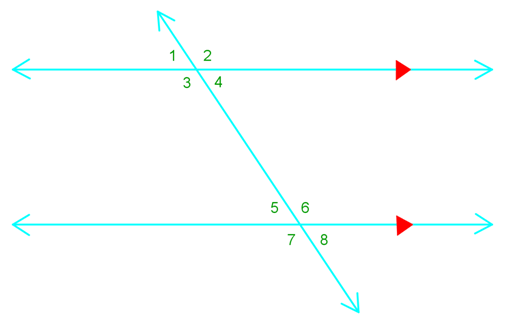
\(\angle 6\) \(\cong\) ?
Step 1: Identify the Given Information
First, observe the diagram provided. It shows two parallel lines intersected by a transversal line. The angles formed at the intersections are labeled with numbers. Our task is to find the angle that is congruent to \(\angle 6\).
Step 2: Understand the Concept of Corresponding Angles
When a transversal intersects two parallel lines, it creates pairs of corresponding angles. Corresponding angles are located at the same relative position at each intersection where the transversal crosses the parallel lines. According to the corresponding angle postulate, these angles are congruent.
Step 3: Locate \(\angle 6\) and Identify Its Corresponding Angle
In the diagram, \(\angle 6\) is located at the bottom right of the intersection formed by the transversal and the lower parallel line. To find the corresponding angle, look at the same relative position at the intersection of the transversal and the upper parallel line. This angle is labeled as \(\angle 2\).
Step 4: Apply the Corresponding Angle Postulate
According to the corresponding angle postulate, \(\angle 6\) is congruent to \(\angle 2\). This is because they are corresponding angles formed by the transversal intersecting the two parallel lines.
Step 5: Verify Using Vertical Angles
To further verify, consider the concept of vertical angles. Vertical angles are the angles opposite each other when two lines intersect. They are always congruent. In the diagram, \(\angle 6\) and \(\angle 7\) are vertical angles, so they are congruent. This means \(\angle 7\) is also congruent to \(\angle 2\) because \(\angle 6\) is congruent to \(\angle 2\).
Step 6: Summarize the Findings
In summary, \(\angle 6\) is congruent to \(\angle 2\) based on the corresponding angle postulate. Additionally, \(\angle 6\) is congruent to \(\angle 7\) due to the vertical angle congruence. Therefore, \(\angle 2\) and \(\angle 7\) are also congruent to each other.
Step 7: Document the Reasoning
It is important to document the reasoning behind the findings. Write down that \(\angle 6\) is congruent to \(\angle 2\) because of the corresponding angle postulate. Also, note that \(\angle 6\) is congruent to \(\angle 7\) due to the vertical angle congruence. This documentation ensures clarity and understanding of the solution process.
FAQs
Here are some frequently asked questions about parallel lines and transversals:
1. What happens when a transversal cuts parallel lines?
When a transversal cuts parallel lines, it creates several pairs of congruent angles. Corresponding angles are congruent, alternate interior angles are congruent, alternate exterior angles are congruent, and same-side interior angles are supplementary (add up to 180°).
2. What are the angles formed when parallel lines are cut by a transversal line?
When parallel lines are cut by a transversal, eight angles are formed. These include corresponding angles, alternate interior angles, alternate exterior angles, and same-side interior angles. Each of these angle pairs has specific properties and relationships.
3. How do you find missing angles with parallel lines and transversals?
To find missing angles, use the properties of angle pairs formed by parallel lines and transversals. For example, if you know one corresponding angle, the other must be equal. If you know one alternate interior angle, you can find the other. Remember that same-side interior angles are supplementary, so they add up to 180°.
4. What is the rule when parallel lines are cut by a transversal?
The main rule is that corresponding angles are congruent, alternate interior angles are congruent, alternate exterior angles are congruent, and same-side interior angles are supplementary. These relationships hold true only when the lines cut by the transversal are parallel.
5. What are the C angles in parallel lines?
The "C angles" refer to corresponding angles in parallel lines cut by a transversal. These angles are in the same relative position at each intersection where the transversal crosses the parallel lines. Corresponding angles are always congruent when the lines are parallel.
Prerequisite Topics for Understanding Parallel Lines and Transversals
To fully grasp the concept of parallel lines and transversals, it's crucial to have a solid foundation in several prerequisite topics. Understanding these fundamental concepts will significantly enhance your ability to tackle more complex geometric problems and applications.
One of the key prerequisites is the application of linear relations. This topic is essential because parallel lines can be represented as linear functions in a coordinate plane. By mastering linear relations, you'll be better equipped to analyze the properties of parallel lines and their interactions with transversals.
Another important aspect to consider is the combination of SohCahToa questions, which deals with angle relationships in geometry. This knowledge is crucial when examining the angles formed by parallel lines and transversals, as it helps in understanding concepts like corresponding angles, alternate interior angles, and vertical angles.
The applications of linear equations also play a significant role in comprehending parallel lines and transversals. Linear equations are used to describe the relationships between lines and angles in these geometric configurations, making it easier to solve problems involving parallel lines cut by a transversal.
Additionally, familiarity with conics, particularly circles, can provide valuable insights into coordinate plane concepts. This knowledge is beneficial when working with parallel lines and transversals in a coordinate system, allowing for a more comprehensive understanding of their properties and relationships.
Lastly, a strong grasp of polygons is essential, especially when dealing with concepts like alternate exterior angles. Polygons often incorporate parallel lines and transversals in their construction, and understanding their properties can greatly enhance your ability to solve complex geometric problems.
By mastering these prerequisite topics, you'll build a strong foundation for understanding parallel lines and transversals. This knowledge will not only help you in solving geometric problems but also in applying these concepts to real-world situations. Remember, each of these topics contributes uniquely to your overall comprehension of geometry, so take the time to review and reinforce your understanding of these fundamental concepts before diving into more advanced material.