AP Statistics Help — Video Lessons & Practice
Get clear explanations for any AP Statistics problem and build exam-ready confidence.

Step-by-Step Video Lessons
Learn concepts to solve problems alone.
Build Mastery
Move on only when you've truly got it.
Real Exam Practice
Includes free real AP exam questions.
Try It Now
Test your knowledge
Our approach aligns with the evidence
Exam Scores
Better Recall
Less Anxiety
AP Statistics Topics
1. Basic Concepts
2. Data Representation
3. Data Interpretation
4. Probability
5. Set Theory
6. Discrete Probabilities
7. Normal Distribution and Z-Scores
8. Confidence Intervals
9. Hypothesis Testing
9 Chapters · 50 Topics · 394 Videos
Discover Our Learning Areas
Explore key subjects and start learning with interactive content.






What Is AP Statistics?
AP Statistics is a College Board Advanced Placement course that introduces high school students to the major concepts and tools used to collect, analyze, and draw conclusions from data. It is the equivalent of a one-semester introductory college statistics course — and a strong score on the AP exam in May can earn you real college credit before you even graduate high school.
The course is organized around four interconnected themes: exploring data, sampling and experimental design, probability, and statistical inference. Unlike most math courses, AP Statistics places as much emphasis on communicating reasoning in writing as it does on calculation. That combination makes it both uniquely rewarding and uniquely challenging.
What Topics Are Covered in AP Statistics?
AP Statistics spans a wide range of interconnected concepts. Here is a breakdown of the major areas you will work through during the course:
Exploratory Data Analysis — Summarizing and describing data using graphical displays (dotplots, histograms, boxplots, scatterplots) and numerical summaries (mean, median, standard deviation, IQR). You learn to compare distributions and identify patterns, clusters, and outliers.
Sampling and Experimental Design — Understanding how data is collected: surveys, observational studies, and controlled experiments. Topics include random sampling methods, sources of bias, and the principles of experimental design including randomization, control, and replication.
Probability and Random Variables — The rules of probability, discrete and continuous random variables, the binomial and geometric distributions, and the normal distribution. This unit underpins everything that comes later in inference.
Sampling Distributions — The behavior of sample statistics (sample mean, sample proportion) across many repeated samples. The Central Limit Theorem is a cornerstone here.
Statistical Inference — Confidence intervals and hypothesis tests for proportions, means, differences between groups, and relationships between variables. Chi-square tests and inference for regression round out the unit. This is the largest portion of the AP exam.
Is AP Statistics Hard?
AP Statistics sits at a moderate difficulty level compared to other AP courses. Students who come in expecting a calculation-heavy math class are sometimes surprised to find that the hardest part is writing clear, precise statistical arguments.
The AP free-response section rewards students who can explain why a procedure is appropriate, interpret results in context, and identify what a conclusion does — and does not — mean. That skill takes deliberate practice. It is not something you develop by watching examples passively; you have to write out interpretations yourself and get feedback on whether your reasoning is sound.
Common stumbling blocks include: correctly stating and interpreting hypotheses; understanding what a p-value actually represents; knowing the conditions required for each inference procedure and what happens when they are violated; and distinguishing between different test types. Students who struggle usually do so not because the math is too hard, but because they never built the habit of reasoning through problems in words.
The encouraging news: the algebra involved rarely goes beyond Algebra 2. If you put in consistent effort and practice writing statistical reasoning — not just solving problems — AP Statistics is very manageable.
How Is AP Statistics Graded and What Is on the AP Exam?
The AP Statistics exam is three hours long, administered by College Board each May, and scored on a scale of 1 to 5.
Section I — Multiple Choice: 40 questions in 90 minutes. Worth 50% of your total score. Questions test all four content areas with an emphasis on interpreting statistical output and reasoning.
Section II — Free Response: 5 shorter free-response questions plus one extended investigative task, totaling 90 minutes. Worth 50% of your total score. Partial credit is available, and graders look specifically for correct statistical vocabulary, complete justification, and conclusions written in the context of the problem.
Most colleges award credit for a score of 3 or higher, though selective institutions often require a 4 or 5. Check the credit policy for each school you are considering — policies vary widely.
Why StudyPug for AP Statistics?
AP Statistics requires a study approach that goes beyond re-reading notes. You need to see worked examples that show the full reasoning process, practice problems that build the habit of writing in context, and honest feedback on where your understanding is weak.
StudyPug is built around exactly that. Here is what sets it apart for AP Statistics students:
Certified-teacher video lessons that teach the method. Every topic in AP Statistics — from describing distributions to running a two-sample t-test — is covered in step-by-step video lessons made by certified teachers, not AI. You see not just what the answer is but how to approach the problem, which conditions to check, and how to write a complete conclusion. That is the skill the AP exam actually tests.
A diagnostic assessment that finds your gaps. Instead of working through every topic from the beginning, you start with a short diagnostic that identifies exactly where your understanding breaks down. You focus on what matters most for your score — no wasted time on topics you already know.
Adaptive practice that meets you where you are. After the diagnostic, practice problems adjust to your current level. As you build confidence on easier questions, the difficulty increases — keeping you in the zone where learning actually happens. The practice bank covers every AP Statistics topic and includes exam-style questions based on real AP test formats.
AP exam prep included. There is no separate prep course to buy. AP Statistics exam prep — including practice with exam-style multiple choice and free-response questions — is part of your subscription. The content is aligned to the College Board AP Statistics curriculum framework.
Free practice to get started. You can access free AP Statistics practice problems before committing to a subscription. It is a genuine no-risk way to see how the platform works.
30-day money-back guarantee. Every subscription includes a full 30-day money-back guarantee. If StudyPug is not the right fit, you get your money back — no questions asked.
What You Learn: AP Statistics Curriculum Coverage
StudyPug's AP Statistics content is aligned to the College Board AP Statistics curriculum framework. The platform covers all major units you will encounter in a standard AP Statistics course:
- One-variable data analysis: shape, center, spread, and outliers
- Two-variable data analysis: scatterplots, correlation, least-squares regression
- Data collection: sampling methods, experimental design, bias
- Probability rules, conditional probability, independence
- Discrete and continuous random variables; binomial and geometric distributions
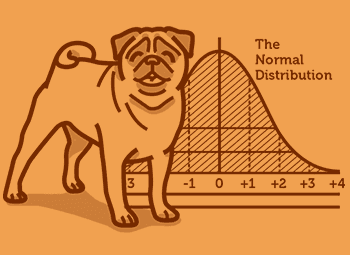
- Normal distributions and the standard normal (z-scores)
- Sampling distributions; the Central Limit Theorem
- Confidence intervals for proportions and means (one-sample and two-sample)
- Hypothesis testing for proportions and means; significance and p-values
- Chi-square tests: goodness of fit, independence, homogeneity
- Inference for regression: slope, confidence intervals, hypothesis tests
Each unit includes video lessons, worked examples, and adaptive practice problems. The free-response writing component is addressed throughout — lessons explicitly model how to write complete, AP-exam-style justifications.
How to Use StudyPug for AP Statistics
The most effective way to use StudyPug for AP Statistics is to treat it as a complement to your class, not a replacement. Here is a practical workflow:
Start with the diagnostic. Before you watch a single video, take the AP Statistics diagnostic assessment. It will surface the specific topics where your understanding is weakest. Focus your first sessions there — even if that means going back to a probability concept you thought you understood.
Watch the lesson, then practice immediately. For each topic, watch the certified-teacher video to see the method, then move directly into practice problems. The goal is not to re-watch the video until you have it memorized — it is to attempt problems, make mistakes, and figure out where your reasoning breaks down.
Write out your reasoning on free-response practice. AP graders award points for clearly written statistical arguments. As you work through practice problems, write full sentences: state your hypotheses in words, interpret your p-value in context, state your conclusion in terms of the original question. StudyPug's step-by-step solutions model exactly this format.
Use exam-style practice in the weeks before the AP exam. In the final four to six weeks before the May exam, shift toward AP-style multiple choice and free-response practice. Work through questions timed, check your answers against the step-by-step solutions, and identify any remaining weak spots to revisit with the relevant video lesson.
Access it anywhere, anytime. StudyPug works on any device — laptop, tablet, or phone. Whether you are reviewing sampling distributions on the bus or rewatching a hypothesis test lesson at midnight before an exam, the content is always available.
AP Statistics FAQ
Unsure how StudyPug works? Need help with setting up? Check our frequently asked questions or contact us for help.
What do you learn in AP Statistics, and what topics does it cover?
AP Statistics covers four major theme areas: exploring data, sampling and experimentation, probability, and statistical inference. You will study descriptive statistics, probability distributions, sampling distributions, confidence intervals, hypothesis tests, and regression analysis. The course is designed to give you the statistical reasoning skills used in college-level work and real-world data analysis. By the end of the year you should be able to design studies, analyze data critically, and draw evidence-based conclusions — skills tested directly on the AP exam in May.
What is the difference between AP Statistics and AP Calculus?
AP Statistics focuses on data analysis, probability, and inference — you learn to collect, describe, and draw conclusions from data without needing calculus. AP Calculus (AB or BC) focuses on limits, derivatives, and integrals — the mathematics of continuous change. Statistics is often considered more conceptual and writing-heavy, while Calculus is more procedurally intensive. Many colleges require one or the other depending on your major. Statistics is typically the better choice for social science, biology, business, and psychology tracks; Calculus suits engineering, physics, and pure math paths.
Is AP Statistics hard, and where do students struggle most?
AP Statistics is considered moderately challenging. The biggest struggle for most students is not computation — it is communicating statistical reasoning in words. Free-response questions on the AP exam require you to justify every conclusion in clear, precise language. Students also commonly struggle with interpreting confidence intervals and p-values correctly, understanding the conditions for inference procedures, and keeping the many different hypothesis tests straight. The good news is that the math itself rarely goes beyond algebra, so strong algebra skills combined with focused practice on reasoning and writing can take you far.
What should I take before AP Statistics, and what comes after it?
Most students take AP Statistics after completing Algebra 2 or Pre-Calculus, though some schools allow it after Algebra 2 alone. Strong algebra and function skills are the main prerequisite — calculus is not required. After AP Statistics, students who score a 3 or higher typically earn college credit that exempts them from an introductory statistics course. In college, AP Stats prepares you for courses in econometrics, research methods, biostatistics, data science, and any field that involves reading and producing quantitative research.
Is AP Statistics on the AP exam, and how is it tested?
Yes — the AP Statistics exam is administered by College Board every May. It is three hours long and divided into two sections. Section I is 40 multiple-choice questions (90 minutes, worth 50% of the score). Section II is 6 free-response questions including one investigative task (90 minutes, worth 50%). Scoring is on a 1–5 scale; most colleges award credit for a score of 3, 4, or 5, though selective schools often require a 4 or 5. The exam tests all four major content areas: exploratory data analysis, sampling, probability, and inference.
What is one of the hardest concepts in AP Statistics, and how do you tackle it?
Hypothesis testing — specifically choosing the correct test, checking conditions, and interpreting the p-value — is consistently the most challenging concept. Many students memorize the steps without understanding what a p-value actually measures (the probability of getting results at least as extreme as observed, assuming the null hypothesis is true). The fix is to practice writing out interpretations in plain language before worrying about calculations. Work through varied scenarios — z-tests, t-tests, chi-square, regression — and always ask: 'What does this conclusion mean in context?' That habit is exactly what AP graders reward on the free-response section.





Written by the StudyPug Team
Last updated June 5, 2026
3 M+
students
★★★★★
4.8 average
K–12
all grades