Year 9 Pre-Algebra Help — Step-by-Step Video Lessons & Practice
Clear video solutions and practice that make pre-algebra click

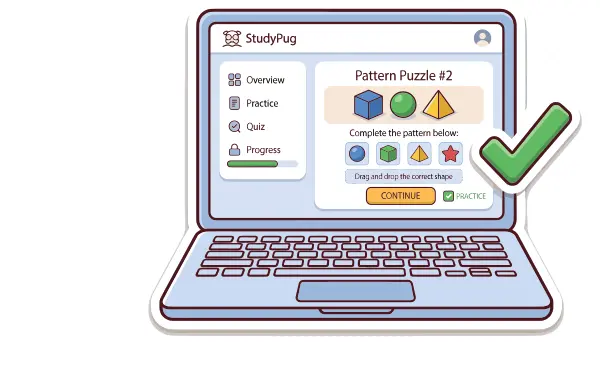
Value vs. Private Tutor
Expert teaching at a fraction of the cost.
Multi-Subject
One subscription unlocks every subject.
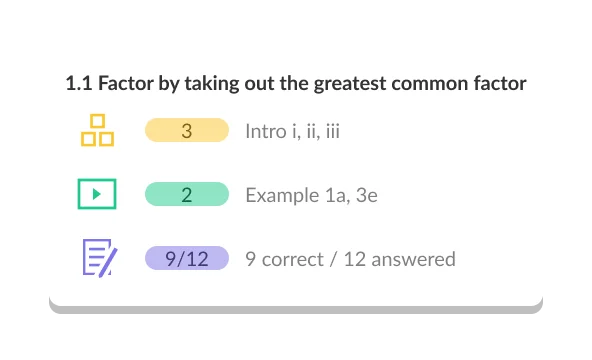
Unlimited Practice
Practice until it truly clicks not until moving on.
Try It Now
Test your knowledge
Our approach aligns with the evidence
Exam Scores
Better Recall
Less Anxiety
Pre-Algebra Topics
1. Integers
2. Factors and multiples
3. Decimals
4. Fractions
5. Ratios, rates, and proportions
6. Measuring Systems
7. Applying mathematical reasoning
8. Radicals
9. Exponents and Scientific Notation
10. Pythagorean Theorem
11. Surface Area of 3-Dimensional Shapes
12. Volume of 3-Dimensional Shapes
13. Function and Linear Relationships
14. Linear Equations
15. Linear Functions
16. Probability
17. Symmetry and Tessellations
18 Chapters · 77 Topics · 661 Videos
Discover Our Learning Areas
Explore key subjects and start learning with interactive content.










What is Year 9 Pre-Algebra?
Year 9 pre-algebra is the bridge between primary arithmetic and the formal algebra your child will study throughout secondary school and into their GCSE maths course. It introduces variables and expressions, teaches students to solve equations and inequalities, and extends their understanding of fractions, decimals, ratios, and proportional reasoning. Mastering pre-algebra at this stage gives students the tools they need to approach GCSE content with confidence rather than anxiety.
What topics are covered in Year 9 pre-algebra?
The pre-algebra curriculum at Year 9 spans several interconnected areas. Students work extensively with integers — including negative numbers and absolute value — before moving on to rational numbers and the rules for operating with fractions and decimals. The order of operations (often remembered through BIDMAS) is revisited and deepened so students can handle multi-step calculations accurately.
Equations and inequalities form the heart of the course. Students learn to write, interpret, and solve one-step and two-step equations, then progress to equations with variables on both sides. Alongside this, they study ratios and proportions in real-world contexts, explore percentage calculations, and are introduced to coordinate geometry — plotting points, reading graphs, and understanding how equations describe lines.
These topics are not isolated: each one builds on the last, which is why gaps from earlier years tend to surface here. A diagnostic assessment at the start of a StudyPug plan identifies those gaps immediately, so your child can fill them before they become bigger problems.
Is Year 9 pre-algebra hard?
Many students and parents find Year 9 pre-algebra unexpectedly challenging. The shift from pure number work to thinking abstractly with variables and expressions is genuinely difficult, and it happens quickly. The most common pressure points are:
Negative integers — adding, subtracting, and multiplying with negative numbers following rules that feel counterintuitive at first.
Order of operations — students who have not consolidated BIDMAS make calculation errors that undermine their answers even when the algebra itself is correct.
Solving equations — keeping both sides of an equation balanced while performing operations requires a methodical approach that takes practice to internalise.
Fractions in algebraic contexts — fraction arithmetic on its own is one thing; fraction operations inside equations and expressions is another level of complexity.
The research is clear: these difficulties respond well to targeted practice combined with teaching that explains the method, not just the steps. That is the principle behind every StudyPug lesson — certified teachers show students how to think through a problem, not just what buttons to press.
What comes after Year 9 pre-algebra?
Pre-algebra sits directly below the full algebra strand of the GCSE maths specification. Once students are confident with equations, expressions, and proportional reasoning, they are ready to expand and factorise expressions, solve simultaneous equations, work with quadratic equations, and explore functions and graphs. These topics appear across all GCSE maths tiers and carry significant weight in the final assessment. Students who struggle through pre-algebra often find GCSE algebra doubly difficult because the gaps compound. The reverse is equally true: a strong pre-algebra foundation makes the GCSE material feel like a natural next step.
Why StudyPug for Year 9 pre-algebra?
StudyPug is built around three things that make a measurable difference at this stage: a diagnostic that finds the real problem, certified-teacher videos that teach the method, and adaptive practice that builds confidence at your child's actual level.
The diagnostic assessment takes only a few minutes and identifies precisely which pre-algebra topics need attention. Parents often discover that a child who appears to struggle broadly with maths is actually missing one or two foundational pieces — and once those are addressed, progress follows quickly.
The certified-teacher video lessons are not AI-generated summaries or animation slides. Real, qualified teachers explain every concept on screen, working through examples the way a good classroom teacher would — showing their reasoning, anticipating common mistakes, and making the method explicit. Your child can pause, rewind, and rewatch as many times as needed, at any time of day.
The adaptive practice adjusts to your child's level in real time. Questions become more challenging as they improve and offer more support when they are struggling. This means every practice session is productive — neither so easy it is pointless nor so hard it is discouraging.
For families with more than one child, the Family Plan covers up to five children across all grade levels and subjects for one subscription price. Each child has their own profile, and the parent dashboard lets you see exactly how each one is progressing — which topics they have completed, where they are gaining confidence, and where they might benefit from a bit more focus. All lessons are aligned to the National Curriculum for England, so the support your child gets on StudyPug maps directly to what their teacher expects of them.
What your child will learn in Year 9 pre-algebra on StudyPug
The StudyPug Year 9 pre-algebra course covers every major topic in the National Curriculum pre-algebra strand, organised into clear, structured lessons. Your child will work through:
- Integers and rational numbers — operations, comparisons, and real-world applications
- Order of operations and evaluating expressions
- One-step and two-step equations — solving and checking solutions
- Equations with variables on both sides
- Introduction to inequalities — writing, solving, and graphing
- Fraction and decimal operations in algebraic settings
- Ratios, rates, and proportional relationships
- Percentages — finding, increasing, decreasing, and reverse percentages
- Coordinate geometry — plotting points and interpreting straight-line graphs
No validated internal topic URLs are available for this page in the current link map. Topic navigation is available directly through the course page topic list.
Using StudyPug for Year 9 pre-algebra practice
Getting started with StudyPug is straightforward. The diagnostic assessment takes a few minutes and immediately points your child (and you, through the parent dashboard) to the topics that need the most attention. From there, the recommended path through the lessons is clear.
A typical StudyPug session might look like this: your child watches a short certified-teacher video on, say, solving two-step equations — usually 8 to 15 minutes — then moves on to the adaptive practice questions for that topic. The questions start at an appropriate level and adjust as their answers come in. If they get stuck, the hint system guides them through without simply giving away the answer, reinforcing the method rather than bypassing it.
Free practice content is available without a full subscription, so your child can get a feel for the platform before you commit. When you are ready to subscribe, the 30-day money-back guarantee means there is no risk: if StudyPug is not working for your family within the first month, you receive a full refund. There is no free trial of the paid plan, but the money-back window gives you the same peace of mind.
StudyPug is available on any device — desktop, tablet, or mobile — so your child can practise at home, on the go, or wherever works best for your family. Photo Search is also available across all grades and subjects: your child can take a photo of a pre-algebra problem and find the matching StudyPug lesson instantly, making it easy to get help on specific homework questions without searching through menus.
Pre-Algebra FAQ
Unsure how StudyPug works? Need help with setting up? Check our frequently asked questions or contact us for help.
What does my child learn in Year 9 pre-algebra, and what topics does it cover?
Year 9 pre-algebra builds the foundation for algebra by covering integers and rational numbers, order of operations, solving one- and two-step equations, working with fractions and decimals, ratios, proportions, percentages, and an introduction to graphing on a coordinate plane. Students also explore basic inequalities and expressions. These topics bridge primary arithmetic and the full algebra content they will encounter in GCSE maths, so a solid grasp at this stage makes a real difference to their secondary school journey.
Is Year 9 pre-algebra hard, and where do students commonly struggle?
Pre-algebra is a significant step up because it moves from purely numerical work to abstract thinking with variables and equations. The most common stumbling blocks are working with negative integers, applying the correct order of operations, and understanding how to solve equations by isolating the variable. Fractions and ratios also catch many students out. The good news is that these are all learnable skills — consistent practice and clear explanations of the method (not just the answer) help students break through these barriers.
What should my child know before Year 9 pre-algebra, and what comes next?
Before starting pre-algebra, students should be confident with multiplication and division of whole numbers, basic fraction operations, and decimal arithmetic. A working knowledge of factors and multiples also helps. After pre-algebra, students move into full algebra — including expanding brackets, solving simultaneous equations, and working with quadratics — which forms the core of their GCSE maths course. A strong pre-algebra foundation makes that transition far smoother and reduces the revision pressure closer to examinations.
How does StudyPug pre-algebra map to what my child learns at school?
StudyPug's Year 9 pre-algebra content is aligned with the National Curriculum for England. Lessons cover the same topics your child's teacher is working through in class — integers, equations, fractions, proportional reasoning, and coordinate geometry — so practice on StudyPug directly reinforces their school work. The curriculum alignment means there are no irrelevant detours: every lesson and practice question supports what they are actually being assessed on.
What is one of the trickiest pre-algebra concepts at Year 9, and how is it taught?
Solving equations with variables on both sides trips up many Year 9 students because it requires keeping track of multiple operations at once. On StudyPug, certified teachers walk through the method step by step — showing exactly how to move terms across the equals sign, combine like terms, and check the answer. Rather than just showing a worked example, the lesson explains the reasoning so students can apply the same strategy to any problem they see on a test or in their homework.
How much maths practice should my child do at Year 9 pre-algebra level?
Most education experts suggest around 20–30 minutes of focused maths practice per day at this stage. Short, regular sessions are more effective than occasional long cramming sessions. With StudyPug, your child can watch a short video lesson, then complete adaptive practice questions that adjust to their level — so every session is productive. A quick diagnostic at the start shows exactly where to focus, meaning no time is wasted on topics they already understand.





Written by the StudyPug Team
Last updated June 5, 2026
3 M+
students
★★★★★
4.8 average
K–12
all grades