GCSE Chemistry Help — Video Lessons & Practice
Get clear explanations for any GCSE Chemistry topic and build exam-ready confidence.

Value vs. Private Tutor
Expert GCSE Chemistry teaching without high fees.
Multi-Subject
Access all curriculum subjects in one subscription.
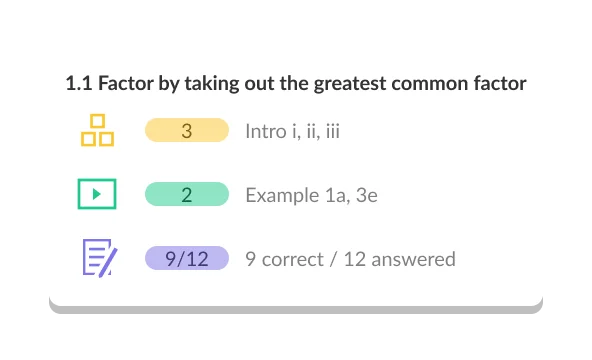
Build Mastery
Move on only when you've mastered it.
GCSE Chemistry Topics
1. Introduction to Chemistry
2. The Atom
3. The Periodic Table and Elements
4. Compounds and Bonding
5. Chemical Reactions and Groups
6. Moles and Amount of Substance
7. Basic Organic Chemistry
8. Solution Chemistry
9. Kinetics and Reaction Rate
10. Equilibrium
11. Acid Base Chemistry and pH
Discover Our Learning Areas
Explore key subjects and start learning with interactive content.





What is GCSE Chemistry?
GCSE Chemistry is a standalone science qualification taken by students in Years 10 and 11 in England, Wales, and Northern Ireland. It is graded on a 9–1 scale and assessed through two written examinations at the end of Year 11. The course covers a wide range of topics — from the structure of atoms and the periodic table through to organic chemistry, rates of reaction, and chemical analysis — giving students a rigorous, systematic understanding of the material world. A strong GCSE Chemistry grade is the gateway to A-Level Chemistry and the science-based university courses that follow.
What topics are covered in GCSE Chemistry?
GCSE Chemistry is divided into several major topic areas that build on each other. The course begins with atomic structure and the periodic table, where students learn how atoms are constructed, how elements are organised, and how trends across groups and periods can be explained by electronic configuration. From there it moves into bonding, structure, and the properties of matter — covering ionic, covalent, and metallic bonding and how each type of structure determines physical properties.
Quantitative chemistry introduces the mole concept, allowing students to calculate masses, volumes, and concentrations of reactants and products. Chemical changes covers reactivity series, displacement reactions, electrolysis, and acids and alkalis. Energy changes explores exothermic and endothermic reactions and the energy diagrams that represent them. Rates of reaction and equilibrium examines how temperature, concentration, pressure, and catalysts affect how fast reactions happen. Finally, organic chemistry introduces hydrocarbons and their derivatives, while chemical analysis and Earth and atmospheric chemistry round out the specification.
Is GCSE Chemistry hard?
GCSE Chemistry has a reputation as one of the more challenging GCSEs, and for good reason. It requires students to hold abstract conceptual models in their heads — electron shells, ionic lattices, covalent molecules — while also performing multi-step mathematical calculations. The mole concept in quantitative chemistry is widely regarded as the single steepest learning curve in the course, because it links the invisible world of atoms to measurable masses and volumes.
That said, difficulty is relative to preparation. Students who tackle each topic in small, well-practised steps and who understand the method behind calculations — rather than trying to memorise answers — consistently outperform those who revise passively. Required practicals also appear in exam questions, so understanding experimental design and data interpretation is just as important as the theory. With the right approach, GCSE Chemistry is entirely manageable.
How is GCSE Chemistry examined?
GCSE Chemistry is assessed by two written papers, each worth 50% of the final grade. Both papers last approximately 1 hour 45 minutes. Paper 1 typically covers atomic structure, bonding, quantitative chemistry, and chemical changes. Paper 2 covers energy changes, rates of reaction, organic chemistry, and chemical analysis, along with Earth and atmospheric chemistry.
Questions include multiple choice, short structured answers, extended writing, and calculation-based items. Required practicals — a set of core experiments specified by the awarding body — are not submitted as coursework but are assessed through written exam questions about method, data handling, and scientific conclusions. AQA, Edexcel, and OCR are the three main awarding bodies offering GCSE Chemistry; while the broad content is similar, there are differences in the required practicals and the exact weighting of topics between specifications.
Why use StudyPug for GCSE Chemistry?
StudyPug is built around the way students actually learn chemistry — by watching a method explained clearly, then practising it until it becomes automatic. Every GCSE Chemistry lesson on StudyPug is delivered by a certified teacher, not AI-generated content. The videos teach the method behind each topic, so when you sit your AQA, Edexcel, or OCR paper and see a question you have never seen before, you know how to approach it.
The platform begins with a diagnostic assessment that identifies precisely which topics are gaps and which are strengths. This means your revision time is directed where it will make the most difference — no working through topics you already know. Adaptive practice then adjusts its difficulty to your performance, providing questions that stretch your understanding at the right level. All content is aligned to the UK specifications, so every lesson and every practice problem maps directly to what your examinations will test.
For students preparing for their GCSE exams, StudyPug also includes exam-style practice questions based on real exam formats, giving you the experience of working under timed, exam-style conditions before the real thing. The 30-day money-back guarantee means there is no risk in trying the full platform.
What you will learn: GCSE Chemistry curriculum coverage
StudyPug covers the full GCSE Chemistry specification across all three major awarding bodies. Topic coverage includes:
- Atomic structure, isotopes, and the periodic table
- Ionic, covalent, and metallic bonding — properties and structure
- Quantitative chemistry — moles, empirical formulae, concentration calculations, gas volumes
- Chemical changes — acids, alkalis, displacement reactions, electrolysis
- Energy changes — exothermic and endothermic reactions, reaction profiles
- Rates of reaction — temperature, concentration, surface area, catalysts, collision theory
- Equilibrium — Le Chatelier's principle and reversible reactions
- Organic chemistry — alkanes, alkenes, alcohols, and polymers
- Chemical analysis — chromatography, flame tests, gas tests, qualitative analysis
- Earth and atmospheric chemistry — the carbon cycle, greenhouse gases, and the early atmosphere
Because GCSE Chemistry in this course is a UK page without validated curriculum-leaf URLs in the current internal link map, all topic navigation is handled through the on-page topic browser. The full list of lessons and practice sets is accessible from the topic section of this page.
How to use StudyPug for GCSE Chemistry revision
The most effective StudyPug workflow for GCSE Chemistry students follows three stages. Start with the diagnostic assessment — it takes only a few minutes and produces a personalised topic priority list. Work through the highest-priority topics first, watching the certified-teacher video lesson for each one. The videos are designed to be short enough to fit into a revision session and focused enough to deliver a clear method you can apply immediately.
After watching a lesson, move straight into the adaptive practice questions for that topic. The platform adjusts the difficulty based on how you answer, so if you get the first few right it will push you further; if you are still shaky it will consolidate the foundations first. This prevents the common revision trap of practising what you already know while avoiding what you find difficult.
As your exam approaches, use the exam-style practice questions to simulate real paper conditions. Pay particular attention to the required practical questions — they are frequently underestimated and appear on both papers. StudyPug's content is available on any device, so you can continue revision on your phone or tablet between school sessions. Cancel anytime, and if you are not satisfied within the first 30 days, the money-back guarantee has you covered.
GCSE Chemistry FAQ
Unsure how StudyPug works? Need help with setting up? Check our frequently asked questions or contact us for help.
What do you learn in GCSE Chemistry, and what topics does it cover?
GCSE Chemistry covers the fundamental ideas of matter and reactions. Core topics include atomic structure and the periodic table, chemical bonding, quantitative chemistry, chemical changes, energy changes in reactions, rates of reaction, organic chemistry, and chemical analysis. Most specifications also include Earth and atmospheric chemistry. Together these topics build a systematic understanding of how substances are made up, how they interact, and how those reactions are used in everyday life and industry.
What is the difference between GCSE Chemistry and GCSE Combined Science?
GCSE Chemistry is a standalone qualification worth two GCSE grades and covers chemistry in full depth across all topic areas. GCSE Combined Science: Trilogy or Synergy is a double-award qualification covering biology, chemistry, and physics together, awarding two grades overall. Students taking separate Chemistry get more contact hours, greater topic depth, and a dedicated Chemistry grade — a stronger foundation for A-Level Chemistry. Combined Science is the more common choice and still covers all the key chemistry concepts, but with less breadth per subject.
Is GCSE Chemistry hard, and where do students struggle most?
GCSE Chemistry is considered one of the more demanding GCSEs because it requires both conceptual understanding and mathematical skills. The topics students find hardest are typically mole calculations and quantitative chemistry, balancing and interpreting chemical equations, understanding bonding models (ionic, covalent, metallic), and organic chemistry mechanisms. The jump from Key Stage 3 Science to GCSE-level abstraction catches many students off guard. Breaking each topic into small steps and practising calculation methods regularly makes a significant difference to outcomes.
What should I take before GCSE Chemistry, and what comes after it?
GCSE Chemistry builds on Key Stage 3 Science, so a solid grounding in basic particle theory, elements and compounds, and simple reactions is expected. After GCSE Chemistry the natural progression is A-Level Chemistry, which demands a strong grade 6 or above at GCSE. A-Level Chemistry then opens pathways to university courses in chemistry, pharmacy, medicine, biochemistry, and materials science. Students who take GCSE Combined Science rather than the separate award can still proceed to A-Level Chemistry, though they may need to bridge a few gaps early on.
Is GCSE Chemistry on the A-Level exam, and how is it tested at GCSE?
GCSE Chemistry is assessed entirely through written exams — there is no coursework. AQA, Edexcel, and OCR all use two exam papers worth 50% each; AQA also includes required practicals that can be assessed within those papers. Questions range from multiple choice and short answer to extended response and calculation-based items. Paper 1 typically covers atomic structure, bonding, and quantitative chemistry; Paper 2 covers rates, organic chemistry, and analysis. Required practicals are examined through written questions about methods, data, and conclusions, so understanding the practical skills is just as important as the theory.
What is one of the hardest concepts in GCSE Chemistry, and how do you tackle it?
Mole calculations are consistently the concept students find most difficult in GCSE Chemistry. The mole links the macroscopic world of grams and litres to the microscopic world of atoms and molecules, and the multi-step nature of the calculations — converting mass to moles, finding ratios from equations, then converting back — is where errors multiply. The most effective approach is to follow a fixed method every time: write the balanced equation, work out the molar masses, find the moles of the known substance, use the ratio, then convert to the required unit. Practising this sequence repeatedly with varied question types builds the pattern recognition needed for the exam.