Geometry Help — Video Lessons & Practice
Get clear explanations for any Geometry problem and build exam-ready confidence for your GCSEs.
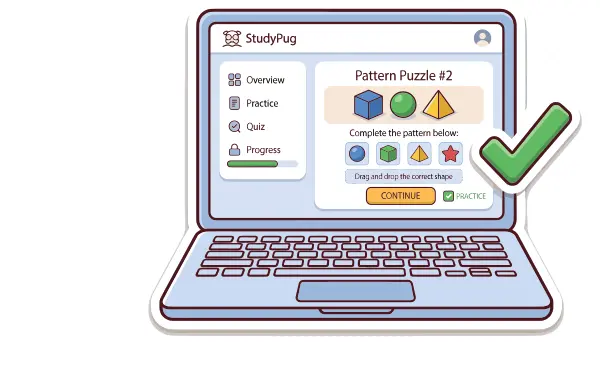
Value vs. Private Tutor
Get expert Geometry help for free.

Multi-Subject
Struggling? Switch subjects anytime.
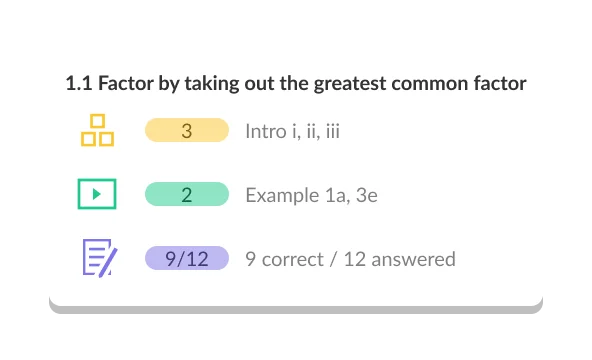
Practice Until Perfect
Practice each concept until mastered.
Try It Now
Test your knowledge
Our approach aligns with the evidence
Exam Scores
Better Recall
Less Anxiety
Geometry Topics
1. Measuring Systems
2. Surface Area and Volume
3. Points, Lines, Segments, Midpoints and Chords
4. Circles, plane and coordinate
5. Triangles and special triangles
6. Angles and trigonometry
7. Sine Rule and Cosine Rule
8. Bearings
9. Transformations
10. Similarity
11. 2D figures and 3D figures
12. Probability
13. Logic
15. Set Theory
16. Vectors
17 Chapters · 88 Topics · 766 Videos
Discover Our Learning Areas
Explore key subjects and start learning with interactive content.
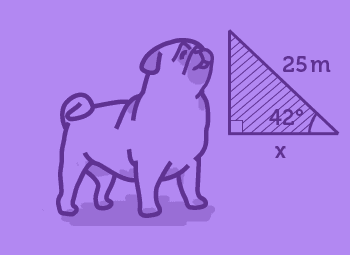



What is Geometry?
Geometry is the branch of mathematics concerned with the properties, measurement, and relationships of points, lines, angles, surfaces, and solids. At GCSE level in the UK, Geometry sits within the broader Mathematics curriculum and accounts for a significant share of exam marks across all three papers. You will work with 2D and 3D shapes, reason about angles and transformations, apply trigonometry to find unknown sides and angles, and construct formal geometric arguments. Understanding Geometry well is not just useful for your GCSE — it underpins A-Level Mathematics and a wide range of careers in engineering, architecture, design, and science.
What topics are covered in GCSE Geometry?
The GCSE Maths specification covers Geometry across several interconnected areas. Core topics include:
Angles and polygons. Angle facts for parallel lines, triangles, and polygons are tested in every exam series. You need to know interior and exterior angle rules for regular polygons and be able to apply them in multi-step problems.
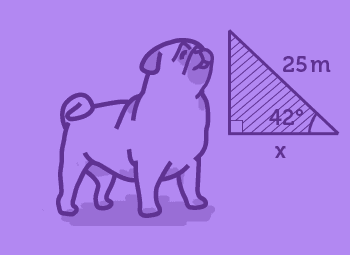
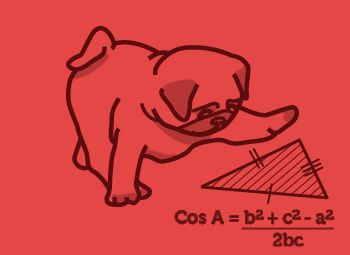
Trigonometry. Right-angled trigonometry (SOH-CAH-TOA) and Pythagoras' theorem appear on all tiers. Higher-tier students also need the sine rule, the cosine rule, and the formula for the area of a non-right-angled triangle.
Circle theorems. Eight theorems govern angles, chords, and tangents in circles. Higher-tier questions often require you to chain two or three theorems together and justify each step in writing.
Transformations and vectors. Rotation, reflection, translation, and enlargement — including fractional and negative scale factors — are assessed alongside vector arithmetic and simple vector proofs.
Area, perimeter, and volume. Formulae for circles, sectors, prisms, cylinders, pyramids, cones, and spheres are all in scope. Problems often combine shape formulae with algebraic manipulation.
Loci and constructions. Compass-and-ruler constructions, perpendicular bisectors, angle bisectors, and regions defined by loci conditions appear regularly, particularly on non-calculator papers.
Is Geometry hard, and what trips students up most?
Many students find Geometry more manageable than Pure Algebra once they understand how the underlying rules work — but the topics that cause the most difficulty tend to share a common feature: they require you to recognise which rule to apply from a diagram rather than from a written prompt.
Circle theorems are the single most commonly cited difficulty. With eight separate theorems, all looking superficially similar on a diagram, students who have only memorised the theorem statements without practising diagram recognition struggle on the exam. The fix is deliberate: spend time on mixed-diagram practice where you have to identify the correct theorem before you calculate anything.
Non-right-angled trigonometry causes similar problems because it introduces two new formulae at once and requires deciding which one to use. Working through a sequence of problems that isolate the decision-making step — when to use the sine rule versus the cosine rule — builds the pattern recognition that exam questions test.
Vector proofs are another common sticking point, particularly because they require algebraic manipulation alongside geometric reasoning. Starting with simple parallel-vector problems before moving to full proofs is the most effective progression.
Why StudyPug for Geometry?
StudyPug is built around the specific challenges that make Geometry feel difficult. When you start, a short diagnostic assessment identifies exactly which topics you need to focus on — so instead of working through every lesson from the beginning, you can go straight to the areas where practice will make the biggest difference. There is no wasted revision time.
Every Geometry lesson is delivered by a certified teacher in a video that walks you through the method step by step. The focus is on teaching you how to solve a problem, not just showing you the answer — which means you can apply the same approach to unseen questions on your GCSE papers. These are not AI-generated lessons; they are made by real qualified teachers who understand exactly where students get stuck.
After watching a lesson, adaptive practice questions adjust their difficulty to match your current level. As your Geometry skills improve, the practice gets more challenging, which keeps progress consistent without becoming discouraging. All content is aligned to the UK GCSE Mathematics curriculum, so every topic on your specification is covered.
StudyPug also includes free daily practice problems, so you can try Geometry questions and sample lessons before subscribing. Every subscription is backed by a 30-day money-back guarantee — the only guarantee StudyPug makes, but it means there is no risk in giving the platform a proper try during a key revision period.
What you learn: Geometry curriculum coverage
StudyPug's Geometry content covers the full UK GCSE Mathematics specification for both Foundation and Higher tier. Topics are organised into focused lessons so you can work through an entire strand — for example, all circle theorem lessons in sequence — or jump directly to a single concept you need to revisit before a test.
The curriculum coverage includes all angle and polygon rules, complete trigonometry from basic right-angle problems through to the sine and cosine rules, all eight circle theorems with diagram-recognition practice, transformations and vector arithmetic, area and volume formulae for every shape type in the specification, and loci and construction techniques. Practice tests are available for each major topic area and are styled to match GCSE exam questions, including the multi-step problem format that appears in the final papers.
Students preparing for their GCSEs will also find revision materials based on real exam-style questions, helping them practise under the conditions they will face in the actual assessment.
Using StudyPug for Geometry revision
The most effective way to use StudyPug for Geometry is to begin with the diagnostic. This takes only a few minutes and produces a clear picture of which topics are secure and which need attention. From there, you can work through the recommended video lessons at your own pace — pausing, rewinding, and rewatching as many times as you need.
After each video, complete the adaptive practice questions for that topic before moving on. The questions start at a level matched to your current understanding and increase in difficulty as you get answers right. When you feel ready, use the topic practice tests to check your progress under timed, exam-style conditions.
StudyPug is available on all devices, so you can continue your Geometry revision on a laptop at home, on a tablet in the library, or on a phone on the way to school. Progress is saved automatically across devices. There is no set schedule — you study at your own pace, fitting revision around your school timetable and other commitments. With the 30-day money-back guarantee in place, you can start straight away and see real progress in your Geometry before your next mock or class assessment.
Geometry FAQ
Unsure how StudyPug works? Need help with setting up? Check our frequently asked questions or contact us for help.
What do you learn in Geometry, and what topics does it cover?
Geometry covers the properties, measurement, and relationships of shapes, angles, and space. At GCSE level in the UK, key topics include angles in polygons, circle theorems, trigonometry (SOH-CAH-TOA and the sine and cosine rules), Pythagoras' theorem, transformations, vectors, area and volume of 2D and 3D shapes, loci and constructions, and coordinate geometry. By the end of Year 10 and 11 you should be comfortable applying these ideas both to straightforward calculations and to multi-step problem solving on the exam.
What is the difference between Geometry and Algebra?
Algebra deals with symbols and equations to describe unknown quantities and relationships, while Geometry focuses on the size, shape, position, and properties of figures in space. In practice the two overlap constantly — you will use algebraic equations to find missing angles, apply formulae to calculate arc lengths, and write geometric proofs using algebraic reasoning. At GCSE, both strands are assessed in every paper, so building strength in Geometry naturally reinforces your Algebra skills and vice versa.
Is Geometry hard, and where do students struggle most?
Geometry can feel difficult because it requires both visual reasoning and precise calculation. Students most commonly struggle with circle theorems (remembering which rule applies when), trigonometry in non-right-angled triangles, vector proofs, and multi-step problems that combine several topic areas. The good news is that most Geometry topics follow clear, learnable rules. Working through step-by-step explanations and practising exam-style questions on each rule — rather than just memorising results — makes the biggest difference to understanding and accuracy.
What should I take before Geometry, and what comes after it?
Before diving into Year 10 Geometry you should be comfortable with basic angle facts (angles on a straight line, in a triangle, on parallel lines), area and perimeter of simple shapes, coordinates, and introductory Pythagoras from Key Stage 3. Geometry at GCSE builds on all of these foundations. After GCSE, students who continue to A-Level Mathematics will meet trigonometry in much greater depth (radians, identities, graphs), vectors in three dimensions, and coordinate geometry of circles — all of which are direct extensions of Year 10 Geometry work.
Is Geometry on the GCSE Maths exam, and how is it tested?
Yes — Geometry forms a major component of the GCSE Mathematics examinations taken at the end of Year 11 in England, Wales, and Northern Ireland (and the equivalent National 5 in Scotland). Students sit three papers: one non-calculator and two calculator papers. Geometry questions appear across all three, ranging from one-mark angle calculations to multi-mark proofs and problem-solving tasks. Higher-tier students are expected to apply circle theorems, sine and cosine rules, and vector reasoning. Practising with GCSE-style questions is one of the most effective ways to prepare.
What is one of the hardest concepts in Geometry, and how do you tackle it?
Circle theorems are widely considered the most challenging Geometry topic at GCSE. There are eight core theorems — including the angle at the centre being twice the angle at the circumference, angles in the same segment being equal, and the alternate segment theorem — and exam questions often require you to chain two or three of them together in a single solution. The best approach is to learn each theorem with a clear diagram, practise identifying which theorem applies from the diagram alone, then work through mixed exam questions that require combining theorems, explaining each step in writing as the mark scheme requires.




Written by the StudyPug Team
Last updated June 5, 2026
3 M+
students
★★★★★
4.8 average
K–12
all grades