Microeconomics Help: Video Lessons & Practice
Work through every topic with clear solutions. Start your free practice test now!
Value vs. Private Tutor
Expert Irish curriculum help without high cost.

Multi-Subject
Switch subjects anytime you want.
Build Mastery
You master it before test day fully.
Microeconomics Topics
1. Introduction to Economics
2. Problems of Economics
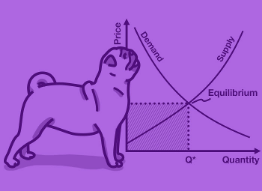
3. Demand and Supply
4. Elasticity
5. Welfare Economics
6. Consumer Choice
7. Output and Costs
8. Perfect Competition
9. Monopoly
11. Government & Inequalities
11 Chapters · 42 Topics · 453 Videos
Discover Our Learning Areas
Explore key subjects and start learning with interactive content.







What is Microeconomics?
Microeconomics is the branch of economics that analyses how individual decision-makers — consumers, firms, and governments — allocate scarce resources and how their interactions determine prices and quantities in markets. Unlike macroeconomics, which looks at the economy as a whole, microeconomics asks precise questions: Why does the price of a good rise when supply falls? How does a monopolist choose its output? What happens to consumer welfare when a tax is imposed? These questions form the backbone of every economics degree at Irish universities, and a confident grasp of micro principles makes every subsequent module — from public finance to econometrics — considerably more manageable.
What topics does Microeconomics cover at university level?
A standard first-year microeconomics course at an Irish university covers a wide range of interconnected topics. You begin with the foundations of supply and demand — understanding how markets reach equilibrium and what happens when they are disrupted by price controls, taxes, or subsidies. From there the course moves into elasticity (price, income, and cross-price), which quantifies how sensitive buyers and sellers are to changes in market conditions.
Consumer theory introduces utility maximisation: given a budget constraint, how does a rational consumer choose between goods? This leads naturally into producer theory — how firms minimise costs and maximise profit given their production technology. Market structures then build on this framework, contrasting perfect competition, monopoly, monopolistic competition, and oligopoly. Game theory provides tools for analysing strategic interactions between firms, and the course typically closes with market failures: externalities, public goods, information asymmetries, and the role of government intervention.
Is Microeconomics hard, and how should you approach studying it?
Microeconomics is mathematically more demanding than many students expect from an economics course. The concepts themselves are intuitive — it makes sense that higher prices reduce demand — but the discipline requires you to express those ideas precisely using algebra, calculus (at intermediate level), and carefully labelled diagrams. Students who struggle most are those who read the textbook without working through problems.
The most effective study strategy is problem-first: attempt a practice question, identify where your reasoning breaks down, then revisit the relevant concept video or notes. Working through exam-style questions under timed conditions, checking your diagrams against model answers, and testing yourself regularly with practice quizzes builds the speed and accuracy that written examinations at Irish universities demand. Topics like indifference curve analysis, Cournot oligopoly equilibrium, and Nash equilibrium in game theory require repeated practice — understanding the logic once is not enough to reproduce it correctly under exam pressure.
How is Microeconomics examined at Irish universities?
Assessment structures differ across institutions but follow a recognisable pattern. Continuous assessment — typically accounting for 20–40% of the final grade — may include online MCQ tests, problem sets submitted weekly or fortnightly, and occasionally a group presentation or case study. The remaining grade comes from a written end-of-semester examination that usually combines short-answer questions (requiring precise definitions and small diagrams) with longer essay questions demanding full graphical analysis and evaluation.
Past exam papers are your single most valuable revision resource. Practise drawing supply-and-demand diagrams from memory, deriving cost curves, and setting up and solving game-theory payoff matrices. Time yourself — most students find they run out of time in microeconomics exams not because they lack knowledge but because they have not built the fluency to work quickly under pressure. Mock exams and practice tests are therefore an essential part of any effective revision plan.
Why use StudyPug for Microeconomics help?
StudyPug is built around three things that make the biggest difference to microeconomics students: knowing exactly where to focus, understanding the method deeply, and practising until it becomes automatic.
When you start, a diagnostic assessment quickly identifies the specific topics where your understanding has gaps — whether that is elasticity calculations, profit maximisation conditions, or game theory. You are not guessing what to study; you are working on what actually needs attention. This matters particularly in microeconomics, where a shaky foundation in one topic (such as marginal cost and marginal revenue) creates compounding difficulties in later topics (such as monopoly pricing and deadweight loss).
The certified-teacher concept videos are recorded by experienced instructors who teach the method, not just the answer. Each video explains the reasoning behind the technique — why a profit-maximising firm sets MR = MC, not just that it does — so that you can apply the same logic to unseen exam questions rather than pattern-matching memorised answers. You can watch each video as many times as you need, pausing and rewinding at the exact moment something is unclear.
Adaptive practice then adjusts the difficulty of questions to match your current level, pushing you just hard enough to build genuine fluency without overwhelming you. As you improve, the system introduces more complex question types — the kind that appear in end-of-semester written examinations and continuous assessment tests.
One subscription gives you access to every course on StudyPug — Microeconomics, Macroeconomics, Calculus, Statistics, Linear Algebra, and more — so as you progress through your degree you never need to source a separate resource for each new module.
What you learn in Microeconomics — course coverage
A typical university microeconomics course covers the following areas, all of which are addressed on StudyPug:
- Supply, demand, and market equilibrium — how prices are determined and how markets adjust to shocks
- Elasticity — price elasticity of demand and supply, income elasticity, cross-price elasticity, and their applications
- Consumer theory — utility functions, indifference curves, budget constraints, and the effects of price and income changes
- Producer theory — production functions, short-run and long-run costs, profit maximisation, and the firm's supply decision
- Market structures — perfect competition, monopoly (including price discrimination), monopolistic competition, and oligopoly
- Game theory — dominant strategies, Nash equilibrium, the prisoner's dilemma, and Cournot and Bertrand competition
- Market failures — externalities, Pigouvian taxes and subsidies, public goods, the Coase theorem, and information asymmetries
- Welfare economics — consumer and producer surplus, deadweight loss, and the effects of taxation and price controls
Note: no validated topic-level URLs are available for this page at this time. As the StudyPug topic library expands, direct links to individual topic pages will be added here.
How to use StudyPug effectively for Microeconomics
The most effective workflow combines the diagnostic, the videos, and the practice tools in a deliberate sequence. Start by running the diagnostic to see which areas need the most work — this takes only a few minutes and immediately gives you a prioritised study list. Work through the concept video for each flagged topic, pausing to take notes on the method. Then attempt the practice questions for that topic without looking at your notes; if you get stuck, use the step-by-step solution to identify exactly where your reasoning went wrong before trying again.
As your end-of-semester examination approaches, switch to the mock exam and practice test resources. These are structured to reflect the format and difficulty of university-level microeconomics assessments, including the kind of multi-part diagram questions and written evaluation components that appear in Irish university exams. Timed mock attempts, followed by honest self-marking against the model answers, are the single most effective way to convert understanding into exam performance.
StudyPug is available on any device — laptop, tablet, or phone — so you can practise between lectures, on the bus, or in the library. Short, focused sessions of twenty to thirty minutes on a single topic are often more productive than long unstructured revision blocks. The adaptive practice system is designed precisely for this: each session picks up where you left off and keeps pushing your understanding forward.
Start with the free practice content to get a feel for the platform, then move to full access when you are ready to work through every topic systematically. All plans are backed by a 30-day money-back guarantee.
Microeconomics FAQ
Unsure how StudyPug works? Need help with setting up? Check our frequently asked questions or contact us for help.
What do you learn in Microeconomics, and what topics does it cover?
Microeconomics studies how individual consumers, firms, and markets make decisions about allocating scarce resources. Core topics include supply and demand, price elasticity, consumer theory (utility maximisation), producer theory (costs and profit), market structures (perfect competition, monopoly, oligopoly), game theory, and market failures such as externalities and public goods. At Irish universities the course typically runs across one or two semesters and builds the analytical foundation for all further economics study.
What is the difference between Microeconomics and Macroeconomics?
Microeconomics focuses on the behaviour of individual agents — a single consumer, firm, or market — and asks questions like how prices are set or why a firm produces at a given output level. Macroeconomics zooms out to the whole economy: GDP, inflation, unemployment, and monetary policy. Most economics degrees require you to take both; the micro tools you build (supply, demand, equilibrium) also underpin macroeconomic models, so a strong microeconomics foundation pays dividends across your entire degree.
What are the prerequisites for Microeconomics, and what course comes after it?
Most Irish universities require no economics background — Leaving Cert economics is helpful but not essential. You should be comfortable with basic algebra and graphs. Introductory Microeconomics typically precedes Intermediate Microeconomics, which in turn feeds into courses like Industrial Organisation, Behavioural Economics, Public Economics, and Econometrics. A solid grasp of micro fundamentals makes every subsequent economics module significantly easier.
Is Microeconomics hard, and where do students struggle most?
Microeconomics is conceptually accessible but demands precise graphical and mathematical reasoning. Students most commonly struggle with indifference curves and budget constraints in consumer theory, correctly deriving a firm's cost curves, distinguishing between short-run and long-run equilibria, and applying game theory to strategic situations. The key is working through many practice problems — reading the theory alone rarely builds the fluency needed for exam questions at Irish university level.
How is Microeconomics assessed at Irish universities — exams, assignments, and continuous assessment?
Assessment varies by institution but typically includes a mix of continuous assessment (problem sets, in-class tests, or MCQ quizzes worth 20–40% of the module grade) and a written end-of-semester exam worth the remainder. The exam often features both short-answer and essay-style questions requiring diagram analysis. Some universities also include a group project or case study. Preparing with timed practice tests and mock exam questions is the most effective way to build exam-ready performance.
What is one of the hardest topics in Microeconomics, and how do you approach it?
Game theory — particularly Nash equilibrium and strategic dominance — is consistently rated the most challenging topic by students. The difficulty is translating a real-world scenario into a payoff matrix and then systematically identifying each player's best response. The best approach: start with simple two-player, two-strategy games; practise identifying dominant strategies before moving to Nash equilibria; then tackle repeated games and mixed strategies. Working through solved examples step by step, rather than memorising outcomes, builds the intuition needed for unseen exam scenarios.





Written by the StudyPug Team
Last updated June 5, 2026
3 M+
students
★★★★★
4.8 average
K–12
all grades