Topic
My Progress
Pug Score
0%
Best Streak
0 in a row
Study Points
+0
Overview
Practice
Read
Quiz
Next Steps
Overview
Practice
Read
Quiz
Next Steps
Read
Population Growth and Regulation: How Ecosystems Keep Balance
Population Studies, Growth and Regulation examines how and why population sizes change over time, including the biological and environmental factors that control growth within ecosystems.
Population Growth Models
Populations grow in two primary patterns that scientists represent as graphs over time.
Exponential growth occurs when resources are unlimited and a population grows at its fastest possible rate, producing a steep J-shaped curve. This pattern is often observed when an invasive species enters a new ecosystem with abundant food and no natural predators.
Logistic growth occurs when resources become limited as a population grows. Growth is rapid at first but gradually slows as the population approaches its carrying capacity, producing an S-shaped curve that levels off.

When a population temporarily exceeds its carrying capacity, resources become depleted and population size typically declines a pattern known as a boom-and-bust cycle.
Limiting Factors and Carrying Capacity
The carrying capacity (K) is the maximum number of individuals of a species that an environment can sustainably support, given available food, water, space, and other resources. Limiting factors are any resources or conditions that cap population growth.
Limiting factors fall into two categories. Density-dependent factors become more powerful as population density increases examples include disease, competition, and predation, all of which intensify when individuals are crowded together. Density-independent factors are abiotic events that affect populations regardless of their size, such as volcanic eruptions, droughts, floods, and wildfires.
The combined effect of all limiting factors that prevent a population from reaching its biotic potential is called environmental resistance. This concept connects to Adaptation and Environmental Pressures, where organisms evolve traits in response to these very pressures.
Population Change: Births, Deaths, and Movement
Population size changes according to four factors: births and immigration increase a population, while deaths and emigration decrease it. The formula is: Population Change = Births + Immigration Deaths Emigration.
Natality refers specifically to the birth rate component of population change. Emigration is the movement of individuals out of a population, reducing its size, while immigration adds individuals from elsewhere. Age structure the distribution of individuals across age groups reveals whether a population is growing (many young), stable (even spread), or declining (few young).
The biotic potential of a species is its theoretical maximum reproductive rate under ideal conditions with no limiting factors present. In reality, environmental resistance always keeps actual growth below biotic potential.
Predator-Prey Relationships and Population Regulation
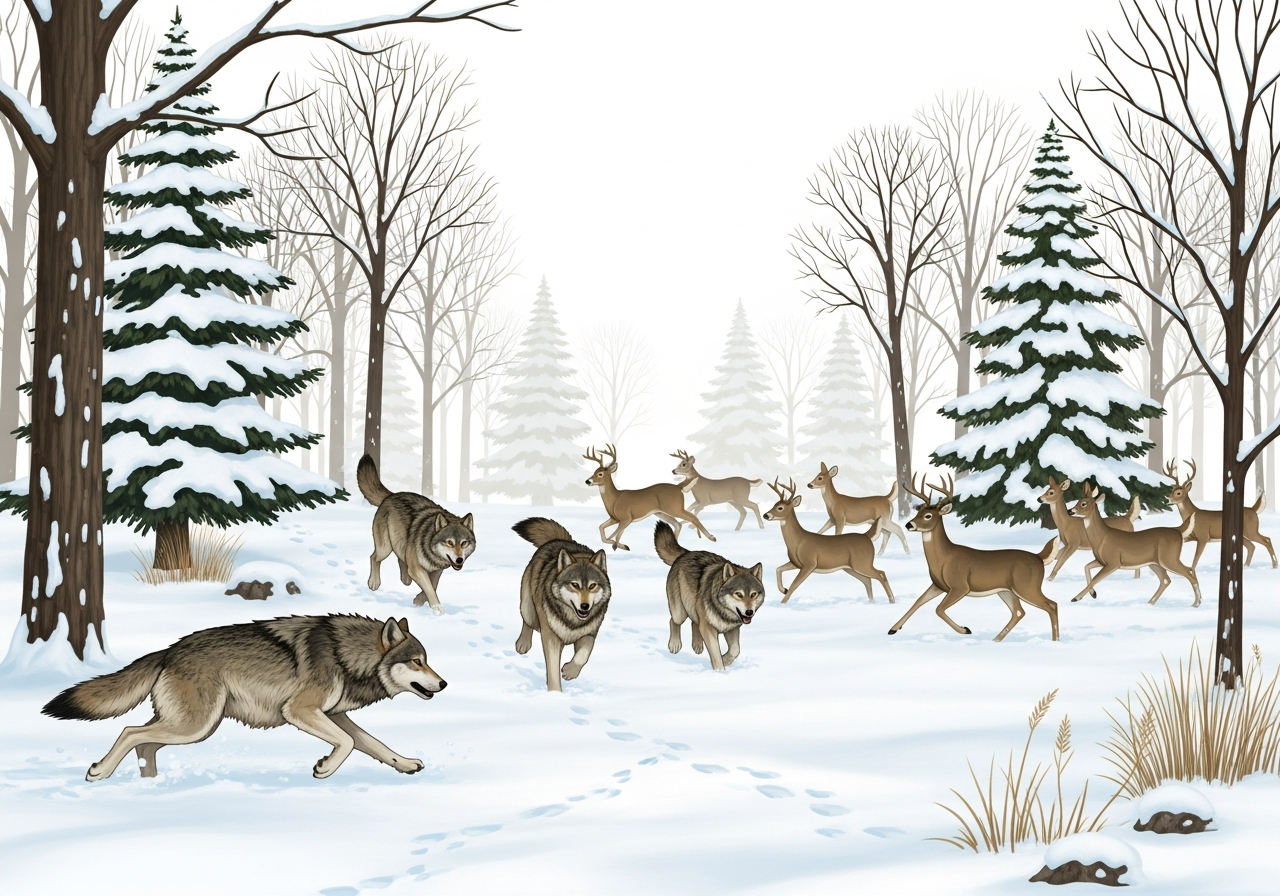
Predator and prey populations are closely linked in a cyclical pattern. When prey populations increase, predator populations rise in response due to abundant food. As predators consume more prey, the prey population declines, which then causes the predator population to fall due to food shortage restarting the cycle.
This dynamic is a classic example of a density-dependent limiting factor and connects to Food Webs and Energy Transfer, where energy moves through ecosystems via feeding relationships. Understanding these cycles also builds on Natural Selection, Survival and Reproduction, since predation drives evolutionary adaptations in both predators and prey.
Key Terms & Definitions
Carrying Capacity (K): The maximum number of individuals of a species that an environment can sustainably support given available resources such as food, water, and space. When a population reaches K, birth rates and death rates are roughly equal.
Biotic Potential: The theoretical maximum reproductive rate a species can achieve under ideal conditions with no limiting factors. Actual growth in nature is always lower due to environmental resistance.
Population Density: The number of individuals of a species living per unit area at a given time, such as deer per square kilometer.
Limiting Factor: Any resource or environmental condition such as food, water, space, or disease that restricts population growth and caps population size.
Natality: The birth rate component of population change; the number of new individuals added to a population through reproduction over a given period.
Density-Dependent Factors: Limiting factors whose effects intensify as population density increases. Examples include disease, competition for resources, and predation all of which worsen in crowded conditions.
Density-Independent Factors: Abiotic events that reduce population size regardless of how large or small the population is. Examples include volcanic eruptions, floods, droughts, and wildfires.
Emigration: The movement of individuals out of a population, which decreases the local population size.
Immigration: The movement of individuals into a population from elsewhere, which increases the local population size.
Age Structure: The distribution of individuals across different age groups within a population. A population with many young individuals is growing; one with few young is declining.
Exponential Growth: Population growth that occurs at a constant rate when resources are unlimited, producing a J-shaped curve on a graph.
Logistic Growth: Population growth that slows as the population approaches carrying capacity due to limited resources, producing an S-shaped curve.
Environmental Resistance: The combined effect of all limiting factors both biotic and abiotic that prevent a population from reaching its biotic potential.
Boom-and-Bust Cycle: A population pattern in which rapid growth overshoots carrying capacity, followed by a sharp decline as resources are depleted.
Population: All individuals of the same species living in a specific area at a given time.
Community: All populations of different species living and interacting in the same area a broader ecological level than a single population.
Applying Population Concepts
Scientists use the mark-recapture method to estimate total population size without counting every individual a practical application of Statistical Analysis and Data Interpretation. Monitoring population sizes over time reveals trends that signal ecosystem health or imbalance, connecting to Data Analysis and Advanced Statistical Methods.
Learners can apply these concepts by analyzing real-world scenarios: an invasive species introduced to a new ecosystem with no predators will show exponential growth initially, while a deer population recovering after wolf removal will eventually level off at carrying capacity due to food and space limitations.
These population dynamics also inform Global Change and Environmental Effects and guide decisions in Environmental Science, Sustainability, and Conservation Strategies.
Building on Prior Knowledge
This topic builds on several foundational concepts. Food Webs and Energy Transfer and Matter Cycles and Biogeochemical Cycles establish how energy and nutrients flow through ecosystems, directly influencing carrying capacity. Natural Selection, Survival and Reproduction and Genetic Variation and Sources of Diversity explain why populations change genetically over time in response to limiting factors.
Understanding Human Impact and Anthropogenic Effects, Environmental Change and Ecosystem Alterations, and Future Scenarios and Climate Predictions provides essential context for how human activities alter population dynamics. Ecosystems Sustainability and Conservation Strategies shows how population regulation principles are applied to protect biodiversity.
Related Topics & Connections
This topic sits within a rich network of ecological concepts. System Dynamics and Complex Interactions provides the broader framework for understanding how populations interact with other ecosystem components. Mastery of population regulation prepares students for subsequent topics including Carbon Cycle and Carbon Movement, Nitrogen Cycle and Nutrient Cycling, Water Cycle and Global Water Distribution, and Energy Flow and System Dynamics all of which depend on stable, regulated populations to function.
Understanding how populations grow and are regulated also directly informs Cycle Disruption and Environmental Effects, since population crashes and explosions can disrupt nutrient and energy cycles. Additionally, the cell-level parallel of growth regulation is explored in Cell Cycle, Growth and Regulation, where similar principles of controlled growth apply at the microscopic scale.