TOPIC

Modern Technology, Current innovations

MY PROGRESS

Pug Score

0%

Getting Started

"Let's build your foundation!"

Best Streak

0 in a row

Study Points

+0

Overview

Practice

Read

Quiz

Next Steps


Get Started

Get unlimited access to all videos, practice problems, and study tools.

Unlimited practice
Full videos

BACK TO MENU

Topic Progress

Pug Score

0%

Getting Started

"Let's build your foundation!"

Best Practice

No score

Read

Not viewed

Best Quiz

No attempts


Best Streak

0 in a row

Study Points

+0

Overview

Practice

Read

Quiz

Next Steps

Read

Modern Technology & Current Innovations: Exploring the Science Changing Our World

Modern Technology and Current Innovations explores the latest scientific and engineering advancements shaping the world, from artificial intelligence and gene editing to renewable energy and space exploration technologies.

Introduction to Modern Technology and Current Innovations

Modern technology refers to the advanced tools, systems, and scientific applications that have emerged in recent decades to address complex challenges across every field of human activity. From medicine to agriculture, from space exploration to everyday communication, current innovations are reshaping the world at an unprecedented pace.

Learners exploring this topic will discover how scientific principles connect to real-world applications, building on foundational knowledge from Materials Science, Properties and Applications, and Technology to understand how material properties enable modern devices and systems.

Computing and Artificial Intelligence

Artificial intelligence (AI) refers to computer systems designed to simulate human cognitive functions such as learning, reasoning, and decision-making. AI systems analyze large datasets to recognize patterns and improve performance over time without being explicitly reprogrammed for every task.

Machine learning is a branch of AI in which algorithms learn from training data to improve accuracy over time. Self-driving vehicles rely on machine learning algorithms to process data from cameras, radar, and LiDAR sensors, enabling real-time identification of pedestrians, road signs, and obstacles.

The Internet of Things (IoT) is a network of everyday physical devices from smart thermostats to wearable fitness trackers embedded with sensors and software that connect to the internet to collect and share data automatically. Cloud computing delivers computing services and storage over the internet, allowing users to access resources from anywhere without local hardware. Quantum computers use qubits, which exploit quantum superposition to exist in multiple states simultaneously, giving them enormous parallel processing potential compared to classical binary bits.

Biotechnology and Medical Innovations

Biotechnology applies biological systems and living organisms to develop useful products and solutions in medicine, agriculture, and environmental management. Key innovations in this field are transforming healthcare and food production.

CRISPR-Cas9 is a revolutionary gene-editing technology that acts like molecular scissors, allowing scientists to locate and modify specific sequences of DNA with remarkable precision. Unlike older genetic techniques, CRISPR can target exact locations in an organism's genome to correct mutations or introduce new traits.

mRNA vaccines deliver genetic instructions that tell the body's own cells to produce a harmless viral protein, training the immune system to recognize and fight the real pathogen without causing disease. Immunotherapy trains or boosts the patient's immune cells to specifically recognize and destroy cancer cells, representing a fundamentally different approach from chemotherapy or radiation. Tissue engineering grows biological structures such as replacement organs using living cells combined with scaffold materials in a laboratory setting.

Biosensors combine a biological recognition element with a transducer to detect specific substances used in glucose monitors, COVID-19 tests, and water quality sensors. Robotic surgery systems allow surgeons to perform minimally invasive procedures through tiny incisions with greater precision than human hands alone, reducing patient recovery time significantly.

Energy, Environment, and Sustainability

Renewable energy technologies convert natural, replenishable sources into electricity. Solar panels use the photovoltaic effect, in which photons from sunlight dislodge electrons in semiconductor materials like silicon, generating an electric current. Wind turbines convert the kinetic energy of moving air through rotating blades into electrical energy via a generator.

A major challenge of solar and wind energy is intermittency they only generate power when conditions are right. Advanced energy storage batteries, particularly lithium-ion batteries, solve this by storing excess electricity for use during low-generation periods. Lithium-ion batteries store energy through electrochemical reactions where lithium ions move between two electrode materials during charging and discharging cycles.

Carbon capture technology addresses climate change by intercepting carbon dioxide before it enters the atmosphere or removing it directly from the air, preventing it from contributing to the greenhouse effect. Electric vehicles (EVs) produce zero direct exhaust emissions while operating, significantly reducing local air pollution in cities, though their overall environmental impact depends on how the electricity used to charge them is generated.

Bioremediation harnesses the metabolic abilities of bacteria, fungi, or plants to clean up environmental pollutants such as oil spills and heavy metals. This topic connects directly to the subsequent study of Green Technology and Environmental Solutions, where students apply these concepts to broader sustainability challenges.

Space Exploration Technologies

Modern space exploration relies on a range of sophisticated technologies introduced in Introduction to Space Exploration and Current Technologies. CubeSats are miniaturised satellites built to a standard 10 cm³ unit, making space missions affordable for universities and startups. Ion thrusters use electrostatic acceleration of ions to produce continuous, fuel-efficient thrust essential for deep-space probes.

Geosynchronous orbit positions a satellite so it hovers over the same ground location continuously, making it ideal for communications and weather monitoring. Remote sensing allows instruments aboard satellites to observe Earth's land, ice, water, and atmosphere from space, supporting climate science and disaster response. Space debris including defunct satellites and rocket fragments poses collision risks to active spacecraft in orbit.

Gravitational assist maneuvers use a planet's gravitational pull and orbital motion to redirect and accelerate a spacecraft's path, allowing missions to reach distant destinations without consuming large amounts of fuel. Space telescopes like the James Webb Space Telescope avoid atmospheric interference, enabling clearer observations of distant cosmic objects a concept explored further in Research Methods and Astronomical Observation.

Manufacturing, Design, and Communication

3D printing, also called additive manufacturing, creates physical three-dimensional objects by depositing material layer by layer based on a digital design file. This technology enables rapid prototyping and custom manufacturing of complex shapes in fields from aerospace to medicine.

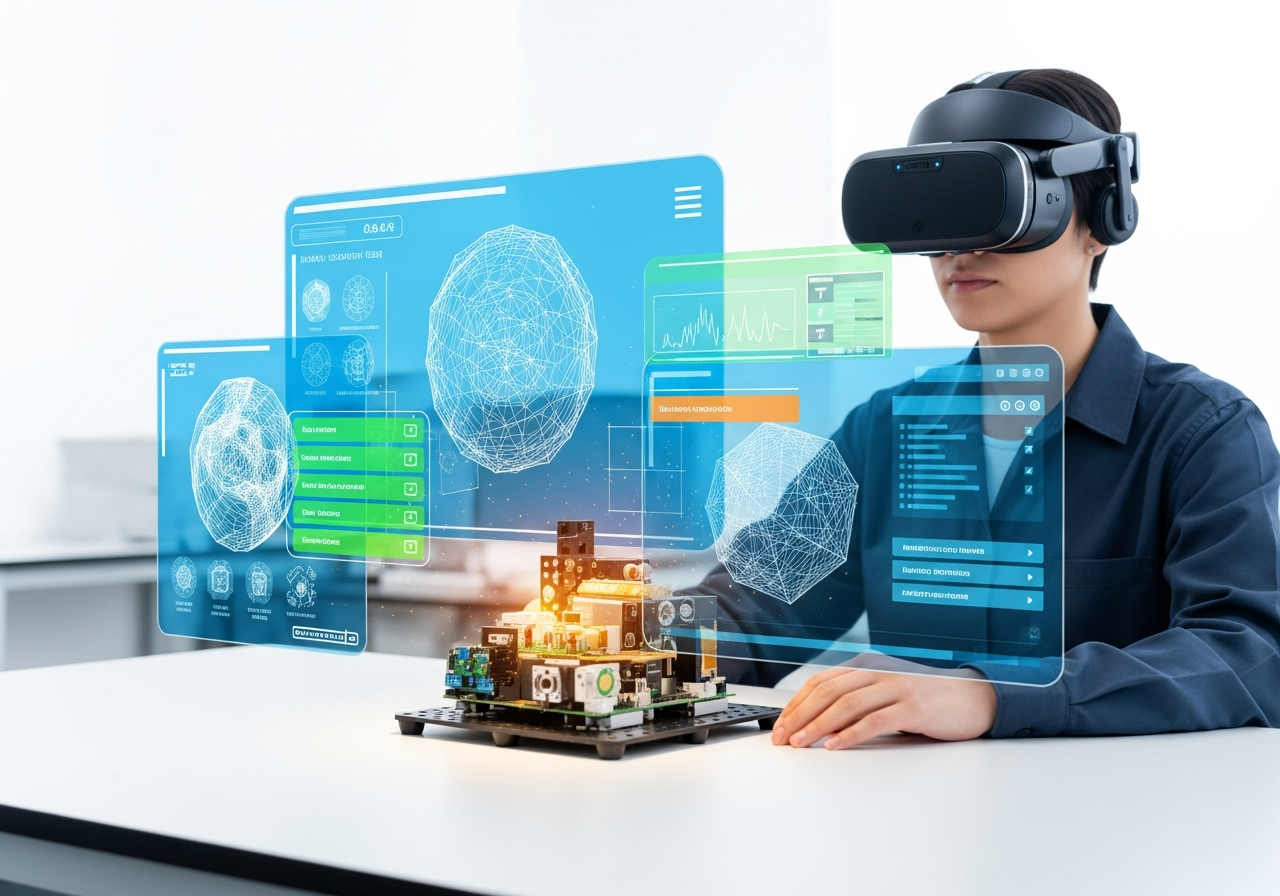
Augmented reality (AR) overlays digital information such as 3D models, measurements, and annotations onto a user's real-world view through a headset or device camera. Engineers use AR to visualise designs at full scale before construction begins, identifying structural errors early and saving time and cost. Virtual reality (VR), by contrast, completely replaces the user's real-world view with a computer-generated environment through a headset.

Fiber optic cables transmit data as pulses of light traveling through thin strands of glass or plastic, allowing information to travel at nearly the speed of light over long distances with minimal signal loss far faster than copper wire cables. 5G wireless network technology uses millimeter wave frequencies to achieve dramatically faster data transfer speeds and lower latency than previous mobile networks. GPS devices determine a user's exact location by calculating the time signals take to travel from multiple orbiting satellites to the receiver, a process called trilateration.

Precision agriculture uses drones, GPS, sensors, and satellite imagery to gather detailed field data and apply water, fertilizer, and pesticides only where needed, reducing waste and improving efficiency. Blockchain technology creates a decentralized, transparent, and tamper-resistant record of transactions, making it ideal for verifying product journeys through supply chains. These design and systems concepts connect to the study of Advanced Design and Complex Problem-Solving and Systems Thinking and Integrated Solutions.
Key Terms & Definitions

Artificial Intelligence (AI): Computer systems designed to simulate human cognitive functions such as learning, reasoning, and decision-making by analyzing data and improving performance over time.

Machine Learning: A branch of AI in which algorithms learn patterns from datasets and improve accuracy over time without being explicitly reprogrammed for every scenario.

Internet of Things (IoT): A network of everyday physical devices embedded with sensors and software that connect to the internet to collect and share data automatically.

Cloud Computing: The delivery of computing services and storage over the internet, allowing users to access resources on demand from anywhere without local hardware.

Quantum Computing: A computing approach that uses qubits, which exploit quantum superposition to represent both 0 and 1 simultaneously, enabling enormous parallel processing potential.

CRISPR-Cas9: A revolutionary gene-editing technology that acts like molecular scissors, allowing scientists to locate and modify specific DNA sequences in living organisms with high precision.

Biosensor: A device that combines a biological recognition element with a transducer to detect specific substances, used in glucose monitors, COVID-19 tests, and water quality sensors.

Bioremediation: The use of bacteria, fungi, or plants to clean up environmental pollutants such as oil spills and heavy metals through natural metabolic processes.

Synthetic Biology: An advanced field that goes beyond genetic engineering by designing entirely new genetic circuits and organisms for applications in medicine, materials, and fuel production.

Carbon Capture: Technology designed to intercept carbon dioxide from emission sources or remove it directly from the atmosphere to reduce greenhouse gas concentrations and address climate change.

Precision Fermentation: A process that uses microorganisms as biological factories to produce proteins and fats identical to those from animals, reducing the environmental footprint of food production.

CubeSat: A miniaturised satellite built to a standard 10 cm³ unit size, making space missions affordable for universities, research institutions, and startups.

Space Debris: Defunct satellites, rocket fragments, and other human-made objects orbiting Earth that pose collision risks to active spacecraft and operational satellites.

Geosynchronous Orbit: An orbital path that keeps a satellite positioned over the same location on Earth's surface continuously, ideal for communications and weather monitoring applications.

Ion Thruster: A spacecraft propulsion system that uses electrostatic acceleration of ions to produce continuous, fuel-efficient thrust, essential for deep-space probe missions.

Remote Sensing: The use of instruments aboard satellites to observe and collect data about Earth's land, ice, water, and atmosphere from space, supporting climate science and disaster response.

Photovoltaic Effect: The scientific principle by which photons from sunlight dislodge electrons in semiconductor materials, generating an electric current used by solar panels to produce electricity.

3D Printing (Additive Manufacturing): A manufacturing process that builds solid three-dimensional objects layer by layer from a digital design file, enabling rapid prototyping and custom production.

Augmented Reality (AR): A technology that overlays digital information such as 3D models and annotations onto a user's real-world view through a headset or device camera.

Virtual Reality (VR): A technology that completely replaces the user's real-world view with a fully computer-generated environment experienced through a headset.

Nanotechnology: The science of designing and manipulating materials and devices at the scale of individual atoms and molecules, typically between 1 and 100 nanometers.

Fiber Optics: A communication technology that transmits data as pulses of light through thin strands of glass or plastic fiber, enabling near-light-speed data transfer over long distances.

5G Technology: The fifth generation of mobile network technology, using millimeter wave frequencies to achieve dramatically faster data transfer speeds and lower latency than previous networks.

GPS (Global Positioning System): A satellite-based navigation system that determines a user's exact location by calculating the time signals take to travel from multiple orbiting satellites to a receiver.

Lithium-Ion Battery: A rechargeable energy storage device that stores electrical energy through electrochemical reactions, with lithium ions moving between two electrode materials during charging and discharging.

Precision Agriculture: A data-driven farming approach that uses drones, GPS, sensors, and satellite imagery to apply resources such as water and fertilizer only where needed, reducing waste.

Immunotherapy: A medical treatment that trains or boosts the patient's own immune cells to specifically recognize and destroy cancer cells, distinct from chemotherapy or radiation therapy.

Tissue Engineering: A biotechnology field that grows functional biological structures such as replacement organs using living cells combined with scaffold materials in a laboratory setting.

Gravitational Assist: A space navigation technique where a spacecraft uses a planet's gravitational pull and orbital motion to gain speed and change direction without consuming large amounts of fuel.

Blockchain: A decentralized, transparent, and tamper-resistant digital record of transactions, useful for verifying product journeys through supply chains and ensuring data integrity.

Applying Modern Technology Concepts

Students can deepen their understanding of current innovations by analyzing real-world case studies. For example, examining how AR is used in engineering design connects directly to Design Process and Advanced Methodology, where learners apply systematic design thinking to complex problems.

Comparing the properties of advanced materials such as carbon fiber composites with traditional materials reinforces concepts from Materials Science and Property Analysis. Investigating how lithium-ion batteries and renewable energy systems work together supports understanding of Electrical Power and Energy Transfer.

Researching astronomical data collected by space telescopes and remote sensing satellites connects to Astronomical Data and Evidence Collection, showing how modern technology enables scientific discovery at cosmic scales.

Prerequisite Knowledge

Before exploring modern technology and current innovations, students should have a solid understanding of Materials Science, Properties and Applications, and Technology. Knowledge of how different materials behave including their physical, chemical, and mechanical properties provides the foundation for understanding why specific materials are chosen for advanced technological applications.

Understanding basic energy concepts and how energy is transferred and transformed also supports comprehension of renewable energy systems, battery technology, and electronic devices covered in this topic.

Related Topics & Connections

This topic sits at the intersection of several important areas of scientific study. The following related topics provide essential context and extend the learning journey:

Prerequisite: Materials Science, Properties and Applications, Technology Understanding material properties is foundational to comprehending how modern devices and systems are constructed and why specific materials are selected for technological applications.

Related: Introduction to Space Exploration and Current Technologies Space exploration technologies such as CubeSats, ion thrusters, and remote sensing satellites represent direct applications of modern innovation in an extreme environment.

Related: Advanced Design and Complex Problem-Solving Technologies like AR, 3D printing, and robotic systems are tools used within advanced design processes to solve complex engineering challenges.

Related: Systems Thinking and Integrated Solutions Modern technologies rarely operate in isolation; systems thinking helps learners understand how IoT, AI, cloud computing, and energy systems work together as integrated solutions.

Related: Energy Resources, Renewable and Non-Renewable Renewable energy technologies such as solar panels and wind turbines represent the practical application of energy resource knowledge to address sustainability challenges.

Related: Research Methods and Astronomical Observation Space telescopes and remote sensing satellites are modern technological tools that enable the astronomical observation and data collection methods studied in this related topic.

Subsequent: Green Technology and Environmental Solutions This topic builds directly on modern technology concepts, applying innovations like carbon capture, bioremediation, and renewable energy to environmental problem-solving.

Subsequent: Design Process, Advanced Methodology, and Technology Design Students apply their understanding of current innovations within structured design methodologies to develop technological solutions.

Subsequent: Materials Science and Property Analysis Advanced analysis of material properties builds on the understanding of how modern materials like carbon fiber composites and nanomaterials are engineered for specific applications.

Subsequent: Electrical Power and Energy Transfer Understanding how modern energy storage and renewable systems work prepares students for deeper study of electrical power and energy transfer principles.

Subsequent: Astronomical Data and Evidence Collection The remote sensing and space telescope technologies introduced here directly support the collection and analysis of astronomical data studied in this subsequent topic.