TOPIC

Research Methods, Astronomical observation

MY PROGRESS

Pug Score

0%

Getting Started

"Let's build your foundation!"

Best Streak

0 in a row

Study Points

+0

Overview

Practice

Read

Quiz

Next Steps


Get Started

Get unlimited access to all videos, practice problems, and study tools.

Unlimited practice
Full videos

BACK TO MENU

Topic Progress

Pug Score

0%

Getting Started

"Let's build your foundation!"

Best Practice

No score

Read

Not viewed

Best Quiz

No attempts


Best Streak

0 in a row

Study Points

+0

Overview

Practice

Read

Quiz

Next Steps

Read

Unlocking the Universe: Research Methods in Astronomical Observation

This topic covers the research methods and observational technologies astronomers use to study the universe, including telescopes, spectroscopy, and the electromagnetic spectrum.

Introduction to Astronomical Research Methods

Astronomy relies on systematic research methods to uncover the nature of the universe. Learners studying this topic will discover how scientists design observations, collect data, and draw conclusions about objects billions of light-years away. This connects directly to Introduction to Space Exploration and Current Technologies, which provides essential context for understanding modern astronomical tools.

Because astronomers cannot travel to distant stars or galaxies, they depend entirely on the light and radiation those objects emit. Every research method in astronomy is ultimately a strategy for extracting information from that incoming radiation.
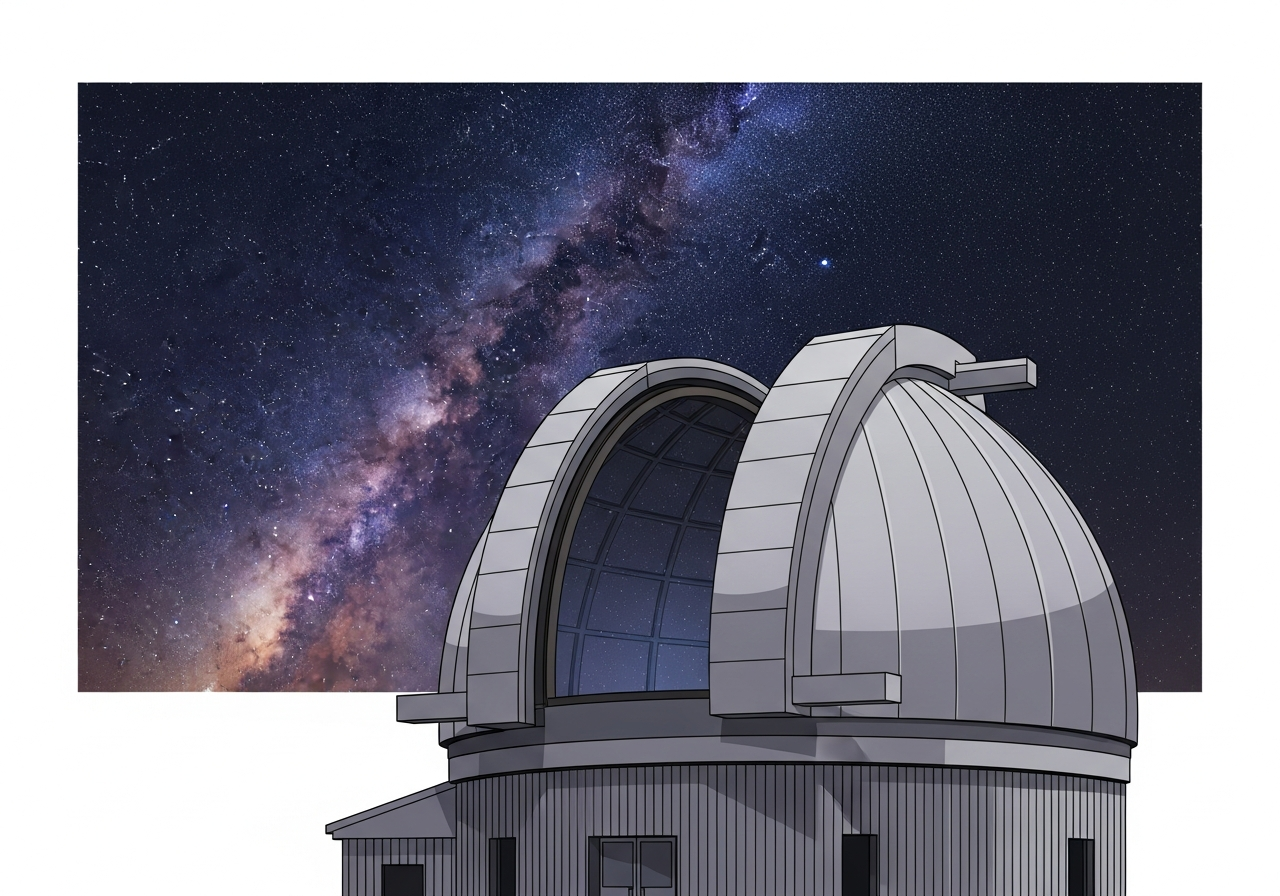
Telescopes: The Primary Tool of Astronomical Observation

A telescope's primary purpose is to collect and focus light from distant objects in space, making them appear brighter and more detailed than the naked eye can perceive. The larger a telescope's aperture (diameter), the more light it gathers, allowing astronomers to detect fainter and more distant objects.

There are two fundamental telescope designs. Refracting telescopes use lenses to bend and focus light, while reflecting telescopes use curved mirrors. Most modern professional observatories use reflecting designs because large mirrors are easier and less expensive to construct than large lenses.

The Hubble Space Telescope orbits above Earth's atmosphere, eliminating the blurring and absorption effects that affect ground-based instruments. This gives it remarkably sharp images across visible, ultraviolet, and infrared wavelengths. Ground-based observatories are often built on mountaintops to reduce atmospheric interference and light pollution from cities.

Adaptive optics systems correct for atmospheric turbulence in real time, allowing ground-based telescopes to achieve near space-quality resolution. Radio telescopes use large parabolic dish antennas to detect radio waves emitted by celestial objects sources that may emit little or no visible light.

The Electromagnetic Spectrum in Astronomy

Each part of the electromagnetic spectrum reveals different cosmic phenomena. Astronomers use the full range of wavelengths from radio waves to gamma rays to build a complete picture of the universe. This connects closely to Light Waves and the Electromagnetic Spectrum.

Radio waves pass through interstellar dust and Earth's atmosphere, making ground-based radio telescopes effective. Infrared light penetrates dust clouds but is absorbed by water vapor, so space telescopes like the James Webb Space Telescope are essential for infrared astronomy. Infrared telescopes are particularly useful for studying star-forming regions shrouded in dust clouds that block visible light.

Ultraviolet (UV) radiation is blocked by the ozone layer, requiring satellites such as Hubble's UV instruments. X-rays are absorbed by the atmosphere and require orbiting observatories like the Chandra X-ray Observatory. Gamma rays, the most energetic photons, require space observatories like the Fermi Gamma-ray Space Telescope, though very high-energy gamma rays can be detected indirectly via Cherenkov radiation in ground-based arrays.

Key Research Techniques

Spectroscopy

Spectroscopy splits starlight into its component wavelengths, producing a spectrum with unique absorption or emission lines. Each element produces a distinctive spectral fingerprint, allowing astronomers to determine the chemical composition of stars. This is one of astronomy's most powerful research tools and connects to Stellar Evolution and the Life Cycle of Stars.

Parallax

Parallax uses Earth's orbital motion to measure stellar distances. By observing a nearby star from two positions six months apart, astronomers measure the tiny angular shift in its apparent position against background stars. The greater the shift, the closer the star. This geometric technique is the foundation of the cosmic distance ladder.

The Doppler Effect

The Doppler effect causes light from objects moving away to shift toward red wavelengths (redshift) and light from approaching objects to shift toward blue wavelengths (blueshift). This reveals whether a star or galaxy is moving toward or away from Earth and is key evidence that the universe is expanding.

Light Curves and Exoplanet Detection

A light curve tracks the brightness of a star over time. Dips in a star's light curve can signal a transiting exoplanet a planet orbiting another star passing in front of it. This transit method has been used by space telescopes like Kepler and TESS to confirm thousands of exoplanets.

Cepheid Variables

Cepheid variable stars pulsate with a period directly related to their intrinsic luminosity. By measuring the pulsation period, astronomers determine the star's true brightness. Comparing that to its apparent brightness from Earth reveals its distance a technique that extends the cosmic distance ladder far beyond parallax.

Charge-Coupled Devices (CCDs)

A charge-coupled device (CCD) is an electronic sensor that converts incoming photons into digital signals, producing highly sensitive images showing the brightness and position of light sources. CCDs replaced photographic film in modern observatories because they capture far more photons per second and produce quantitative digital data.

Astrometry

Astrometry is the precise measurement of the positions and motions of stars over time. Dedicated astrometric instruments, such as the Gaia satellite, track stellar positions with extraordinary accuracy, enabling the detection of stellar motion and even the gravitational influence of orbiting planets.

The Scientific Method in Astronomy

Astronomical research follows the scientific method rigorously. After forming a hypothesis a specific, testable prediction scientists design systematic observations to gather data. A theory is a well-tested explanation supported by substantial evidence from many independent studies, unlike a hypothesis which is an initial untested prediction.

Observations must be objective, meaning they are based on measurable data rather than personal opinions. Results must be repeatable so other scientists can verify them independently. Peer review where qualified experts evaluate research before publication ensures that published findings are accurate and credible.

When a result is described as statistically significant, it means the result is unlikely to be due to chance and is probably a real scientific finding. Scientists use statistical tests and set thresholds (commonly a p-value below 0.05) before claiming a discovery. This connects to Data Analysis and Advanced Statistical Methods.

Computer models and simulations allow astronomers to test theories and predict outcomes for events impossible to observe directly, such as galaxy collisions or stellar evolution over billions of years. This links to Scientific Models and Mathematical Modeling.

Measuring Cosmic Distances

Astronomers use specialized units to express the vast distances in space. A light-year is a unit of distance approximately 9.46 trillion kilometers equal to how far light travels through space in one year at 300,000 km/s. An astronomical unit (AU) equals the average distance from Earth to the Sun (approximately 150 million kilometers) and is used to measure distances within our solar system. For distances beyond the solar system, light-years or parsecs are used instead.

Cosmic Microwave Background Radiation

The cosmic microwave background (CMB) radiation is thermal radiation left over from approximately 380,000 years after the Big Bang, when the universe cooled enough for atoms to form and light to travel freely. It provides a snapshot of the early universe and strongly supports the Big Bang theory. CMB is detected using specialized space observatories and represents one of the most important pieces of evidence in modern cosmology.

Key Terms & Definitions

Parallax: The apparent shift in a nearby star's position against background stars as Earth orbits the Sun, used to calculate stellar distances through trigonometry.

Spectroscopy: The technique of splitting light into its component wavelengths to identify the chemical composition and radial velocity of stars and other celestial objects.

Light Curve: A graph that tracks the brightness of a star or other celestial object over time; dips can indicate a transiting exoplanet.

Charge-Coupled Device (CCD): An electronic sensor used in modern telescopes that converts photons into digital signals, producing highly sensitive images of brightness and position.

Adaptive Optics: A technology that corrects for atmospheric turbulence in real time, allowing ground-based telescopes to achieve near space-quality resolution.

Electromagnetic Spectrum: The full range of radiation wavelengths, from radio waves to gamma rays, used by astronomers to study different cosmic phenomena.

Doppler Effect: The change in wavelength of light (or sound) caused by the relative motion between source and observer; used to determine whether a star or galaxy is moving toward or away from Earth.

Redshift: The stretching of light to longer (redder) wavelengths when a source moves away from the observer; key evidence for the expanding universe.

Blueshift: The compression of light to shorter (bluer) wavelengths when a source moves toward the observer.

Light-Year: A unit of distance equal to approximately 9.46 trillion kilometers the distance light travels in one year at 300,000 km/s.

Astronomical Unit (AU): The average distance from Earth to the Sun (approximately 150 million kilometers), used to measure distances within our solar system.

Aperture: The diameter of a telescope's primary lens or mirror; a larger aperture collects more light, revealing fainter and more distant objects.

Refracting Telescope: A telescope that uses lenses to bend and focus incoming light.

Reflecting Telescope: A telescope that uses curved mirrors to gather and focus light, free from chromatic aberration and easier to build at large sizes.

Radio Telescope: A large parabolic dish antenna that detects radio waves emitted by celestial objects, effective for studying objects that emit little visible light.

Exoplanet: A planet orbiting a star outside our solar system, often detected by the dimming of the host star's light during a transit.

Cepheid Variable Star: A type of star whose pulsation period is directly related to its intrinsic luminosity, used to measure cosmic distances.

Astrometry: The precise measurement of the positions and motions of stars over time, used to detect stellar movement and orbiting planets.

Hypothesis: A specific, testable prediction proposed before an experiment or observation is conducted.

Theory: A well-tested, broadly accepted scientific explanation supported by substantial evidence from multiple independent investigations.

Peer Review: A process where independent experts critically evaluate a researcher's methods, data, and conclusions before publication to ensure accuracy and credibility.

Statistically Significant: A result that is unlikely to be due to chance, indicating it probably represents a real scientific finding.

Objective Observation: An observation based on measurable, verifiable data rather than personal beliefs or feelings.

Resolution: The ability of a telescope to distinguish fine details and separate closely spaced objects clearly in an image.

Light Pollution: Artificial light from cities and human-made sources that brightens the night sky and obscures faint celestial objects.

Cosmic Microwave Background (CMB): Thermal radiation left over from approximately 380,000 years after the Big Bang, considered strong evidence for the Big Bang theory.

Control Variable: A factor held constant throughout an experiment so that any observed change can be attributed to the independent variable being tested.

Quantitative Data: Information expressed as precise numerical measurements, such as a star's coordinates or brightness value.

Applying Research Methods in Practice

Students can deepen their understanding by examining how astronomers combine data from multiple telescopes observing different wavelengths to build a more complete picture of a cosmic object. Each wavelength reveals different physical properties, so multi-wavelength analysis is far more powerful than single-wavelength observation.

Learners can also explore how Research Design and Independent Investigation principles apply directly to astronomy designing a systematic observation plan, identifying variables, and determining what data would support or refute a hypothesis. Connecting these skills to Technical Writing and Scientific Communication helps students understand how findings are shared with the broader scientific community.

Prerequisite Knowledge

Before studying astronomical research methods, learners should be comfortable with Advanced Design and Complex Experimental Protocols, which provides the foundation for designing rigorous scientific investigations. Understanding Scientific Models Mathematical and Conceptual Models is also essential, as astronomers rely heavily on models to represent phenomena that cannot be observed directly.

Familiarity with Scientific Theory Theory Development and Testing helps students appreciate how astronomical knowledge is built and validated over time. Skills in Statistical Analysis and Data Interpretation are critical for evaluating whether observational results are meaningful. Finally, awareness of Emerging Technologies and Current Developments provides context for understanding how rapidly astronomical instrumentation is advancing.

Related Topics & Connections

This topic sits at the intersection of observational science and space exploration. Galaxies Types and Formation and Stellar Evolution Life Cycle of Stars are directly studied using the research methods covered here, particularly spectroscopy and light curve analysis.

The methods learned here prepare students for Astronomical Data and Evidence Collection and Solar Radiation and Energy from Space, where data gathered through these techniques is analyzed in depth. Advanced work in Data Analysis Advanced Statistical Methods in Scientific Investigation and Research Design Complex Experimental Protocols builds directly on the foundations established here.

Students interested in theoretical frameworks will find that Scientific Models Theoretical Modeling extends the modeling skills introduced in this topic. The broader technological context is explored in Modern Technology Current Innovations and Future Tech Emerging Technologies, which examine how next-generation observatories will transform astronomical research.