Topic
Galaxies, Types and formationMy Progress
Pug Score
0%
Getting Started
Let's build your foundation!
Best Streak
0 in a row
Study Points
+0
Overview
Practice
Read
Quiz
Next Steps
Back to Menu
Topic Progress
Pug Score
0%
Getting Started
"Let's build your foundation!"
Best Practice
No score
Read
Not viewed
Best Quiz
No attempts
Best Streak
0 in a row
Study Points
+0
Overview
Practice
Read
Quiz
Next Steps
Read
Galaxies: Exploring Types, Structure, and Formation Across the Universe
This topic explores the types, structures, and formation of galaxies, helping students understand the large-scale organization of the universe and the forces that shape it.
What Are Galaxies?
A galaxy is an enormous system containing billions of stars, gas, dust, and dark matter, all held together by gravity. The observable universe contains an estimated two trillion galaxies, each varying in size, shape, and age. Our own solar system resides within the Milky Way, a barred spiral galaxy approximately 100,000 light-years in diameter, located in a small cluster called the Local Group.
Understanding galaxies connects directly to the study of Stellar Evolution and the Life Cycle of Stars, since stars are the fundamental building blocks of every galaxy. Learners who have studied Geological Time and Earth's History will appreciate the immense timescales involved in galaxy formation and evolution.
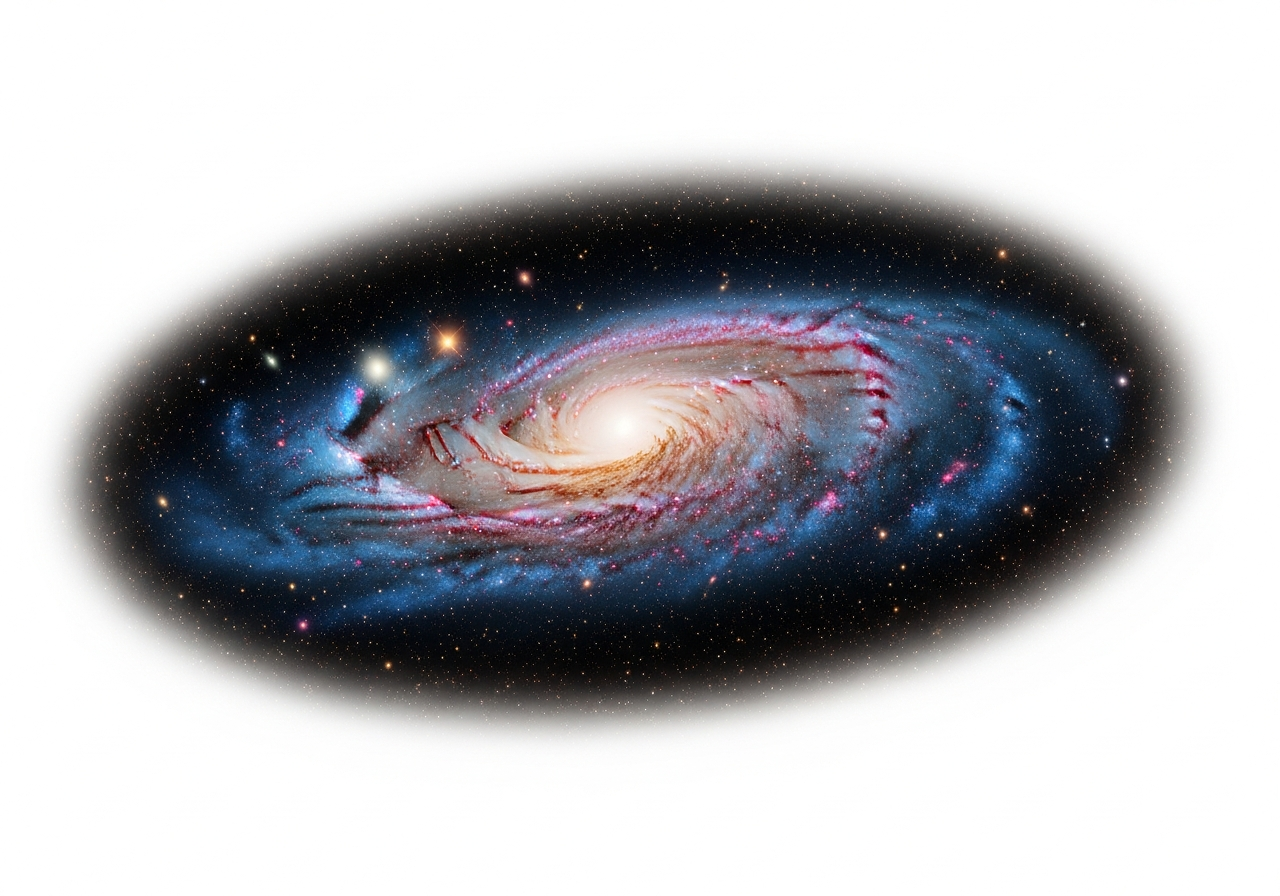
Types of Galaxies: The Hubble Sequence
Astronomer Edwin Hubble developed the foundational galaxy classification system known as the Hubble Sequence, often depicted as a tuning-fork diagram. Galaxies are classified by their visual shape and structure into four main categories.
Elliptical Galaxies
Elliptical galaxies are rounded or oval-shaped systems containing mostly older, redder stars with very little gas or dust remaining. Because their raw star-forming material was exhausted long ago, very little new star formation occurs in these galaxies.
Spiral and Barred Spiral Galaxies
Spiral galaxies have a flat, rotating disk with curved spiral arms regions of stars, gas, and dust extending outward from a central bulge where new stars actively form. A barred spiral galaxy, like the Milky Way, features an elongated bar of stars through its nucleus, with spiral arms extending from the bar's ends.
Lenticular Galaxies
Lenticular galaxies are intermediate between elliptical and spiral types they possess a disk structure like spirals but lack prominent spiral arms and have little ongoing star formation, similar to ellipticals.
Irregular Galaxies
Irregular galaxies have no defined shape and do not fit neatly into the spiral or elliptical categories. They often result from gravitational interactions, collisions, or mergers with other galaxies. The Large Magellanic Cloud, which orbits the Milky Way, is a well-known example of an irregular dwarf galaxy.
Galaxy Structure: Key Features
Most large spiral galaxies share several structural components that students should recognize.
The galactic bulge is the dense, rounded central region packed with older stars and typically harboring a supermassive black hole an extremely massive black hole containing millions to billions of solar masses. In the Milky Way, this central black hole is called Sagittarius A*. The galactic halo is a large spherical region surrounding the disk, containing old stars, globular clusters, and a significant amount of dark matter. An Active Galactic Nucleus (AGN) marks a galaxy with an extremely energetic core driven by a feeding supermassive black hole.
Galaxy Formation and the Big Bang
The Big Bang Theory is the widely accepted scientific model stating the universe originated approximately 13.8 billion years ago from an extremely hot, dense state and has been expanding ever since. The Big Bang produced the hydrogen and helium gas that filled the early universe, and within the first few hundred million years, gravity caused these gases to collapse into the first protogalaxies early clouds of gas and dark matter in the process of forming galaxies.
Galaxies form preferentially along the cosmic web, the universe's large-scale scaffolding of dense filaments and nodes. Accretion is the process by which galaxies and their black holes grow by gravitationally pulling in surrounding material. When two galaxies collide, they merge over billions of years, often triggering starburst galaxies galaxies experiencing an unusually rapid and intense period of new star formation at rates 10 to 1,000 times higher than typical galaxies.
Dark matter is invisible matter that does not interact with light but exerts gravitational force, providing the scaffolding needed for galaxies to form and hold together. Without dark matter, galaxies would lack sufficient mass to maintain their structure. Cosmic redshift the stretching of light wavelengths from distant galaxies reveals that those galaxies are moving away from us as the universe expands, a key piece of evidence supporting the Big Bang Theory first observed by Edwin Hubble.
The Andromeda Galaxy, the nearest large galaxy to the Milky Way, is currently moving toward us and is expected to collide and merge with the Milky Way in approximately 4.5 billion years. A galaxy cluster is the largest gravitationally bound structure, containing hundreds to thousands of member galaxies. The Milky Way belongs to the Local Group, which is part of the larger Virgo Supercluster.
Key Terms & Definitions
Hubble Sequence (Tuning-Fork Diagram): The foundational galaxy classification system developed by Edwin Hubble that organizes galaxies by their visual shape into ellipticals, lenticulars, spirals, barred spirals, and irregulars.
Lenticular Galaxy: A galaxy intermediate between elliptical and spiral types it has a disk but no spiral arms and little ongoing star formation.
Active Galactic Nucleus (AGN): An extremely energetic core found in certain galaxies, driven by a supermassive black hole that is actively consuming surrounding material.
Redshift: The stretching of light wavelengths from distant galaxies toward the red end of the spectrum, indicating those galaxies are moving away from us as the universe expands. It is key to calculating galactic distances.
Elliptical Galaxy: A rounded or oval-shaped galaxy dominated by older, redder stars with very little gas, dust, or ongoing star formation.
Cosmic Web: The universe's large-scale structure of dense filaments and nodes along which galaxies preferentially form and cluster.
Accretion: The process by which galaxies and supermassive black holes grow by gravitationally pulling in surrounding gas, dust, and other material.
Starburst Galaxy: A galaxy forming new stars at an exceptionally high rate 10 to 1,000 times higher than typical galaxies often triggered by a merger or collision event.
Galaxy Cluster: The largest gravitationally bound structure in the universe, containing hundreds to thousands of individual member galaxies, along with hot gas and dark matter.
Protogalaxy: A primordial cloud of gas and dark matter in the early universe that is gravitationally collapsing to form the first stars and eventually a mature galaxy the earliest stage of galaxy assembly.
Dark Matter: An invisible form of matter that does not interact with light but exerts gravitational force, providing the scaffolding necessary for galaxies to form and remain structurally intact.
Supermassive Black Hole: An extremely massive black hole containing millions to billions of solar masses, found at the center of most large galaxies.
Galactic Bulge: The dense, rounded central region of a spiral galaxy, packed with older stars and typically harboring a supermassive black hole.
Galactic Halo: A large spherical region surrounding the disk of a spiral galaxy, containing old stars, globular clusters, and a significant amount of dark matter.
Spiral Arms: Curved regions of stars, gas, and dust that extend outward from the central bulge of a spiral galaxy, where active star formation occurs.
Local Group: The galaxy cluster of approximately 54 galaxies that includes the Milky Way, the Andromeda Galaxy, the Triangulum Galaxy, and numerous dwarf galaxies, all bound together by gravity.
Big Bang Theory: The widely accepted scientific model stating the universe originated approximately 13.8 billion years ago from an extremely hot, dense state and has been expanding ever since.
Dwarf Galaxy: A small galaxy containing only a few billion stars, often orbiting a much larger nearby galaxy as a satellite, such as the Magellanic Clouds orbiting the Milky Way.
Applying Galaxy Concepts
Students can deepen their understanding by examining real astronomical data and images from telescopes such as the Hubble Space Telescope. Analyzing deep-field images helps learners appreciate the estimated two trillion galaxies in the observable universe and practice applying the Hubble Sequence classification system.
Connecting galaxy formation to Scientific Models and Mathematical Modeling allows students to see how astronomers use mathematical frameworks to describe cosmic structures. Exploring Research Methods and Astronomical Observation further illustrates how scientists gather evidence about galaxies across vast distances.
Building on Prior Knowledge
Students who have studied Geological Time and Earth's History are well-prepared to grasp the enormous timescales involved in galaxy formation and evolution. Understanding deep time is essential for appreciating how protogalaxies formed hundreds of millions of years after the Big Bang.
Knowledge of Atomic Models and Historical Development also supports understanding of how hydrogen and helium the first elements produced after the Big Bang became the raw material for the first galaxies and stars.
Related Topics & Connections
This topic sits within a rich network of interconnected science concepts. The study of Stellar Evolution and the Life Cycle of Stars is closely linked, as stars are born within galaxies and their life cycles shape galactic evolution over time.
Learners interested in how scientists study these distant structures will find Research Methods and Astronomical Observation directly relevant, covering the telescopes and techniques used to observe galaxies. Introduction to Space Exploration and Current Technologies extends this further by examining the spacecraft and instruments enabling modern galactic research.
The mathematical and modeling frameworks used to describe galaxy formation connect to Scientific Models and Mathematical Modeling, while the atomic-scale origins of galactic matter relate to Atomic Models and Historical Development. Looking ahead, Future Tech and Emerging Technologies explores how next-generation instruments may revolutionize galaxy research.
This topic also prepares students for subsequent studies including Astronomical Data and Evidence Collection, Solar Radiation and Energy from Space, Climate Effects and Solar Influence, and Energy Distribution and Global Patterns all of which build on an understanding of how energy and matter originate and travel across the universe.