TOPIC
Communities, Interaction between populationsMY PROGRESS
Pug Score
0%
Getting Started
"Let's build your foundation!"
Best Streak
0 in a row
Study Points
+0
Overview
Practice
Watch
Read
Quiz
Next Steps
Get Started
Get unlimited access to all videos, practice problems, and study tools.
BACK TO MENU
Topic Progress
Pug Score
0%
Getting Started
"Let's build your foundation!"
Videos Watched
0/0
Best Practice
No score
Read
Not viewed
Best Quiz
No attempts
Best Streak
0 in a row
Study Points
+0
Overview
Practice
Watch
Read
Quiz
Next Steps
Read
Discover How Populations Interact in Communities and Ecosystems
You will learn how different populations of living things interact with each other in a community, including relationships like predation, competition, mutualism, and parasitism.
What Is a Community in an Ecosystem?
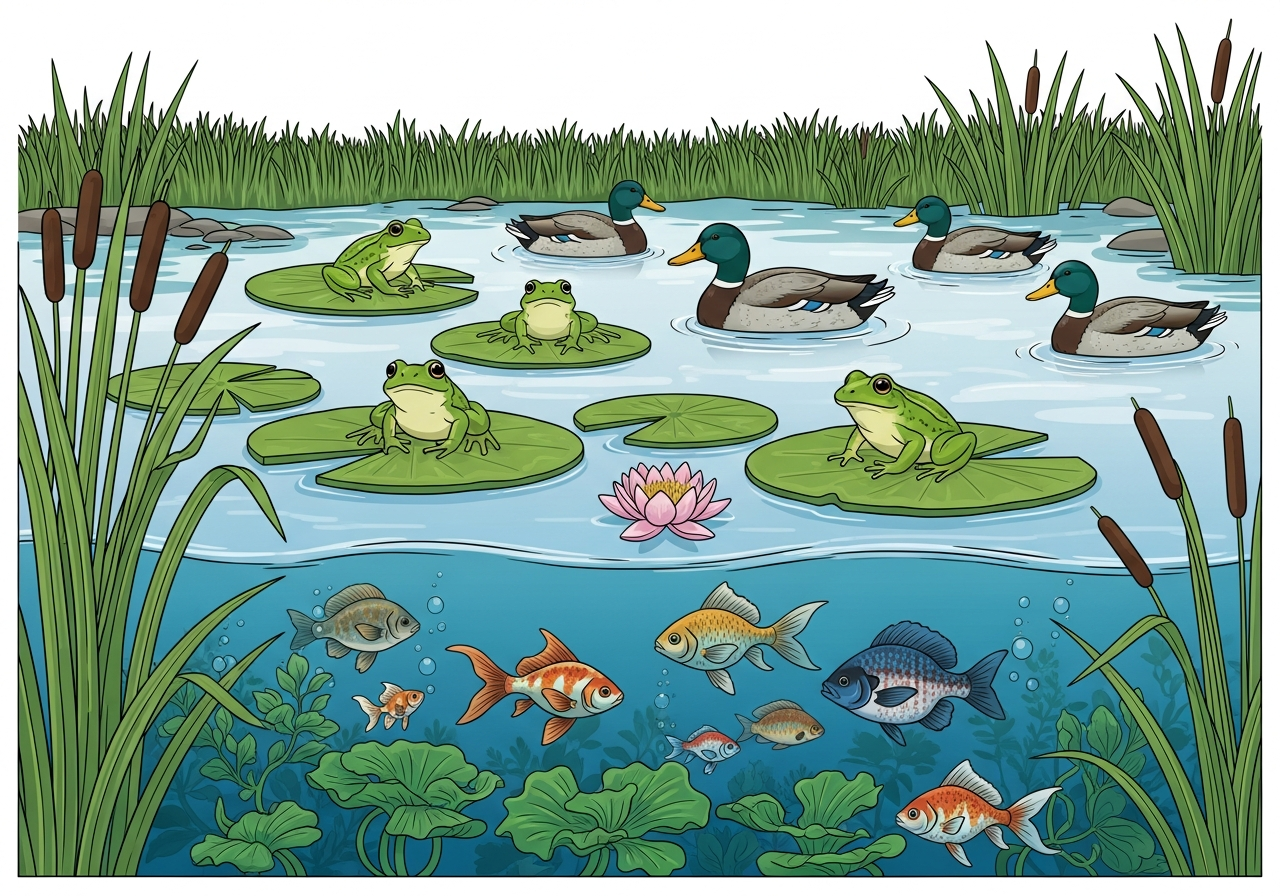
In science, a community is a group of different populations living together in one area and interacting with each other. For example, a pond community might include frogs, fish, ducks, and water plants all sharing the same space.
A population is a group of the same kind of organism living in one place like all the rabbits in a meadow. A community always has many different populations, while a population has only one species.
You can explore how living and non-living parts work together by visiting Ecosystem Components: Living and Non-Living Elements. Understanding communities also connects to Population Dynamics: Groups of Organisms in an Area.
How Do Populations Interact in a Community?
Populations in a community interact in many important ways. These interactions affect how well each population survives and grows.
Predation: Predator and Prey
When one animal hunts and eats another, we call this predation. The animal that hunts is the predator, and the animal that gets eaten is the prey. For example, a fox is a predator that hunts rabbits, which are its prey.
Predators are very important because they keep prey populations from growing too large. If all the foxes disappeared, the rabbit population would grow very large and fast.
Competition
When two populations need the same limited resource like food, water, or space they compete with each other. For example, red squirrels and gray squirrels both eat acorns, seeds, and nuts in the same forest, so they must compete for those resources.
Mutualism
Mutualism is when two populations both benefit from their relationship. Bees and flowers are a great example bees collect nectar from flowers for food, and as they fly from flower to flower, they spread pollen, which helps flowers reproduce and make seeds. Both the bee and the flower gain something helpful.
Clownfish and sea anemones also show mutualism in the ocean. The clownfish gets shelter among the anemone's stinging tentacles, and the anemone gets protection from animals that would eat it.
Parasitism
Parasitism is when one organism benefits while the other is harmed. A tick living on a deer is a good example the tick drinks the deer's blood for food, but the deer loses blood and can get sick. The tick is the parasite and the deer is the host.
Producers, Consumers, and Decomposers
Every organism in a community plays a special role. These roles help energy flow through the ecosystem and keep the community balanced.
- Producers Plants like grass and trees use sunlight to make their own food through photosynthesis. They are always at the start of a food chain.
- Consumers Animals cannot make their own food, so they must eat other living things. A herbivore eats only plants (like a rabbit), a carnivore eats only animals (like a fox), and an omnivore eats both plants and animals (like a bear).
- Decomposers Organisms like mushrooms, worms, and bacteria break down dead plants and animals and return nutrients to the soil. This helps new plants grow and keeps the ecosystem healthy.
A food chain shows the path that energy takes from a plant to an animal. For example: Grass Rabbit Fox. You can learn more about how energy moves by visiting Energy Transfer: Producer to Consumer Flow and Food Webs: Interconnected Food Chains.
Why Balance in a Community Matters
All populations in a community are connected. If one population changes, others change too. If plants in a forest disappear, deer would lose their food and their population would decrease. If a disease kills most rabbits, foxes would lose their food source and also decrease.
Biodiversity having many different species in a community helps ecosystems stay balanced and healthy. More species means the community can recover more easily from changes.
You can explore how changes affect ecosystems by visiting Environmental Changes: Local Ecosystem Effects and Conservation: Protection Strategies.
Key Terms and Definitions
Community: A community is a group of different populations living together in one area and interacting with each other. For example, all the plants and animals in a forest form a community.
Population: A population is all the members of the same species living together in one place, such as all the rabbits in a field.
Ecosystem: An ecosystem includes all the living things and non-living things like water, soil, and sunlight working together in one specific place.
Habitat: A habitat is the natural place where an animal or plant normally lives and finds everything it needs to survive, like food, water, and shelter.
Predator: A predator is an animal that hunts and eats other animals for food. An owl that hunts mice is a predator.
Prey: Prey is an animal that gets hunted and eaten by a predator. A mouse hunted by an owl is prey.
Predation: Predation is the interaction where a predator hunts prey for food. It is one of the most important interactions between populations in a community.
Competition: Competition happens when two or more populations need the same limited resource, like food, water, or space, and must fight over it.
Symbiosis: Symbiosis describes any close, long-term relationship between two different species living together. It includes mutualism, commensalism, and parasitism.
Mutualism: Mutualism is a type of symbiosis where both populations benefit from their relationship. Bees and flowers are a classic example of mutualism.
Commensalism: Commensalism is a type of symbiosis where only one side benefits and the other is unaffected like a barnacle riding on a whale.
Parasitism: Parasitism is when one organism (the parasite) benefits by living on or in another organism (the host), which is harmed in the process.
Parasite: A parasite is the organism that benefits in a parasitic relationship, like a tick that drinks a deer's blood.
Host: A host is the organism that a parasite depends on for survival, and is often harmed in the process, like a deer with a tick on it.
Producer: A producer is a living thing that makes its own food using sunlight energy through photosynthesis. Plants and trees are producers.
Consumer: A consumer is a living thing that eats other organisms to get its energy. Animals like rabbits, foxes, and bears are consumers.
Decomposer: A decomposer breaks down dead plants and animals into small nutrients that go back into the soil. Mushrooms, worms, and bacteria are decomposers.
Herbivore: A herbivore is a consumer that only eats plants to get all its energy. Rabbits and deer are herbivores.
Carnivore: A carnivore is a consumer that only eats other animals for energy. Foxes and owls are carnivores.
Omnivore: An omnivore is an animal that eats both plants and other animals for energy. Bears and humans are omnivores.
Food Chain: A food chain is a path that shows how energy moves from a plant to an animal and then to another animal. For example: Grass Rabbit Fox.
Biodiversity: Biodiversity means having many different species in a community. More species help the community stay balanced and healthy overall.
Practice What You Know
You can practice identifying interactions between populations by looking at animals around you. Ask yourself: Is one animal eating another? Are two animals competing for the same food? Are two living things helping each other?
Try drawing your own food chain starting with a plant, then a herbivore, then a carnivore. You can also explore Trophic Levels: Producers, Consumers, and Decomposers to go deeper into how energy flows through a community.
Think about what would happen if one population disappeared from your food chain. How would the other populations be affected? This kind of thinking will help you understand Energy Flow: Food Webs and Energy Transfer.
What You Already Know That Helps
You already learned about Animal Groups: Major Animal Classifications and Animal Adaptations: Physical and Behavioral Features, which help you understand how different animals are suited to their roles in a community.
You also explored Plant Adaptations: Structural Adaptations, which explains how plants survive in their environments as producers. Understanding Environmental Changes: Local Ecosystem Effects shows you how changes in an ecosystem can affect all the populations in a community.
Related Topics and Connections
This topic connects to many other important ideas in science. Here is how they all fit together:
- You learned about Population Dynamics: Groups of Organisms in an Area understanding how populations grow and change helps you see why interactions between them matter.
- Ecosystem Components: Living and Non-Living Elements shows you the full picture of what makes up an ecosystem, including the non-living parts that support communities.
- Food Webs: Interconnected Food Chains builds on what you learn here by showing how many food chains connect together in a community.
- Energy Transfer: Producer to Consumer Flow explains how energy moves through the interactions you study in this topic.
- Trophic Levels: Producers, Consumers, Decomposers gives you a deeper look at the roles organisms play in a community.
- Energy Loss: Energy Transfer Efficiency shows what happens to energy as it moves through a food chain.
- Structural Adaptations: Physical Features for Survival and Behavioral Adaptations: Actions That Aid Survival help you understand how organisms are built and behave to succeed in their community interactions.
- Resource Use: Effects on Environment and Conservation: Protection Strategies show you how human actions affect communities and what you can do to help protect them.
- Traditional Practices: Resource Management and Sustainable Practices and Environmental Knowledge: Local Ecosystem Understanding connect science to real-world and cultural ways of caring for ecosystems.
- This topic prepares you for Energy Flow: Food Webs and Energy Transfer, Terrestrial Biomes: Land-Based Ecosystem Types, Aquatic Biomes: Water-Based Ecosystem Types, and Matter Cycles: Water, Carbon, Nitrogen Cycles.
- You will also be ready to explore Environmental Science: Human Effects on Ecosystems, Habitat Protection: Conservation Methods, Indigenous Science: Traditional Ecological Knowledge, and Cultural Practices: Sustainable Resource Management.