TOPIC
Emerging Technologies, Current developmentsMY PROGRESS
Pug Score
0%
Getting Started
"Let's build your foundation!"
Best Streak
0 in a row
Study Points
+0
Overview
Practice
Watch
Read
Quiz
Next Steps
Get Started
Get unlimited access to all videos, practice problems, and study tools.
BACK TO MENU
Topic Progress
Pug Score
0%
Getting Started
"Let's build your foundation!"
Videos Watched
0/0
Best Practice
No score
Read
Not viewed
Best Quiz
No attempts
Best Streak
0 in a row
Study Points
+0
Overview
Practice
Watch
Read
Quiz
Next Steps
Read
Emerging Technologies: Discover the Innovations Changing Our World
This topic explores current developments in emerging technologies, including artificial intelligence, biotechnology, 3D printing, nanotechnology, and renewable energy, examining how these innovations are applied across medicine, agriculture, engineering, and environmental science.
What Are Emerging Technologies?
Emerging technologies are new scientific and engineering innovations that are rapidly changing the world. These developments build on foundational knowledge from topics such as Energy Efficiency and Power Consumption and Electrical Safety and Household Electricity, applying scientific principles to solve real-world problems.
From artificial intelligence to gene editing, these technologies are reshaping medicine, agriculture, communication, and environmental management. Understanding them prepares students for a future shaped by rapid innovation.
Artificial Intelligence (AI) and Machine Learning
Artificial intelligence refers to computer systems that simulate human reasoning and learning. AI enables machines to analyze data, recognize patterns, and make decisions independently without being programmed for every specific task.
One powerful application is medical imaging. AI systems are trained on millions of images labelled by expert doctors, allowing them to detect signs of diseases like cancer or pneumonia with high accuracy. This process is called machine learning, where the system improves through exposure to large datasets rather than following a fixed rule list.
AI also powers self-driving cars, which use sensors and AI algorithms to navigate roads without human input, and voice assistants that understand and respond to spoken language.
Biotechnology and CRISPR Gene Editing
Biotechnology harnesses living organisms or biological processes to create useful products. It includes fields such as genetic engineering, fermentation, and the development of medicines.
A landmark biotechnology tool is CRISPR-Cas9, which acts like molecular scissors it cuts DNA at a specific location in an organism's genome, allowing scientists to remove, add, or alter sections of genetic code. This precision distinguishes CRISPR from older techniques like mutagenesis, which caused random, uncontrolled changes.
CRISPR has potential applications in treating genetic diseases, developing disease-resistant crops, and even eliminating disease-carrying mosquito populations. The genome the full blueprint of an organism's genetic code can now be edited with unprecedented accuracy.
3D Printing and Advanced Manufacturing
3D printing, also called additive manufacturing, creates physical objects layer by layer based on a digital model. This technology is used in medicine, engineering, and food production.
A significant medical application is the creation of customized prosthetic limbs. Unlike traditional prosthetics, which take weeks to manufacture and cost thousands of dollars, 3D-printed versions can be produced in hours at a fraction of the cost using biodegradable or recyclable plastics. A prosthetic device replaces lost or impaired body parts, and 3D printing makes these devices far more accessible.
An algorithm the logical set of instructions computers execute guides the 3D printer to build each layer precisely according to the digital design.
Nanotechnology and Smart Materials
Nanotechnology involves engineering matter at the atomic or molecular scale, typically between 1 and 100 nanometres. At this scale, materials can have unique properties not seen in larger forms, enabling advances in medicine, electronics, and materials science.
Smart materials are a related innovation. Shape-memory alloys, such as Nitinol, return to a pre-set shape when heated to a specific temperature. Nitinol stents are inserted into blood vessels in a compressed form and then expand to their original shape at body temperature, holding the vessel open. This property returning to an original shape upon heating is what makes shape-memory alloys so valuable in medical devices.
Renewable Energy and Environmental Technologies
Renewable energy comes from naturally replenishing sources like solar, wind, and hydropower. Solar photovoltaic panels convert sunlight directly into electricity without producing greenhouse gas emissions, making them a key tool in addressing climate change.
This topic connects directly to Generation Methods and Different Power Sources and Environmental Tech and Green Solutions. Emerging technologies like carbon capture remove excess carbon dioxide from the atmosphere, while biodegradable materials developed through green chemistry break down naturally and reduce long-term pollution.
Wave energy converters capture the kinetic energy of ocean waves, and smart grids use digital technology to monitor and manage electricity flow efficiently integrating renewable sources into existing power networks.
Other Key Emerging Technologies
Several additional technologies are transforming daily life. The Internet of Things (IoT) connects everyday devices to the internet, enabling smart homes and smart city infrastructure. Virtual reality (VR) creates immersive computer-generated environments, while augmented reality (AR) overlays digital information onto the real-world environment.
Wearable health monitoring devices track vital signs like heart rate and activity levels continuously. Telemedicine allows patients to consult doctors remotely through video calls, expanding healthcare access. Quantum computers use quantum bits (qubits) that can exist in multiple states simultaneously, allowing them to solve certain complex problems far faster than traditional computers.
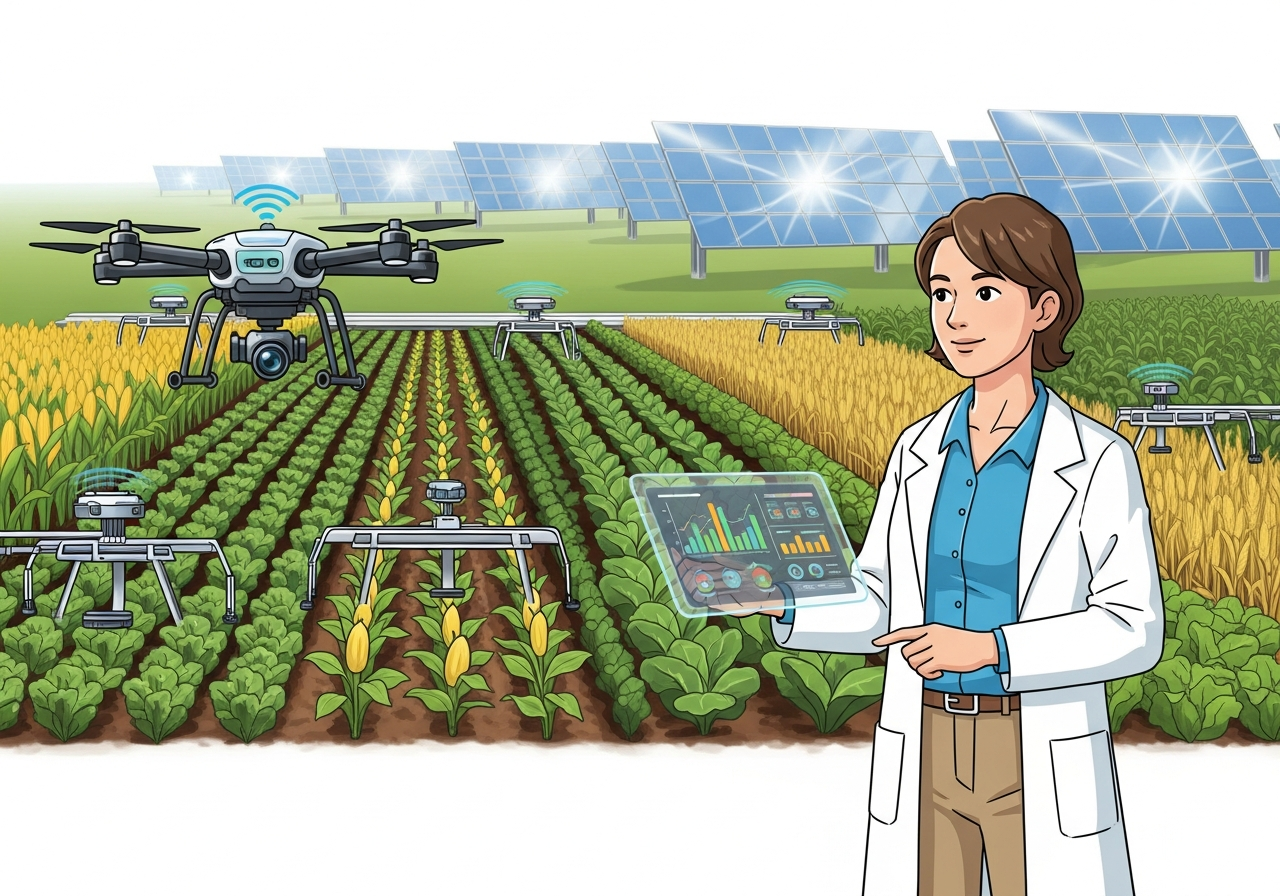
Lab-grown cultured meat is produced from animal cells in a laboratory without raising livestock, potentially reducing the environmental impact of food production. Precision agriculture uses GPS, sensors, and satellite data to apply exactly the right amount of water and fertilizer to each section of a field.
Key Terms and Definitions
Artificial Intelligence (AI): Computer systems that simulate human reasoning and learning, enabling machines to analyze data, recognize patterns, and make decisions independently. Example: AI systems that analyze medical images to detect disease.
Nanotechnology: The engineering of matter at the atomic or molecular scale, typically between 1 and 100 nanometres. Applications include targeted drug delivery, stronger materials, and more efficient electronics.
Renewable Energy: Energy that comes from naturally replenishing sources such as solar, wind, and hydropower, which do not produce harmful greenhouse gas emissions during operation.
Biotechnology: A field that harnesses living organisms or biological processes to create useful products, including medicines, genetically modified crops, and biofuels.
3D Printing (Additive Manufacturing): A technology that creates solid three-dimensional objects layer by layer from a digital design file, using materials such as plastic, metal, or biological cells.
CRISPR-Cas9: A gene-editing tool that acts like molecular scissors, cutting DNA at targeted sites to allow scientists to remove, add, or alter specific genes with great precision.
Shape-Memory Alloy: A metal alloy, such as Nitinol, that returns to its original pre-set shape when heated to a specific temperature. Used in medical stents and other devices.
Genome: The complete set of genetic instructions found in an organism the full blueprint of its genetic code, contained within DNA.
Prosthetic Device: An artificial device that replaces a lost or impaired body part, such as an arm or leg. 3D printing has made prosthetics faster and cheaper to produce.
Algorithm: A logical set of instructions that a computer executes to process information and perform tasks. Algorithms guide AI systems, 3D printers, and self-driving vehicles.
Internet of Things (IoT): A network of everyday physical devices connected to the internet that share data with each other, enabling smart homes, cities, and industries.
Virtual Reality (VR): A technology that creates a fully computer-generated environment that users can explore and interact with through immersive headset displays.
Augmented Reality (AR): A technology that overlays digital information such as images, text, or animations onto the real-world environment users currently see.
Quantum Computing: A computing technology that uses quantum bits (qubits), which can exist in multiple states simultaneously, allowing certain complex problems to be solved much faster than traditional computers.
Stem Cells: Unique biological cells that can develop into many different types of specialized body cells, making them valuable for repairing or replacing damaged tissues and organs.
Precision Agriculture: A farming approach that uses GPS, sensors, drones, and satellite data to monitor and manage crops with extreme accuracy, reducing waste and increasing yields.
Telemedicine: A healthcare technology that allows patients to consult with doctors remotely through video calls or messaging, improving access to medical care.
Bioremediation: The use of living organisms, such as specially engineered bacteria, to clean up environmental pollution such as plastic waste in oceans.
Applying Emerging Technologies to Real-World Problems
Students can deepen their understanding by connecting these technologies to real-world challenges. For example, learners can explore how Future Scenarios and Climate Predictions are influenced by carbon capture technology and renewable energy systems.
Analyzing how CRISPR might address genetic diseases, or how precision agriculture reduces water waste, helps students connect scientific concepts to global issues such as those explored in Human Impact and Anthropogenic Effects and Ecosystems, Sustainability, and Conservation Strategies.
Young scholars can also examine the design principles behind emerging technologies by connecting to Design Process and Advanced Problem-Solving and Materials Science, Properties and Applications.
Building on Prior Knowledge
This topic builds on several foundational concepts. Students who have studied Space Technology, Satellites and Exploration will recognize how satellite systems support GPS navigation and precision agriculture. Knowledge of Electrical Safety and Household Electricity provides context for understanding smart grids and IoT devices.
Understanding Energy Efficiency and Power Consumption is essential for appreciating why renewable energy technologies and smart energy management systems are so important. Learners who understand Electromagnetic Effects and Electromagnetism Principles will better understand how many electronic emerging technologies function at a fundamental level.
Related Topics and Connections
This topic sits at the center of a rich network of scientific concepts. The study of Scientific Models, Mathematical and Conceptual Models supports understanding of how AI systems and simulations are built and tested. Advanced Design and Complex Experimental Protocols connects to the engineering processes behind developing new technologies.
Emerging technologies directly inform environmental science. Students can explore these connections through Environmental Tech and Green Solutions and Generation Methods and Different Power Sources, which examine how clean energy technologies are developed and deployed.
This topic prepares students for more advanced study in Future Tech and Emerging Technologies, Modern Technology and Current Innovations, and Introduction to Space Exploration and Current Technologies. It also lays the groundwork for Systems Thinking and Integrated Solutions, Energy Resources, Renewable and Non-Renewable, Global Change and Environmental Effects, and Environmental Science, Sustainability, and Conservation Strategies.