TOPIC
Cell Components, Organelles and functionsMY PROGRESS
Pug Score
0%
Getting Started
"Let's build your foundation!"
Best Streak
0 in a row
Study Points
+0
Overview
Practice
Watch
Read
Quiz
Next Steps
Get Started
Get unlimited access to all videos, practice problems, and study tools.
BACK TO MENU
Topic Progress
Pug Score
0%
Getting Started
"Let's build your foundation!"
Videos Watched
0/0
Best Practice
No score
Read
Not viewed
Best Quiz
No attempts
Best Streak
0 in a row
Study Points
+0
Overview
Practice
Watch
Read
Quiz
Next Steps
Read
Discover Cell Organelles and Their Amazing Functions
You will learn about the key components and organelles inside cells, understanding what each structure does and how plant and animal cells differ from each other.
What Are Cell Organelles?
Every living thing is made of cells, and inside each cell are tiny structures called organelles. Think of a cell like a tiny city each organelle has a specific job that keeps the whole cell running. You will discover that understanding these structures connects directly to what you already know about Basic Principles and Fundamental Concepts of Cells.
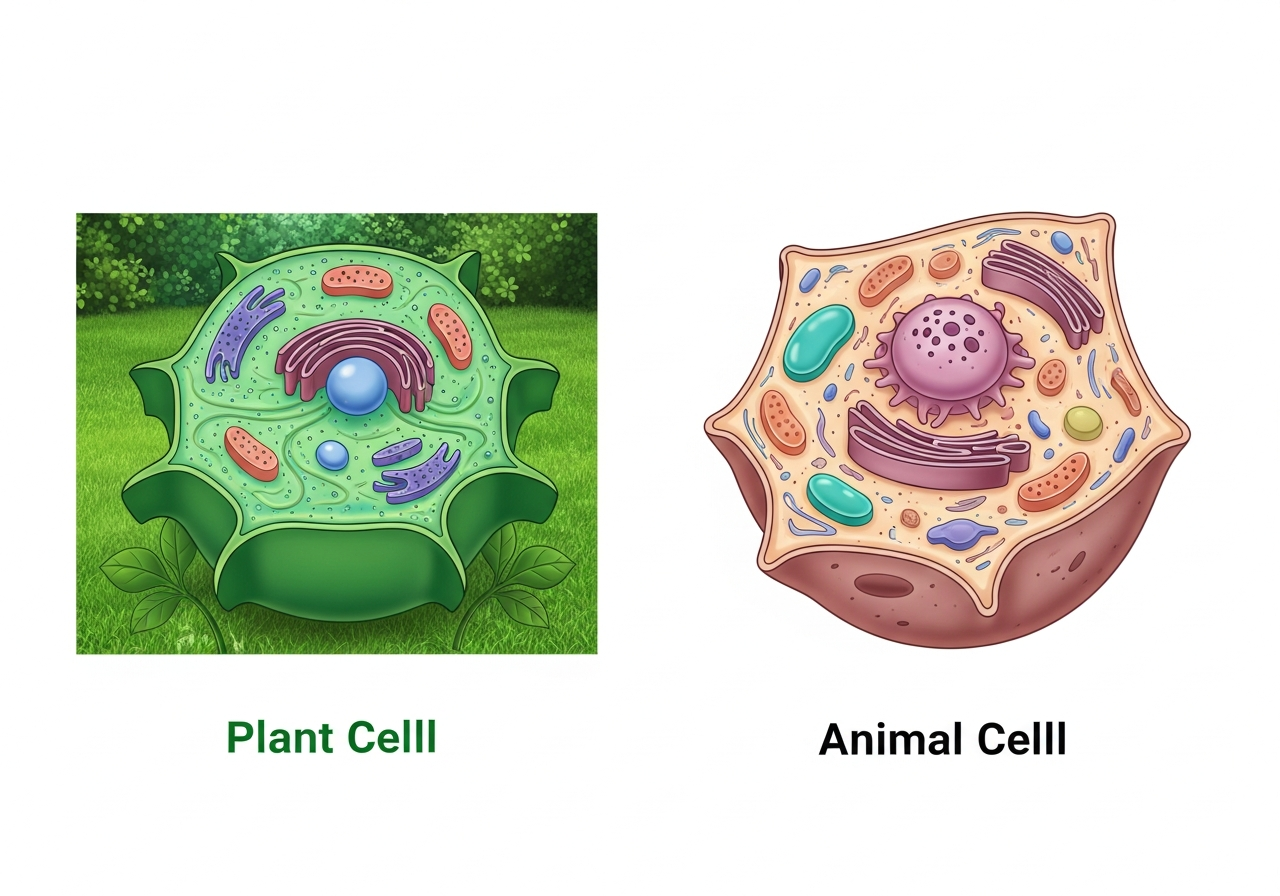
Cells come in two main types: plant cells and animal cells. Both share many organelles, but plant cells have some extra structures that animal cells do not. You can explore these differences further in Cell Types: Plant and Animal Cells.
Major Organelles and Their Functions
Here is a breakdown of the most important organelles you need to know:
The Nucleus Control Center
The nucleus is the cell's command center. It stores the cell's DNA (genetic information) and directs all cell activities. It is surrounded by a nuclear envelope (nuclear membrane), which protects the DNA and controls what enters and exits the nucleus through tiny pores. The nucleus communicates with the rest of the cell by sending out messenger RNA (mRNA), which carries instructions to ribosomes to build proteins.
Mitochondria Powerhouse of the Cell
The mitochondria are the sites of cellular respiration, where glucose and oxygen are converted into ATP the usable energy currency of the cell. Active cells like muscle cells have many more mitochondria because they need more energy. Both plant and animal cells contain mitochondria.
Chloroplasts Food Makers (Plant Cells Only)
Found only in plant cells, chloroplasts perform photosynthesis they use sunlight, water, and carbon dioxide to produce glucose. They contain chlorophyll, the green pigment that absorbs sunlight and gives plants their green color. If a plant cell lost all its chloroplasts, it could no longer make its own food.
Ribosomes Protein Builders
Ribosomes are tiny, membrane-free structures found floating in the cytoplasm or attached to the endoplasmic reticulum. They read mRNA instructions and assemble amino acids into proteins through a process called translation. Ribosomes are found in both prokaryotic and eukaryotic cells.
Endoplasmic Reticulum (ER) Transport Network
The endoplasmic reticulum is a network of folded membranes that acts as the cell's internal highway. Rough ER has ribosomes attached and helps make proteins, while smooth ER handles lipids. It transports materials throughout the cell.
Golgi Apparatus Post Office of the Cell
The Golgi apparatus receives proteins from the ER, modifies them, packages them into vesicles, and ships them to their destinations inside or outside the cell. It works like a postal service for the cell.
Lysosomes Recycling Centers
Lysosomes are membrane-bound sacs filled with digestive enzymes. They break down old organelles, bacteria, and waste materials, acting as the cell's cleanup and recycling system.
Vacuole Storage Compartment
The vacuole stores water, nutrients, and waste. In plant cells, the large central vacuole stores water and maintains turgor pressure, which keeps the plant firm. If the vacuole loses water, the plant wilts.
Cell Membrane The Gatekeeper
The cell membrane surrounds every cell and is selectively permeable it allows some substances to pass through while blocking others. This means it controls what enters and exits the cell, maintaining a stable internal environment.
Cell Wall Rigid Support (Plant Cells Only)
Found only in plant cells, the cell wall is made mostly of cellulose and provides rigid structural support. It surrounds the cell membrane and gives plant cells a fixed shape. Animal cells do not have a cell wall.
Cytoplasm The Fluid Interior
The cytoplasm is the gel-like fluid that fills the cell and holds all the organelles in place. It allows materials to move through the cell.
Comparing Plant and Animal Cells
You will find that plant and animal cells share the nucleus, cell membrane, mitochondria, ribosomes, endoplasmic reticulum, Golgi apparatus, and lysosomes. However, plant cells also have chloroplasts, a large central vacuole, and a cell wall structures not found in animal cells. Animal cells have centrioles, which help organize cell division, while most plant cells do not.
| Organelle | Plant Cell | Animal Cell |
|---|---|---|
| Nucleus | Yes | Yes |
| Cell Membrane | Yes | Yes |
| Mitochondria | Yes | Yes |
| Ribosomes | Yes | Yes |
| Cell Wall | Yes | No |
| Chloroplasts | Yes | No |
| Large Central Vacuole | Yes | No (small vacuoles only) |
| Centrioles | No | Yes |
You can deepen your understanding of how these cells function by exploring Cell Functions: Transport and Energy Production.
Key Terms and Definitions
Organelle: A tiny structure inside a cell that has a specific job, similar to how organs in your body each have a specific function.
Nucleus: The control center of the cell that contains DNA and directs all cell activities. It is surrounded by the nuclear envelope.
DNA (Deoxyribonucleic Acid): The genetic blueprint stored in the nucleus that carries instructions for all cell functions and is organized into chromosomes.
Mitochondria: The organelles where cellular respiration takes place, converting glucose into ATP energy. They are found in both plant and animal cells.
ATP (Adenosine Triphosphate): The usable energy currency of the cell, produced by mitochondria during cellular respiration.
Chloroplast: An organelle found only in plant cells that performs photosynthesis, using sunlight to make glucose from carbon dioxide and water.
Chlorophyll: The green pigment inside chloroplasts that absorbs sunlight and gives plants their green color.
Ribosome: A tiny, membrane-free organelle that builds proteins by reading mRNA instructions and linking amino acids together. This process is called translation.
Endoplasmic Reticulum (ER): A network of folded membranes that transports materials through the cell. Rough ER has ribosomes and makes proteins; smooth ER handles lipids.
Golgi Apparatus: The cell's post office it receives proteins from the ER, modifies them, packages them, and ships them to their destinations.
Lysosome: A membrane-bound sac containing digestive enzymes that break down old organelles, bacteria, and waste materials. It acts as the cell's recycling center.
Vacuole: A storage compartment in the cell. The large central vacuole in plant cells stores water and maintains turgor pressure to keep the plant firm.
Turgor Pressure: The internal pressure created by water stored in the central vacuole that keeps plant cells firm and upright.
Cell Membrane: A flexible, selectively permeable barrier surrounding every cell that controls what substances enter and exit the cell.
Selectively Permeable: A property of the cell membrane meaning it allows only certain substances to pass through while blocking others.
Cell Wall: A rigid outer layer made mostly of cellulose found only in plant cells. It surrounds the cell membrane and provides structural support and protection.
Cytoplasm: The gel-like fluid that fills the inside of the cell and holds all the organelles in place, allowing materials to move through the cell.
Protoplasm: A general term for all the living material inside a cell, including the cytoplasm and all the organelles suspended within it.
Nuclear Envelope (Nuclear Membrane): The double membrane surrounding the nucleus that protects the DNA and controls what molecules, such as mRNA, enter and exit the nucleus.
Messenger RNA (mRNA): A molecule produced by the nucleus that carries a copy of the DNA instructions out to ribosomes, where proteins are built.
Translation: The process by which ribosomes read mRNA instructions and assemble amino acids into proteins.
Photosynthesis: The process performed by chloroplasts in plant cells that uses sunlight, water, and carbon dioxide to produce glucose (food).
Cellular Respiration: The process performed by mitochondria that converts glucose and oxygen into ATP energy, releasing carbon dioxide as a byproduct.
Centriole: An organelle found in animal cells (but not most plant cells) that helps organize spindle fibers during cell division.
Chromosomes: Tightly coiled structures made of DNA found inside the nucleus that carry all the genetic information for an organism.
Practice and Apply Your Knowledge
You can strengthen your understanding by practicing questions that ask you to identify organelles, compare plant and animal cells, and explain what happens when an organelle is removed or damaged. For example, think about what would happen to a plant cell if all its chloroplasts were removed it could no longer perform photosynthesis and would lose its ability to make food.
You can also practice by connecting cell functions to body systems you have already studied, such as how Gas Exchange: Breathing and Cellular Respiration relates to the work mitochondria do inside your cells every second.
What You Should Already Know
Before diving into cell organelles, you should be familiar with the Cells to Systems: Hierarchical Organization of Life, which shows you how cells build up into tissues, organs, and organ systems. You should also have some background in how body systems work, including Heart Function: Cardiac Cycle and Circulation, Digestion Process: Mechanical and Chemical Breakdown, Nutrient Absorption: Transport of Nutrients, Blood and Vessels: Structure and Function, and System Integration: Connection Between Systems. All of these topics show you why cells need organelles like mitochondria to power the work of every system in your body.
Related Topics and Connections
This topic sits at the heart of a larger web of science concepts. Here is how it connects to what you have learned and what you will learn next:
Building on Foundations: You already explored Basic Principles: Fundamental Concepts of Cells, which introduced you to what cells are and why they matter. This topic takes you deeper into the internal machinery of those cells.
Expanding to Cell Types: Once you understand organelles, you can compare them across Cell Types: Plant and Animal Cells and see exactly which structures each type has and why.
Understanding Cell Work: Organelles do not just exist they perform tasks. You will explore how they carry out those tasks in Cell Functions: Transport and Energy Production.
Connecting to Classification: Understanding cell structure also connects to Taxonomy Systems: Kingdoms and Classification Criteria and Species Diversity: Biodiversity Measurements, since scientists use cell structure to classify organisms into kingdoms.
Evolution Connections: Cell organelles also appear in discussions of Evidence of Change: Fossil Record and Similarities and Natural Selection: Adaptation and Survival, where scientists compare cell structures across species to understand evolutionary relationships.
Looking Ahead: Mastering cell organelles prepares you for Genetic Variation: Sources of Diversity, where you will learn how the nucleus and DNA drive variation between organisms, and Comparative Biology: Anatomical and Genetic Evidence, where you will compare organisms at the cellular and genetic level.