TOPIC
Heart Function, Cardiac cycle and circulationMY PROGRESS
Pug Score
0%
Getting Started
"Let's build your foundation!"
Best Streak
0 in a row
Study Points
+0
Overview
Practice
Watch
Read
Quiz
Next Steps
Get Started
Get unlimited access to all videos, practice problems, and study tools.
Back to Menu
Topic Progress
Pug Score
0%
Getting Started
"Let's build your foundation!"
Videos Watched
0/0
Best Practice
No score
Read
Not viewed
Best Quiz
No attempts
Best Streak
0 in a row
Study Points
+0
Overview
Practice
Watch
Read
Quiz
Next Steps
Read
Discover How Your Heart Pumps Blood Through Your Body
You will learn how your heart pumps blood through your body using a repeating cycle of contracting and relaxing, delivering oxygen and nutrients to every cell.
How Your Heart Works as a Pump
Your heart is a powerful muscular organ that pumps blood through your entire body every single minute of your life. Its main job is to deliver oxygen and nutrients to every cell and remove waste products like carbon dioxide. You can think of your heart as the engine of your circulatory system.
Your heart is divided into four chambers. The two upper chambers are called the atria (singular: atrium), and the two lower chambers are called the ventricles. The right atrium and left atrium collect blood, while the right ventricle and left ventricle pump blood out.
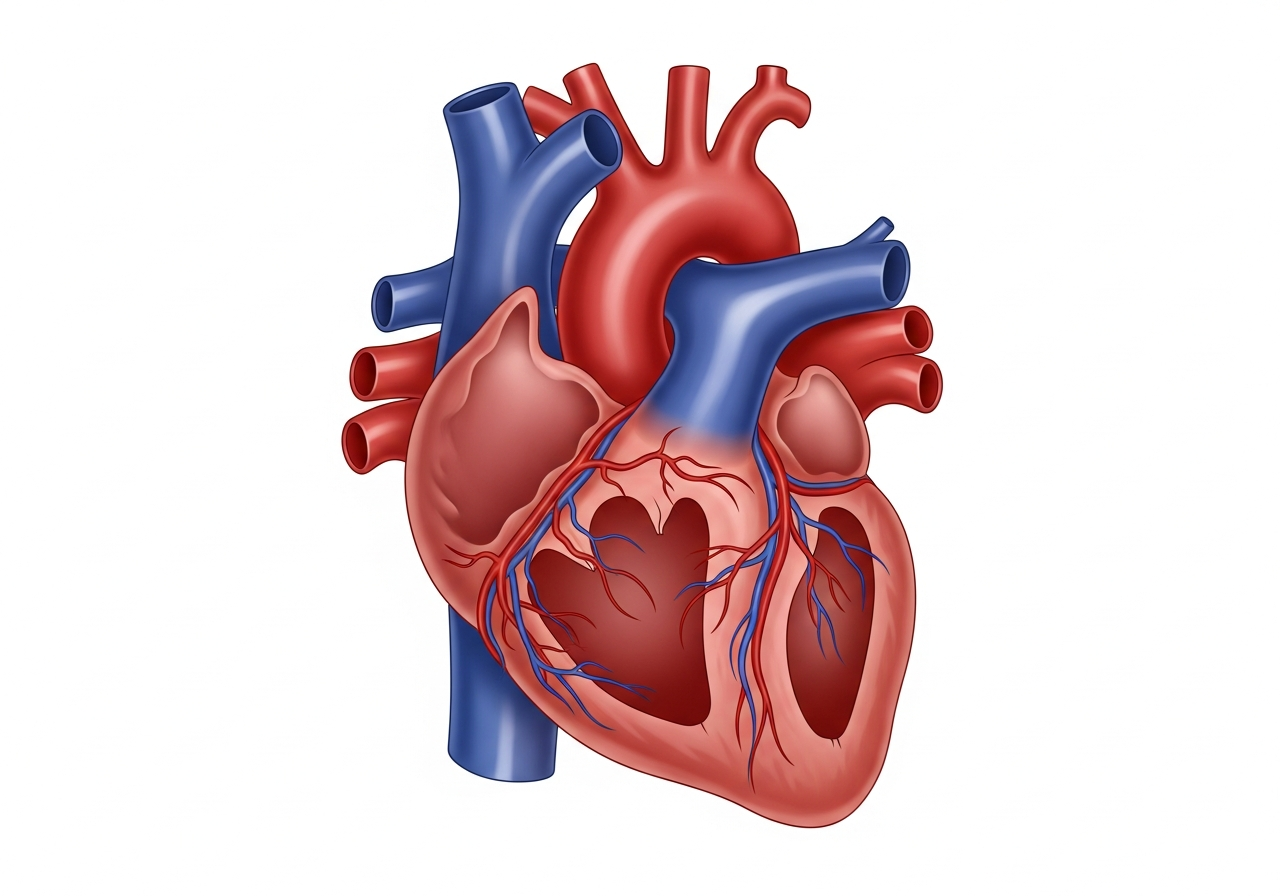
A thick wall of muscle called the septum divides the left and right sides of the heart, keeping oxygen-rich blood and oxygen-poor blood completely separate. The left ventricle has thicker, more muscular walls than the right ventricle because it must pump blood all the way to your entire body with great force.
The Cardiac Cycle: Systole and Diastole
Every time your heart beats, it goes through a complete sequence of events called the cardiac cycle. This cycle has two main phases that repeat continuously throughout your life.
During systole, your heart muscle contracts and squeezes blood out of the chambers into the blood vessels. During diastole, your heart muscle relaxes and the chambers refill with blood, getting ready for the next contraction.
Your heart also makes a familiar "lub-dub" sound with every beat. This sound is caused by your heart valves snapping shut. The first sound ("lub") happens when the valves between the atria and ventricles close. The second sound ("dub") happens when the valves at the exit of the ventricles close. Valves act like one-way doors that keep blood flowing in only one correct direction and prevent backflow.
Your pulse is the rhythmic throbbing you can feel in your wrist or neck each time your heart beats. A healthy resting heart rate for a child is between 70 and 100 beats per minute. When you exercise, your heart rate increases so your muscles receive more oxygen-rich blood.
Two Loops of Circulation
Your blood travels through two connected loops. Pulmonary circulation is the loop that carries blood from the right side of your heart to your lungs and back. In the lungs, blood drops off carbon dioxide and picks up fresh oxygen.
Systemic circulation is the larger loop that carries oxygen-rich blood from the left side of your heart through the aorta the largest artery in your body to all your organs and tissues, then returns oxygen-poor blood back to the right side of your heart through the vena cava, the largest vein.
The pulmonary artery is unique because it is the only artery that carries oxygen-poor blood, transporting it from the right ventricle to the lungs. The human circulatory system is called a "closed" system because blood always stays inside the heart and blood vessels.
Blood pressure is the force that blood pushes against the walls of your arteries as your heart pumps. Your heart rate and blood pressure both change based on what your body needs at any moment.
Key Terms and Definitions
Arteries: Arteries are blood vessels that carry blood away from your heart to the rest of your body. A helpful memory trick is that "artery" and "away" both start with the letter A. Arteries have thick, muscular walls to handle the high pressure of blood pumped directly from your heart.
Veins: Veins are blood vessels that carry blood back toward your heart after it has delivered oxygen and nutrients to your body's cells. Veins have thinner walls than arteries and often contain valves to help blood flow against gravity.
Capillaries: Capillaries are the smallest and thinnest blood vessels in your body, with walls only one cell thick. This thinness allows oxygen, nutrients, and carbon dioxide to pass easily between your blood and surrounding tissues. Capillaries connect arteries to veins.
Plasma: Plasma is the yellowish liquid portion of your blood that transports everything dissolved in it, including nutrients, hormones, and waste products. It makes up the majority of your blood's volume.
Valves: Valves are flap-like structures inside your heart that open to let blood flow forward and close to stop it from flowing backward. They ensure blood always moves in the correct direction through your heart's chambers.
Atria: The atria (singular: atrium) are the two upper chambers of your heart. The right atrium receives oxygen-poor blood returning from your body, and the left atrium receives oxygen-rich blood from your lungs.
Ventricles: The ventricles are the two lower chambers of your heart that pump blood out. The right ventricle pumps blood to the lungs, and the left ventricle pumps oxygen-rich blood out to your entire body.
Cardiac cycle: The cardiac cycle is the complete sequence of events that happens each time your heart beats, including the contraction phase (systole) and the relaxation phase (diastole). This cycle repeats continuously throughout your life.
Systole: Systole is the contraction phase of the cardiac cycle, during which your heart muscle squeezes and pushes blood out of the chambers into the blood vessels.
Diastole: Diastole is the relaxation phase of the cardiac cycle, during which your heart muscle relaxes and the chambers fill with blood in preparation for the next contraction.
Pulse: Your pulse is the rhythmic throbbing you can feel in your arteries each time your heart beats and pushes blood through them. You can feel your pulse at your wrist or neck, and it tells you your heart rate in beats per minute.
Aorta: The aorta is the largest artery in your body. It exits from your left ventricle and carries oxygen-rich blood out to your entire body.
Vena cava: The vena cava is the largest vein in your body. It returns oxygen-poor blood from all over your body back to the right atrium of your heart.
Pulmonary artery: The pulmonary artery carries oxygen-poor blood from your right ventricle to your lungs, where the blood will pick up fresh oxygen. It is the only artery in your body that carries oxygen-poor blood.
Septum: The septum is a thick wall of muscle that divides the left and right sides of your heart, keeping oxygen-rich blood and oxygen-poor blood from mixing.
Hemoglobin: Hemoglobin is a protein found inside your red blood cells that binds to oxygen in the lungs and releases it to cells throughout your body. It gives blood its bright red color.
Blood pressure: Blood pressure is the force that your circulating blood exerts on the walls of your arteries as your heart pumps. It is recorded as two numbers representing pressure during heartbeats and between heartbeats.
Practice Activities: Test Your Understanding
You can check your understanding of the cardiac cycle by tracing the path of a single drop of blood through both pulmonary and systemic circulation. Start at the right atrium and follow it all the way through both loops back to the starting point.
You can also practice identifying the phases of the cardiac cycle by placing your hand on your chest and feeling the "lub-dub" rhythm. Try counting your pulse at rest, then after light activity, to observe how your heart rate connects to your breathing and gas exchange.
Challenge yourself to label a diagram of the heart with all four chambers, the septum, the major valves, the aorta, the vena cava, and the pulmonary artery and vein. This will help you connect structure to function across the integrated body systems you are studying.
Building on What You Already Know
Before exploring the circulatory system, you studied Sensory Systems and the Five Senses. Just as your sensory organs collect information and send signals through your nervous system, your heart collects blood and sends it through your blood vessels. Both systems rely on specialized structures working together to keep your body functioning.
You have also explored Cells to Systems: Hierarchical Organization of Life, which shows you how individual cells combine into tissues, organs, and organ systems. Your heart is a perfect example of this organization muscle cells form the heart wall, which pumps blood to every cell in your body.
Related Topics and Connections
Your understanding of heart function connects directly to several important topics. In Blood and Vessels: Structure and Function, you will explore the detailed structure of arteries, veins, and capillaries and how they work alongside your heart to move blood efficiently.
The circulatory system works closely with the respiratory system. In Gas Exchange: Breathing and Cellular Respiration, you will discover exactly how oxygen enters your blood in the lungs and how carbon dioxide is removed the process that makes pulmonary circulation essential.
In System Integration: Connection Between Systems, you will see how the circulatory system teams up with the digestive, respiratory, and other body systems to keep you healthy and active.
The circulatory system also plays a key role in delivering the nutrients your digestive system processes. In Nutrient Absorption: Transport of Nutrients, you will learn how nutrients absorbed from food enter your bloodstream and are carried to cells. This connects to Digestion Process: Mechanical and Chemical Breakdown, where food is broken down before nutrients can be transported.
Energy is central to why your circulatory system works so hard. In Energy Conversion: Transformation Between Forms and Energy Flow: Food Webs and Energy Pyramids, you will explore how energy moves through living systems, which depends on the oxygen and nutrients your blood delivers.
This topic also prepares you for more advanced cell biology. In Cell Functions: Transport and Energy Production, you will learn how individual cells use the oxygen and nutrients delivered by your blood. You will also explore Cell Components: Organelles and Functions and Basic Principles: Fundamental Concepts of Cells, which build on your understanding of how the circulatory system supports life at the cellular level.