TOPIC

Changes Over Time, Rapid and slow changes

MY PROGRESS

Pug Score

0%

Getting Started

"Let's build your foundation!"

Best Streak

0 in a row

Study Points

+0

Overview

Practice

Watch

Read

Quiz

Next Steps


Get Started

Get unlimited access to all videos, practice problems, and study tools.

Unlimited practice
Full videos

BACK TO MENU

Topic Progress

Pug Score

0%

Getting Started

"Let's build your foundation!"

Videos Watched

0/0

Best Practice

No score

Read

Not viewed

Best Quiz

No attempts


Best Streak

0 in a row

Study Points

+0

Overview

Practice

Watch

Read

Quiz

Next Steps

Read

Rapid and Slow Changes: How Earth's Landforms Are Always Changing

You will learn how Earth's landforms change over time through rapid events like volcanic eruptions and slow processes like erosion and weathering, and discover how natural forces constantly reshape our planet's surface.

What Are Landforms and How Do They Change?

A landform is a natural shape or feature found on Earth's surface. Mountains, valleys, plains, canyons, and plateaus are all landforms. You can also explore Types of Landforms: Mountains, Valleys, Plains to learn more about these features.

Earth's surface is always changing! Some changes happen very quickly, and some take thousands or even millions of years. Scientists group these into two types: rapid changes and slow changes.
Rapid Changes to Earth's Surface

A rapid change happens very quickly in seconds, minutes, hours, or days. These changes can dramatically reshape the land in a short time.

  • Volcanic eruption: Lava flows out of a volcano and cools to form solid rock, creating new land. This is one of the fastest ways new landforms are built.
  • Earthquake: The ground shakes and cracks suddenly, shifting Earth's surface in seconds or minutes.
  • Flood: Heavy rain causes water to quickly cover and reshape large areas of land, washing away soil and depositing mud in new places.
  • Landslide: Heavy rain or shaking causes rocks and soil to slide rapidly down a slope all at once.
  • Avalanche: Snow and ice suddenly release and rush down a slope in seconds.
  • Tsunami: An underwater earthquake triggers giant waves that strike the coast in hours, causing sudden dramatic changes to the land.

You can connect these ideas to Formation Processes: Erosion, Deposition, Weathering to see how rapid events work alongside slower processes.

Slow Changes to Earth's Surface

A slow change takes a very long time hundreds, thousands, or even millions of years. You might not notice these changes happening, but over time they can completely reshape the land.

  • Weathering: Rocks are slowly broken down into smaller pieces by wind, water, ice, and temperature changes over a long period of time.
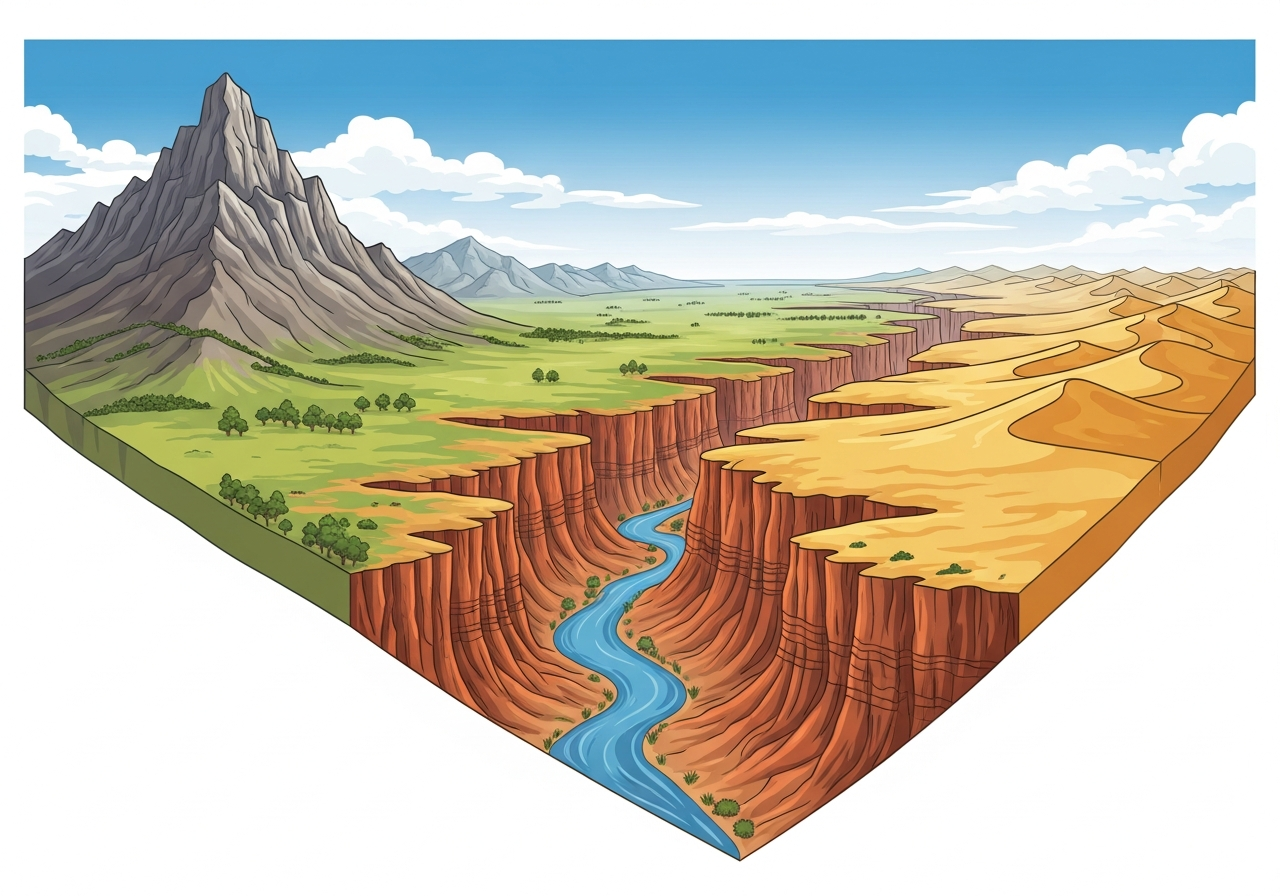
  • Erosion: Wind or water carries away pieces of rock and soil from one place to another. A river wearing away rock to form a canyon is a great example.
  • Deposition: Wind or water slows down and drops the soil and rocks it was carrying in a new place, building up landforms like river deltas and sand dunes.
  • Glacier movement: A glacier is a huge, slow-moving mass of ice that carves out valleys and pushes rocks as it slides along over thousands of years.
  • Ice wedging: Water seeps into cracks in rocks, freezes, expands, and slowly splits the rock apart over many years. This is also called freeze-thaw weathering.

You can learn more about how these processes work together by visiting Formation Processes: Erosion, Deposition, Weathering.

How Landforms Are Created and Worn Away

Volcanoes create new land when lava cools into solid rock. Some islands, like Hawaii, were formed this way! Meanwhile, wind and water slowly wear away mountains through weathering and erosion over millions of years.

Plant roots help prevent rapid changes by holding soil in place so wind and water cannot easily carry it away. When humans cut down trees, erosion speeds up because the soil loses its natural protection. You can explore this further in Resource Use: Effects on Environment and Conservation: Protection Strategies.

Key Terms and Definitions

Landform: A landform is a natural shape or feature found on Earth's surface, such as a mountain, valley, plain, or canyon. Landforms are created by natural forces, not by people.

Rapid change: A rapid change is a change to Earth's surface that happens very quickly in seconds, minutes, hours, or days. Examples include volcanic eruptions, earthquakes, floods, landslides, avalanches, and tsunamis.

Slow change: A slow change is a change to Earth's surface that takes a very long time hundreds, thousands, or millions of years. Examples include weathering, erosion, deposition, and glacier movement.

Weathering: Weathering is the breaking down of rocks into smaller pieces over a long time by forces like wind, water, ice, and temperature changes. It is one of the main ways Earth's surface changes slowly.

Erosion: Erosion is the process of wind or water moving soil and rock away from one place to another. A river slowly wearing away rock to form a canyon is a great example of erosion.

Deposition: Deposition happens when wind or water slows down and drops the soil and rocks it was carrying in a new place. Deposition can create new landforms like river deltas and sand dunes.

Glacier: A glacier is a huge, slow-moving mass of ice that flows over land. As it moves, it carves out valleys and pushes rocks, shaping the land over thousands of years.

Ice wedging: Ice wedging is when water seeps into cracks in rocks, freezes, expands, and slowly pushes the rock apart over many years. This is also called freeze-thaw weathering.

Avalanche: An avalanche is a rapid change where snow and ice suddenly release and rush down a slope in seconds.

Tsunami: A tsunami is a rapid change triggered by an underwater earthquake. Giant waves travel across the ocean and strike the coast, causing sudden dramatic changes to the land.

Flood: A flood is a rapid change where heavy rain causes water to quickly cover large areas of land, washing away soil and depositing mud in new places within hours.

Landslide: A landslide is a rapid change where rocks and soil suddenly slide down a slope all at once, often caused by heavy rain or an earthquake.

Canyon: A canyon is a deep, narrow valley with steep rocky walls, usually carved slowly by a river over thousands of years. The Grand Canyon is a famous example.

Delta: A delta is a landform made of soil and sediment deposited where a river meets a larger body of water like a sea or ocean. Deltas build up slowly through deposition.

Plateau: A plateau is a large, flat area of land that stands high above the surrounding ground. It is elevated like a mountain but has a flat top instead of a peak.

Sand dunes: Sand dunes are hills of sand formed when wind slowly blows and piles up sand over a long period of time. They are a great example of a slow change caused by wind.

Mountain: A mountain is a very tall landform that rises steeply high above the land around it. Mountains are among the highest and most dramatic landforms on Earth.

Valley: A valley is a low area of land that sits between hills or mountains on both sides. Valleys are often formed by rivers or glaciers carving through the land.

Plain: A plain is a large, flat area of land that stretches out wide and level across the ground. Plains are often used for farming because of their flat, open surface.

Practice What You Know

You can practice telling the difference between rapid and slow changes by thinking about how long each event takes. Ask yourself: Does this happen in seconds or hours? That is a rapid change. Does it take thousands of years? That is a slow change.

You can also connect your learning to Data Analysis: Patterns and Relationships and Investigation Design: Controlled Experiments to practice observing and recording how Earth changes over time.

What You Already Know That Helps

Before learning about rapid and slow changes, you explored some important topics that connect to this one. You learned about Weather Impact: Effects on Earth's Surface, which shows how weather forces like rain and wind shape the land. You also studied the Water Cycle: Evaporation, Condensation, Precipitation, which explains how water moves through the environment and causes erosion and flooding.

You explored Weather Patterns: Seasonal Weather Changes and Environmental Changes: Local Ecosystem Effects, which help you understand how natural forces affect the land around you over time.

Related Topics and Connections

This topic connects to many other important science ideas. You can explore Rocks and Minerals: Properties and Classification to understand what landforms are made of, and Soil Composition: Components and Properties to learn about the material that erosion and deposition move around.

You can also study Weather Patterns: Long-Term Weather Trends and Seasonal Changes: Earth's Tilt and Orbit to see how weather and seasons drive slow changes over time. Learning about Traditional Practices: Resource Management and Sustainable Practices and Environmental Knowledge: Local Ecosystem Understanding will show you how people work with and protect the land.

For measurement and investigation skills, check out Variable Control: Independent and Dependent Variables and Measurement: Standard Units and Precision. These skills help scientists study how fast or slow Earth changes.

This topic prepares you for more advanced ideas like Surface Features: Mountains, Valleys, Oceans and Internal Structure: Layers of the Earth, where you will discover what is happening deep inside our planet to drive these changes.