TOPIC
Formation Processes, Erosion, deposition, weatheringMY PROGRESS
Pug Score
0%
Getting Started
"Let's build your foundation!"
Best Streak
0 in a row
Study Points
+0
Overview
Practice
Watch
Read
Quiz
Next Steps
Get Started
Get unlimited access to all videos, practice problems, and study tools.
BACK TO MENU
Topic Progress
Pug Score
0%
Getting Started
"Let's build your foundation!"
Videos Watched
0/0
Best Practice
No score
Read
Not viewed
Best Quiz
No attempts
Best Streak
0 in a row
Study Points
+0
Overview
Practice
Watch
Read
Quiz
Next Steps
Read
Weathering, Erosion, and Deposition: How Earth's Surface Changes
You will learn how weathering breaks down rocks, erosion moves them, and deposition builds new landforms three key processes that constantly change Earth's surface.
How Do Landforms Form? Weathering, Erosion, and Deposition
Have you ever wondered how mountains get shorter or how canyons get carved so deep? Earth's surface is always changing because of three powerful processes: weathering, erosion, and deposition. You can learn about Types of Landforms: Mountains, Valleys, and Plains to see the amazing shapes these processes create.
These changes can happen very slowly over millions of years, or very quickly like a landslide that moves rock and soil in seconds. Understanding these processes helps you understand why Earth looks the way it does today.
What Is Weathering?
Weathering is the process of breaking rocks into smaller pieces over time. It is the first step in changing the land. Weathering does not move the pieces it just breaks them apart.
There are two main types of weathering you should know:
- Physical weathering (also called mechanical weathering): Rocks are broken into smaller pieces without changing what they are made of. A great example is ice wedging when water seeps into cracks in a rock and freezes, it expands and splits the rock apart. Wind blowing sand against rocks (called abrasion) is another example. Tree roots growing into cracks and pushing rocks apart is also physical weathering.
- Chemical weathering: The rock actually changes its makeup. For example, acid in rainwater can slowly dissolve the surface of limestone, changing the rock itself.
Over millions of years, weathering can wear a tall mountain down into a shorter, rounder shape. The Appalachian Mountains are much older and shorter than the Rocky Mountains because of this!
What Is Erosion?
After weathering breaks rocks apart, erosion picks up those broken pieces and carries them to a new place. Wind, water, and ice are the main agents of erosion.
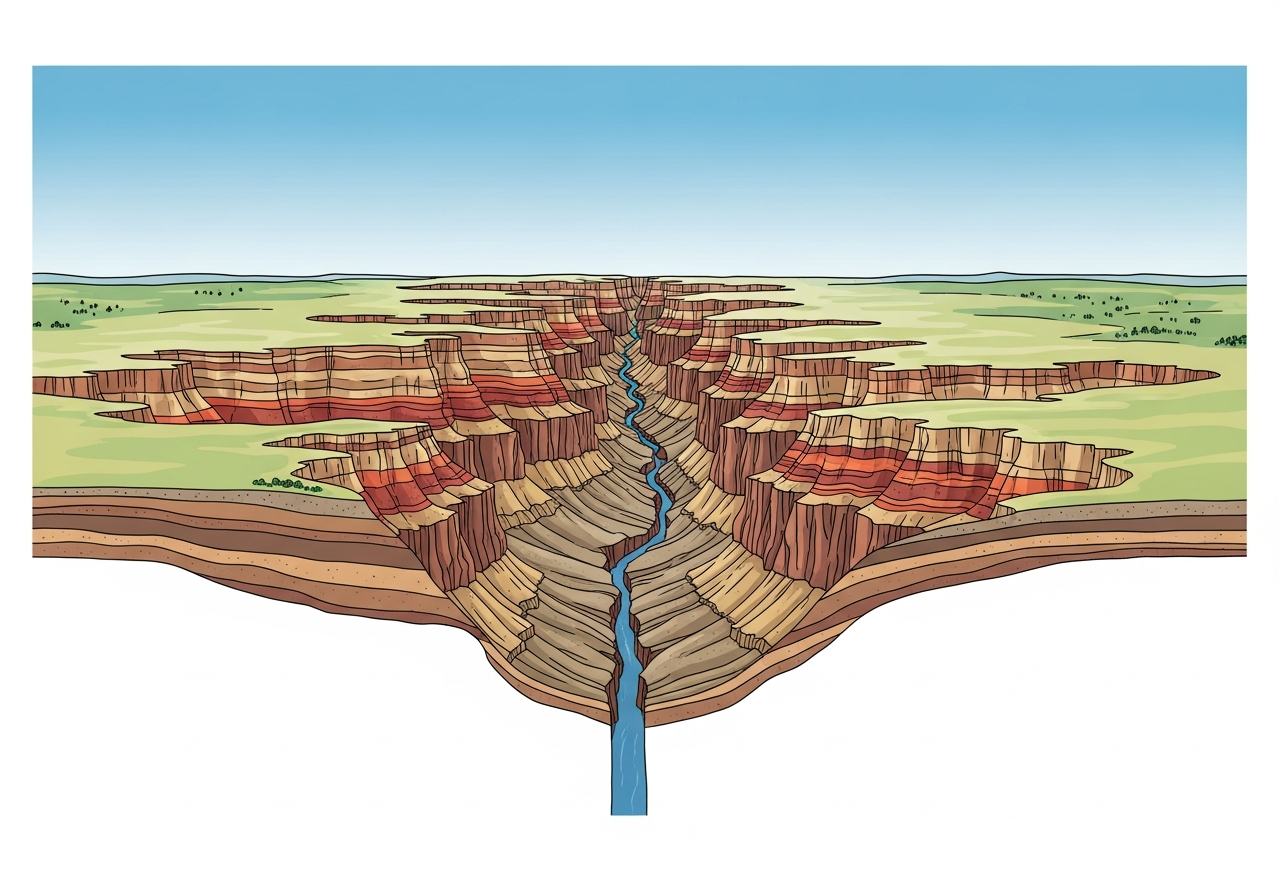
- Water erosion: When rain falls on a hillside, it flows downhill and carries soil and small rocks away. Over a very long time, a river can carve a deep canyon. The Colorado River carved the Grand Canyon over about five to six million years!
- Wind erosion: Wind picks up dry, loose sand and moves it from place to place. This is common in deserts and along beaches.
- Glacial erosion: A glacier is a large, slow-moving body of thick ice and snow. As it moves, it scrapes and carves the land beneath it, creating wide, U-shaped valleys.
Erosion happens faster on land without plants or grass because there are no roots to hold the loose soil in place. Plant roots act like anchors, holding soil together so wind and water cannot carry it away as easily.
What Is Deposition?
Deposition is the last step. It happens when wind or water slows down and drops the sediment it has been carrying. Sediment is the name for the small pieces of rock, sand, and soil that are moved during erosion.
Deposition can build brand-new landforms! Here are some examples:
- A delta forms when a river slows down as it enters a larger body of water and drops its sediment. This builds up a flat, fan-shaped landform. The Nile River delta in Egypt is a famous example.
- Sand dunes are built when wind drops sand in one spot after eroding it from another area.
- A point bar (a sandy area) builds up on the inside of a river curve where water moves slower and drops its sediment.
You can explore how these changes connect to Changes Over Time: Rapid and Slow Changes to understand which changes happen quickly and which take millions of years.
Key Terms & Definitions
Weathering: The process of breaking rocks into smaller pieces over time through wind, water, ice, or living things. Weathering does not move the pieces it only breaks them apart. It is the first step in changing Earth's surface.
Erosion: The movement of broken rock and soil to a new place by wind, water, or ice. Weathering breaks the rock apart first, and then erosion moves those pieces away.
Deposition: The dropping of sediment in a new location by wind or water. When the agent of erosion slows down, it can no longer carry its load and drops it this is deposition. It can build new landforms like deltas and sand dunes.
Sediment: The small pieces of rock, sand, silt, and soil that are picked up and moved by wind or water during erosion. When water or wind slows down, sediment is deposited in a new location. Over time, layers of sediment can build up to form new landforms.
Landform: A natural shape or feature found on Earth's surface, such as a mountain, valley, canyon, plain, or hill. Landforms are not made by people they are shaped by natural forces like weathering, erosion, and deposition.
Physical (Mechanical) Weathering: A type of weathering that breaks rocks into smaller pieces without changing their chemical makeup. Examples include ice wedging, abrasion by sand, and roots breaking rocks apart.
Chemical Weathering: A type of weathering where substances like acid in rainwater react with rock and actually change its composition. Limestone is especially vulnerable to this process.
Ice Wedging: A type of physical weathering where water seeps into cracks in a rock, freezes, expands, and splits the rock into smaller pieces. Over many freeze-thaw cycles, this can break large boulders into many smaller pieces.
Glacier: A large, slow-moving body of thick ice and snow. As a glacier moves, it scrapes and carves the land beneath it, creating wide, U-shaped valleys through glacial erosion.
Canyon: A deep, narrow valley carved by a river over a very long time. The Grand Canyon in Arizona is one of the most famous canyons in the world it is a classic example of water erosion creating a landform.
Delta: A flat, fan-shaped landform that forms when a river slows down as it enters a larger body of water and drops its sediment. The Nile River delta in Egypt is a well-known example.
Sand Dune: A mound of sand built up when wind picks up dry, loose sand and deposits it in one place. Sand dunes are common in deserts and along beaches.
Valley: A low area of land located between hills or mountains. Valleys are often formed by rivers cutting through the land or by glaciers carving out rock. River valleys are V-shaped, while glacier valleys are U-shaped.
Plain: A large, flat area of land with very few hills. Plains are great for farming because of their level surface and fertile soil. The Great Plains in the central United States is a well-known example.
Hill: A raised area of land that is smaller and more rounded than a mountain. Hills rise gently above the land around them.
Plateau: A large, flat area of land raised high above the surrounding ground like a table rising from the land. It is different from a plain, which is low and flat.
Practice What You Know
You can test your understanding by thinking about these questions: What would happen to a hillside if all the plants were removed? How does a river change the land over millions of years? Can you name one example of deposition creating a new landform?
You can also connect this topic to Rocks and Minerals: Properties and Classification and Soil Composition: Components and Properties to understand what sediment is made of and how soil forms from weathered rock.
What You Already Know That Helps
You have already learned about Weather Impact: Effects on Earth's Surface and Weather Patterns: Seasonal Weather Changes, which show you how rain, wind, and temperature affect the land. These connect directly to how water and wind cause weathering and erosion.
Your knowledge of the Water Cycle: Evaporation, Condensation, and Precipitation helps you understand where the water that causes erosion comes from. You also learned about Gravitational Forces: Effects on Objects, which explains why eroded material moves downhill. Understanding Environmental Changes: Local Ecosystem Effects and Natural Resources: Renewable vs. Non-Renewable helps you see how erosion affects the environment and the resources we depend on.
Related Topics & Connections
This topic connects to many other important science ideas. Here is how they all fit together:
- Types of Landforms: Mountains, Valleys, and Plains You will recognize the landforms that weathering, erosion, and deposition create, like mountains, valleys, and plains.
- Changes Over Time: Rapid and Slow Changes You will compare fast changes (like landslides) with slow changes (like a river carving a canyon) to understand how Earth's surface shifts over different timescales.
- Rocks and Minerals: Properties and Classification You will learn what rocks are made of and how weathering breaks them down into sediment.
- Soil Composition: Components and Properties You will discover that soil is partly made of weathered rock and sediment deposited over time.
- Resource Use: Effects on Environment You will see how human activities can speed up erosion and affect natural resources.
- Conservation: Protection Strategies You will learn how planting trees and grass helps prevent soil erosion and protect the land.
- Surface Features: Mountains, Valleys, and Oceans This topic builds on what you learn here, exploring Earth's surface features in even more detail.
- Internal Structure: Layers of the Earth You will go deeper and learn what is inside Earth, connecting surface changes to forces below the ground.
- Matter Cycles: Water, Carbon, and Nitrogen Cycles You will see how the movement of water connects to the water cycle and other matter cycles on Earth.