TOPIC
Perpendicular line proofsMY PROGRESS
Pug Score
0%
Getting Started
"Let's build your foundation!"
Study Points
+0
Overview
Watch
Read
Next Steps
Get Started
Get unlimited access to all videos, practice problems, and study tools.
Back to Menu
Topic Progress
Pug Score
0%
Getting Started
"Let's build your foundation!"
Videos Watched
0/0
Read
Not viewed
Study Points
+0
Overview
Watch
Read
Next Steps
Read
Mastering Perpendicular Lines in Geometry
Introduction to Parallel Lines and Transversals
Welcome to the fascinating world of geometry! Today, we're diving into the concept of parallel lines and transversals. Parallel lines are two or more lines that never intersect, no matter how far they extend. A transversal is a line that crosses these parallel lines, creating interesting angles and relationships. Our introduction video is a great starting point to visualize these concepts. It demonstrates how transversals create corresponding angles, alternate interior angles, and alternate exterior angles when intersecting parallel lines. Understanding these relationships is crucial for solving more complex geometric problems. As we explore this topic, you'll discover how these seemingly simple lines form the foundation for many geometric principles. The video will help you grasp these concepts visually, making it easier to apply them in various mathematical scenarios. Let's embark on this geometric journey together and unravel the mysteries of parallel lines and transversals!
Understanding Parallel Lines and Their Properties
Parallel lines are a fundamental concept in geometry that plays a crucial role in understanding linear equations and various real-world applications. These lines are unique in that they maintain a constant distance from each other and never intersect, no matter how far they extend. Let's dive deeper into the fascinating world of parallel lines and explore their properties and relationship to linear equations.
To begin, imagine two straight lines drawn on a piece of paper that never meet, no matter how far you extend them. These are parallel lines. In mathematical notation, we often use the symbol "||" to denote parallel lines. For example, we might write "Line A || Line B" to indicate that Line A is parallel to Line B.
One of the key properties of slope of a line is that they have the same slope. The slope of a line represents its steepness or incline, and it's a crucial concept in both geometry and algebra. For parallel lines, this shared slope means they rise or fall at the same rate. This property is essential when working with linear equations, as we'll see shortly.
Another important characteristic of parallel lines is that they maintain a constant distance between them. This distance, often called the "perpendicular distance," remains the same no matter where you measure it along the lines. This property is what ensures that parallel lines never intersect, even if extended infinitely.
When it comes to linear equations, parallel lines have a special relationship. In the standard form of a linear equation (y = mx + b), the 'm' represents the slope of the line. For parallel lines, the 'm' values in their respective equations will be identical. For instance, the lines represented by y = 2x + 3 and y = 2x - 5 are parallel because they both have a slope of 2.
It's worth noting that parallel lines are distinct from intersecting lines. While parallel lines never meet, intersecting lines cross at a single point. This difference is crucial in various geometric proofs and problem-solving scenarios. Visualize two roads: parallel lines would be like two straight highways that never meet, while intersecting lines would be like two streets that cross at an intersection.
In geometry, parallel lines often appear in shapes and figures. For example, opposite sides of a rectangle or square are always parallel. This property is essential in construction, architecture, and design, where maintaining parallel lines ensures structural integrity and aesthetic balance.
To further illustrate the concept, imagine a coordinate plane with two lines: y = 3x + 2 and y = 3x - 4. These lines have the same slope (3) but different y-intercepts (2 and -4, respectively). If you were to graph these lines, you'd see that they run parallel to each other, never intersecting but maintaining the same angle relative to the x-axis.
Understanding parallel lines is not just academically important; it has practical applications in various fields. In construction, ensuring walls are parallel is crucial for building stability. In computer graphics, parallel lines are used to create perspective and depth in images. Even in everyday life, we encounter parallel lines in things like railroad tracks, lined paper, and the edges of tables.
As you delve deeper into geometry and algebra, you'll find that the concept of parallel lines becomes increasingly important. It forms the basis for understanding more complex geometric shapes, solving systems of equations, and even exploring advanced topics like vector algebra and linear transformations.
In conclusion, parallel lines are a fascinating and fundamental concept in mathematics. Their properties of maintaining constant distance and never intersecting make them unique and essential in both theoretical and practical applications. By understanding parallel lines and their relationship to linear equations, you'll have a solid foundation for exploring more advanced mathematical concepts and solving real-world problems in geometry and beyond.
Transversals and Angle Relationships
Let's dive into the fascinating world of transversals and the angles they create when intersecting parallel lines. This concept is a cornerstone of geometry, and understanding it will help you solve many geometric puzzles. So, let's break it down in a friendly, easy-to-understand way!
First, what exactly is a transversal? Imagine two parallel lines minding their own business, running side by side. Now, picture a third line coming along and crossing both of these parallel lines. This third line is what we call a transversal. It's like a bridge connecting our parallel lines.
When this transversal intersects our parallel lines, something magical happens - it creates eight angles! These angles have special relationships that make them incredibly useful in geometry. Let's explore these relationships:
1. Corresponding Angles: These are angles in the same position relative to both the transversal and the parallel lines. They're like twins, always equal to each other.
2. Alternate Interior Angles: These angles are on opposite sides of the transversal but inside the parallel lines. They're also equal to each other, like best friends who always agree.
3. Alternate Exterior Angles: Similar to alternate interior angles, but these are outside the parallel lines. They're equal too!
4. Consecutive Interior Angles: These angles are on the same side of the transversal and inside the parallel lines. Here's where it gets interesting - they're supplementary angles!
Now, let's talk about supplementary angles. These are pairs of angles that add up to 180 degrees. They're like puzzle pieces that fit perfectly together to form a straight line. In our transversal scenario, consecutive interior angles are always supplementary. This means if you know one angle, you can easily find the other by subtracting from 180 degrees.
But wait, there's more! Let's discuss vertical angles. These are angles opposite each other when two lines intersect. Picture an "X" - the angles at the top and bottom are vertical angles, as are the angles on the left and right. Here's the cool part: vertical angles are always equal to each other. It's like they're mirror images!
To illustrate these concepts, let's use a real-world example. Imagine you're looking at a railroad crossing. The railroad tracks are your parallel lines, and the road crossing them is your transversal. The angles formed where the road meets the tracks demonstrate all the relationships we've discussed.
Understanding these angle relationships is incredibly useful. For instance, if you know just one angle in this setup, you can figure out all the others using these relationships. It's like having a skeleton key that unlocks all the angles!
Here's a fun fact: these angle relationships hold true even if the lines aren't perfectly straight. As long as they're parallel, the relationships remain the same. It's like magic, but it's just geometry!
To practice, try drawing your own set of parallel lines and transversals. Label the angles and see if you can identify all the relationships we've discussed. It's a great way to cement your understanding and have some geometric fun!
Remember, geometry isn't just about memorizing rules. It's about understanding relationships and seeing how different parts of a figure interact. By mastering transversals and angle relationships, you're building a strong foundation for more advanced geometric concepts.
So next time you're out and about, keep an eye out for parallel lines and transversals. They're everywhere - in architecture, road designs, and even in nature. Understanding these concepts will give you a new appreciation for the geometry that surrounds us every day.
Keep exploring, keep questioning, and most importantly, keep enjoying your journey through the wonderful world of geometry!
Corresponding Angles and F-Angles
When exploring the fascinating world of geometry, understanding corresponding angles and their relationship to F-angles is crucial. These concepts play a significant role in the study of parallel lines and transversals, forming the foundation for more complex geometric principles.
Let's begin by defining corresponding angles. Imagine two parallel lines and transversals intersected by a transversal (a line that crosses both parallel lines). The angles formed at the points where the transversal crosses the parallel lines are called corresponding angles if they occupy the same relative position. These angles always have the same measure and are congruent to each other.
To visualize this, picture two parallel horizontal lines with a diagonal line crossing them. The angles formed at the top-left of the upper intersection and the top-left of the lower intersection are corresponding angles. Similarly, the angles at the bottom-right of both intersections are also corresponding angles.
Now, let's introduce the concept of F-angles. The term "F-angle" isn't as commonly used as corresponding angles, but it refers to a specific angle relationship that forms an "F" shape when visualized. F-angles occur when you have two parallel lines cut by a transversal, and you focus on two specific angles: one formed by the transversal and one of the parallel lines, and another formed by the transversal and the other parallel line on the opposite side of the transversal.
The relationship between corresponding angles and F-angles is intriguing. While corresponding angles are always congruent, F-angles are supplementary, meaning they add up to 180 degrees. This relationship is key to understanding various angle relationships in parallel line configurations.
To better grasp these concepts, let's consider a real-world example. Imagine a ladder leaning against a wall, with the floor representing one parallel line and the wall representing the other. The ladder acts as the transversal. The angle formed by the ladder and the floor corresponds to the angle formed by the ladder and the wall at the top. These are corresponding angles. The F-angle relationship can be observed between the angle of the ladder and the floor, and the angle between the ladder and the wall where they meet.
Understanding these angle relationships is crucial in various fields. Architects use these principles when designing buildings, ensuring structural integrity. Engineers apply these concepts in construction and machine design. Even in art and graphic design, knowledge of corresponding angles and F-angles can help create balanced and visually appealing compositions.
It's important to note that these angle relationships only hold true when dealing with parallel lines. If the lines are not parallel, the corresponding angles will not be congruent, and the F-angles will not be supplementary. This distinction underscores the importance of parallel lines in these geometric relationships.
As you delve deeper into geometry, you'll find that corresponding angles and F-angles are just the beginning. These concepts lay the groundwork for understanding alternate interior angles, alternate exterior angles, and consecutive interior angles. Each of these angle relationships contributes to our ability to solve complex geometric problems and understand the world around us from a mathematical perspective.
In conclusion, corresponding angles and F-angles are fundamental concepts in geometry that help us understand the relationships between parallel lines and transversals. By recognizing these angle relationships, we can solve geometric problems, appreciate architectural designs, and even find mathematical beauty in everyday objects. Whether you're a student studying geometry, a professional in a field that relies on these principles, or simply someone curious about the mathematical world around us, understanding corresponding angles and F-angles opens up a new way of seeing and interpreting spatial relationships.
Alternate Interior and Exterior Angles
Let's dive into the fascinating world of geometry and explore alternate interior angles and alternate exterior angles. These concepts play a crucial role in understanding the relationships between parallel lines and transversals.
First, let's set the stage. Imagine two parallel lines crossed by another line, which we call a transversal. This arrangement creates several angles, and some of these angles have special relationships. That's where our stars of the show come in: alternate interior angles and alternate exterior angles.
Alternate interior angles are pairs of angles that are formed on the inner side of the parallel lines and on opposite sides of the transversal. They create a sort of "Z" pattern inside the parallel lines, which is why some students remember them as "Z-angles." Here's the cool part: alternate interior angles are always congruent, meaning they have the same measure. This property is super helpful in solving geometry problems!
Now, let's talk about alternate exterior angles. As you might guess from the name, these are angles formed on the outer side of the parallel lines, again on opposite sides of the transversal. They also form a "Z" pattern, but this time outside the parallel lines. Just like their interior counterparts, alternate exterior angles are always congruent.
To help you visualize this, picture a capital letter "N." The two vertical lines of the N represent our parallel lines, and the diagonal stroke is our transversal. The angles at the top left and bottom right of the N are alternate exterior angles, while the angles inside the N (where the diagonal meets the verticals) are alternate interior angles.
Why are these relationships important? Well, they're incredibly useful in geometry proofs and problem-solving. If you know that one angle in a pair of alternate angles is 45 degrees, you immediately know the other one is also 45 degrees. This can help you figure out other angles in the diagram or prove that certain lines are parallel.
Let's look at a practical example. Imagine you're designing a logo with parallel lines crossed by a diagonal. If you want the angles on one side to match those on the other for symmetry, you can use the properties of alternate angles to ensure your design is balanced.
It's worth noting that these properties only hold true when the lines are truly parallel. If the lines aren't parallel, all bets are off! That's why parallel lines are so special in geometry they create these consistent, predictable relationships between angles.
Remember, when you're working with alternate angles, look for that "Z" pattern. For alternate interior angles, the Z is inside the parallel lines. For alternate exterior angles, the Z is outside. This visual cue can be a big help when you're tackling geometry problems.
As you explore more complex geometric figures, you'll find that understanding alternate interior and exterior angles can be a powerful tool. They're often the key to unlocking tricky proofs or finding elegant solutions to seemingly complicated problems.
So next time you see parallel lines crossed by a transversal, take a moment to appreciate the beautiful symmetry and relationships created by alternate interior and exterior angles. These concepts are not just abstract geometry they're part of the fundamental language that describes the shapes and patterns in the world around us.
Co-Interior Angles and Their Properties
Let's dive into the fascinating world of co-interior angles, also known as interior angles on the same side of the transversal. These angles play a crucial role in geometry, especially when we're dealing with parallel lines and transversals. Don't worry if these terms sound a bit intimidating we'll break it down step by step!
First, let's picture two parallel lines and transversals. Now, imagine drawing a line that crosses both of these parallel lines. This crossing line is called a transversal. When we do this, we create several pairs of angles, and among them are our co-interior angles.
Co-interior angles are the pair of angles that appear on the same side of the transversal and between the two parallel lines. They're like two friends sitting on the same side of a seesaw! These angles have some special properties that make them incredibly useful in geometry.
The most important property of co-interior angles is that they are always supplementary when the lines they're formed between are parallel. This means that these two angles always add up to 180 degrees. Isn't that neat? It's like they're working together to form a straight line!
For example, if one of the co-interior angles measures 70 degrees, we can quickly figure out that its partner angle must be 110 degrees, because 70 + 110 = 180. This property is super helpful when solving geometry problems or proving theorems.
But what happens if the lines aren't parallel? Well, in that case, our co-interior angles wouldn't be supplementary anymore. They could add up to more or less than 180 degrees. This is actually a great way to test if lines are parallel just check if their co-interior angles are supplementary!
Co-interior angles have interesting relationships with other types of angles formed by parallel lines and transversals. For instance, they're closely related to alternate interior angles. While co-interior angles are on the same side of the transversal, alternate interior angles are on opposite sides. Both pairs are crucial in understanding the geometry of parallel lines.
Another cool thing about co-interior angles is their relationship with corresponding angles. Each co-interior angle forms a pair of corresponding angles with an angle on the other parallel line. These corresponding angles are always congruent (equal) when the lines are parallel.
Understanding co-interior angles can really boost your geometry skills. They're like puzzle pieces that help us solve complex problems involving parallel lines and transversals. Whether you're working on a math assignment, preparing for a test, or just curious about geometry, knowing about co-interior angles gives you a powerful tool.
To visualize this better, try drawing two parallel lines and a transversal on a piece of paper. Label the angles and see if you can identify the co-interior pairs. Remember, they're on the same side of the transversal and between the parallel lines. Practice finding these angles and calculating their measures it's a great way to reinforce your understanding!
In conclusion, co-interior angles are a fundamental concept in geometry. Their supplementary nature when formed by parallel lines and a transversal makes them invaluable for solving problems and understanding spatial relationships. By mastering this concept, you're opening doors to more advanced geometric principles. Keep exploring, and don't hesitate to practice geometry can be really fun once you get the hang of it!
Applying Angle Relationships in Geometry Problems
Let's dive into some practical examples of how to apply angle relationships in geometry problems. These skills are essential for tackling various challenges involving parallel lines and transversals, and other geometric configurations. Ready to sharpen your problem-solving abilities? Let's get started!
Example 1: Parallel Lines and Transversals
Imagine two parallel lines cut by a transversal. We're given that one of the alternate interior angles is 65°. How can we find the other angles?
Step 1: Recall that alternate interior angles are congruent.
Step 2: The other alternate interior angle is also 65°.
Step 3: Remember that corresponding angles are congruent, so the two corresponding angles on the outside are also 65°.
Step 4: Use the fact that linear pairs sum to 180° to find the remaining angles (180° - 65° = 115°).
Example 2: Vertical Angles
In an intersection of two lines, one angle measures 42°. How do we find the other angles?
Step 1: Recall that vertical angles are congruent.
Step 2: The angle opposite the 42° angle is also 42°.
Step 3: Use the linear pair relationship to find the other two angles (180° - 42° = 138°).
Example 3: Triangle Angles
In a triangle, two angles measure 55° and 70°. What's the third angle?
Step 1: Remember that the sum of angles in a triangle is always 180°.
Step 2: Set up the equation: 55° + 70° + x = 180°
Step 3: Solve for x: x = 180° - 125° = 55°
When tackling geometry problems involving angle relationships in geometry, always start by identifying the given information and the relationships present (parallel lines, transversals, triangles, etc.). Then, apply the relevant angle relationship rules step-by-step. Don't forget to clearly state your reasoning at each step this not only helps in problem-solving but also in communicating your solution effectively.
Practice regularly with various types of geometry problems to become more comfortable with these concepts. Remember, mastering angle relationships is key to success in more advanced geometry topics. Keep exploring, and don't hesitate to ask questions when you encounter challenging problems. Happy problem-solving!
Conclusion: Mastering Parallel Lines and Transversals
In this exploration of parallel lines and transversals, we've uncovered key geometric relationships that form the foundation of advanced mathematics. The introduction video provided a crucial visual understanding of how these lines interact, creating various angle pairs with unique properties. Remember, parallel lines never intersect, and transversals create corresponding, alternate, and interior angles. These angle relationships are essential in solving geometric problems and real-world applications. The concepts we've covered, such as vertical angles, supplementary angles, and congruent angles, are fundamental to geometry. To truly master this topic, regular practice is vital. Try solving different problems involving parallel lines and transversals, and don't hesitate to revisit the introduction video for clarification. As you become more comfortable with these concepts, you'll find they open doors to more advanced geometric principles. Keep exploring, questioning, and applying these ideas to deepen your understanding of geometry's beautiful intricacies.
Perpendicular Line Proofs
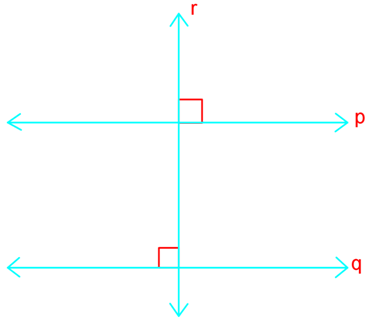
Determine what set(s) of lines are perpendicular.
Step 1: Identify the Lines
First, observe the diagram carefully to identify the lines involved. In this case, we have three lines labeled as R, P, and Q. These lines are the primary focus of our analysis to determine which sets are perpendicular.
Step 2: Look for Right Angle Indicators
Next, look for any indicators of right angles in the diagram. Right angles are typically marked with a small square symbol at the intersection of two lines. In the given diagram, you can see these square symbols between lines P and R, and between lines R and Q. These symbols indicate that the angles at these intersections are 90 degrees.
Step 3: Analyze the First Set of Lines
Now, let's analyze the first set of lines. The square symbol between lines P and R indicates a 90-degree angle, which means that line R is perpendicular to line P. This is our first set of perpendicular lines.
Step 4: Analyze the Second Set of Lines
Next, observe the second set of lines. The square symbol between lines R and Q also indicates a 90-degree angle. This means that line R is also perpendicular to line Q. This is our second set of perpendicular lines.
Step 5: Confirm No Other Perpendicular Sets
Finally, confirm that there are no other sets of perpendicular lines in the diagram. In this case, there are no additional square symbols indicating right angles between any other lines. Therefore, we have identified all the sets of perpendicular lines in the diagram.
Conclusion
In conclusion, by carefully analyzing the diagram and looking for right angle indicators, we have determined the sets of lines that are perpendicular. The two sets of perpendicular lines are R and P, and R and Q. This completes our analysis for this question.
FAQs
Q: What are perpendicular lines?
A: Perpendicular lines are two lines that intersect at a 90-degree angle. They form a right angle where they meet. In geometry, perpendicular lines are crucial for understanding various shapes and spatial relationships.
Q: How do you know if two lines are perpendicular?
A: There are several ways to determine if lines are perpendicular:
1. They form a 90-degree angle where they intersect.
2. Their slopes are negative reciprocals of each other (e.g., if one line has a slope of 2, the perpendicular line will have a slope of -1/2).
3. The product of their slopes equals -1.
4. They form four congruent angles at their intersection point.
Q: What are some real-life examples of perpendicular lines?
A: Perpendicular lines are common in everyday life:
1. The corner of a room where walls meet
2. The intersection of streets in a grid layout
3. The hands of a clock at 3:00
4. The edges of a sheet of paper
5. The crossbars on a window frame
Q: How do perpendicular lines differ from parallel lines?
A: Perpendicular lines intersect at a 90-degree angle, while parallel lines never intersect and maintain a constant distance from each other. Perpendicular lines form right angles, but parallel lines do not form any angles between them.
Q: What is the perpendicular line theorem?
A: The perpendicular line theorem states that if two lines are perpendicular to the same line, they are parallel to each other. This theorem is essential in geometry proofs and helps establish relationships between lines in complex figures.
Prerequisite Topics for Perpendicular Line Proofs
Understanding perpendicular line proofs requires a solid foundation in several key geometric and algebraic concepts. One of the most crucial prerequisites is parallel lines and transversals. This topic is essential because it introduces the relationships between angles formed when a line intersects two or more parallel lines, which is often a key component in perpendicular line proofs.
Another important concept to grasp is the properties of polygons, particularly when it comes to understanding alternate exterior angles. These angle relationships play a significant role in many geometric proofs, including those involving perpendicular lines.
The slope of a line is a fundamental concept that directly relates to perpendicular lines. In fact, perpendicular lines have slopes that are negative reciprocals of each other, making this algebraic knowledge crucial for proving perpendicularity.
Familiarity with linear equations is also vital. Many perpendicular line proofs involve manipulating equations to demonstrate the perpendicular relationship between two lines. This algebraic skill is indispensable when working with analytical geometry proofs.
Understanding the coordinate plane is essential for visualizing and proving perpendicular relationships, especially when dealing with analytical proofs. This knowledge allows you to represent perpendicular lines graphically and algebraically.
Lastly, a strong grasp of angle relationships in geometry is crucial. This includes understanding complementary and supplementary angles, as well as the properties of right angles, which are fundamental to perpendicular line proofs.
By mastering these prerequisite topics, you'll be well-equipped to tackle perpendicular line proofs with confidence. Each concept builds upon the others, creating a comprehensive understanding of the geometric and algebraic principles that underpin these proofs. Remember, the key to success in mathematics is often found in thoroughly understanding the foundational concepts before moving on to more complex applications.