TOPIC
Using models to add and subtract fractionsMY PROGRESS
Pug Score
0%
Getting Started
"Let's build your foundation!"
Best Streak
0 in a row
Study Points
+0
Overview
Practice
Watch
Read
Quiz
Next Steps
Get Started
Get unlimited access to all videos, practice problems, and study tools.
Back to Menu
Topic Progress
Pug Score
0%
Getting Started
"Let's build your foundation!"
Videos Watched
0/0
Best Practice
No score
Read
Not viewed
Best Quiz
No attempts
Best Streak
0 in a row
Study Points
+0
Overview
Practice
Watch
Read
Quiz
Next Steps
Read
Adding Fractions with Models: Visualize Your Way to Success
In this section, we will write addition or subtraction statements involving fractions for given diagrams. We were introduced to addition and subtraction statements in previous sections. In this section, we will also be asked to use diagrams to solve word problems involving the addition and subtraction of fractions.
Introduction: Understanding Fractions and Models
Welcome to our lesson on fractions and models! Understanding fractions is a crucial skill in mathematics, and using models can greatly enhance your comprehension. Fractions are essential in everyday life, from cooking to measuring and beyond. By mastering fractions, you'll unlock a powerful tool for problem-solving and mathematical reasoning. Our introduction video is designed to help you grasp these concepts easily and effectively. It provides a visual representation of fractions, making abstract ideas more concrete and relatable. As we begin this journey together, remember that learning fractions is like building with blocks we'll start with the basics and gradually construct more complex understanding. The video will guide you through various models, such as pie charts for fractions, number lines, and area models, each offering a unique perspective on fractions. So, let's dive in and discover the fascinating world of fractions together!
The Basics of Fractions: Numerator and Denominator
Let's dive into the world of fractions! Fractions are like puzzle pieces that help us understand parts of a whole. They're made up of two essential components: the numerator and the denominator. Think of these as the dynamic duo of the fraction world!
First, let's talk about the numerator. It's the number on top of the fraction, telling us how many parts we're dealing with. Imagine you have a delicious pizza cut into 8 slices, and you've eaten 3. The numerator in this case would be 3.
Now, meet the denominator - the number at the bottom of the fraction. It represents the total number of equal parts in the whole. In our pizza example, the denominator would be 8, because the whole pizza was divided into 8 slices.
Let's visualize this with some shapes. Picture a circle divided into four equal parts, with two parts shaded. We can represent this as the fraction 2/4. The numerator (2) tells us how many parts are shaded, while the denominator (4) shows the total number of parts in the circle.
Similarly, imagine a rectangle split into six equal sections, with five colored in. This would be represented as 5/6. The numerator (5) indicates the colored sections, and the denominator (6) represents the total sections in the rectangle.
Now that we understand the basics, let's explore different types of fractions. We have proper fractions, improper fractions, and mixed numbers. Don't worry - they're not as complicated as they sound!
Proper fractions are like well-behaved siblings. The numerator is always smaller than the denominator. For example, 3/4, 2/5, and 1/8 are all proper fractions. Visually, these represent parts of a whole that are less than one complete unit.
Improper fractions, on the other hand, are the rebellious ones. Here, the numerator is equal to or greater than the denominator. For instance, 5/4, 7/3, and 9/2 are improper fractions. These represent quantities that are equal to or greater than one whole unit.
Let's visualize an improper fraction. Imagine you have two circles, each divided into three parts. If you shade all three parts of the first circle and two parts of the second, you'd have 5/3. That's five out of three parts - an improper fraction!
Now, let's introduce mixed numbers. These are like a combination of a whole number and a proper fraction. For example, 1 2/3 is a mixed number. It means one whole unit plus two-thirds of another unit. To visualize this, picture one complete circle and another circle with two out of three parts shaded.
You can convert improper fractions to mixed numbers and vice versa. For instance, the improper fraction 7/4 can be written as the mixed number 1 3/4. Imagine four quarters (1/4) in a dollar. Seven quarters would be one whole dollar (4/4) plus three more quarters (3/4), giving us 1 3/4.
Let's practice with more visual examples. Picture a square divided into nine equal parts, with seven parts colored. This represents the fraction 7/9. Now, imagine three identical rectangles, each split into five sections. If you shade all sections in two rectangles and four sections in the third, you'd have the improper fraction 14/5, which can also be expressed as the mixed number 2 4/5.
Remember, fractions are all around us in everyday life. When you eat half a sandwich, use a quarter cup of milk in a recipe, or spend three-quarters of an hour studying, you're working with fractions. The more you practice identifying the numerator and denominator in these real-life situations, the more comfortable you'll become with fractions.
As you continue your journey with fractions, you'll discover how they can be added, subtracted, multiplied, and divided. But for now, focus on understanding the numerator and denominator, and practice identifying proper
Visualizing Fractions: Using Circles, Rectangles, and Number Lines
Let's explore the wonderful world of fraction models! These visual representations are fantastic tools to help us understand fractions better. We'll look at three common models: circles, rectangles, and number lines. Each model offers a unique way to see how fractions work, making it easier to grasp these sometimes tricky concepts.
First, let's talk about circle models. Imagine a delicious pizza - that's your circle! To represent fractions with a circle, we divide it into equal parts. For example, to show 1/4, we'd divide our "pizza" into four equal slices and shade one slice. Here's how to draw a circle model:
- Draw a circle
- Decide how many parts you need (this is your denominator)
- Divide the circle into that many equal parts
- Shade the number of parts you want to represent (this is your numerator)
Circle models are great for showing parts of a whole and work well for fractions like 1/2, 1/3, 1/4, and so on.
Next up, we have rectangle models. These are super helpful when we want to compare fractions or show equivalent fractions. To create a rectangle model:
- Draw a rectangle
- Divide it horizontally into the number of parts in your denominator
- Shade in the number of parts for your numerator
For instance, to show 3/5, you'd divide your rectangle into 5 equal parts and shade 3 of them. Rectangle models are particularly useful when dealing with fractions that have larger denominators.
Lastly, let's look at number line models. These are excellent for ordering fractions on number lines and seeing how fractions relate to whole numbers. Here's how to create a number line model:
- Draw a horizontal line
- Mark 0 on the left end and 1 on the right end
- Divide the line into the number of parts in your denominator
- Count over from 0 the number of parts in your numerator and mark that spot
For example, to show 2/3 on a number line, you'd divide the line between 0 and 1 into three equal parts and mark the second tick from 0.
Now, let's practice with some examples! Say we want to represent 3/4 using all three models:
- Circle model: Draw a circle, divide it into 4 equal parts, and shade 3 of them.
- Rectangle model: Draw a rectangle, divide it into 4 equal horizontal sections, and shade 3 of them.
- Number line model: Draw a line from 0 to 1, divide it into 4 equal parts, and mark the third tick from 0.
Each model gives us a different way to "see" 3/4, helping us understand it better. The circle shows us 3 out of 4 parts of a whole, the rectangle lets us easily compare 3/4 to other fractions, and the number line shows us where 3/4 sits between 0 and 1.
Remember, practice makes perfect! Try representing different fractions using these models. Start with simple fractions like 1/2 or 2/3, then challenge yourself with trickier ones like 5/8 or 3/7. The more you use these models, the more comfortable you'll become with fractions.
These visual representations are powerful tools in your math toolkit. They help make abstract fraction concepts more concrete and easier to understand. Whether you're adding fractions, comparing them, or just trying to visualize what a fraction really means, these models are here to help. So next time you're stuck on a fraction problem, try ordering fractions on number lines.
Adding Fractions Using Models
Adding fractions can be a challenging concept for many students, but using visual models can make it much easier to understand. Let's explore how to add fractions step-by-step using circles and rectangles as our visual aids. We'll start with adding fractions that have the same denominator and then move on to adding fractions with different denominators.
First, let's consider adding fractions with the same denominator. Imagine you have two pizzas, each divided into 8 slices. If you eat 3 slices from one pizza and 2 slices from the other, how many slices have you eaten in total? We can represent this as 3/8 + 2/8. Using a circular model, we can easily visualize this:
(Imagine two circles, each divided into 8 parts. In the first circle, 3 parts are shaded. In the second circle, 2 parts are shaded.)
To add these fractions, we simply count the total number of shaded parts: 3 + 2 = 5. So, 3/8 + 2/8 = 5/8. The denominator stays the same because we're still working with eighths.
Now, let's try a slightly more complex example with the same denominator. What if we want to add 4/6 + 1/6? We can use rectangular models this time:
(Picture two rectangles, each divided into 6 equal parts. In the first rectangle, 4 parts are colored. In the second, 1 part is colored.)
Again, we count the total colored parts: 4 + 1 = 5. So, 4/6 + 1/6 = 5/6. Remember, when the denominators are the same, we add the numerators and keep the denominator the same.
Now, let's tackle the more challenging task of adding fractions with different denominators. For example, let's add 1/2 + 1/3. We can't simply add the numerators here because the pieces are different sizes. We need to find a common denominator first.
To visualize this, let's use two rectangles:
(Imagine one rectangle divided into 2 equal parts with 1 part shaded, and another rectangle divided into 3 equal parts with 1 part shaded.)
To add these, we need to divide both rectangles into equal parts that match. The least common multiple for fractions of 2 and 3 is 6, so let's divide each rectangle into 6 parts:
(Now picture the first rectangle divided into 6 parts, with 3 parts shaded (equivalent to 1/2). The second rectangle is also divided into 6 parts, with 2 parts shaded (equivalent to 1/3).)
Now we can see that 1/2 is equivalent to 3/6, and 1/3 is equivalent to 2/6. Adding these together, we get 3/6 + 2/6 = 5/6.
Let's try one more example: 3/4 + 1/2. Again, we need to find a common denominator. The least common multiple for fractions of 4 and 2 is 4, so we'll use fourths:
(Visualize two circles, each divided into 4 parts. In the first circle, 3 parts are shaded (representing 3/4). In the second circle, 2 parts are shaded (representing 1/2, which is equivalent to 2/4).)
Now we can add: 3/4 + 2/4 = 5/4. This is an improper fraction, which we could simplify to 1 1/4 if needed.
Remember, when adding fractions with different denominators, the key steps are:
1. Find a common denominator (usually the least common multiple of the denominators).
2. Convert each fraction to an
Subtracting Fractions Using Models
Subtracting fractions can be a challenging concept for many students, but using visual models can make it much easier to understand. Let's explore how to subtract fractions step-by-step, starting with fractions that have the same denominator and then moving on to those with different denominators.
First, let's consider subtracting fractions with the same denominator. Imagine you have two chocolate bars, each divided into 8 equal pieces. If you have 5/8 of one bar and want to subtract 3/8, you can visualize it like this:
(Visual representation of 5/8 - 3/8 using chocolate bar model)
To subtract, simply remove 3 pieces from the 5 you started with. You're left with 2/8, which can be simplified to 1/4. The key here is that when the denominators are the same, you only need to subtract the numerators.
Now, let's move on to subtracting fractions with different denominators. This process is a bit more complex, but don't worry we'll break it down step by step. Let's use the example of 3/4 - 1/3.
Step 1: Find a common denominator. In this case, the least common multiple for fractions of 4 and 3 is 12.
Step 2: Convert each fraction to an equivalent fraction with the common denominator: 3/4 = (3 × 3)/(4 × 3) = 9/12 1/3 = (1 × 4)/(3 × 4) = 4/12
Step 3: Now that we have the same denominator, we can subtract the numerators: 9/12 - 4/12 = 5/12
Let's visualize this process using fraction circles:
(Visual representation of 3/4 and 1/3 using fraction circles, then showing the conversion to 9/12 and 4/12, and finally the subtraction to 5/12)
The visual model helps us see why we need a common denominator. We can't directly subtract 1/3 from 3/4 because the pieces are different sizes. By converting to twelfths, we're essentially cutting our pieces into smaller, equal-sized units that we can then subtract.
Remember, when subtracting fractions with different denominators, always follow these steps: 1. Find a common denominator 2. Convert each fraction to an equivalent fraction with the common denominator 3. Subtract the numerators 4. Simplify the result if possible
Let's try one more example: 5/6 - 1/4
Step 1: The common denominator is 12 (LCM of 6 and 4) Step 2: 5/6 = (5 × 2)/(6 × 2) = 10/12 1/4 = (1 × 3)/(4 × 3) = 3/12 Step 3: 10/12 - 3/12 = 7/12
(Visual representation of 5/6 and 1/4 using fraction bars, showing the conversion to 10/12 and 3/12, and the final subtraction to 7/12)
Using these visual models, you can see how the fractions relate to each other and why we need to find a common denominator. It's like creating a common language for our fractions so they can interact properly.
Remember, practice makes perfect! Don't get discouraged if it takes some time to master this skill. Keep visualizing the fractions, use physical objects or drawings if it helps, and soon you'll be subtracting fractions with confidence. The key is to understand the concept behind each step, not just memorize the rules.
As you become more comfortable with these methods, you'll find that simplifying fractions becomes easier and more intuitive. The key is to practice regularly and seek help when needed.
Solving Word Problems with Fraction Models
Fraction models are powerful tools for solving real-world word problems involving fractions. By visualizing fractions and their operations, we can better understand and tackle complex problems. Let's explore how to apply these models to solve word problems involving addition and subtraction of fractions.
When faced with a word problem, the first step is to carefully read and interpret the question. Identify the key information and determine which fractions are involved. Next, choose an appropriate fraction model to represent the problem. Common models include area models, number lines, and set models.
Let's start with an addition example: "Sarah baked a pie and ate 1/4 of it. Her brother ate 1/3 of the remaining pie. What fraction of the whole pie did they eat together?"
To solve this, we can use an area model. Draw a circle to represent the whole pie. Divide it into fourths and shade 1/4 to represent Sarah's portion. The remaining 3/4 is then divided into thirds, and we shade 1/3 of that (which is 1/4 of the whole pie). Now we can see that Sarah and her brother ate 1/4 + 1/4 = 1/2 of the pie in total.
For subtraction, consider this problem: "John has 3/4 of a gallon of paint. He uses 1/3 of a gallon on a project. How much paint does he have left?"
Here, a number line model works well. Draw a number line from 0 to 1, representing a full gallon. Mark 3/4 on the line to show John's initial amount. Then, count back 1/3 from that point. To do this accurately, we need to find a common denominator. The least common multiple of 4 and 3 is 12, so we convert 3/4 to 9/12 and 1/3 to 4/12. Now we can easily subtract 4/12 from 9/12 on our number line, leaving us with 5/12 of a gallon remaining.
Remember, the key to success is breaking down the problem into manageable steps. First, identify the fractions involved. Then, choose a model that best represents the situation. Finally, perform the operations step-by-step, using your model as a guide.
Practice is essential for mastering these skills. Try creating your own word problems and solving them using different fraction models. As you become more comfortable, you'll find that these techniques have numerous real-world applications, from cooking and construction to financial planning and time management.
Don't be discouraged if you find some problems challenging at first. Fraction word problems can be tricky, but with persistence and the right approach, you'll improve rapidly. Remember that each problem you solve strengthens your mathematical reasoning and problem-solving abilities.
As you work through word problems, always check if your answer makes sense in the context of the question. For example, if you're subtracting fractions, your answer should be smaller than the original amount. This simple check can help you catch errors and build confidence in your solutions.
By mastering fraction models and applying them to word problems, you're developing valuable skills that extend far beyond the math classroom. These techniques will serve you well in various aspects of daily life, from dividing a pizza among friends to calculating discounts while shopping. Embrace the challenge, and soon you'll be solving fraction word problems with ease and confidence!
Conclusion: Mastering Fractions with Models
In this article, we've explored the power of fraction models in understanding and working with fractions. We've seen how area models, number lines, and set models can visually represent fractions, making complex concepts more accessible. These models are invaluable tools for grasping fraction equivalence, addition, subtraction, and more. Remember, mastering fractions is a journey that requires practice and persistence. We encourage you to regularly use these models when solving fraction problems, as they can significantly enhance your understanding and problem-solving skills. Don't hesitate to apply these techniques to various mathematical challenges you encounter. To further solidify your knowledge, we recommend watching related instructional videos and tackling practice problems. By consistently engaging with fraction models, you'll build a strong foundation in mathematics that will serve you well in future studies. Keep exploring, keep practicing, and watch your fraction skills soar!
Example:
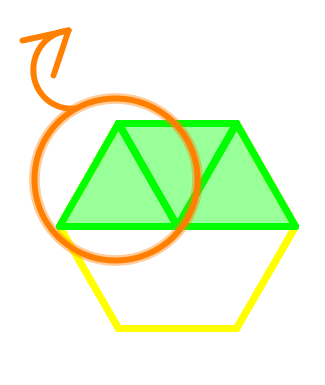
Write the addition or subtraction statement for the diagram. Write the answer in the lowest terms.
Step 1: Understanding the Diagram
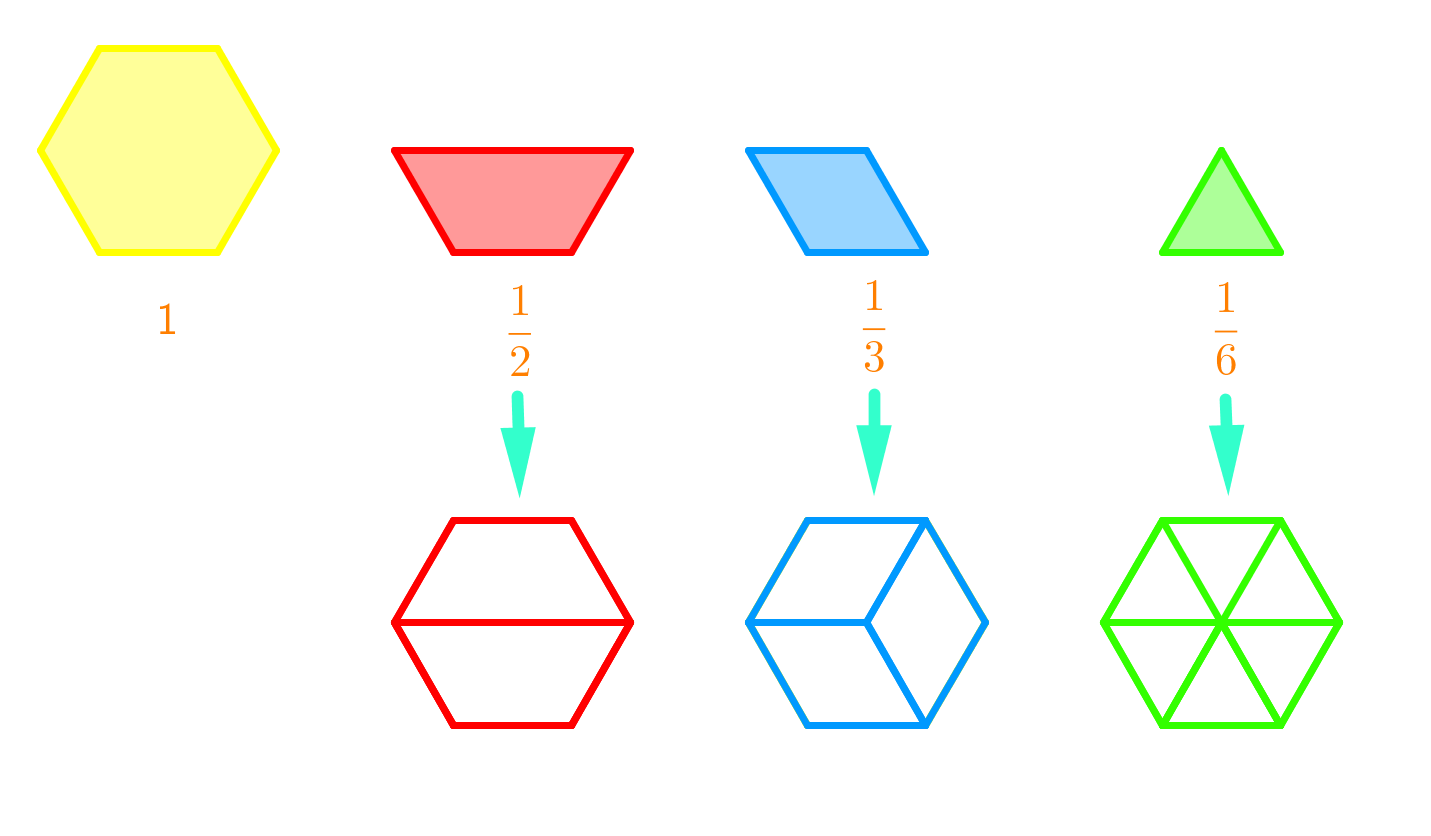
First, let's understand the diagram. We are using pattern blocks to represent fractions. The yellow block represents one whole. The red block represents one-half because two red blocks fit into one yellow block. The blue block represents one-third because three blue blocks fit into one yellow block. The green triangle represents one-sixth because six green triangles fit into one yellow block.
Step 2: Identifying the Fractions in the Diagram
In the given diagram, we are using green triangles. Each green triangle represents one-sixth (1/6) of the whole. We can see that there are three green triangles in the diagram. Therefore, we have three fractions of 1/6 each.
Step 3: Writing the Initial Fraction Statement
Since we have three green triangles, we can write the initial fraction statement as:
1/6 + 1/6 + 1/6
Step 4: Adding the Fractions
When adding fractions with the same denominator, we add the numerators and keep the denominator the same. So, we add the numerators:
1 + 1 + 1 = 3
Therefore, the sum of the fractions is:
3/6
Step 5: Understanding the Subtraction
Next, we need to understand the subtraction part of the problem. The diagram shows an arrow removing one green triangle. This means we are subtracting one-sixth (1/6) from the total.
So, we start with 3/6 and subtract 1/6:
3/6 - 1/6
Step 6: Performing the Subtraction
When subtracting fractions with the same denominator, we subtract the numerators and keep the denominator the same. So, we subtract the numerators:
3 - 1 = 2
Therefore, the result of the subtraction is:
2/6
Step 7: Simplifying the Fraction
Finally, we need to simplify the fraction to its lowest terms. To do this, we find the greatest common divisor (GCD) of the numerator and the denominator. The GCD of 2 and 6 is 2. We divide both the numerator and the denominator by their GCD:
2 ÷ 2 = 1
6 ÷ 2 = 3
Therefore, the simplified fraction is:
1/3
FAQs
Here are some frequently asked questions about using models to add and subtract fractions:
1. How can I use models to add fractions?
To add fractions using models, start by representing each fraction visually (e.g., with area models or number lines). For fractions with the same denominator, simply combine the shaded parts. For fractions with different denominators, first convert them to equivalent fractions with a common denominator, then add the numerators while keeping the denominator the same.
2. What are the models of fractions?
Common fraction models include area models (circles or rectangles divided into equal parts), number lines, and set models. Area models are particularly useful for visualizing parts of a whole, while number lines help in understanding fraction magnitude and order.
3. How do you add fractions using algorithms?
To add fractions algorithmically: 1) Find a common denominator (usually the least common multiple of the denominators). 2) Convert each fraction to an equivalent fraction with this common denominator. 3) Add the numerators while keeping the denominator the same. 4) Simplify the result if possible.
4. How to add mixed numbers with models?
To add mixed numbers with models: 1) Convert mixed numbers to improper fractions. 2) Represent each improper fraction using an area model. 3) Find a common denominator if necessary. 4) Combine the shaded areas. 5) Convert the result back to a mixed number if it's an improper fraction.
5. How can I use models to subtract fractions?
For subtracting fractions with models, represent the first fraction visually, then remove the part representing the second fraction. With different denominators, first convert to equivalent fractions with a common denominator. Area models and number lines are particularly useful for visualizing fraction subtraction.
Prerequisite Topics for Using Models to Add and Subtract Fractions
Understanding the fundamentals of fractions is crucial when learning to use models for adding and subtracting fractions. One essential prerequisite is mastering proper fractions. This knowledge forms the foundation for more complex fraction operations and helps students visualize fraction relationships in models.
Equally important is the ability to work with improper fractions and mixed numbers. These concepts are vital when using models to represent fractions larger than one whole. Students who are comfortable with improper fractions and mixed numbers can more easily interpret and manipulate fraction models in various addition and subtraction scenarios.
Another key prerequisite is proficiency in adding and subtracting mixed numbers. This skill directly relates to using models for fraction operations, as many real-world problems involve mixed numbers. Understanding how to work with mixed numbers allows students to apply fraction models to a wider range of practical situations.
Perhaps the most critical prerequisite for using models to add and subtract fractions is mastering the technique of subtracting fractions with different denominators. This skill is fundamental because fraction models often require students to work with unlike denominators. Being able to find common denominators and perform operations on fractions with different denominators is essential for accurately using and interpreting fraction models.
These prerequisite topics collectively build a strong foundation for using models to add and subtract fractions. Students who have a solid grasp of proper and improper fractions, mixed numbers, and operations with unlike denominators are better equipped to understand and utilize fraction models effectively. The ability to visualize these concepts through models enhances problem-solving skills and deepens overall fraction comprehension.
Moreover, these prerequisites are interconnected. For instance, understanding how to multiply proper fractions aids in finding common denominators when adding or subtracting fractions with unlike denominators. Similarly, proficiency in working with mixed numbers is beneficial when using models that represent fractions greater than one whole.
By mastering these prerequisite topics, students develop a more intuitive understanding of fractions. This intuition is invaluable when using models to add and subtract fractions, as it allows students to predict outcomes, check their work, and understand why certain steps are necessary in the process. The visual representation provided by models becomes more meaningful and easier to interpret when built upon a solid foundation of these fundamental fraction concepts.
In conclusion, a thorough understanding of these prerequisite topics is essential for successfully using models to add and subtract fractions. It enables students to approach fraction problems with confidence, utilize models effectively, and develop a deeper, more practical understanding of fraction operations in various contexts.