AP Calculus AB Help — Video Lessons & Practice
Get clear explanations for every AP Calculus AB topic and build exam-ready confidence.
Certified-Teacher Concept Videos
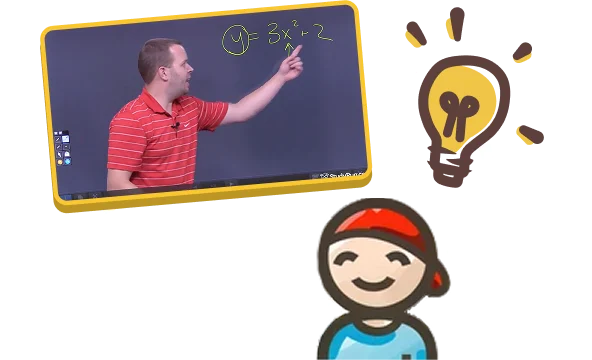
Every AP Calculus AB lesson is taught by a certified teacher who shows you the method step by step — so you can solve similar problems on the AP exam yourself.

Diagnostic Assessment + Adaptive Practice
A quick diagnostic finds exactly where your gaps are in limits, derivatives, or integrals, then adaptive practice adjusts difficulty to your level — no wasted study time.

AP Exam Prep Included
Practice with AP-style questions built into your subscription — timed sets, scoring guides, and full solutions so you walk into the AP exam ready.
Try It Now
Test your knowledge
Our approach aligns with the evidence
Exam Scores
Better Recall
Less Anxiety
AP Calculus AB Topics
1. Limits & Continuity
2. Derivatives
3. Derivative Applications
4. Integrals
5. Integration techniques
6. Integral Applications
7 Chapters · 44 Topics · 313 Videos
Discover Our Learning Areas
Explore key subjects and start learning with interactive content.




What is AP Calculus AB?
AP Calculus AB is a college-level mathematics course offered through the College Board's Advanced Placement programme. It introduces students to the two core branches of calculus — differential calculus (the study of rates of change and derivatives) and integral calculus (the study of accumulation and definite integrals) — at a depth equivalent to a first-semester university calculus course. Students who score well on the AP exam in May can earn university credit, placing out of an introductory calculus module and saving both time and tuition fees.
What topics are covered in AP Calculus AB?
AP Calculus AB is organised around six big ideas defined by the College Board. The course opens with limits and continuity — understanding how functions behave as they approach a value, and what it means for a function to be continuous. From there it moves into differentiation: the definition of the derivative, differentiation rules (power, product, quotient, and chain rules), implicit differentiation, and derivatives of exponential, logarithmic, and trigonometric functions.
The second half of the course covers applications of differentiation (related rates, optimisation, curve sketching, and the Mean Value Theorem), then transitions into integration — Riemann sums, definite and indefinite integrals, u-substitution, and the Fundamental Theorem of Calculus. The course closes with differential equations (slope fields, separation of variables) and applications of integration (area between curves, average value of a function, and accumulation problems).
Is AP Calculus AB hard?
AP Calculus AB has a reputation as one of the more challenging AP courses, and that reputation is earned — but the difficulty is manageable with the right preparation. The course demands solid pre-calculus foundations: comfort with functions, trigonometry, exponentials, and algebraic manipulation is essential before the new calculus concepts can take hold.
The topics where students struggle most are related rates (which combines implicit differentiation, geometry, and multi-step problem setup), the chain rule (especially when nested functions appear), and applying the Fundamental Theorem of Calculus in less familiar forms. Students who catch gaps in their prerequisite knowledge early and practise applying methods — not just memorising formulas — consistently perform better on both in-class assessments and the AP exam.
How is AP Calculus AB assessed?
The AP Calculus AB exam is administered by the College Board each May. It runs for 3 hours and 15 minutes and is divided into two sections. Section I is multiple choice (45 questions worth 50% of the score), split into a no-calculator portion and a graphing-calculator portion. Section II is free response (6 questions worth 50% of the score), also split by calculator use.
Free-response questions require students to show their reasoning clearly and justify answers in writing — correct answers alone are not enough if the method is unclear. Scores run from 1 to 5; a score of 3 or above is widely recognised by universities for credit or advanced placement. Many universities require a 4 or 5 for credit towards competitive programmes in engineering, computing, or the physical sciences.
Why StudyPug for AP Calculus AB?
StudyPug is built around three features that matter most for AP Calculus AB students.
Diagnostic Assessment. Before you watch a single video, a short diagnostic identifies exactly which AP Calculus AB topics need attention — whether that's limits, the chain rule, or integration by substitution. You study smarter, not harder, because you focus on the right material from the start.
Certified-teacher concept videos. Every lesson is taught by a certified teacher who explains the method, not just the answer. For AP Calculus AB, this matters enormously: the free-response section of the AP exam rewards students who can explain their reasoning, and the only way to do that is to genuinely understand the method behind each technique. StudyPug's videos are not AI-generated — they are created by real teachers who know where students get stuck and how to explain their way past it.
Adaptive Practice. After each video, adaptive practice problems adjust in difficulty to match your current level. As you improve on derivatives, the questions push you toward harder applications. Struggling with a particular integration technique? The system keeps you practising it until it sticks. This targeted loop — learn the method, apply it, get feedback, repeat — is how AP Calculus AB topics move from confusing to automatic.
AP-style practice questions based on real exam formats are included in your subscription, so you can rehearse the full exam experience — timed, structured, and scored — before May arrives.
What you learn in AP Calculus AB with StudyPug
StudyPug's AP Calculus AB content covers the complete College Board curriculum from the first lesson on limits through to differential equations and area applications. Topic coverage includes:
- Limits, limit laws, and continuity (including the Squeeze Theorem and limits at infinity)
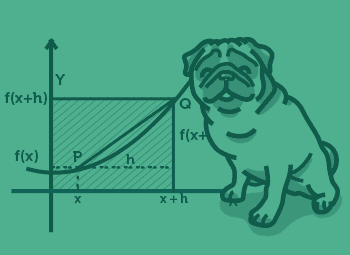
- Definition of the derivative and first principles
- Differentiation rules: power, product, quotient, chain, implicit, and logarithmic differentiation
- Derivatives of exponential, logarithmic, trigonometric, and inverse trigonometric functions
- Applications of derivatives: related rates, optimisation, curve sketching, Mean Value Theorem, L'Hôpital's Rule
- Riemann sums and the definite integral
- The Fundamental Theorem of Calculus (both parts)
- Integration techniques: u-substitution, integration by parts (introductory), and basic differential equations
- Applications of integration: area between curves, average value, and accumulation functions
- Slope fields and separation of variables
Because no validated internal topic links are available for the Ireland AP Calculus AB page at this time, we have listed the topic areas above as plain text. Every topic listed corresponds to a lesson available inside the StudyPug platform.
How to use StudyPug for AP Calculus AB
Getting started takes about five minutes. After signing up, take the AP Calculus AB diagnostic assessment — it runs through a short set of questions across limits, derivatives, and integrals and produces a prioritised study plan based on your results. You will immediately see which topics are your strengths and which need the most work before the AP exam.
From your study plan, open the first recommended video. Each lesson runs between five and fifteen minutes and focuses on a single technique or concept. Watch the teacher work through a problem from start to finish, then use the practice problems to apply the same method yourself. The adaptive system tracks your responses and adjusts — if you answer correctly, the difficulty steps up; if you struggle, it reinforces the fundamentals before moving on.
As the AP exam approaches, switch to the exam-style practice sets. These replicate the structure of the AP Calculus AB exam — timed multiple-choice blocks and free-response questions with full solution walk-throughs. The 30-day money-back guarantee means you can start using StudyPug with no risk, and cancellation is available at any time with no lock-in. Free practice problems are available without a subscription if you want to try the platform before committing to a plan.
AP Calculus AB FAQ
Unsure how StudyPug works? Need help with setting up? Check our frequently asked questions or contact us for help.
What do you learn in AP Calculus AB, and what topics does it cover?
AP Calculus AB covers the foundational ideas of differential and integral calculus. Core topics include limits and continuity, derivatives and differentiation rules (power, product, quotient, chain), applications of derivatives (related rates, optimisation, curve sketching), the definite integral, the Fundamental Theorem of Calculus, and basic integration techniques including u-substitution. The course is roughly equivalent to a first-semester university calculus course and is designed to prepare students for the AP exam in May.
What is the difference between AP Calculus AB and AP Calculus BC?
AP Calculus AB covers limits, derivatives, and integrals at an introductory level — the equivalent of one semester of university calculus. AP Calculus BC covers all of AB plus additional topics: parametric equations, polar coordinates, vectors, advanced integration techniques, and infinite series (including Taylor and Maclaurin series). BC is the equivalent of two university semesters. Students who feel solid in AB concepts sometimes move on to BC, but AB alone provides strong university calculus credit through the AP exam.
Is AP Calculus AB hard, and where do students struggle most?
AP Calculus AB is considered one of the more demanding AP courses because it requires strong algebra and pre-calculus foundations before the new calculus concepts make sense. Students most commonly struggle with the chain rule, related rates, and understanding the connection between a function, its derivative, and its graph. Integration also trips students up, especially applying the Fundamental Theorem of Calculus. The difficulty is manageable with consistent practice and clear explanations — catching up on gaps in prerequisites early makes a real difference.
What should I take before AP Calculus AB, and what comes after it?
Before AP Calculus AB you should be comfortable with pre-calculus: functions, trigonometry, exponentials and logarithms, and algebraic manipulation. Most students take Pre-Calculus or Maths Analysis the year before. After AP Calculus AB, students typically progress to AP Calculus BC to cover the second semester of university calculus, or they move directly into first-year university maths (calculus 2 or linear algebra) having earned credit. Strong AB performance opens doors to science, engineering, economics, and computing programmes at university.
Is AP Calculus AB on the AP exam, and how is it tested?
Yes — AP Calculus AB culminates in the College Board AP exam, typically sat in May. The exam is 3 hours 15 minutes and has two sections: multiple choice (45 questions, 50% of score — split into calculator and no-calculator portions) and free response (6 questions, 50% of score — again split by calculator use). Free-response questions require written justification, so understanding the method matters as much as getting the right answer. Scores run from 1 to 5; a score of 3 or higher is widely accepted for university credit.
What is one of the hardest concepts in AP Calculus AB, and how do you tackle it?
Related rates is consistently one of the hardest topics in AP Calculus AB. The challenge is that you must set up an equation relating two or more changing quantities, then differentiate implicitly with respect to time — a skill that combines the chain rule, geometry, and algebraic manipulation all at once. The best approach is to practise a structured method: draw a diagram, identify all variables and their rates, write the relating equation, differentiate both sides with respect to time, then substitute known values. Seeing multiple worked examples with the method explained step by step is far more effective than memorising formulas.