Canadian K-12 Science Curriculum
Science standards vary by province. Choose yours to see the courses and grade sequences that match your student's school.
Science Curriculum by Province
Each province sets its own science standards. Selecting one shows its grade sequence, courses, and end-of-year assessments.
Province Standards
Aligned with your province's science standards
Every lesson is organized around provincial standards and classroom pacing, so a student finds the exact concept being taught that week in their own school.
- Full coverage of your province's science outcomes from elementary through high school
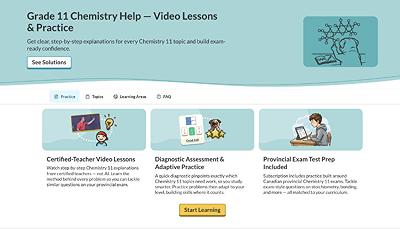
- Video lessons that walk through each concept step by step, matching what teachers present in class
- Practice problems with worked solutions so students can check their reasoning and fill gaps
CURRICULUM GUIDE
About Canadian science standards
How Canadian science standards work
Canada has no single national science curriculum. Each province develops and adopts its own outcomes, so the scope and sequence students follow depends on where they live.
How provincial science frameworks differ
Provinces differ in when topics like chemistry, physics, and Earth science are introduced. Ontario separates these into distinct courses in senior grades, while Alberta and British Columbia use an integrated approach through the middle years.
How science progresses through school
In the early and middle grades, science is typically taught as a single integrated subject. From grade 10 onward, most provinces split it into named courses such as Biology, Chemistry, and Physics.
Where science gets assessed
Several provinces test science in specific grades through provincial assessments. Senior science courses in provinces such as Alberta and British Columbia also feed into provincial diploma exams that factor into university readiness.
Science Test Prep
National exams that are the same wherever you study — no province needed.
CAEC Science
Adaptive practice and step-by-step video lessons for every Science topic on the CAEC.
AB PAT Grade 6 Science
Step-by-step video lessons and adaptive practice for every Grade 6 Science topic.
AB PAT Grade 9 Science
Step-by-step video lessons and adaptive practice for every Grade 9 Science topic.
AB PAT Grade 9 K&E Science
Step-by-step video lessons and adaptive practice for every Grade 9 K&E Science topic.
Common Questions About Canadian Science Curriculum
We've got answers to some popular questions.
Which science standards does StudyPug follow?
StudyPug follows each province's own science outcomes. Select your province and the content maps to the specific expectations students are taught in that region.
How do science frameworks differ between Ontario and British Columbia?
Ontario organizes senior science into separate Biology, Chemistry, and Physics courses beginning in grade 11, while British Columbia uses an integrated Science 10 course before students choose a specialization in grade 11.
Which science course does a student take in grade 10, and does it vary by province?
Yes, it varies. Most provinces offer a general Science 10, but the topics covered and how they connect to grade 11 specializations differ depending on provincial curriculum documents.
Are senior and advanced science courses covered?
Yes. StudyPug covers senior-level courses including Biology, Chemistry, and Physics at the grade 11 and 12 level, aligned to the provincial outcomes where those courses are offered.
Does StudyPug help with provincial diploma exams in science?
Yes. For provinces where diploma exams apply to science, such as Alberta, the practice problems and lessons are structured around the same outcomes those exams assess.
Is this material suitable for homeschooling?
Yes. Homeschooling families can use the provincial curriculum pages to follow the same sequence and outcomes as local schools, working through lessons and practice at their own pace.

Reviewed by the StudyPug Curriculum Team
Last updated October 5, 2026
3 M+
students
★★★★★
4.8 average
K-12
all grades