TOPIC
Astronomical Data, Evidence collectionMY PROGRESS
Pug Score
0%
Getting Started
"Let's build your foundation!"
Best Streak
0 in a row
Study Points
+0
Overview
Practice
Read
Quiz
Next Steps
Get Started
Get unlimited access to all videos, practice problems, and study tools.
BACK TO MENU
Topic Progress
Pug Score
0%
Getting Started
"Let's build your foundation!"
Best Practice
No score
Read
Not viewed
Best Quiz
No attempts
Best Streak
0 in a row
Study Points
+0
Overview
Practice
Read
Quiz
Next Steps
Read
Unlocking the Universe: Astronomical Data and Evidence Collection
This topic examines the methods astronomers use to collect and analyze evidence about the universe, including spectroscopy, redshift, parallax, and gravitational wave detection.
Introduction to Astronomical Data and Evidence Collection
Astronomers cannot visit distant stars or galaxies, so they rely on collecting and analyzing data from radiation that travels across space to Earth. This topic explores the diverse methods scientists use to gather evidence about the universe, from analyzing starlight to detecting ripples in spacetime. Understanding these techniques is foundational to topics such as Cosmology and Universe Theories and Space Exploration and Current Technologies.
Building on prior knowledge of Research Methods and Astronomical Observation and Stellar Evolution and the Life Cycle of Stars, learners will discover how multiple lines of evidence combine to reveal the universe's structure, composition, and history.
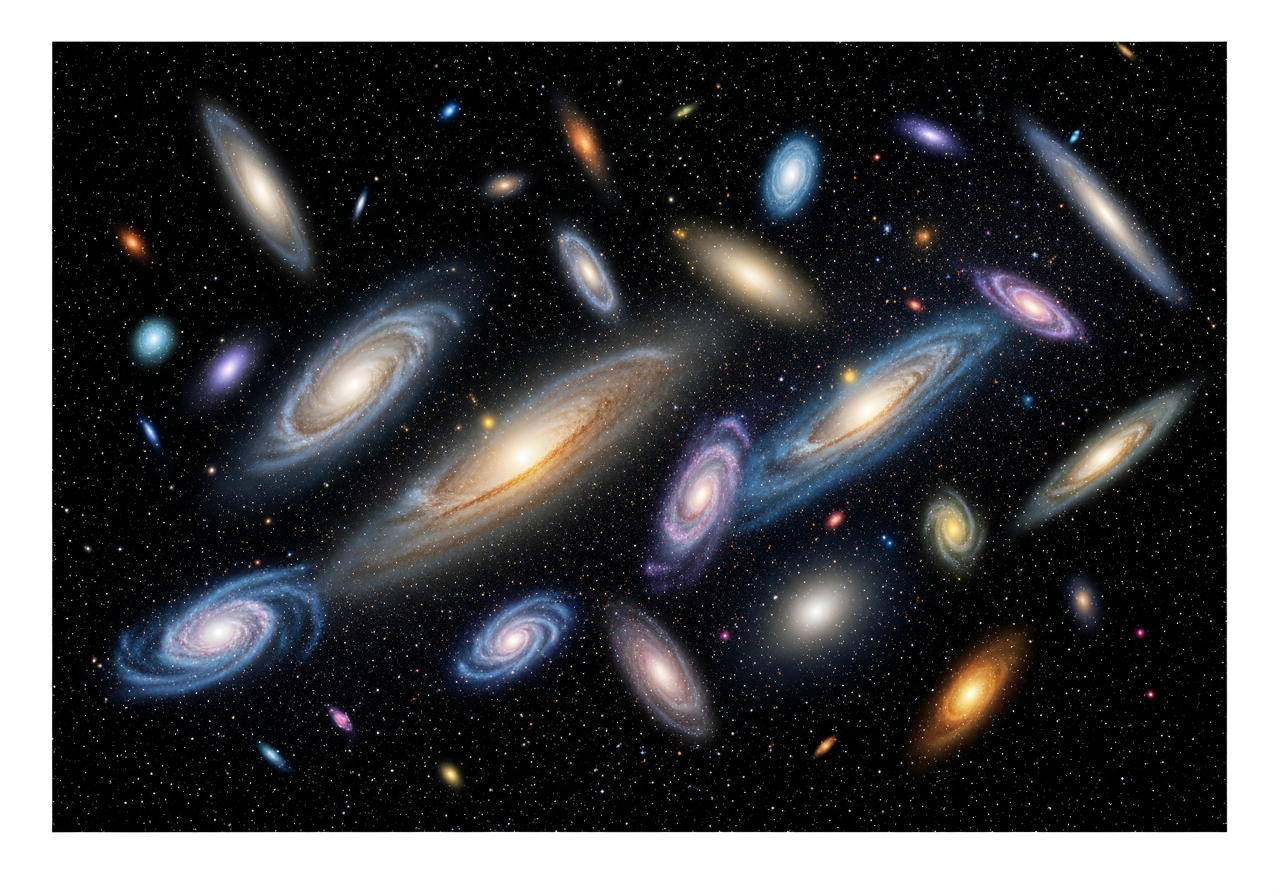
Key Data Collection Methods in Astronomy
Spectroscopy
Spectroscopy is one of the most powerful tools in astronomy. When light from a star or galaxy passes through a spectrometer, it separates into a spectrum revealing dark absorption lines at specific wavelengths. Each element produces a unique pattern of absorption lines, allowing astronomers to determine the chemical composition, temperature, and motion of distant objects.
Stellar Parallax and Standard Candles
Stellar parallax measures the apparent shift in a star's position as Earth moves to different points in its orbit. This shift is measured in arcseconds (1/3600 of a degree). However, parallax becomes ineffective beyond approximately 100 parsecs because the angular shift becomes too small to detect. For greater distances, astronomers use standard candles objects with known luminosity such as Type Ia supernovae applying the inverse square law to calculate distances to remote galaxies.
Redshift and the Expanding Universe
When astronomers analyze light from distant galaxies, spectral lines appear shifted toward longer (redder) wavelengths a phenomenon called redshift. This occurs because galaxies are moving away from Earth as the universe expands, creating a Doppler effect. The greater the redshift, the faster the galaxy is receding and the more distant it is. Edwin Hubble's observations in the 1920s established that more distant galaxies show greater redshift values, forming the basis of Hubble's Law and providing key evidence for the Big Bang theory.
Gravitational Waves
Gravitational waves are ripples in spacetime caused by violent cosmic events such as colliding black holes or neutron stars. First predicted by Einstein's general relativity, they were detected in 2015 by LIGO (Laser Interferometer Gravitational-Wave Observatory) using laser interferometry. Gravitational waves travel at the speed of light and allow astronomers to detect phenomena invisible to conventional telescopes, complementing traditional light-based observations.
Multi-Wavelength Observations
Modern astronomy analyzes radiation across the entire electromagnetic spectrum radio waves, infrared, visible light, ultraviolet, X-rays, and gamma rays. Radio telescopes detect hydrogen gas clouds and pulsars, while infrared instruments penetrate cosmic dust. Space-based observatories like the Hubble Space Telescope and James Webb Space Telescope avoid atmospheric interference, capturing clearer data. This multi-wavelength approach provides far more comprehensive information than visible light alone.
Cosmic Microwave Background Radiation
The Cosmic Microwave Background (CMB) is thermal radiation filling the universe, a remnant of the early universe after the Big Bang. Tiny temperature fluctuations in the CMB (about 1 part in 100,000) represent density differences that eventually led to galaxy formation. These fluctuations align with Big Bang model predictions, making the CMB one of the strongest pieces of evidence for the universe's origin.
Key Terms and Definitions
Spectroscopy: A technique that analyzes the light emitted or absorbed by celestial objects by separating it into a spectrum, revealing information about chemical composition, temperature, and motion through characteristic absorption or emission lines.
Radio Telescope: An instrument that detects radio waves emitted by astronomical objects, allowing astronomers to study phenomena such as hydrogen gas clouds, pulsars, and distant galaxies that may be invisible in optical wavelengths.
Redshift: The phenomenon where light from a distant galaxy appears shifted toward longer (redder) wavelengths because the galaxy is moving away from Earth. Greater redshift indicates faster recession and greater distance, providing evidence for the expanding universe.
Parallax: The apparent shift in a star's position when observed from two different points in Earth's orbit. This angular shift, measured in arcseconds, is used to calculate distances to nearby stars through trigonometry.
Light-Year: The distance that light travels in one year (approximately 9.46 trillion kilometers), used to express the enormous distances between objects in space.
Cosmic Microwave Background (CMB): Faint thermal radiation that permeates the entire universe, representing the afterglow of the Big Bang. Tiny temperature fluctuations in the CMB provide evidence for the early universe's structure and the Big Bang theory.
Doppler Effect: The change in observed wavelength of light (or sound) caused by the relative motion between the source and the observer. In astronomy, it causes blueshift when objects approach and redshift when objects recede.
Gravitational Lensing: The bending of light from a distant object by the gravitational field of a massive object (such as a galaxy cluster) between the source and the observer. It acts as a natural telescope, magnifying distant objects and revealing dark matter.
Electromagnetic Spectrum: The complete range of all types of electromagnetic radiation, ordered by wavelength and frequency, including radio waves, microwaves, infrared, visible light, ultraviolet, X-rays, and gamma rays. Different wavelengths reveal different properties of astronomical objects.
Interferometry: A technique that combines signals from multiple telescopes to achieve much higher resolution than a single telescope could provide, effectively creating a much larger virtual instrument for detailed astronomical observations.
Standard Candles: Celestial objects with known intrinsic luminosity (such as Type Ia supernovae) that allow astronomers to calculate distances by comparing apparent brightness with actual luminosity using the inverse square law.
Hubble's Law: The observation that more distant galaxies show greater redshift values, indicating they are receding faster. This relationship provides key evidence for the expanding universe and the Big Bang theory.
Gravitational Waves: Ripples in the fabric of spacetime generated by violent cosmic events such as colliding black holes or neutron stars. They travel at the speed of light and were first detected by LIGO in 2015.
Absorption Lines: Dark lines appearing at specific wavelengths in a stellar spectrum, caused by elements in a star's atmosphere absorbing particular wavelengths of light. Each element produces a unique pattern, enabling chemical identification.
Arcsecond: A unit of angular measurement equal to 1/3600 of a degree, used to express the tiny angular shifts detected in stellar parallax measurements.
Applying Astronomical Evidence Collection Skills
Learners strengthen their understanding by analyzing real astronomical data scenarios. Students can practice interpreting spectral line patterns to identify elements in stars, calculate distances using the parallax formula, and evaluate redshift data to determine galaxy recession speeds. These skills connect directly to Data Analysis and Advanced Statistical Methods in Scientific Investigation and Scientific Models and Theoretical Modeling.
Students can also evaluate the strengths and limitations of each data collection method for example, recognizing that parallax fails beyond 100 parsecs and that gravitational wave detection reveals events invisible to optical telescopes. Applying these analytical skills prepares learners for Statistical Analysis and Advanced Data Interpretation and Scientific Writing and Journal-Style Reporting.
Prerequisite Knowledge
Before studying astronomical data collection, learners should be familiar with foundational concepts. Galaxies: Types and Formation and Stellar Evolution and the Life Cycle of Stars provide essential context for understanding what astronomers are observing. Knowledge of Research Methods and Astronomical Observation introduces the tools and instruments used in the field.
Students should also have a grounding in Scientific Models and Mathematical Modeling, Data Analysis and Advanced Statistical Methods, Technical Writing and Scientific Communication, and Research Design and Independent Investigation to fully engage with the analytical demands of this topic.
Related Topics and Connections
This topic connects to a broad network of scientific concepts. Solar Radiation and Energy from Space is closely related, as understanding electromagnetic radiation is central to interpreting astronomical data. Research Design and Complex Experimental Protocols supports the design of rigorous observational studies, while Technical Writing: Research Papers and Reports and Peer Review and the Scientific Review Process teach students how to communicate and validate findings.
Mastering astronomical evidence collection prepares learners for advanced topics including Cosmology and Universe Theories, Stellar Evolution and Star Life Cycles, and Space Exploration and Current Technologies. It also builds skills needed for Research Methods and Data Collection, Research Methodology and Complex Experimental Design, Scientific Integrity and Data Handling, Research Ethics and Ethical Considerations, and Evolutionary Evidence and Multiple Lines of Evidence.