TOPIC
Generation Methods, Different power sourcesMY PROGRESS
Pug Score
0%
Getting Started
"Let's build your foundation!"
Best Streak
0 in a row
Study Points
+0
Overview
Practice
Read
Quiz
Next Steps
Get Started
Get unlimited access to all videos, practice problems, and study tools.
BACK TO MENU
Topic Progress
Pug Score
0%
Getting Started
"Let's build your foundation!"
Best Practice
No score
Read
Not viewed
Best Quiz
No attempts
Best Streak
0 in a row
Study Points
+0
Overview
Practice
Read
Quiz
Next Steps
Read
How Is Electricity Generated? Exploring Power Sources and Generation Methods
This topic examines how electricity is generated from a variety of power sources, distinguishing between renewable and non-renewable energy and explaining the energy transformations involved in each generation method.
Introduction to Electricity Generation Methods and Power Sources
Electricity does not simply appear it must be generated by converting energy from one form into another. Understanding generation methods and different power sources helps learners appreciate how the electricity used in homes, schools, and industries is produced. This topic builds directly on prior knowledge of circuit components, current, voltage, and resistance.
Power sources are broadly classified as either renewable or non-renewable. Renewable sources are naturally replenished over short timescales, while non-renewable sources exist in limited quantities and take millions of years to form.
How Different Power Stations Generate Electricity
Solar Energy and Photovoltaic Cells
Solar panels use photovoltaic (PV) cells made of semiconductor materials such as silicon. When photons from sunlight strike the semiconductor, electrons are knocked loose and flow as an electric current a process known as the photoelectric effect. This is a direct light-to-electrical energy conversion with no turbine required.
Wind Turbines
Wind turbines capture the kinetic energy of moving air. The blades spin a rotor, which turns a generator. The energy transformation sequence is: kinetic energy mechanical energy electrical energy. Wind energy produces no air pollution during operation, making it a clean renewable option.
Hydroelectric Power
In a hydroelectric power station, water stored behind a dam is released through a penstock a channel that directs falling water onto a turbine. The turbine spins a generator to produce electricity. The transformation sequence is: potential energy kinetic energy mechanical energy electrical energy. A major environmental concern is that large dams can flood natural habitats.
Geothermal Energy
Geothermal power plants tap heat from hot rocks deep inside the Earth. This heat converts water into steam, which drives a turbine connected to a generator. Geothermal energy is reliable because it does not depend on weather conditions such as sunlight or wind.
Nuclear Power and Fission
Nuclear power plants use nuclear fission the process of splitting uranium atoms inside a reactor core. The enormous heat released converts water into high-pressure steam. The steam spins a turbine, which drives a generator. Nuclear energy does not produce greenhouse gases during operation, but it does generate dangerous radioactive waste that is difficult to dispose of safely.
Fossil Fuel Power Stations
Coal, oil, and natural gas are fossil fuels formed over millions of years from ancient organisms buried under intense heat and pressure. In a coal-fired power station, coal is burned (combustion) to heat water into steam, which spins a turbine connected to a generator. The energy transformation sequence is: chemical energy thermal energy kinetic energy electrical energy. Burning fossil fuels releases greenhouse gases such as carbon dioxide, contributing to climate change. Natural gas produces fewer pollutants than coal when burned, but it is still a non-renewable fossil fuel.
Biomass Energy
Biomass energy comes from organic materials such as wood, crop waste, and animal waste. These materials are burned to produce heat, which generates steam to drive turbines. Biomass is considered renewable because organic material can be regrown.
Tidal Energy
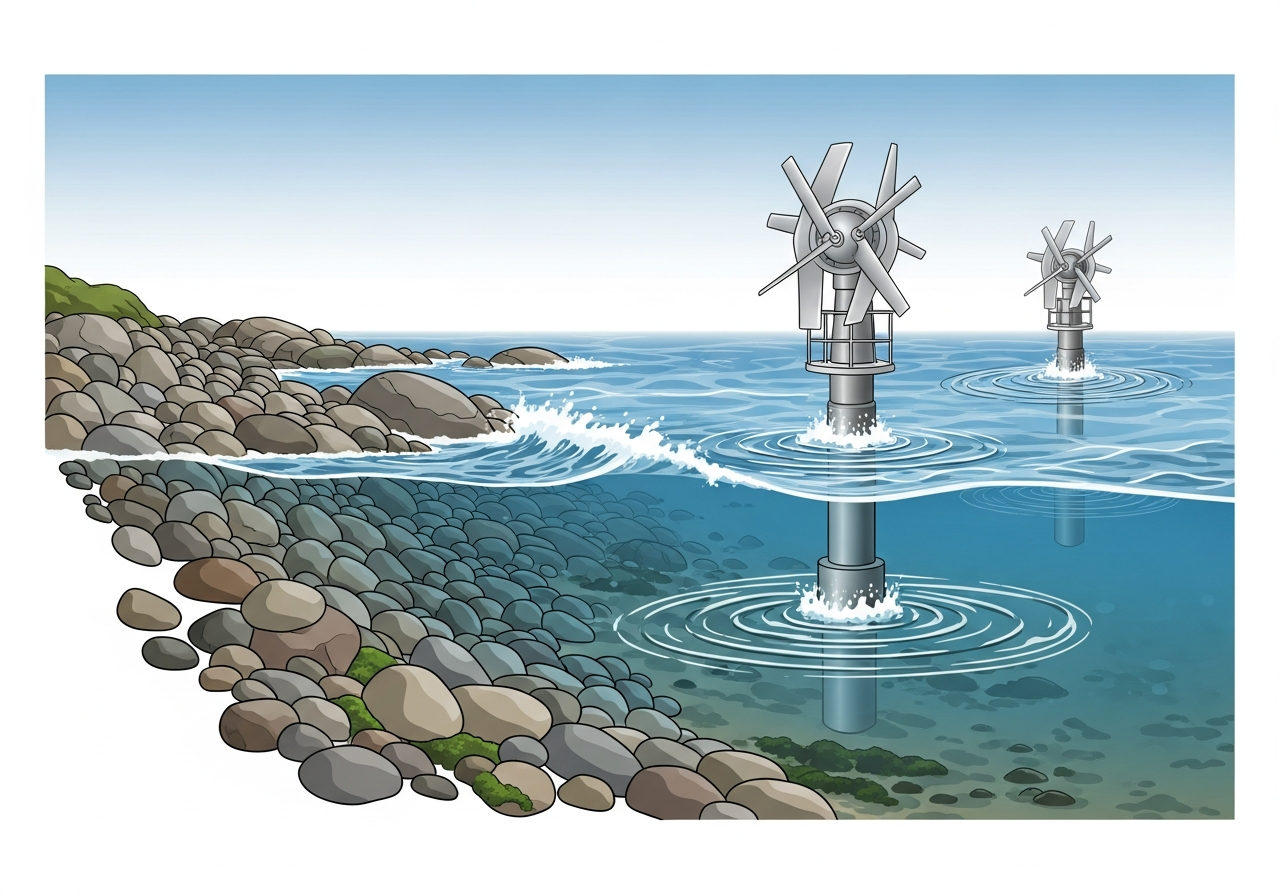
Tidal energy harnesses the rise and fall of ocean tides caused by the gravitational pull of the moon and sun. Tidal turbines placed in the ocean capture this kinetic energy and convert it into electricity. Tidal energy is a renewable source well-suited to coastal communities.
Key Terms & Definitions
Renewable Energy: Energy from sources that are naturally replenished on short timescales, such as sunlight, wind, and flowing water, and will not run out.
Non-Renewable Energy: Energy from sources that exist in limited quantities and cannot be quickly replaced, such as coal, oil, natural gas, and uranium.
Photovoltaic (PV) Cell: A device made of semiconductor material (usually silicon) that converts light energy from the sun directly into electrical energy using the photoelectric effect.
Photoelectric Effect: The process by which photons from sunlight strike a semiconductor material, knocking electrons loose and causing them to flow as an electric current.
Turbine: A rotating device with blades that spins when pushed by steam, water, or wind, converting kinetic energy into mechanical (rotational) energy that drives a generator.
Generator: A device that converts mechanical energy (spinning motion) into electrical energy using the principle of electromagnetic induction.
Electromagnetic Induction: The fundamental physics principle behind all generators a spinning rotor inside a magnetic field induces an electric current in a coil of wire.
Nuclear Fission: The process of splitting uranium atoms inside a reactor core, releasing enormous amounts of heat energy used to produce steam that drives turbines.
Fossil Fuels: Non-renewable energy sources coal, oil, and natural gas formed over millions of years from the remains of ancient organisms buried under heat and pressure.
Combustion: The burning of a fuel (such as coal or natural gas) in the presence of oxygen to release heat energy.
Greenhouse Gases: Gases such as carbon dioxide released when fossil fuels are burned; they trap heat in the atmosphere and contribute to global warming and climate change.
Penstock: A channel or pipe in a hydroelectric power plant that directs falling water from the reservoir onto the turbine blades.
Geothermal Energy: Energy harnessed from the natural heat stored in hot rocks and magma deep beneath the Earth's surface, used to produce steam that drives turbines.
Biomass Energy: Energy produced by burning organic materials such as wood, crop waste, and animal waste to generate heat that produces steam for turbines.
Tidal Energy: Energy generated by harnessing the rise and fall of ocean tides, caused primarily by the gravitational pull of the moon, to spin underwater turbines.
Radioactive Waste: Hazardous by-products of nuclear fission that remain dangerous for thousands of years and require careful, long-term storage.
Transmission Lines: High-voltage cables that carry generated electricity from power stations to homes, schools, and businesses.
Applying Knowledge: Energy Transformations in Practice
Students can deepen their understanding by tracing the complete energy transformation chain for each power source. For example, in a coal plant: chemical energy thermal energy kinetic energy electrical energy. In a wind turbine: kinetic energy mechanical energy electrical energy.
A practical model activity involves pouring water over a small wheel connected to a generator to demonstrate how hydroelectric power works directly illustrating the principles of energy transfer and conservation of energy. Learners can also compare renewable and non-renewable sources by evaluating reliability, environmental impact, and availability in different regions.
When a community near a river wants sustainable electricity, a small hydroelectric generator is most appropriate. When a region has little wind or sunlight, geothermal energy is the most reliable option. These decision-making scenarios help students apply their knowledge to real-world contexts.
Building on Prior Knowledge
This topic connects directly to several foundational concepts. Knowledge of circuit components, current, voltage, and resistance explains how generated electricity flows through circuits. Understanding series and parallel circuits shows how electricity is distributed once generated.
Learners who have studied electrical safety and household electricity will recognize why safe transmission and distribution of generated power matters. Prior study of energy efficiency and power consumption provides context for why choosing the right generation method is important. Foundational understanding of energy transfer through conduction, convection, and radiation and thermal properties of conductors and insulators supports understanding of how heat is used in steam-driven power stations.
Related Topics & Connections
This topic is closely connected to Electromagnetic Effects and Electromagnetism Principles, since all generators rely on electromagnetic induction to convert mechanical energy into electrical energy. Understanding electromagnetism deepens comprehension of why turbines and generators work together.
The concepts of Energy Types: Potential and Kinetic Forms and Energy Transfer and Conservation of Energy are central to tracing how energy moves through each generation system without being created or destroyed.
The formation of fossil fuels is explored in Resource Formation: Mineral and Fossil Fuel Formation, providing important context for why coal, oil, and natural gas are non-renewable. The environmental consequences of burning these fuels connect to Human Impact and Anthropogenic Effects and Future Scenarios and Climate Predictions.
Solutions to these environmental challenges are explored in Environmental Technology and Green Solutions and Emerging Technologies and Current Developments. This topic prepares learners for subsequent study of Energy Resources: Renewable and Non-Renewable, Global Change and Environmental Effects, Future Technology and Emerging Technologies, and Modern Technology and Current Innovations.