TOPIC
MY PROGRESS
Pug Score
0%
Getting Started
"Let's build your foundation!"
Best Streak
0 in a row
Study Points
+0
Overview
Practice
Watch
Read
Quiz
Next Steps
Get Started
Get unlimited access to all videos, practice problems, and study tools.
BACK TO MENU
Topic Progress
Pug Score
0%
Getting Started
"Let's build your foundation!"
Videos Watched
0/0
Best Practice
No score
Read
Not viewed
Best Quiz
No attempts
Best Streak
0 in a row
Study Points
+0
Overview
Practice
Watch
Read
Quiz
Next Steps
Read
Comparative Biology: Unlocking Evolution Through Anatomy and Genetics
This topic explores how scientists use anatomical structures and genetic data to compare species and uncover evolutionary relationships, providing evidence for common ancestry and the theory of evolution.
Comparative biology is the scientific study of similarities and differences among living organisms to understand evolutionary relationships. By examining body structures and genetic information, scientists can determine how closely related different species are and trace their shared ancestry. This field builds directly on foundational concepts from Evidence of Change, Fossil Record and Similarities and Natural Selection, Adaptation and Survival.
Two major categories of evidence are used in comparative biology: anatomical evidence (the study of body structures) and genetic evidence (the comparison of DNA sequences). Together, these lines of evidence build a compelling case for the theory of evolution.
Anatomical Evidence: Comparing Body Structures
Homologous Structures
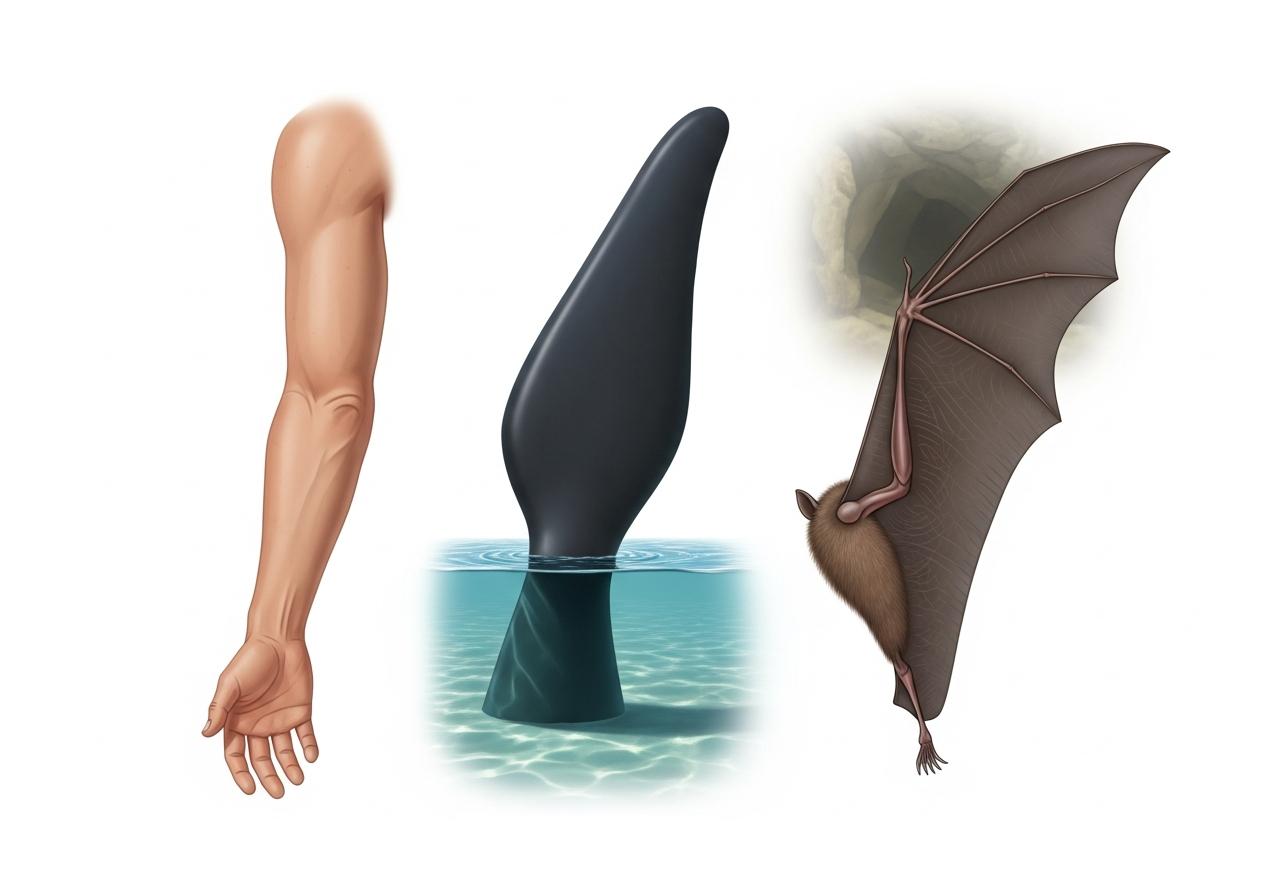
Homologous structures are body parts that share a similar underlying anatomy inherited from a common ancestor, even if they serve very different functions today. The human arm, whale flipper, and bat wing all contain the same set of bones the humerus, radius, ulna, and hand bones arranged in the same pattern. This shared bone structure is strong evidence that these organisms descended from a common ancestor.
Analogous Structures
Analogous structures perform similar functions but have completely different internal structures and did not evolve from a shared ancestor. A bird's wing and a butterfly's wing both allow flight, but a bird's wing contains bones while a butterfly's wing is a thin membrane supported by veins. This independent development of similar features in unrelated lineages is called convergent evolution.
Vestigial Structures
Vestigial structures are reduced, non-functional remnants of structures that were fully functional in an organism's ancestors. Pythons have tiny hip and leg bones buried in their muscles even though they have no legs evidence that their ancient ancestors possessed functional limbs. The human tailbone (coccyx) is another example, representing a remnant of a tail present in our distant ancestors.
Genetic Evidence: Comparing DNA
Modern scientists compare DNA sequences between species to measure genetic similarity. The more similar the DNA, the more recently two species likely shared a common ancestor. For example, humans and chimpanzees share approximately 98% of their DNA, indicating they diverged from a shared ancestor relatively recently in evolutionary time.
When two species have very different DNA sequences, it indicates their lineages separated from a common ancestor far back in evolutionary history, as mutations accumulate over time. Scientists organize this data using phylogenetic trees, which are branching diagrams that show when different lineages diverged. This connects closely to the study of Genetic Variation, Sources of Diversity and Fossil Record, Historical Evidence.
Comparing protein sequences provides additional molecular evidence, since proteins are built from DNA instructions. Species that share more similar proteins are considered more closely related, confirming relationships identified through anatomical comparisons.
Key Terms & Definitions
Comparative Biology: The scientific study of similarities and differences in the structures and genetics of different species to understand evolutionary relationships.
Homologous Structures: Body parts in different species that share a similar underlying anatomy inherited from a common ancestor, even if they serve different functions. Example: a human arm and a whale flipper.
Analogous Structures: Structures in different species that perform similar functions but evolved independently and have different internal structures. Example: a bird's wing and a butterfly's wing.
Vestigial Structures: Reduced or non-functional remnants of structures that were fully functional in an organism's ancestors. Example: tiny leg bones in pythons or the human tailbone.
Convergent Evolution: The process by which unrelated species independently evolve similar features in response to similar environmental pressures, producing analogous structures.
Common Ancestor: An ancient species from which two or more different species eventually evolved through the process of divergence over time.
DNA Sequence Comparison: A scientific method of measuring genetic similarity between species by analyzing and comparing the order of bases in their DNA, used to determine how closely related organisms are.
Phylogenetic Trees: Branching diagrams that organize genetic and anatomical data to show evolutionary relationships and the points at which different lineages diverged from common ancestors.
Mutations: Changes in the DNA sequence of an organism that accumulate over time and are the source of heritable genetic variation, making DNA comparisons between species possible.
Comparative Anatomy: The scientific study of similarities and differences in the physical body structures of different species to identify evolutionary relationships.
Molecular Evidence: Evidence for evolutionary relationships based on comparisons of DNA sequences and protein sequences across different species.
Applying Comparative Biology Concepts
Students can strengthen their understanding by comparing the front limbs of vertebrates such as humans, bats, whales, and dogs. Identifying the humerus, radius, and ulna across these species illustrates how homologous structures reveal common ancestry despite very different functions. This connects to the broader study of Adaptation, Environmental Pressures and Natural Selection, Survival and Reproduction.
Learners can also practice distinguishing homologous from analogous structures by asking two key questions: Do the structures share the same internal anatomy? Do the species share a common ancestor with that feature? If both answers are yes, the structures are homologous; if the function is similar but the internal structure differs, the structures are analogous.
Building on Prior Knowledge
This topic builds on several foundational concepts. Understanding Taxonomy Systems, Kingdoms and Classification Criteria and Species Diversity, Biodiversity Measurements helps students appreciate why classifying organisms by evolutionary relationships matters. Knowledge of Biodiversity, Species Relationships Basic provides context for understanding how species are connected.
At the cellular level, concepts from Basic Principles, Fundamental Concepts Cells, Cell Components, Organelles and Functions, and Cell Types, Plant and Animal Cells explain why DNA comparisons are possible all living cells contain DNA that can be analyzed and compared. The study of Geological Time, Earth's History also provides the deep time framework needed to understand how species diverge over millions of years.
Related Topics & Connections
Comparative biology sits at the intersection of several important scientific fields. The Fossil Record, Historical Evidence provides a timeline of anatomical changes in ancient species, complementing the structural comparisons made in comparative anatomy. Adaptation, Environmental Pressures explains why analogous structures arise different species face similar environmental challenges and independently evolve similar solutions.
Understanding Genetic Variation, Sources of Diversity is essential for interpreting DNA comparisons, since mutations are the source of the genetic differences scientists measure between species. Natural Selection, Survival and Reproduction explains the mechanism by which homologous structures become modified for different functions over time.
This topic also prepares students for more advanced cellular biology concepts. The study of Basic Principles, Fundamental Concepts Cell Biology and Organelles, Structure and Function deepens understanding of the cellular machinery that DNA encodes. Further study of Tissue Types, Cell Specialization, Organ Systems, System Integration, and Cellular Disease, Cancer and Mutations builds on the genetic foundation established here.