TOPIC
MY PROGRESS
Pug Score
0%
Getting Started
"Let's build your foundation!"
Best Streak
0 in a row
Study Points
+0
Overview
Practice
Watch
Read
Quiz
Next Steps
Get Started
Get unlimited access to all videos, practice problems, and study tools.
BACK TO MENU
Topic Progress
Pug Score
0%
Getting Started
"Let's build your foundation!"
Videos Watched
0/0
Best Practice
No score
Read
Not viewed
Best Quiz
No attempts
Best Streak
0 in a row
Study Points
+0
Overview
Practice
Watch
Read
Quiz
Next Steps
Read
Mineral Resources: How They Form and How We Extract Them
You will learn how mineral resources form through geological processes like magma cooling and hydrothermal activity, and how humans extract these valuable materials from Earth's crust using different mining methods.
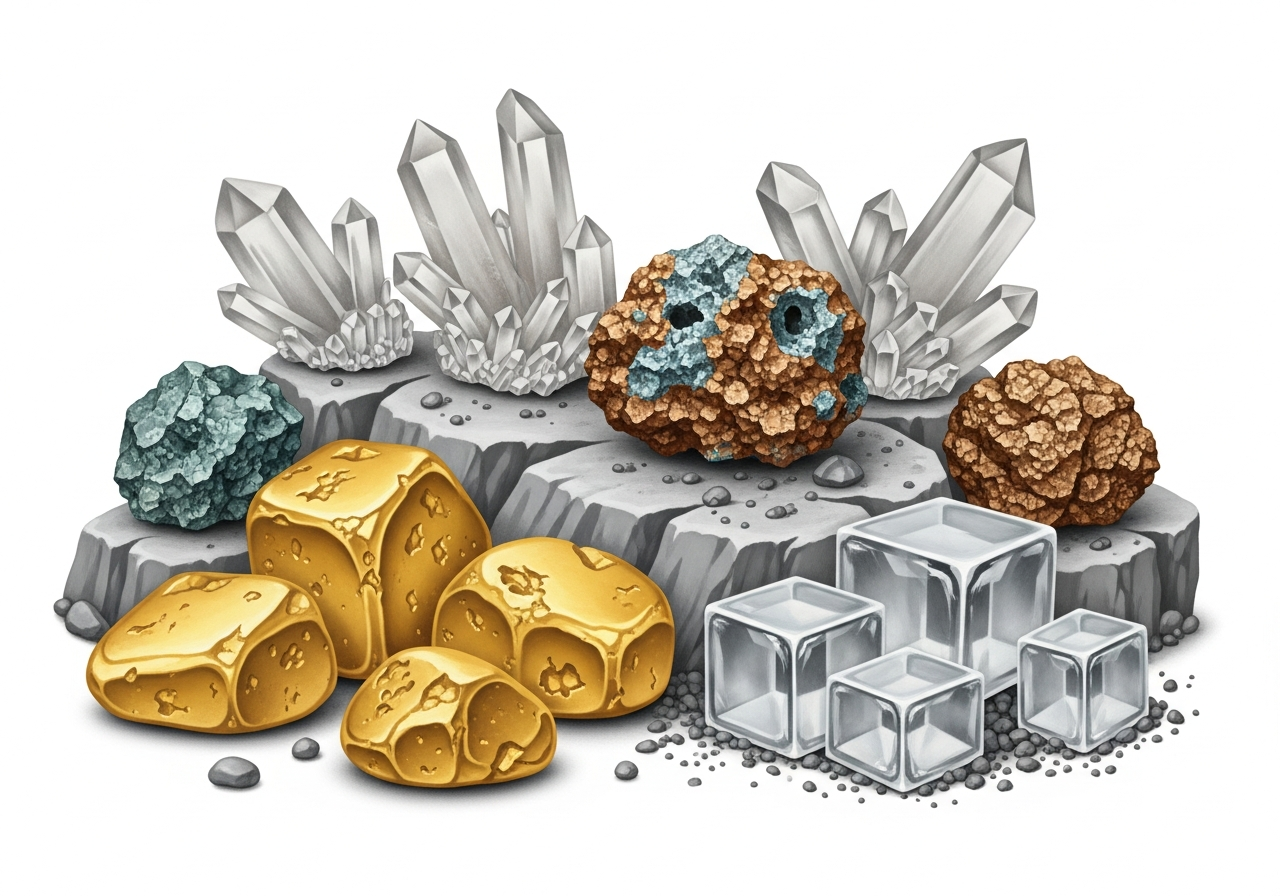
A mineral resource is a naturally occurring, inorganic solid substance found in Earth's crust that you and other people find useful. Minerals like iron ore, copper, gold, and quartz are all examples of mineral resources that industries depend on every day.
To be classified as a mineral, a substance must be naturally occurring, inorganic (not made from living organisms), solid at room temperature, and have a definite chemical composition. For example, quartz has the fixed formula SiO, halite is NaCl, and gold is simply Au.
You can connect this to what you already know from Mineral Properties, Physical and Chemical Properties understanding how minerals are identified prepares you to recognize them as resources.
How Do Mineral Deposits Form?
Most mineral deposits form through one of several geological processes. When magma cools slowly underground, atoms arrange themselves into crystals, forming igneous mineral deposits. This connects directly to your study of Rock Types: Igneous, Sedimentary, and Metamorphic.
Hydrothermal deposits form when superheated, mineral-rich water travels through cracks in rock. As the water cools, it can no longer hold dissolved minerals in solution, so those minerals crystallize and collect in rock fractures forming veins of gold, copper, and other metals.
Evaporite deposits form when mineral-rich water in lakes or seas evaporates, leaving behind dissolved minerals like halite (salt) and gypsum. Placer deposits form when weathering breaks down rocks and heavy minerals like gold settle in riverbeds due to their high density.
The Rock Cycle: Formation and Transformation explains how rocks change over time, which directly influences where and how mineral deposits develop.
Mining and Extraction Methods
Open-pit mining (surface mining) involves removing soil and rock above a deposit to create a large stepped pit. It is used for large-volume, near-surface deposits like copper mines. Underground mining uses shafts and tunnels to reach deep, high-grade ore deposits with less surface disturbance.
Placer mining exploits the natural sorting of dense minerals by river currents denser particles like gold settle while lighter sediment washes away. After mining, smelting uses intense heat to melt ore and separate the valuable metal from surrounding waste rock called slag.
Geologists play a key role in this process they study rock formations to locate where valuable mineral deposits are likely found before any mining begins.
Mineral Resources and Sustainability
Mineral resources are nonrenewable because geological processes that form them take millions of years far longer than any human lifetime. Once a deposit is fully mined, it is essentially gone. This connects to your earlier study of Natural Resources: Renewable and Non-Renewable.
Recycling metals like aluminum, copper, and steel reduces the need to mine new ore, saves energy, and decreases environmental damage. You can explore more about this through Resource Management: Sustainable Use and Conservation and Resource Use: Sustainable Practices.
Large-scale open-pit mining destroys land, produces waste rock (tailings), and can pollute nearby water sources making sustainable use and recycling critically important.
Key Terms and Definitions
Mineral: A naturally occurring, inorganic solid with a definite chemical composition and crystal structure. You can think of quartz (SiO) or gold (Au) as clear examples.
Mineral Resource: A naturally occurring solid substance found in Earth's crust that humans extract and use. Examples include iron ore, copper, and quartz.
Ore: A rock or mineral deposit that contains enough of a valuable substance to make mining it economically worthwhile. Not every rock containing a mineral qualifies as ore it must be profitable to extract.
Vein: A mineral deposit that forms when mineral-rich fluids flow through cracks in existing rock and the minerals crystallize inside the fracture.
Magma: Molten rock located beneath Earth's surface. When magma cools slowly underground, large mineral crystals form.
Sediment: Loose material sand, gravel, silt transported and deposited by rivers, glaciers, or wind. Sediment can sometimes concentrate heavy minerals through placer processes.
Hydrothermal Deposit: A mineral deposit formed when hot, mineral-rich water moves through rock cracks and deposits dissolved minerals as it cools down.
Evaporite Formation: The process where dissolved minerals are deposited as water in lakes or seas dries up, leaving behind minerals like salt and gypsum.
Placer Deposit: A concentration of heavy, resistant minerals like gold that collect in riverbeds after being eroded and transported from surrounding rocks.
Open-Pit Mining: A surface mining method where you remove rock and soil to create a large open hole, used for shallow, large-volume mineral deposits.
Underground Mining: A method of digging shafts and tunnels to reach and remove deeply buried mineral deposits that cannot be reached from the surface.
Placer Mining: A mining method that uses the natural sorting of dense minerals by river currents denser particles settle while lighter sediment washes away.
Smelting: A high-temperature process that melts ore to separate the valuable metal from surrounding waste rock (called slag), producing a purer metal product.
Nonrenewable Resource: A resource that takes millions of years to form naturally and cannot be replaced within a human lifetime. Mineral resources are nonrenewable.
Gemstone: A rare, attractive mineral that is cut and polished for use in jewelry and decoration. Examples include diamonds, rubies, sapphires, and emeralds.
Metallic Mineral: A mineral resource valued for its metal content, such as copper (used in electrical wiring) or iron ore (used to make steel).
Earth's Crust: The solid outermost layer of Earth where nearly all mineral resources are found and extracted through mining.
Sustainable Use: Using mineral resources carefully and efficiently so that future generations will also have enough available to them.
Practice and Application
You can practice identifying whether a substance qualifies as a mineral by checking: Is it naturally occurring? Is it inorganic? Is it solid at room temperature? Does it have a definite chemical composition? Apply this checklist to substances like coal, quartz, and gold.
You can also practice distinguishing between mining methods ask yourself whether a deposit is shallow or deep, large-volume or high-grade, to decide which method fits best. Connect this to Separation Methods: Filtration, Evaporation, and Distillation to see how separation science applies to mineral processing.
Building on What You Already Know
Before exploring mineral resources, you should be comfortable with several foundational topics. Your knowledge of Types of Changes: Physical vs. Chemical Changes helps you understand how minerals transform during smelting and processing. Understanding Solution Properties: Concentration and Solubility explains why hot water dissolves more minerals than cold water the key to hydrothermal deposit formation.
Your study of Conservation: Protection and Restoration connects directly to why sustainable mineral use matters for protecting Earth's environments.
Related Topics and Connections
Understanding mineral resources connects to several important Earth science topics. You will find that Earth's Structure: Internal Layers explains where magma originates and why the crust is where minerals are found. Geological Events: Earthquakes and Volcanoes shows you how tectonic activity brings mineral-rich magma closer to the surface.
Plate Tectonics: Continental Drift Theory explains why mineral deposits are unevenly distributed around the world tectonic plate movement creates the heat and pressure that concentrates minerals into rich deposits along plate boundaries.
This topic also prepares you for more advanced studies. You will build on this foundation in Resource Formation: Mineral and Fossil Fuel Formation, which deepens your understanding of how resources develop over geological time. Introduction Rock Cycle: Formation Processes and Plate Tectonics: Global Patterns will expand your understanding of Earth's dynamic systems. You will also explore Geological Time: Earth's History to understand the vast timescales involved in mineral formation.
For the environmental side, Environmental Science: Resource Management and Sustainable Practices, Conservation: Environmental Protection, and Ecological Wisdom: Sustainable Practices all connect to why responsible mineral extraction and recycling are essential for protecting our planet.