TOPIC

Physical Properties, Mass, volume, density

MY PROGRESS

Pug Score

0%

Getting Started

"Let's build your foundation!"

Best Streak

0 in a row

Study Points

+0

Overview

Practice

Watch

Read

Quiz

Next Steps


Get Started

Get unlimited access to all videos, practice problems, and study tools.

Unlimited practice
Full videos

BACK TO MENU

Topic Progress

Pug Score

0%

Getting Started

"Let's build your foundation!"

Videos Watched

0/0

Best Practice

No score

Read

Not viewed

Best Quiz

No attempts


Best Streak

0 in a row

Study Points

+0

Overview

Practice

Watch

Read

Quiz

Next Steps

Read

Discover Mass, Volume, and Density The Building Blocks of Physical Science

You will learn how to measure and compare the physical properties of matter mass, volume, and density using scientific tools and formulas.

What Are Physical Properties of Matter?

A physical property is something you can observe or measure about an object without changing what it is made of. Mass, volume, and density are three of the most important physical properties you will study in science. You can learn more about how properties connect to materials by exploring Materials Science: Properties and Applications.

Matter is anything that has mass and takes up space. Every object around you a rock, a cup of water, or a balloon is made of matter.
Understanding Mass

Mass is the amount of matter inside an object. You measure mass using a balance scale, which compares your object to known standard masses. The most common units for mass in science are grams (g) and kilograms (kg).

An important fact: mass stays exactly the same no matter where an object is located. If you took a rock to the Moon, its mass would not change only its weight would change because gravity is weaker there.

Understanding Volume

Volume is the amount of space an object takes up. For a box-shaped solid, you can find volume by multiplying length × width × height. The answer is in cubic centimeters (cm³).

For liquids, you use a graduated cylinder to measure volume in milliliters (mL). One milliliter equals one cubic centimeter they are the same amount of space.

For irregularly shaped objects like rocks, you use water displacement. You place the object in water and measure how much the water level rises. That rise equals the object's volume. For example, if a graduated cylinder reads 30 mL before you drop in a marble and 35 mL after, the marble's volume is 5 mL.

Understanding Density

Density describes how tightly matter is packed into a given space. You calculate density using this formula: Density = Mass ÷ Volume. For example, if a rock has a mass of 30 grams and a volume of 10 mL, its density is 3 grams per milliliter (g/mL).

Density is a property of the material itself, not the size of the object. If you cut a block of wood in half, both pieces have the exact same density as the original block, because both mass and volume are halved equally.

Density explains why objects float or sink. Water has a density of 1 g/mL. Objects with a density less than 1 g/mL float, and objects with a density greater than 1 g/mL sink. A large piece of cork floats because cork is less dense than water, while a tiny piece of steel sinks because steel is denser than water size does not determine whether something floats or sinks, density does.

Key Terms and Definitions

Matter: Matter is anything that has mass and takes up space. Every object you can touch or hold is made of matter.

Physical Property: A physical property is a characteristic you can observe or measure without changing what the object is made of. Mass, volume, density, color, and hardness are all physical properties.

Mass: Mass is the amount of matter inside an object. You measure it with a balance scale in grams or kilograms. Mass does not change based on location.

Volume: Volume is the amount of space an object takes up. You measure it in milliliters (mL) or cubic centimeters (cm³). For liquids, you use a graduated cylinder; for box shapes, you multiply length × width × height.

Density: Density is the amount of mass packed into a given volume. You calculate it by dividing mass by volume (D = M ÷ V). It is measured in grams per milliliter (g/mL) or grams per cubic centimeter (g/cm³).

Balance Scale: A balance scale is a tool used to measure mass by comparing an object to known standard masses. It is the most common tool for measuring mass in science class.

Graduated Cylinder: A graduated cylinder is a tall, narrow container with measurement lines used to measure the volume of liquids in milliliters.

Water Displacement: Water displacement is a method used to find the volume of an irregularly shaped object. You place the object in water and measure how much the water level rises that amount equals the object's volume.

Grams (g) and Kilograms (kg): These are the standard metric units you use to measure mass in science. A gram is a small unit; a kilogram equals 1,000 grams.

Milliliters (mL) and Cubic Centimeters (cm³): These are the standard units for measuring volume. One milliliter equals one cubic centimeter exactly.

Exploring Density: Float or Sink?

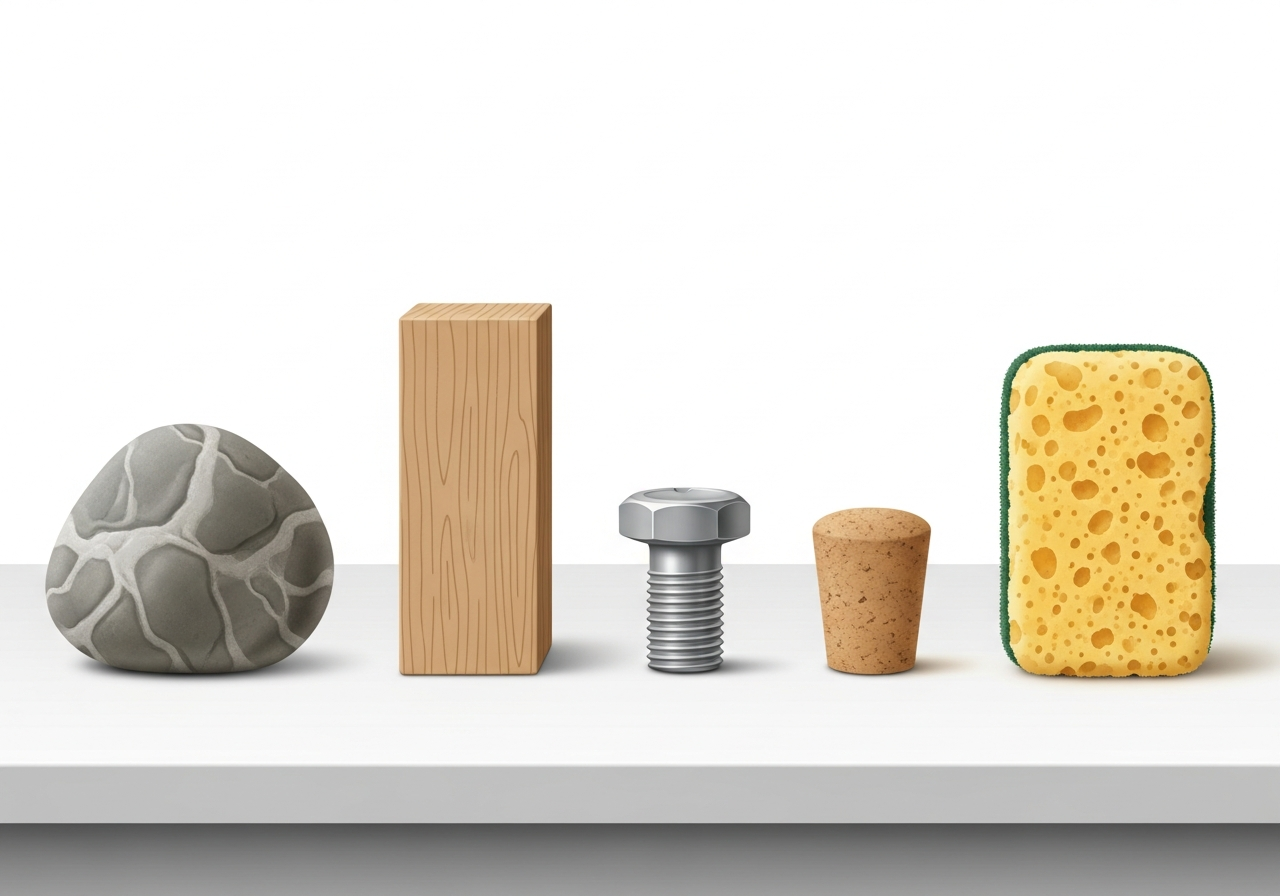
One of the best ways to compare density is to place objects in water. Objects that are denser than water sink, and objects that are less dense than water float. Try dropping a coin and a cork into water the coin sinks because metal is denser than water, and the cork floats because it is less dense.

You can also compare two objects of the same size. A rock and a sponge that are the same size will feel very different the rock is much heavier because it has greater density. This connects to what you will explore in Particle Theory: Arrangement and Movement of Particles, where you learn why some materials pack more matter into the same space than others.

Remember: a student who says "the bigger the object, the denser it must be" is incorrect. A giant foam block has very low density, while a small iron bolt has very high density. Density depends on mass divided by volume, not size alone.

What You Should Already Know

Before studying physical properties, it helps to understand measurement. In Measurement: Standard Units and Precision, you learned how to use metric units accurately skills you will use every time you measure mass and volume.

You also explored physical properties when you studied Rocks and Minerals: Properties and Classification and Soil Composition: Components and Properties. In those topics, you described materials by their observable characteristics now you are adding mass, volume, and density to your toolkit.

Related Topics and Connections

Understanding physical properties opens the door to many exciting science topics. Here is how this topic connects to what you have learned and what you will learn next:

When you study Chemical Properties: Reactivity, pH, and Combustibility, you will compare physical properties (like density) with chemical properties (like burning or rusting). Physical properties describe matter without changing it; chemical properties describe how matter changes into something new.

In Phase Changes: Temperature Effects on State, you will discover how heating or cooling matter changes its state and how density changes when matter changes from solid to liquid to gas.

You will use data skills from Data Collection: Quantitative and Qualitative Data and Analysis Methods: Patterns, Trends, and Relationships to record and interpret your measurements of mass, volume, and density.

This topic also prepares you for Mineral Properties: Physical and Chemical Properties, where you will use density to help identify minerals. You will apply what you know about physical properties when you explore Solution Properties: Concentration and Solubility, Types of Changes: Physical vs. Chemical Changes, and Mixtures: Heterogeneous and Homogeneous.