TOPIC
Materials Science, Properties and applicationsMY PROGRESS
Pug Score
0%
Getting Started
"Let's build your foundation!"
Best Streak
0 in a row
Study Points
+0
Overview
Practice
Watch
Read
Quiz
Next Steps
Get Started
Get unlimited access to all videos, practice problems, and study tools.
BACK TO MENU
Topic Progress
Pug Score
0%
Getting Started
"Let's build your foundation!"
Videos Watched
0/0
Best Practice
No score
Read
Not viewed
Best Quiz
No attempts
Best Streak
0 in a row
Study Points
+0
Overview
Practice
Watch
Read
Quiz
Next Steps
Read
Discover Materials Science: Properties and Real-World Applications
You will learn how the properties of materials such as hardness, flexibility, and conductivity determine how and why each material is used in everyday products and technology.
What Is Materials Science?
Materials science is the study of what things are made of and how those materials behave. When you understand the properties of a material, you can choose the right material for any job. This connects directly to the Design Cycle, where choosing the right material is a key step in solving problems.
A property is a characteristic that describes how a material looks, feels, or behaves. For example, hardness, color, and flexibility are all properties you can observe and test.
Key Material Properties You Need to Know
Different materials have different properties. Here are the most important ones you will use when studying materials science:
- Hardness how resistant a material is to being scratched or dented (e.g., diamond, steel)
- Flexibility how easily a material bends without breaking (e.g., rubber, fabric)
- Transparency how well light passes through a material so objects can be seen clearly (e.g., glass, clear plastic)
- Conductivity how well a material allows heat or electricity to flow through it (e.g., copper wire)
- Absorbency how well a material soaks up and holds liquids (e.g., sponge, towel)
You can also observe texture (how a surface feels rough or smooth), magnetism (whether a material is attracted to a magnet), and buoyancy (whether a material can float on water). These properties connect to what you learned in Physical Properties: Mass, Volume, and Density.
Natural vs. Man-Made Materials
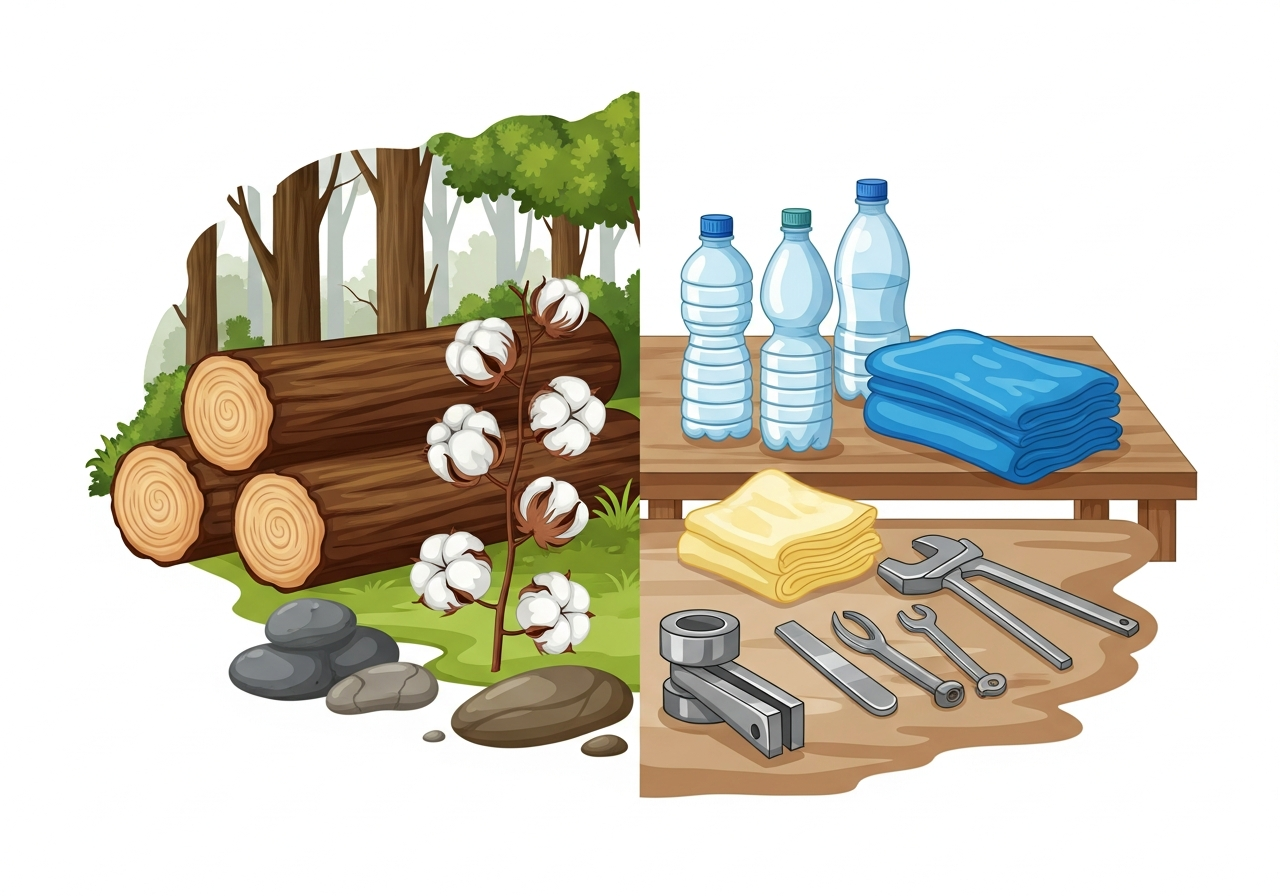
Natural materials come directly from nature wood from trees, cotton from plants, and stone from the ground. Synthetic (man-made) materials are created by people using chemicals or manufacturing processes, like plastic and nylon.
Both types of materials are useful depending on their properties. For example, cotton is soft and breathable for summer clothing, while plastic is lightweight, waterproof, and moldable for bottles and packaging.
Matching Materials to Applications
When you choose a material for a job, you match its properties to what the product needs to do. Here are some common examples:
| Material | Key Properties | Common Uses |
|---|---|---|
| Metal | Strong, conductive, high melting point | Tools, wiring, frying pans, bridges |
| Wood | Strong, workable, sturdy | Furniture, construction, cutting boards |
| Plastic | Lightweight, waterproof, moldable | Bottles, toys, packaging, bags |
| Fabric/Cotton | Soft, flexible, breathable, absorbent | Clothing, furnishings, towels |
| Glass | Transparent, rigid | Windows, eyeglass lenses, containers |
| Rubber | Flexible, grippy, waterproof | Shoe soles, rubber bands, tires |
| Wool | Insulating, soft | Winter sweaters, blankets |
This skill of matching materials to tasks is the foundation of Material Selection: Properties and Applications, which you will explore next.
Key Terms & Definitions
Property: A characteristic that describes how a material looks, feels, or behaves such as hardness, color, or flexibility. You use properties to decide which material is best for a job.
Hardness: How resistant a material is to being scratched or dented. Diamond and steel are very hard materials. You test hardness by trying to scratch a material's surface.
Flexibility: How easily a material bends or changes shape without breaking. Rubber bands and fabric are flexible. You can test flexibility by bending a material back and forth.
Transparency: The ability of a material to let light pass through it so you can see objects clearly on the other side. Glass and clear plastic are transparent.
Conductivity: How well a material allows heat or electricity to flow through it. Copper is an excellent conductor of electricity, which is why it is used in wires.
Absorbency: The ability of a material to soak up and hold liquids inside it. Sponges and towels are absorbent materials used for cleaning.
Waterproof: A property that means water cannot pass through or soak into the material. Raincoats and plastic bags are waterproof.
Magnetic: A property that means a material is attracted to magnets. Iron and steel are magnetic, but aluminum and copper are not.
Brittle: A property that means a material breaks or shatters easily when dropped or hit, rather than bending. Glass is a brittle material.
Opaque: A material that blocks light completely so you cannot see through it. Wood and metal are opaque materials.
Buoyancy: The ability of a material to float on water. This property is important when choosing materials for boats.
Texture: How the surface of a material feels when you touch it rough, smooth, bumpy, or soft. You observe texture using your sense of touch.
Natural material: A material that comes directly from nature, such as wood, cotton, or stone, without being manufactured by people.
Synthetic (man-made) material: A material created by people using chemicals or manufacturing processes, such as plastic or nylon.
Insulator: A material that does not conduct heat or electricity well, slowing down the transfer of energy. Wool and foam are good thermal insulators.
Activities: Exploring Material Properties
You can test material properties yourself! Try these simple investigations to build your understanding of Testing and Evaluation: Performance Assessment:
- Scratch test: Use a coin or nail to scratch different materials and rank them by hardness.
- Bend test: Try bending strips of plastic, cardboard, and metal to compare flexibility.
- Water drop test: Drop water onto different surfaces to see which are waterproof and which are absorbent.
- Magnet test: Hold a magnet near different objects to find out which materials are magnetic.
- Light test: Shine a flashlight through different materials to compare transparency and opacity.
These activities connect to the Problem Definition and Solution Design skills you have already practiced.
Building on What You Already Know
You have already learned important topics that prepare you for materials science. Your knowledge of Rocks and Minerals: Properties and Classification and Soil Composition: Components and Properties gave you practice identifying natural material properties.
Your study of Heat Transfer: Conduction, Convection, and Radiation and Insulation: Materials and Heat Retention taught you how conductivity and insulation work in real life. You also used Optimization: Improving Designs to refine your material choices in design challenges.
Related Topics & Connections
Materials science connects to many other science topics you are exploring. Understanding Particle Theory: Arrangement and Movement of Particles helps you understand why materials have different properties at the particle level. Phase Changes: Temperature Effects on State shows you how materials can change form when heated or cooled.
You will also connect materials science to Physical Properties: Mass, Volume, and Density and Chemical Properties: Reactivity, pH, and Combustibility, which explore deeper material behaviors. The Systems Thinking: Interconnected Components topic helps you see how materials work together in larger systems.
This topic prepares you for Design Process: Engineering Methodology, where you will use material knowledge to build and test real solutions. You will also explore Types of Changes: Physical vs. Chemical Changes and Reactions: Signs of Chemical Reactions, which show you how materials can transform. Finally, Mineral Properties: Physical and Chemical Properties will deepen your understanding of natural materials.