TOPIC
Inscribed angles and proofsMY PROGRESS
Pug Score
0%
Getting Started
"Let's build your foundation!"
Study Points
+0
Overview
Watch
Read
Next Steps
Get Started
Get unlimited access to all videos, practice problems, and study tools.
Back to Menu
Topic Progress
Pug Score
0%
Getting Started
"Let's build your foundation!"
Videos Watched
0/0
Read
Not viewed
Study Points
+0
Overview
Watch
Read
Next Steps
Read
Inscribed Angles and Central Angles: Unlocking Circle Geometry
Introduction to Inscribed Angles and Central Angles
Welcome to our exploration of inscribed angles and central angles in circles! These fundamental geometric concepts are crucial for understanding circle properties and solving various problems in geometry. An inscribed angle is formed when two chords intersect on the circle's circumference, while a central angle has its vertex at the circle's center. The relationship between these angles is fascinating and forms the basis for many geometric theorems. Our introduction video provides a clear, visual explanation of these concepts, making it easier for you to grasp their significance. As we delve deeper into circles, you'll discover how inscribed and central angles relate to arc measures and chord lengths. This knowledge is not only essential for geometry but also has practical applications in fields like engineering and architecture. So, let's embark on this exciting journey through circular geometry together, unraveling the mysteries of inscribed and central angles!
Understanding Inscribed Angles
Inscribed angles are a fascinating concept in geometry that plays a crucial role in understanding circular shapes and their properties. Let's dive into what inscribed angles are, how they're formed, and their unique characteristics.
An inscribed angle is an angle formed by two chords of a circle that intersect on the circle's circumference. In simpler terms, it's an angle where the vertex lies on the circle, and its sides are chords of that circle. This configuration creates a special relationship between the angle and the arc it subtends, which we'll explore in more detail.
To fully grasp inscribed angles, we need to understand some related concepts. First, let's define arcs. An arc is a portion of the circumference of a circle. There are two types of arcs: minor arcs and major arcs. A minor arc is the smaller of the two arcs created by two points on a circle, while a major arc is the larger one. When we talk about arcs in relation to inscribed angles, we're usually referring to minor arcs unless specified otherwise.
Now, let's look at how inscribed angles are formed. Imagine drawing a circle and choosing any point on its circumference. From this point, draw two lines to two other points on the circle. The angle formed at the first point is an inscribed angle. The arc between the other two points is said to be subtended by this angle.
One of the most important properties of inscribed angles is their relationship to central angles. A central angle is an angle with its vertex at the center of the circle. Here's a key fact to remember: an inscribed angle is always half the measure of the central angle that subtends the same arc. For example, if a central angle measures 120°, an inscribed angle subtending the same arc would measure 60°.
Another fascinating property of inscribed angles is that all inscribed angles subtending the same arc or chord are equal, regardless of where their vertex is located on the circle (as long as it's on the same side of the chord). This principle is incredibly useful in solving geometric problems and understanding circular relationships.
Let's consider an example to illustrate this. Imagine a circle with a chord AB. Now, pick any point C on the circle (on one side of AB) and draw lines CA and CB. The angle ACB is an inscribed angle. If you choose another point D on the same side of AB and draw lines DA and DB, you'll find that angle ADB is equal to angle ACB. This holds true for any point you choose on that side of the chord.
Inscribed angles also have a special relationship with right angles. If an inscribed angle subtends a diameter of the circle (a chord that passes through the center), it will always be a right angle (90°). This is because the central angle in this case is 180°, and the inscribed angle is half of that.
Understanding chords is crucial when working with inscribed angles. A chord is a line segment that connects two points on a circle's circumference. The relationship between inscribed angles and chords is particularly useful in solving problems involving circular geometry. For instance, if two chords intersect inside a circle, the angles formed are equal to half the sum of the measures of the arcs intercepted by the angles and their vertical angles.
These properties of inscribed angles have numerous practical applications. In architecture and engineering, they're used to design arches and circular structures. In navigation, they help in determining positions and distances. Even in art, understanding inscribed angles can aid in creating perspective and circular designs.
As you explore inscribed angles further, you'll discover how they relate to other geometric concepts like tangent lines, cyclic quadrilaterals, and the power of a point theorem. Each of these connections deepens our understanding of circular geometry and provides powerful tools for solving complex geometric problems.
In conclusion, inscribed angles are a fundamental concept in circular geometry. Their unique properties, such as being half the measure of central angles and remaining constant when subtending the same arc, make them invaluable in various mathematical and real-world applications. By understanding inscribed angles, arcs, and chords, you'll gain a deeper appreciation for the elegant relationships within circles and enhance your problem-solving
Properties of Inscribed Angles
Hey there! Let's dive into the fascinating world of inscribed angles. You know, these little geometric wonders have some pretty cool properties that can make solving circle problems a breeze. So, what exactly is an inscribed angle? Well, it's an angle that has its vertex on a circle and its sides intersecting the circle at two other points. Simple enough, right? Now, here's where it gets interesting. One of the most important properties of inscribed angles is that if two inscribed angles are on the same arc or equal arcs, they're congruent. That means they have the same measure. Isn't that neat? It's like they're twins, no matter where you place them on the circle, as long as they're looking at the same part of the circle's circumference. Let's break it down with an example. Imagine you have a circle, and you draw two angles inside it. Both angles have their legs touching the same two points on the circle. Even if the vertex of one angle is at a different spot on the circle than the other, they'll still be equal. It's like magic, but it's just geometry! Now, here's a special case that'll blow your mind: right angle inscribed angles. When you have an inscribed angle that's sitting on a diameter of the circle (that's a line that goes straight through the center and touches both sides of the circle), it always forms a right angle. Always! No matter where you put the vertex on the semicircle, you'll get a 90-degree angle. How cool is that? This property of right angle inscribed angles is super useful. Think about it if you ever need to create a right angle but don't have a protractor or a square, you can use this trick. Just draw a circle, mark its diameter, and any angle inscribed on that semicircle will be right. It's like having a perfect 90-degree angle generator at your fingertips! These properties have tons of real-world applications. Architects and engineers using inscribed angles when designing arches and domes. The principle ensures that the structure distributes weight evenly and maintains its shape. Surveyors use these concepts when measuring distances and angles on curved surfaces. Even in computer graphics and game design, understanding inscribed angles helps create realistic circular motions and rotations. But wait, there's more! These properties also come in handy when solving geometry problem solving. If you're working on a problem involving circles and angles, keeping these rules in mind can often lead you to a quick solution. It's like having a secret weapon in your math arsenal. Remember, the key takeaways here are: inscribed angles on the same arc are congruent, and inscribed angles in a semicircle are always right angles. These simple yet powerful concepts open up a whole world of possibilities in geometry and beyond. So next time you're looking at a circle, whether it's a pizza, a wheel, or just a drawing on paper, think about these inscribed angles. They're everywhere, silently governing the geometry of curved shapes all around us. Pretty amazing how such a simple concept can have such far-reaching implications, isn't it? Keep exploring these ideas, and you'll start seeing circles and angles in a whole new light. Who knows? You might even start impressing your friends with your newfound geometric wisdom. After all, understanding inscribed angles is like having a superpower in the world of shapes and spaces!
Introduction to Central Angles
Central angles are fundamental concepts in geometry that play a crucial role in understanding circles and their properties. A central angle is an angle formed by two radii of a circle that intersect at the circle's center. This unique positioning at the heart of the circle distinguishes central angles from other types of angles, particularly inscribed angles.
Unlike inscribed angles, which have their vertex on the circle's circumference, central angles originate from the circle center. This key difference affects how these angles relate to arcs and chords within the circle. Central angles have a direct, one-to-one relationship with the arcs they intercept. The measure of a central angle is always equal to the measure of the arc it subtends. For example, a 60-degree central angle will always intercept a 60-degree arc on the circle's circumference.
This property of central angles makes them particularly useful in various geometric calculations and real-world applications. In contrast, inscribed angles, which are formed by two chords intersecting on the circle's circumference, have a different relationship with their intercepted arcs. An inscribed angle is always half the measure of the central angle that subtends the same arc.
Central angles also have a special relationship with chords. The perpendicular bisector of a chord always passes through the center of the circle, creating two congruent central angles. This property is often used in geometric proofs and constructions. Moreover, the largest chord in a circle is always the diameter, which is subtended by a 180-degree central angle.
Understanding central angles is essential for grasping more complex circular theorems and properties. They serve as a foundation for exploring topics like inscribed angles, tangent lines, and cyclic quadrilaterals. In practical applications, central angles are used in fields such as astronomy to measure celestial arcs, in navigation to determine directions, and in engineering for designing circular structures and mechanisms.
To visualize central angles, imagine a slice of pizza. The point where the crust meets at the center of the pizza represents the vertex of the central angle, while the straight edges of the slice form the angle's rays. The arc of crust on the outer edge of the slice corresponds to the intercepted arc of the central angle. This analogy helps in understanding how central angles relate to the circle's area and circumference.
In conclusion, central angles are pivotal in circular geometry, offering a direct link between angular measure and arc length. Their properties and relationships with arcs and chords provide a solid foundation for exploring more advanced geometric concepts, making them an indispensable tool in mathematics and various practical fields.
Relationship Between Inscribed and Central Angles
Let's dive into an exciting geometric relationship that will enhance your understanding of circles! We're going to explore the connection between inscribed angles and central angles that intercept the same arc. This concept is not only fascinating but also incredibly useful in solving various geometry problems.
First, let's clarify what we mean by inscribed angles and central angles. An inscribed angle is an angle formed by two chords that intersect on the circle's circumference. On the other hand, a central angle is an angle whose vertex is at the center of the circle. Both of these angles can intercept the same arc on the circle, and that's where the magic happens!
Here's the key theorem we'll be focusing on: The measure of an inscribed angle is always half the measure of the central angle that subtends (or intercepts) the same arc. This relationship is consistent and holds true for all inscribed and central angles in a circle. Isn't that amazing?
Let's break this down with an example. Imagine a pizza cut into slices. The angle at the center of the pizza (where all the slices meet) is like our central angle. Now, if you were to draw a line connecting the outer edges of that slice on the crust, you'd form an inscribed angle. The inscribed angle will always be exactly half of the central angle for that same slice!
To put this into practice, let's say we have a central angle of 120°. If an inscribed angle intercepts the same arc, what would its measure be? Using our theorem, we know it would be half of 120°, which is 60°. It's that simple!
This relationship works both ways. If you know the measure of an inscribed angle, you can find the measure of the corresponding central angle by doubling it. For instance, if an inscribed angle measures 45°, the central angle intercepting the same arc would be 90°.
Now, let's try a practice problem to reinforce this concept. Imagine a circle with an inscribed angle of 35°. What would be the measure of the central angle intercepting the same arc? Take a moment to think about it... Got it? The answer is 70°! We simply doubled the inscribed angle to get the central angle.
Here's another interesting fact: All inscribed angles that intercept the same arc are equal, even if they're at different points on the circle's circumference. This is because they're all half of the same central angle. Cool, right?
Understanding this relationship is crucial for solving more complex geometry problems involving circles. It allows you to find missing angle measures, calculate arc lengths, and even solve real-world problems related to circular objects or movements.
As you continue to explore geometry, remember this fundamental relationship. It's like a secret key that unlocks many circular mysteries! Practice identifying inscribed and central angles in various diagrams, and always keep in mind that the inscribed angle is half the central angle for the same intercepted arc.
Don't worry if it takes some time to fully grasp this concept. Geometry is all about visualizing and understanding relationships, and with practice, you'll find yourself becoming more and more comfortable with these ideas. Keep exploring, keep questioning, and most importantly, enjoy the beautiful world of geometric relationships!
Applications and Problem-Solving
Get ready to explore the exciting world of inscribed and central angles in real-life applications! These geometric concepts aren't just theoretical they're all around us, solving problems and shaping our world in fascinating ways. Let's dive into some practical examples that will ignite your curiosity and sharpen your critical thinking skills!
Architecture is a prime field where inscribed and central angles shine. Imagine designing a stunning circular amphitheater. Architects use these angles to ensure perfect sightlines for every spectator. By applying the inscribed angle theorem, they can calculate the optimal seating arrangement, making sure everyone has a great view of the stage. It's geometry in action, creating unforgettable experiences!
Now, let's tackle a real-world problem. Suppose you're an urban planner tasked with designing a roundabout at a busy intersection. How do you ensure smooth traffic flow? The answer lies in central angles! By dividing the circle into equal central angles, you can create perfectly spaced entry and exit points. This application of geometry not only improves traffic efficiency but also enhances safety for drivers.
Here's a step-by-step solution to a roundabout design problem:
- Determine the number of roads intersecting (let's say 4).
- Calculate the central angle for each road: 360° ÷ 4 = 90°.
- Design entry and exit points at these 90° intervals.
- Use inscribed angles to create smooth curves for merging lanes.
Isn't it amazing how geometry solves real-world challenges?
But wait, there's more! Inscribed angles play a crucial role in satellite communication. Engineers use these principles to design parabolic antennas that can precisely focus signals. By understanding the relationship between inscribed angles and arcs, they create dishes that capture and transmit data across vast distances. It's mind-blowing to think that the same concepts you're learning are powering global communications!
Let's explore another everyday application. Have you ever wondered how your car's windshield wipers work so efficiently? It's all thanks to inscribed angles! The wiper arm moves in an arc, creating an inscribed angle that maximizes the cleaned area. Engineers carefully calculate these angles to ensure optimal visibility in all weather conditions. Next time you're driving in the rain, take a moment to appreciate the geometry at work!
Now, let's put your problem-solving skills to the test with a real-world scenario:
Imagine you're designing a Ferris wheel for a new amusement park. The wheel has a diameter of 50 meters, and you need to determine how many cabins to install for the best experience. Here's how to approach this problem:
- Consider factors like cabin size, spacing, and ride duration.
- Decide on a central angle between cabins (e.g., 20°).
- Calculate the number of cabins: 360° ÷ 20° = 18 cabins.
- Use the inscribed angle theorem to ensure each cabin has a great view at the top.
By solving this problem, you're not just crunching numbers you're creating joy and excitement for thousands of people!
The applications of inscribed and central angles extend to many other fields. In sports, they help design the perfect curve for a racing track. In optics, they're crucial for creating precise lenses and mirrors. Even in art, these geometric principles guide artists in creating balanced and visually appealing compositions.
As you can see, mastering these concepts opens up a world of possibilities. Every time you encounter a circular structure or a curved design, challenge yourself to identify the inscribed and central angles at play. This habit will sharpen your observation skills and deepen your appreciation for the geometry that shapes our world.
Remember, problem-solving with these geometric principles isn't just about finding the right answer it's about developing a mindset that sees solutions where others see obstacles. So, embrace these challenges with enthusiasm! Each problem
Conclusion and Further Study
Inscribed angles and central angles are fundamental concepts in circle geometry. The introduction video provides a crucial foundation for understanding these relationships. Inscribed angles are half the measure of central angles subtending the same arc, while central angles are measured from the circle's center. To deepen your knowledge of circle geometry, explore topics like chord properties, tangent lines, and circle theorems. Online resources like Khan Academy and GeoGebra offer interactive tools for practice. Textbooks and geometry workbooks can provide additional exercises. Remember, geometry's applications extend far beyond the classroom, influencing fields such as architecture, engineering, and computer graphics. The problem-solving skills developed through studying circle geometry are invaluable in many careers. As you continue your journey in mathematics, keep in mind that mastering these concepts opens doors to advanced topics and real-world applications. Embrace the challenge and enjoy the beauty of geometric relationships!
Inscribed Angles and Proofs: Find x
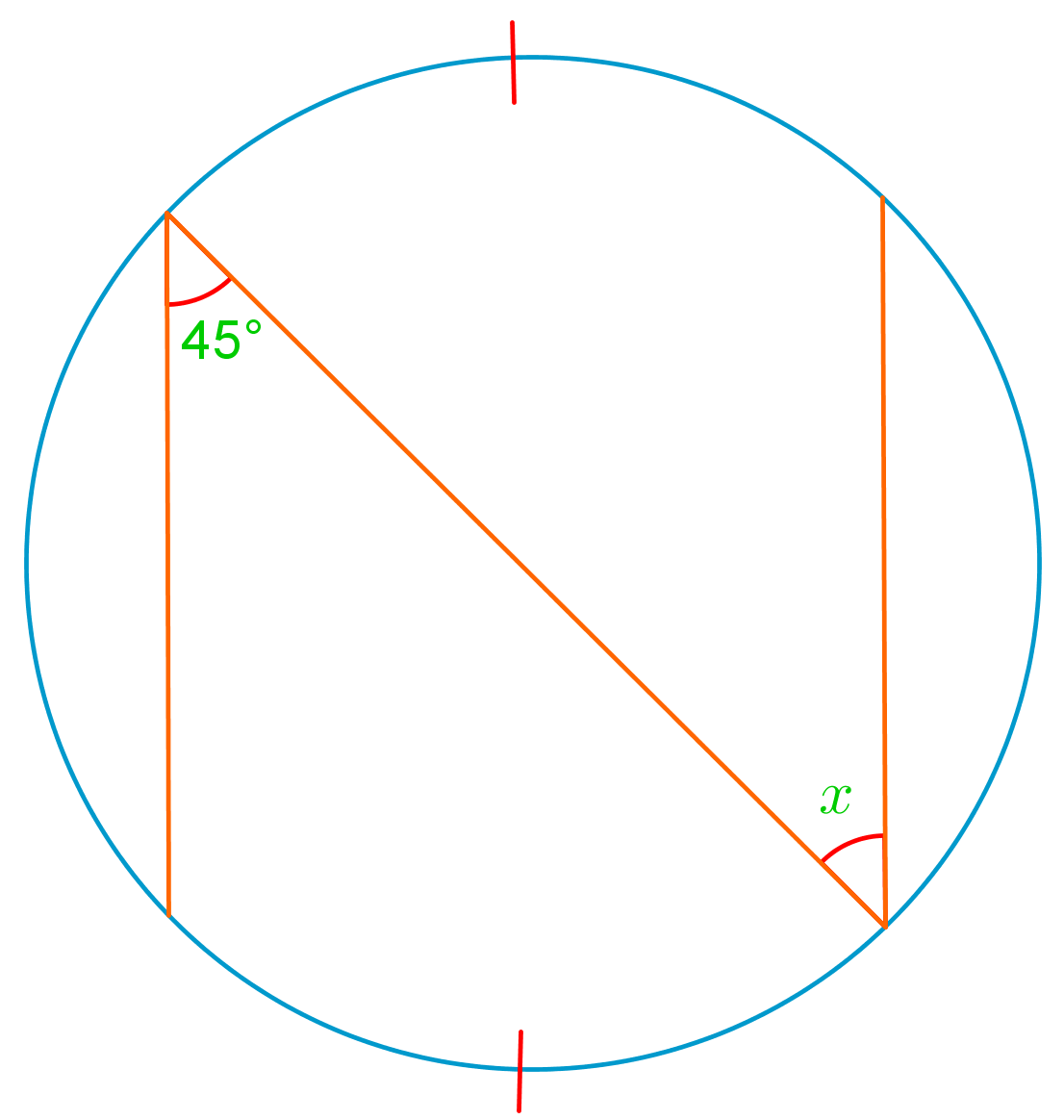
Find x
Step 1: Understanding the Problem
In this problem, we are given a circle with certain arc lengths and inscribed angles. The goal is to find the value of the missing angle, denoted as x. The key concept here is the relationship between arc lengths and inscribed angles in a circle.
Step 2: Identifying the Given Information
From the diagram, we can see that there are two inscribed angles and their corresponding arc lengths. One of the inscribed angles is given as 45 degrees. We need to determine the value of the other inscribed angle, which is represented by x.
Step 3: Applying the Inscribed Angle Theorem
The Inscribed Angle Theorem states that an inscribed angle is half the measure of its intercepted arc. This means that if two inscribed angles intercept the same arc, they are equal. In this case, we have an inscribed angle of 45 degrees intercepting a certain arc length.
Step 4: Analyzing the Arc Lengths
According to the problem, the arc length intercepted by the 45-degree angle is the same as the arc length intercepted by the angle x. This implies that the two inscribed angles are equal because they intercept the same arc length.
Step 5: Concluding the Relationship
Since the inscribed angle of 45 degrees and the angle x intercept the same arc length, we can conclude that the measure of angle x is also 45 degrees. This is based on the Inscribed Angle Theorem, which states that inscribed angles intercepting the same arc are equal.
Step 6: Final Verification
To ensure our solution is correct, we can verify that the arc lengths and inscribed angles are consistent with the given information. Both angles intercept the same arc length, and therefore, they must be equal. This confirms that our solution is accurate.
Conclusion
By applying the Inscribed Angle Theorem and analyzing the given arc lengths, we have determined that the value of the missing angle x is equal to the given inscribed angle of 45 degrees. This solution is based on the fundamental properties of inscribed angles and their relationship with arc lengths in a circle.
FAQs
Q1: What is the difference between an inscribed angle and a central angle?
A: An inscribed angle has its vertex on the circle's circumference and is formed by two chords, while a central angle has its vertex at the center of the circle and is formed by two radii. The key relationship is that an inscribed angle is always half the measure of the central angle that subtends the same arc.
Q2: How do you calculate the measure of an inscribed angle?
A: To calculate the measure of an inscribed angle, you can use its relationship with the central angle. The inscribed angle is always half the measure of the central angle that subtends the same arc. If you know the measure of the arc, the inscribed angle is half of that measure.
Q3: What is the inscribed angle theorem?
A: The inscribed angle theorem states that an inscribed angle is half the measure of the central angle that subtends the same arc on a circle. This theorem is fundamental in circle geometry and has many applications in problem-solving and real-world scenarios.
Q4: Can inscribed angles be right angles?
A: Yes, inscribed angles can be right angles. In fact, any inscribed angle that intercepts a semicircle (half of the circle's circumference) will always be a right angle (90 degrees). This property is known as the inscribed angle in a semicircle theorem.
Q5: How are inscribed and central angles used in real-world applications?
A: Inscribed and central angles have numerous real-world applications. They are used in architecture for designing arches and domes, in urban planning for creating efficient roundabouts, in satellite communications for designing parabolic antennas, and in engineering for designing windshield wipers and Ferris wheels. These concepts are also crucial in fields like optics, sports track design, and artistic compositions.
Prerequisite Topics
Understanding inscribed angles and proofs is a crucial aspect of geometry that builds upon several fundamental concepts. To fully grasp this topic, it's essential to have a solid foundation in related areas. One of the most important prerequisites is the knowledge of central and inscribed angles in circles. This concept forms the backbone of inscribed angle proofs, as it establishes the relationship between inscribed and central angles, which is vital for solving more complex problems.
Another key prerequisite is understanding tangent properties in circles. Tangent lines play a significant role in many inscribed angle proofs, especially when dealing with circles that intersect or touch at specific points. Knowing how tangent lines behave and their properties in relation to circles can greatly simplify the process of constructing and understanding proofs involving inscribed angles.
Additionally, familiarity with arc length calculation is beneficial when working with inscribed angles and proofs. While this concept is more advanced and often encountered in calculus, having a basic understanding of how arc lengths relate to angles in a circle can provide valuable insights when dealing with inscribed angle problems.
The relationship between inscribed and central angles is particularly crucial. This fundamental principle states that an inscribed angle is half the measure of the central angle that subtends the same arc. This relationship forms the basis for many proofs and problem-solving techniques in this area of geometry. By mastering this concept, students can more easily tackle complex proofs involving inscribed angles.
Understanding tangent lines in circles is equally important. Tangent lines are perpendicular to the radius at the point of tangency, which is a property often used in proofs involving inscribed angles. This knowledge allows students to make logical deductions and construct valid arguments in their proofs.
While arc length calculation might seem more advanced, it provides a deeper understanding of the relationship between angles and the circumference of a circle. This knowledge can be particularly useful when dealing with problems that involve multiple inscribed angles or when working with sectors of circles.
By thoroughly understanding these prerequisite topics, students will be well-equipped to tackle the challenges presented by inscribed angles and proofs. These foundational concepts provide the necessary tools and logical framework to approach more complex geometric problems with confidence. As students progress in their study of geometry, they'll find that these prerequisite topics continually resurface, reinforcing their importance in the broader context of mathematical understanding.