Macroeconomics Help: Video Lessons & Practice
Step-by-step lessons on GDP, fiscal policy, and more — so you're ready for midterms and finals.
Value vs. Private Tutor
Expert macroeconomics help without the price tag.

Multi-Subject
Learn Macroeconomics and switch subjects anytime.
Build Mastery
Master supply and demand first.
Macroeconomics Topics
1. Measuring GDP
2. Jobs and Inflation
3. Understanding Economic Growth
4. Finance and Loans
5. Money and Banks
6. The Exchange Rate
7. Aggregate Supply and Demand
8. The Keynesian Model
9. Inflation and Unemployment
9 Chapters · 36 Topics · 118 Videos
Discover Our Learning Areas
Explore key subjects and start learning with interactive content.













What is Macroeconomics?
Macroeconomics is the branch of economics that studies how entire economies behave — examining national output, employment, inflation, and the policy decisions that shape them. Where microeconomics looks at individual buyers and sellers, macroeconomics asks bigger questions: Why do economies grow? What causes recessions? How do central banks control inflation? If you are taking a university macroeconomics course, you will work with models that explain these dynamics and develop the analytical skills to evaluate fiscal and monetary policy in the real world.
What Topics Are Covered in a University Macroeconomics Course?
A standard university Macroeconomics course covers a broad set of interconnected topics. You will begin with national income accounting — learning how GDP is measured and what it tells us about an economy's health. From there the course moves through economic growth theory, the determinants of unemployment, and the causes and consequences of inflation.
The analytical core of most courses is the Aggregate Demand–Aggregate Supply (AD-AS) model, which you will use to trace the short-run and long-run effects of demand shocks, supply shocks, and policy responses. Alongside this you will study the money market, the Federal Reserve's tools (interest rate policy, open market operations, reserve requirements), and how monetary policy transmits to the broader economy.
Later modules typically introduce the Phillips curve trade-off between inflation and unemployment, open-economy macroeconomics including exchange rates and trade balances, and current debates around topics such as quantitative easing and fiscal multipliers. Problem sets and exams ask you to apply these frameworks to real or hypothetical scenarios, so understanding the mechanics — not just the terminology — is what the course rewards.
Is Macroeconomics Hard? Where Do Students Struggle Most?
Macroeconomics is considered moderately difficult, and the challenge is often more conceptual than mathematical at the introductory level. Students who breeze through Microeconomics sometimes find Macro harder because the models are more abstract — you are reasoning about an entire economy, not a single firm or household.
The most common trouble spots are the AS-AD model (particularly understanding why the long-run aggregate supply curve is vertical and how short-run equilibrium self-corrects), the money market and Federal Reserve transmission mechanisms, the Phillips curve and stagflation scenarios, and the difference between the spending multiplier for government purchases versus lump-sum taxes. Students also frequently mix up the effects of expansionary fiscal policy and expansionary monetary policy, especially in open-economy contexts where exchange rates complicate the picture.
The good news is that these concepts respond well to structured practice. Working through varied exam-style scenarios — rather than re-reading notes passively — is the most effective preparation strategy.
How Is Macroeconomics Graded? Midterms, Finals, and Assignments
At US universities, Macroeconomics grades are typically built from two or three midterm exams (which together often account for 40–50% of the final grade), a cumulative final exam (30–40%), and weekly or bi-weekly problem sets or short written responses. Some professors also include in-class quizzes, participation grades, or a short research paper.
Exam formats vary by institution, but multiple-choice questions testing conceptual understanding are common, alongside graphing questions that require you to draw, label, and shift AD-AS or money-market diagrams correctly. Free-response questions ask you to walk through a policy scenario step by step — explaining not just what happens but why. Reviewing past exams and completing timed practice tests under realistic conditions is one of the highest-leverage study activities you can do.
Why StudyPug for Macroeconomics?
StudyPug is built specifically for university students who need more than a textbook. Here is what makes it different for macroeconomics learners.
Diagnostic assessment first. Before you watch a single video, a quick diagnostic identifies exactly which macroeconomics topics you are shaky on. That means you spend your limited study time on the areas that will move your grade, not on topics you already know.
Certified-teacher concept videos that teach the method. Every video lesson is made by an experienced, certified instructor — not AI-generated content. The lessons walk you through the reasoning behind each step, so you understand the AS-AD model or the money market deeply enough to handle a question you have never seen before. Watch each video as many times as you need until it clicks.
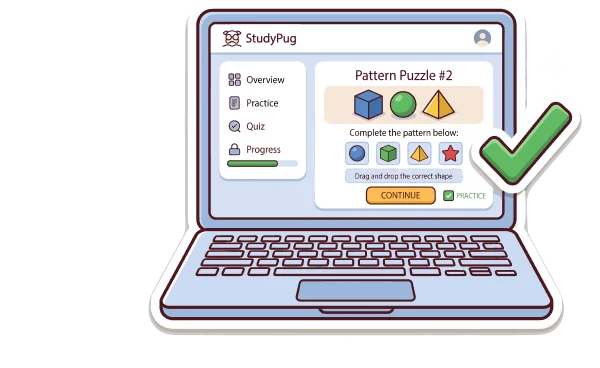
Adaptive practice that adjusts to you. Once you are ready to practice, StudyPug's adaptive system adjusts the difficulty of macroeconomics practice problems based on your performance. You are always working at the right level — challenged enough to improve, supported enough to build real confidence.
Full exam prep for midterms and finals. Mock exams and practice tests are structured to mirror real university assessments, covering GDP analysis, fiscal policy scenarios, monetary policy diagrams, and Phillips curve questions. Work through them timed, review the step-by-step solutions, and go into your final prepared.
One subscription, every course. Your StudyPug plan includes Macroeconomics alongside Microeconomics, Calculus I–III, Linear Algebra, Statistics, Differential Equations, and more. If you are taking multiple courses this semester, you are covered — no extra cost.
30-day money-back guarantee. Try StudyPug risk-free. If it is not the right fit within the first 30 days, you get a full refund — no questions.
What You Will Learn: Key Macroeconomics Topics
StudyPug's macroeconomics content is organized around the core topics that appear on midterms and finals at US universities. Key areas include:
- GDP and National Income Accounting — measuring output, income, and expenditure; real vs. nominal GDP; the GDP deflator and CPI.
- Economic Growth — the Solow growth model, capital accumulation, productivity, and long-run determinants of living standards.
- Unemployment and Labor Markets — types of unemployment, the natural rate, cyclical unemployment, and labor force participation.
- Inflation and the Price Level — causes of inflation, the Fisher effect, costs of inflation, and hyperinflation.
- The AD-AS Model — aggregate demand and its determinants, short-run vs. long-run aggregate supply, and equilibrium analysis.
- Fiscal Policy — government spending, taxation, budget deficits, the spending multiplier, and Ricardian equivalence.
- Money, Banking, and the Federal Reserve — the money supply, money demand, open market operations, and interest rate policy.
- Monetary Policy and the AD-AS Framework — how the Fed shifts the money supply, interest rate transmission, and the IS-LM connection.
- The Phillips Curve — the short-run trade-off between inflation and unemployment, stagflation, and expectations-augmented models.
- Open Economy Macroeconomics — exchange rates, net exports, the trade balance, and the effects of policy in an open economy.
Because no validated internal topic URLs are currently available for this course page, explore the full topic list directly on StudyPug's Macroeconomics course page after signing up.
How to Use StudyPug for Macroeconomics
Getting started takes a few minutes. Sign up, then take the diagnostic assessment — it maps your current knowledge and creates a personalized study path. From there, watch the certified-teacher video lesson for your first weak-spot topic. Pause, rewind, and rewatch as needed; there are no time limits.
After each lesson, move into the adaptive practice problems for that topic. The system tracks your accuracy and adjusts difficulty, so you are always building on what you know. When your exam is approaching, switch to the mock exam mode — work through a timed, full-length practice test, then review every question with the step-by-step solution video.
You can use StudyPug on any device — laptop before lecture, phone between classes, tablet late at night. Your progress is saved automatically, so you can pick up exactly where you left off. Start your free practice today and see how quickly macroeconomics starts to make sense.
Macroeconomics FAQ
Unsure how StudyPug works? Need help with setting up? Check our frequently asked questions or contact us for help.
What do you learn in Macroeconomics, and what topics does it cover?
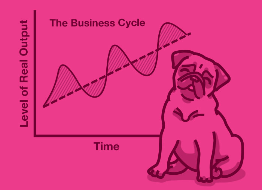
Macroeconomics examines how national and global economies function as a whole. Core topics include GDP measurement, economic growth, unemployment, inflation, aggregate demand and supply, fiscal policy, monetary policy, the Federal Reserve, the Phillips curve, trade balances, and exchange rates. You will also study business cycles, long-run growth models, and open-economy dynamics. By the end of the course, students can analyze government budget decisions and central bank actions and evaluate their real-world effects on output and prices.
What is the difference between Macroeconomics and Microeconomics?
Microeconomics focuses on individual decision-makers — consumers, firms, and markets — studying how prices are set, how households allocate budgets, and how firms compete. Macroeconomics zooms out to the economy as a whole, analyzing national output, aggregate price levels, unemployment rates, and the policy tools governments and central banks use to stabilize the economy. Both courses are usually required for economics majors; Microeconomics is typically taken first and provides the foundational supply-and-demand framework that Macroeconomics then applies at a national scale.
What are the prerequisites for Macroeconomics, and what course comes after it?
Most university Macroeconomics courses require Principles of Microeconomics or a combined Principles of Economics course as a prerequisite. Some programs also expect basic algebra. After introductory Macroeconomics, students typically progress to Intermediate Macroeconomics, which introduces IS-LM and AD-AS models in greater mathematical depth. From there, advanced electives include Monetary Economics, International Finance, Economic Growth Theory, and graduate-level Macroeconomic Theory. Confirming your program's specific sequence with your academic advisor is always recommended.
Is Macroeconomics hard, and where do students struggle most?
Macroeconomics is considered moderately challenging. Many students find it more abstract than Microeconomics because the models describe entire economies rather than concrete individual choices. The most common sticking points are the AS-AD model and how shifts in each curve interact, the money market and Federal Reserve policy mechanics, interpreting the Phillips curve trade-off, and keeping straight the multiplier effects for government spending versus taxes. Consistent practice applying each model to real-world scenarios — rather than memorizing definitions — is the approach that tends to produce the biggest improvement.
How is Macroeconomics assessed — midterms, finals, and assignments?
At most US universities, Macroeconomics is assessed through two or three midterm exams, a cumulative final exam, and periodic problem sets or short essays. Exams typically include multiple-choice questions testing conceptual recall, graphing questions requiring you to draw and shift AS-AD or money-market diagrams, and free-response questions asking you to analyze a policy scenario. Participation, quizzes, and a research paper may also factor in depending on the professor. Checking your syllabus early in the semester gives you the exact weighting for each component.
What is one of the hardest topics in Macroeconomics, and how do you approach it?
The AS-AD model is consistently the topic students find most difficult. It combines short-run and long-run aggregate supply, aggregate demand, and price-level adjustment all in one framework — and exam questions often require you to trace a full chain of events from an initial shock through to the new equilibrium. The best approach is to start by drawing the baseline diagram cleanly, then identify which curve shifts and in which direction, then trace the short-run effect on output and prices, and finally show the long-run self-correction. Practicing this four-step routine on varied scenarios until it becomes automatic is the most effective preparation.





Written by the StudyPug Team
Last updated June 5, 2026
3 M+
students
★★★★★
4.8 average
K–12
all grades