Microeconomics Help: Video Lessons & Practice
Step-by-step video lessons and adaptive practice for every microeconomics topic — from supply and demand to game theory.
Value vs. Private Tutor
Expert teaching without the tutor price.

Multi-Subject
Study any subject and switch anytime.
Build Mastery
You actually master it before moving on.
Microeconomics Topics
1. Introduction to Economics
2. Problems of Economics
3. Demand and Supply
4. Elasticity
5. Welfare Economics
6. Consumer Choice
7. Output and Costs
8. Perfect Competition
9. Monopoly
11. Government & Inequalities
11 Chapters · 42 Topics · 453 Videos
Discover Our Learning Areas
Explore key subjects and start learning with interactive content.






What Is Microeconomics?
Microeconomics is the branch of economics that studies how individual consumers, firms, and markets make decisions under scarcity. It explains why prices rise and fall, how businesses decide what to produce, and how government policy affects market outcomes. If you are taking a university microeconomics course, you will use optimization techniques and equilibrium analysis to model real-world economic behavior — skills that carry forward into every advanced economics elective and into careers in finance, consulting, and public policy.
The course is typically taken in the first or second year of an economics, business, or social science degree. It sits at the intersection of mathematical reasoning and economic intuition, which is what makes it both challenging and rewarding.
Supply and Demand: The Foundation of Microeconomics
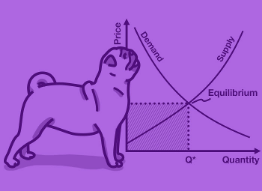
Supply and demand is the first major framework you encounter — and it runs through every topic that follows. The demand curve shows how quantity demanded changes as price changes, holding everything else constant. The supply curve shows the same relationship from the producer's side. Equilibrium is where they intersect.
Where students stumble is with shifts versus movements along a curve. A price change causes a movement along the demand curve; a change in income, preferences, or the price of a related good causes a shift. Getting this distinction right is essential for every comparative statics problem on midterms and finals. Regular microeconomics practice problems that ask you to identify the cause before drawing the graph will build this reflex quickly.
Price Elasticity: How Much Do Quantities Respond?
Elasticity measures responsiveness. Price elasticity of demand tells you how much quantity demanded changes when price changes by one percent. Cross-price elasticity and income elasticity extend the idea to related goods and changes in income. Firms use elasticity to set prices; governments use it to design taxes.
The math is straightforward: percentage change in quantity divided by percentage change in price. The difficulty is interpreting the result correctly and knowing which formula applies (arc elasticity versus point elasticity). Working through elasticity practice problems — especially the ones that combine elasticity with total revenue — is the fastest way to get comfortable before a midterm.
Market Structures: From Perfect Competition to Monopoly
Market structures describe the competitive environment a firm operates in. The four main types are perfect competition, monopolistic competition, oligopoly, and monopoly. Each has a distinct profit-maximization condition, price outcome, and welfare implication.
In perfect competition, firms are price takers and price equals marginal cost in long-run equilibrium. A monopolist sets marginal revenue equal to marginal cost and charges a price above that — creating deadweight loss. Oligopoly introduces strategic interaction: firms must anticipate rivals' responses, which is where game theory enters. Students often struggle with the jump from single-firm analysis to multi-firm strategic reasoning. Step-by-step video lessons that work through each structure before moving to the next make that transition much smoother.
Consumer Theory: Utility, Budgets, and Optimal Choice
Consumer theory models how a rational individual allocates a limited budget across goods to get the highest possible utility. The key concept is the optimality condition: the marginal rate of substitution equals the price ratio. Graphically, the consumer picks the bundle where the highest indifference curve touches the budget line.
The mathematical version — Lagrangian utility maximization — is one of the most commonly tested skills in intermediate micro courses. It is also one of the most common points of confusion. The trick is to internalize the economic meaning of each step rather than memorizing the procedure. Once you understand that the Lagrange multiplier represents the marginal utility of income, the whole method makes sense.
Game Theory: Strategic Interaction and Nash Equilibrium
Game theory is the study of strategic decision-making — situations where your best choice depends on what someone else does. In a Nash equilibrium, no player can improve their outcome by changing their strategy unilaterally, given what the others are doing.
The most reliable way to find a Nash equilibrium in a normal-form game is to identify each player's best response to every possible strategy of the other player, then look for the intersection. Dominant strategies — if they exist — simplify this process. Practicing with varied payoff matrices builds the pattern recognition that exam questions demand. Game theory topics also appear in oligopoly analysis and in more advanced courses like Industrial Organization.
Why StudyPug for Microeconomics Help
Microeconomics rewards active problem-solving, not passive review. StudyPug is built around that reality.
The platform opens with a diagnostic assessment that identifies exactly which microeconomics topics are solid and which need work — so you are not wasting study time on material you already understand. From that starting point, certified-teacher concept videos teach the method behind each topic. These are not AI-generated summaries; they are step-by-step lessons from experienced instructors who explain the economic reasoning, not just the mechanics. The goal is deep understanding — so that you can adapt when an exam question is phrased differently from the practice problems you have seen.
Adaptive practice then adjusts difficulty in real time based on your performance. If you are getting cost-curve problems right, the platform moves you toward more challenging market-structure questions. If elasticity is a weak point, it keeps you there until you are confident. This is significantly more efficient than working through a fixed problem set from beginning to end.
StudyPug covers full university economics depth — Microeconomics, Macroeconomics, Econometrics, Statistics, Calculus, and Linear Algebra — all under one subscription. You are not paying separately for each course. Free daily practice content is available without a subscription, and all paid plans come with a 30-day money-back guarantee.
What You Learn: Microeconomics Topic Coverage
StudyPug's Microeconomics course covers the full scope of a standard university curriculum, including:
- Supply and demand analysis, market equilibrium, and comparative statics
- Price, income, and cross-price elasticity of demand and supply
- Consumer theory: utility functions, indifference curves, budget constraints, and utility maximization
- Substitution and income effects; normal, inferior, and Giffen goods
- Producer theory: production functions, isoquants, cost minimization, and cost curves
- Short-run and long-run cost analysis; economies of scale
- Profit maximization under perfect competition; long-run equilibrium
- Monopoly pricing, price discrimination, and deadweight loss
- Monopolistic competition and product differentiation
- Oligopoly models: Cournot, Bertrand, and Stackelberg
- Game theory: normal-form games, Nash equilibrium, dominant strategies, and repeated games
- Factor markets: labor supply and demand, wage determination
- Market failures: externalities, public goods, asymmetric information
- Welfare analysis: consumer surplus, producer surplus, and efficiency
Each topic has dedicated video lessons and practice problem sets. You can jump to any topic directly — there is no need to work through the whole course in order if you need targeted help before a midterm.
Note: No validated internal topic URLs are currently available in the link map for this course page. Links will be added once the SP_PageFeed is updated.
How to Use StudyPug for Microeconomics Practice
The most effective workflow for microeconomics exam prep on StudyPug follows a clear pattern: diagnose, learn, practice, and test.
Start with the diagnostic. Even if you feel confident in most areas, the diagnostic assessment often surfaces a conceptual gap — an elasticity formula you have been applying incorrectly, or a cost-curve relationship you have been visualizing wrong. Addressing that early saves hours before finals.
Watch the concept video before attempting practice problems. StudyPug's certified-teacher lessons teach the economic reasoning behind each technique. Watching a lesson on monopoly pricing before doing monopoly practice problems means you understand the logic of MR = MC, not just the formula — and that understanding holds up when exam questions are framed differently from what you have seen.
Use adaptive practice between sessions. The platform adjusts to your performance, so daily short practice sessions are more effective than one long cramming session the night before. Building fluency with supply-demand shifts, elasticity calculations, and cost curves requires repetition over time.
Simulate your exams with mock tests. StudyPug's mock exams are structured to reflect the format of real midterms and finals — timed, cumulative, and covering the mix of graphical and mathematical questions your course uses. Running through a mock exam a week before your actual test is one of the highest-leverage study activities you can do. Review every question you got wrong, trace it back to the concept, watch the relevant video, and repeat the practice.
All of this — diagnostic, video lessons, adaptive practice, and mock exams — is available across desktop and mobile, so you can keep up with microeconomics practice between classes, during a commute, or the night before an assignment is due. Start your free practice today and see where you stand.
Microeconomics FAQ
Unsure how StudyPug works? Need help with setting up? Check our frequently asked questions or contact us for help.
What do you learn in Microeconomics, and what topics does it cover?
Microeconomics studies how individuals, households, and firms make decisions about allocating scarce resources. Core topics include supply and demand, price elasticity, consumer theory (utility and budget constraints), producer theory (production and cost functions), market structures (perfect competition, monopoly, oligopoly, monopolistic competition), game theory, factor markets, and market failures such as externalities and public goods. Most university courses also cover welfare analysis and basic general equilibrium. It builds the analytical framework used across economics, finance, and public policy.
What is the difference between Microeconomics and Macroeconomics?
Microeconomics focuses on individual decision-makers — consumers, firms, and markets — analyzing how prices are set, how resources are allocated, and how market structures shape outcomes. Macroeconomics zooms out to the whole economy, studying GDP, inflation, unemployment, monetary policy, and fiscal policy. Most university programs require both, typically taken in sequence. Micro is usually taken first because its analytical tools — optimization, equilibrium analysis — form the foundation for intermediate macro and many upper-level electives. Strong micro skills make the transition to macro significantly easier.
What are the prerequisites for Microeconomics, and what course comes after it?
Most universities require introductory economics (Econ 101 or equivalent) and basic algebra before enrolling in intermediate microeconomics. Some programs also recommend introductory calculus, since optimization and marginal analysis use derivatives. After completing micro, students typically move to Intermediate Microeconomic Theory, Industrial Organization, Game Theory, or Econometrics, depending on their program. Micro is also a gateway to specialized fields like Public Economics, Labor Economics, and Health Economics. Building strong foundations in supply-demand and optimization here pays dividends throughout the economics curriculum.
Is Microeconomics hard, and where do students struggle most?
Microeconomics can be challenging because it requires combining economic intuition with mathematical reasoning. The most common struggle points are elasticity calculations, utility maximization (especially Lagrangian methods), cost curve analysis, and game theory (Nash equilibrium and dominant strategies). Many students also find monopoly pricing and welfare triangles abstract at first. The subject rewards consistent practice with problem sets — passive reading rarely builds the analytical fluency exams demand. Students who work through varied practice problems and revisit the underlying logic of each concept tend to perform significantly better by finals.
How is Microeconomics assessed — midterms, finals, and assignments?
At most US universities, Microeconomics is assessed through a combination of problem sets or homework (typically 20–30% of the grade), one or two midterm exams (30–40%), and a cumulative final exam (30–40%). Some courses include short quizzes or participation components. Midterms usually cover supply-demand through market structures; finals are comprehensive. Problem sets often require showing mathematical derivations alongside graphical analysis. Strong exam performance generally depends on working through a high volume of practice problems beforehand — recognizing problem types quickly is as important as knowing the theory.
What is one of the hardest topics in Microeconomics, and how do you approach it?
Game theory — particularly Nash equilibrium and strategic interactions in oligopoly — is widely considered one of the hardest microeconomics topics. Students struggle because the reasoning is circular: each player's best response depends on what the other does. The most effective approach is to start with simple 2×2 normal-form games, practice identifying dominant strategies systematically, and only then move to mixed-strategy equilibria. Repeated practice with payoff matrices builds pattern recognition. Connecting game theory back to real oligopoly examples (price wars, advertising races) helps anchor the abstract logic before tackling more complex sequential games.





Written by the StudyPug Team
Last updated June 5, 2026
3 M+
students
★★★★★
4.8 average
K–12
all grades