TOPIC
Non-metamorphic Life Cycles, Direct development patternsMY PROGRESS
Pug Score
0%
Getting Started
"Let's build your foundation!"
Best Streak
0 in a row
Study Points
+0
Overview
Practice
Read
Quiz
Next Steps
Get Started
Get unlimited access to all videos, practice problems, and study tools.
Back to Menu
Topic Progress
Pug Score
0%
Getting Started
"Let's build your foundation!"
Best Practice
No score
Read
Not viewed
Best Quiz
No attempts
Best Streak
0 in a row
Study Points
+0
Overview
Practice
Read
Quiz
Next Steps
Read
Discover How Animals Grow Up Without Changing Their Body Shape!
You will learn how some animals are born or hatched looking like tiny versions of their parents and simply grow bigger without changing their body shape.
What Is Direct Development?
When an animal is born or hatches from an egg, it sometimes looks just like a tiny version of its parent. This type of growth is called direct development. You can think of it as a "straight path" from young to adult no big body changes needed!
Animals that use direct development are called non-metamorphic animals. This means they grow up without going through the dramatic body transformations you see in butterflies or frogs. You will find direct development in many animals you already know, like dogs, cats, lizards, birds, and fish. Learn more about how different organisms grow and change by exploring Growth Patterns: How Different Organisms Grow and Change.
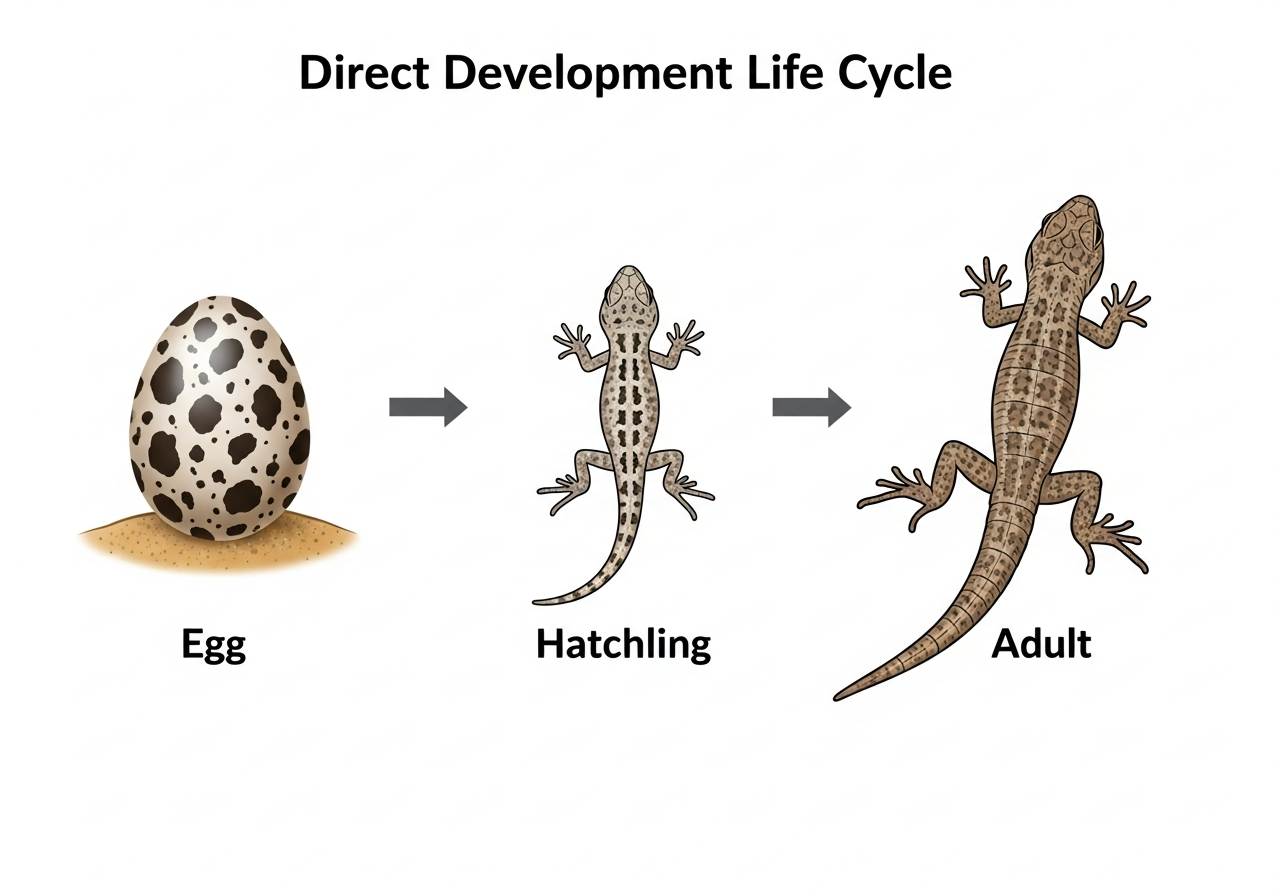
How Direct Development Works
In direct development, the young animal already has the same body shape as the adult. It just needs to grow bigger and stronger. A puppy has four legs, fur, and a tail just like an adult dog. A baby lizard hatches with four legs and scaly skin just like its parent.
This is very different from Metamorphic Life Cycles: Complete and Incomplete Metamorphosis, where an animal's body completely changes shape. A caterpillar looks nothing like a butterfly, and a tadpole looks nothing like a frog. But a kitten already looks like a small cat!
Examples of Direct Development Animals
| Animal | Young Form | Changes Body Shape? |
|---|---|---|
| Dog | Puppy | No |
| Cat | Kitten | No |
| Lizard | Hatchling | No |
| Bird | Chick | No |
| Fish | Baby Fish (Fry) | No |
| Butterfly | Caterpillar | Yes (metamorphosis) |
Key Terms & Definitions
Direct Development: You use this term to describe when a young animal is born or hatched already looking like a tiny adult. The animal simply grows bigger without changing its body shape.
Non-Metamorphic: This word describes animals that grow up without going through big body shape changes. Dogs, cats, lizards, and birds are all non-metamorphic animals.
Life Cycle: A life cycle is all the stages an animal goes through from the time it is born until it dies. Every animal has its own life cycle.
Hatchling: A hatchling is a newborn animal that just came out of an egg. A baby lizard or baby bird is called a hatchling right after it hatches.
Offspring: Offspring is the word for a young animal. A puppy is the offspring of a dog, and a kitten is the offspring of a cat.
Adult: An adult is a fully grown animal that is ready to have its own young. An adult dog, adult lizard, or adult bird has finished growing.
Juvenile: A juvenile is a young animal that already looks like its parent but has not finished growing yet. A juvenile lizard looks like a small adult lizard.
Metamorphosis: Metamorphosis is when an animal's body completely changes shape as it grows. A butterfly goes through metamorphosis it starts as an egg, becomes a caterpillar, then a chrysalis, and finally a butterfly.
How You Can Spot Direct Development
You can tell if an animal uses direct development by asking one simple question: does the young animal look like a small version of the adult? If yes, it is direct development! A baby robin hatches and already looks like a small bird. A baby snake hatches and already looks like a tiny adult snake.
You can also look at the number of legs. If a young animal has the same number of legs as the adult, that is a strong clue it follows direct development. Compare this to Animal Life Cycles: Various Animal Growth Patterns to see how different animals grow in different ways.
Remember: hatching from an egg does NOT always mean metamorphosis. Lizards, birds, and fish all hatch from eggs but still use direct development!
What You Already Know That Helps
You have already learned about Living vs Non-Living: Characteristics That Define Life, which helps you understand that all living things grow and change. You also explored Animal Classification: Major Animal Groups and Characteristics, which helps you sort animals into groups.
Your knowledge of Parent-Offspring Relations: Similarities Between Parents and Offspring is very important here in direct development, the young animal looks similar to its parent from the very start. You also learned about External Features: Body Coverings, Limbs, and Sensory Organs, which helps you compare body parts between young and adult animals.
Related Topics & Connections
Understanding direct development connects to many other exciting science topics. You can explore Plant Life Cycles: Seed Production and Dispersal to see how plants also have their own growth patterns. You can compare animal and plant life cycles to find similarities and differences.
Learning about Animal Groups: Major Animal Classifications helps you see that direct development is found across many animal groups mammals, reptiles, birds, and fish all use it. You can also explore Animal Adaptations: Physical and Behavioral Features to understand how an animal's body features help it survive from the moment it is born.
This topic prepares you for more advanced ideas. You will soon learn about Structural Adaptations: Physical Features for Survival and Behavioral Adaptations: Actions That Aid Survival, where you will see how the body features animals are born with help them stay safe and find food. You will also explore Population Dynamics: Groups of Organisms in an Area to understand how groups of animals with direct development live and grow together.