Topic
My Progress
Pug Score
0%
Best Streak
0 in a row
Study Points
+0
Overview
Practice
Watch
Read
Quiz
Next Steps
Overview
Practice
Watch
Read
Quiz
Next Steps
Read
Complete and Incomplete Metamorphosis: Discover How Insects Grow and Change
You will learn how insects grow and change through complete and incomplete metamorphosis, discovering the stages each type of animal goes through as it becomes an adult.
Metamorphosis is the way an animal's body changes as it grows up. The word comes from a Greek word meaning "change in form." You can see metamorphosis happen in insects like butterflies, grasshoppers, and beetles.
You already know that different organisms grow and change in many ways. Metamorphosis is one of the most amazing kinds of change you will find in nature!
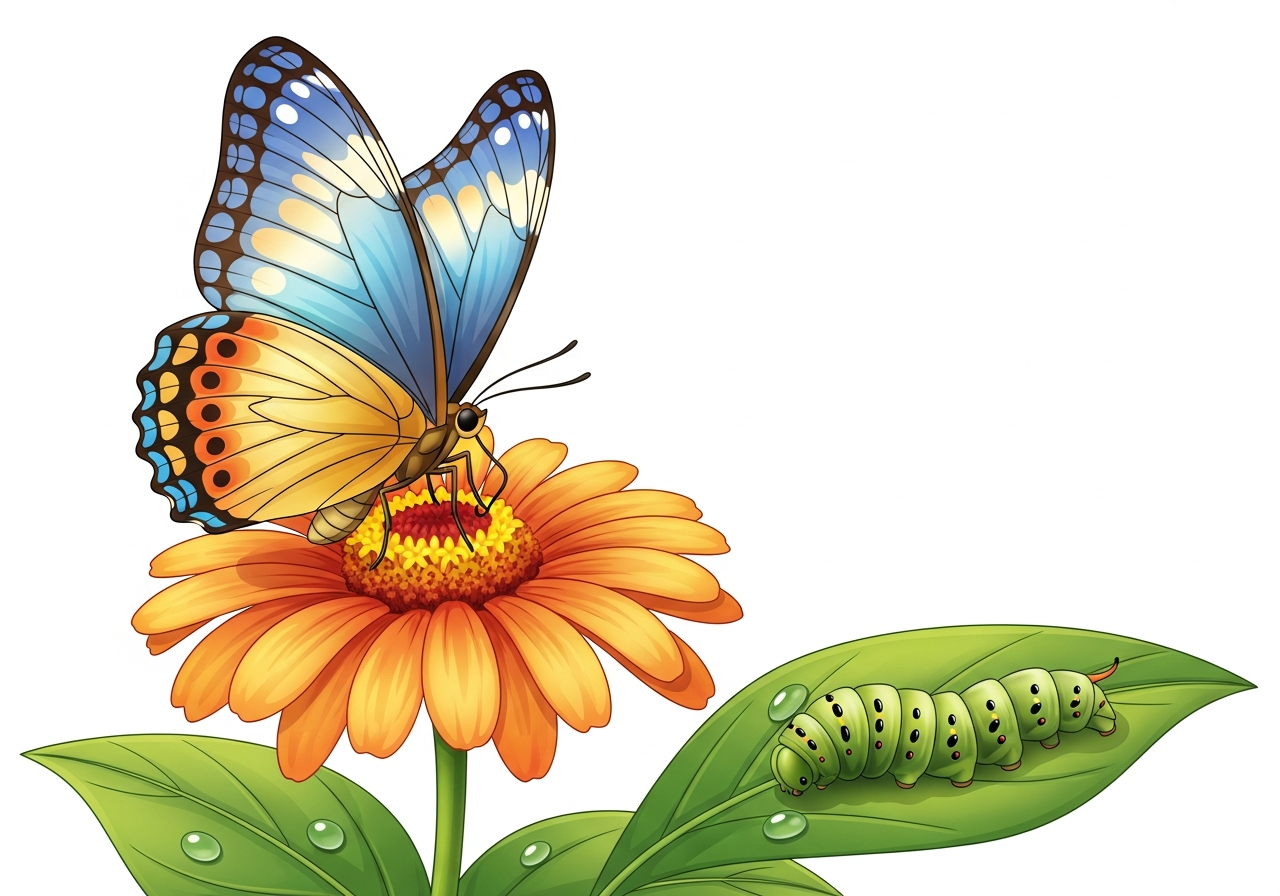
Complete Metamorphosis: Four Stages
Complete metamorphosis has four stages: egg, larva, pupa, and adult. The animal looks very different at each stage. Butterflies, moths, beetles, and ladybugs all go through complete metamorphosis.
Here is how each stage works for a butterfly:
- Egg: The adult female lays a tiny egg on a leaf.
- Larva (caterpillar): The egg hatches into a larva. The caterpillar eats lots of leaves and grows bigger.
- Pupa (chrysalis): The caterpillar wraps itself in a chrysalis and rests. Inside, its body completely changes.
- Adult: A beautiful butterfly with colorful wings comes out. It lays eggs to start the cycle again.

Incomplete Metamorphosis: Three Stages
Incomplete metamorphosis has only three stages: egg, nymph, and adult. There is no pupa stage. Grasshoppers, crickets, and cockroaches go through incomplete metamorphosis.
A grasshopper nymph hatches from an egg and already looks like a small adult grasshopper. As it grows, it slowly develops full wings. It is called "incomplete" because it is missing the pupa stage.

Complete vs. Incomplete Metamorphosis: Key Differences
The main difference between the two types is the pupa stage. Complete metamorphosis has a pupa stage where the insect completely transforms. Incomplete metamorphosis skips the pupa stage entirely.
| Feature | Complete Metamorphosis | Incomplete Metamorphosis |
|---|---|---|
| Number of stages | Four | Three |
| Stages | Egg, Larva, Pupa, Adult | Egg, Nymph, Adult |
| Has pupa stage? | Yes | No |
| Young looks like adult? | No (larva looks different) | Yes (nymph looks similar) |
| Examples | Butterfly, moth, beetle | Grasshopper, cricket |
Frogs and Metamorphosis
Frogs also go through big body changes! A frog egg hatches into a tadpole that swims in water using a tail. As the tadpole grows, it develops four legs and its tail slowly disappears. Frogs do not have a nymph or pupa stage like insects do.
Key Terms & Definitions
Metamorphosis: Metamorphosis is the big change an animal's body goes through as it grows from a young animal into an adult. The word means "change in form."
Complete Metamorphosis: Complete metamorphosis is a life cycle with four stages egg, larva, pupa, and adult. The animal looks very different at each stage. Butterflies and beetles go through complete metamorphosis.
Incomplete Metamorphosis: Incomplete metamorphosis is a life cycle with only three stages egg, nymph, and adult. It is called "incomplete" because it is missing the pupa stage. Grasshoppers go through incomplete metamorphosis.
Egg: The egg is the very first stage in both complete and incomplete metamorphosis. The adult female insect lays the egg, and a young insect hatches out of it.
Larva: A larva is the young insect that hatches from an egg in complete metamorphosis. It looks very different from the adult and spends most of its time eating and growing. A caterpillar is the larva of a butterfly.
Pupa: The pupa is the resting and changing stage in complete metamorphosis. The insect stays very still while its body completely transforms inside. The pupa stage does NOT happen in incomplete metamorphosis.
Adult: The adult is the final stage in both types of metamorphosis. The adult insect can fly, find a mate, and lay eggs to start the life cycle again.
Nymph: A nymph is the young insect in incomplete metamorphosis. It looks like a small adult but does not have fully grown wings yet. A grasshopper nymph is a good example.
Chrysalis: A chrysalis is the hard protective covering that a butterfly caterpillar forms around itself during the pupa stage. Inside the chrysalis, the caterpillar transforms into a butterfly.
Cocoon: A cocoon is the silky covering that a moth caterpillar spins around itself during the pupa stage. A cocoon is made by moths, while a chrysalis is made by butterflies.
Tadpole: A tadpole is the young form of a frog. It hatches from a frog egg and swims in water using a tail. As it grows, it develops legs and its tail disappears.
Practice What You Know
You can practice identifying the stages of metamorphosis by looking at pictures of insects and asking: "Does this animal have four stages or three stages?" If it has a pupa stage, it is complete metamorphosis. If there is no pupa stage, it is incomplete metamorphosis.
You can also explore various animal growth patterns to see how different animals grow and change in their own special ways.
What You Already Know
Before learning about metamorphosis, you explored some important ideas that help you understand this topic. You learned about how different organisms grow and change, which gives you a great foundation for understanding life cycles.
You also studied major animal groups and characteristics and body coverings, limbs, and sensory organs, which help you notice how an insect's body looks different at each stage. Understanding similarities between parents and offspring helps you see why a nymph looks like its parent but a larva does not. You also know about characteristics that define life, which explains why growing and changing are signs of a living thing.
Related Topics & Connections
This topic connects to many other exciting science ideas you will explore. You can compare metamorphic life cycles with direct development patterns, where some animals grow without going through dramatic changes like metamorphosis.
You will also discover seed production and dispersal in plant life cycles to see how plants grow and change in their own way, just like insects do. Exploring major animal classifications will help you understand which groups of animals go through metamorphosis.
Learning about physical and behavioral features of animal adaptations and structural adaptations in plants will show you how living things are built to survive. After this topic, you will be ready to explore actions that aid survival and physical features for survival, which build on what you know about how animals grow and change.