Topic
My Progress
Pug Score
0%
Best Streak
0 in a row
Study Points
+0
Overview
Practice
Watch
Read
Quiz
Next Steps
Overview
Practice
Watch
Read
Quiz
Next Steps
Read
Discover Science Tools and How to Use Them!
You will learn about basic science tools and how to use each one the right way to explore the world around you.
You use tools every day! Science tools help you explore and learn about the world. Each tool has a special job.
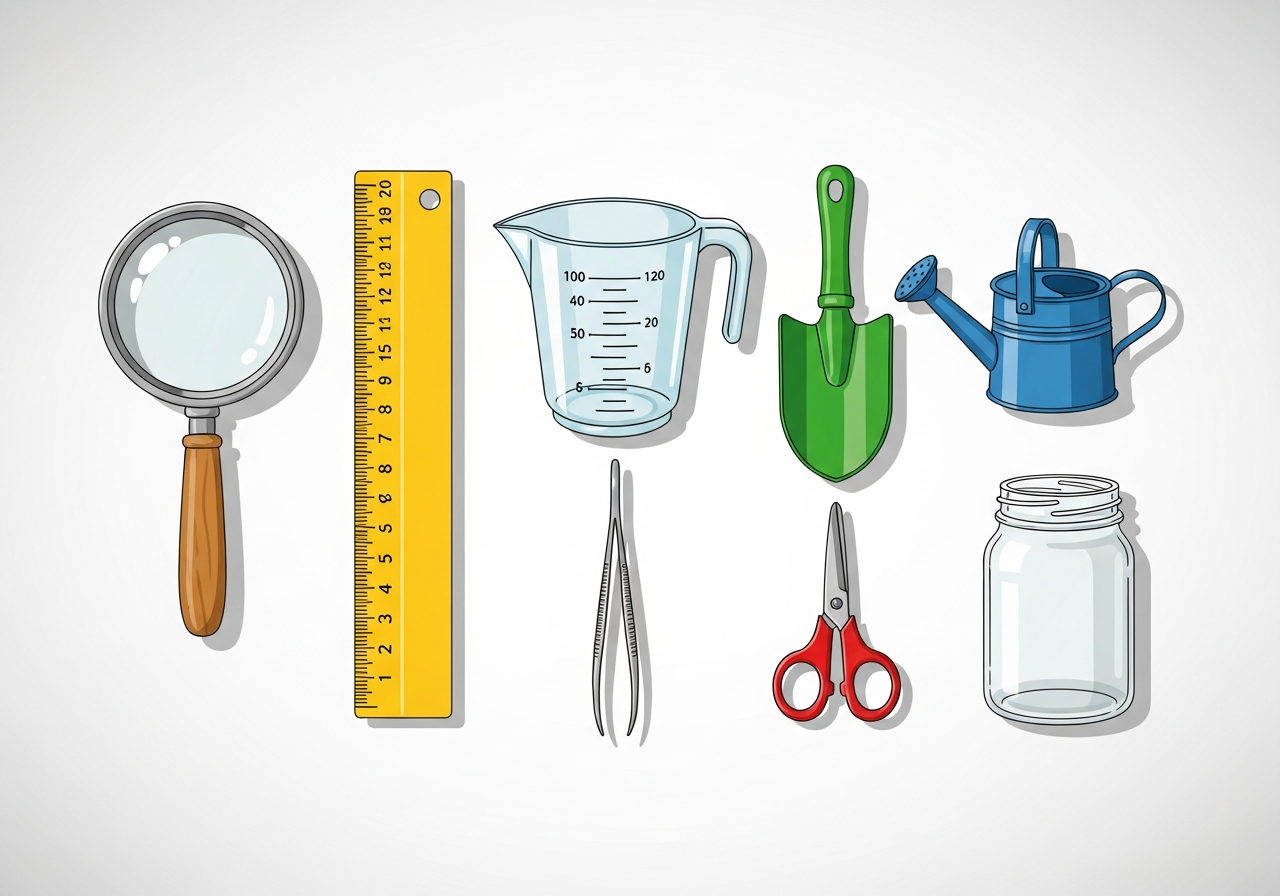
You pick the right tool for each job. Using the right tool makes science fun and easy!
Tools for Looking Closely
Magnifying Glass
A magnifying glass makes tiny things look bigger. You can use it to see small details on bugs, rocks, leaves, and flowers. Your eyes alone cannot see those tiny parts!
You would use a magnifying glass to look at a ladybug's spots, an ant's legs, or tiny parts of a flower petal.

Tools for Measuring
Ruler
A ruler helps you measure how long or tall something is. You can use a ruler to see how tall your plant grows each day. Rulers have numbers that show length.
Measuring Cup and Beaker
A measuring cup and a beaker help you measure liquids like water. You can use them to give your plant just the right amount of water. Too much or too little water is not good for plants!
Scale
A scale helps you find out how heavy something is. You can put rocks or pebbles on a scale to see which one is heavier.
Tools for Digging and Collecting
Shovel and Trowel
A shovel is great for digging holes in the garden. A trowel is a smaller tool for digging small holes to plant seeds. Both tools have a flat blade that scoops dirt.
Jar and Tweezers
You can use a jar to collect and observe small insects safely. Tweezers help you pick up tiny seeds or small objects without dropping them. Your fingers are too big for some tiny things!
Watering Can
A watering can helps you give water to plants. It controls how much water flows out so you do not give too much.
Scissors
Scissors help you cut paper safely for science projects. They have special blades that cut things like paper for your leaf collection.
Key Terms and Definitions
Magnifying Glass: A tool you use to make tiny things look bigger so you can see small details clearly.
Ruler: A tool you use to measure how long or tall something is. It has numbers on it.
Measuring Cup: A tool you use to measure how much liquid, like water, you have.
Beaker: A tool like a cup that you use to measure liquids for science experiments.
Scale: A tool you use to find out how heavy something is. You put objects on it to compare their weight.
Shovel: A tool with a flat blade you use to dig holes in the ground and scoop dirt.
Trowel: A small digging tool you use to make small holes in soil for planting seeds.
Tweezers: A small tool you use to pick up tiny objects like seeds carefully.
Jar: A container you use to collect and safely observe small insects.
Watering Can: A tool you use to pour water onto plants in a controlled way.
Scissors: A tool with two blades you use to cut paper safely for science projects.
Observe: To look at something very carefully to learn about it.
Measure: To find out how long, tall, or heavy something is using a tool.
Try It Yourself!
You can practice choosing the right tool! Ask yourself: Do I need to look closely? Use a magnifying glass. Do I need to measure? Use a ruler or measuring cup. Do I need to dig? Use a shovel or trowel.
Try sorting tools into groups: tools for looking, tools for measuring, and tools for digging. You are thinking like a real scientist!
What You Already Know
You already know how to look at things around you and ask questions. That is the start of science! Now you are learning which tools help you find answers.
Using the right tool is part of problem solving. When you have a question, you pick the best tool to help you find out the answer.
Related Topics and Connections
Learning about tools and materials is part of Problem Solving in science. When you know how to use tools the right way, you can solve science problems every day. You are building skills that will help you in all your science adventures!