Topic
My Progress
Pug Score
0%
Best Streak
0 in a row
Study Points
+0
Overview
Practice
Read
Quiz
Next Steps
Overview
Practice
Read
Quiz
Next Steps
Read
Unlocking the Universe: Research Methods in Astronomical Observation
This topic covers the research methods and observational technologies astronomers use to study the universe, including telescopes, spectroscopy, and the electromagnetic spectrum.
Astronomy relies on systematic research methods to uncover the nature of the universe. Learners studying this topic will discover how scientists design observations, collect data, and draw conclusions about objects billions of light-years away. This connects directly to Introduction to Space Exploration and Current Technologies, which provides essential context for understanding modern astronomical tools.
Because astronomers cannot travel to distant stars or galaxies, they depend entirely on the light and radiation those objects emit. Every research method in astronomy is ultimately a strategy for extracting information from that incoming radiation.
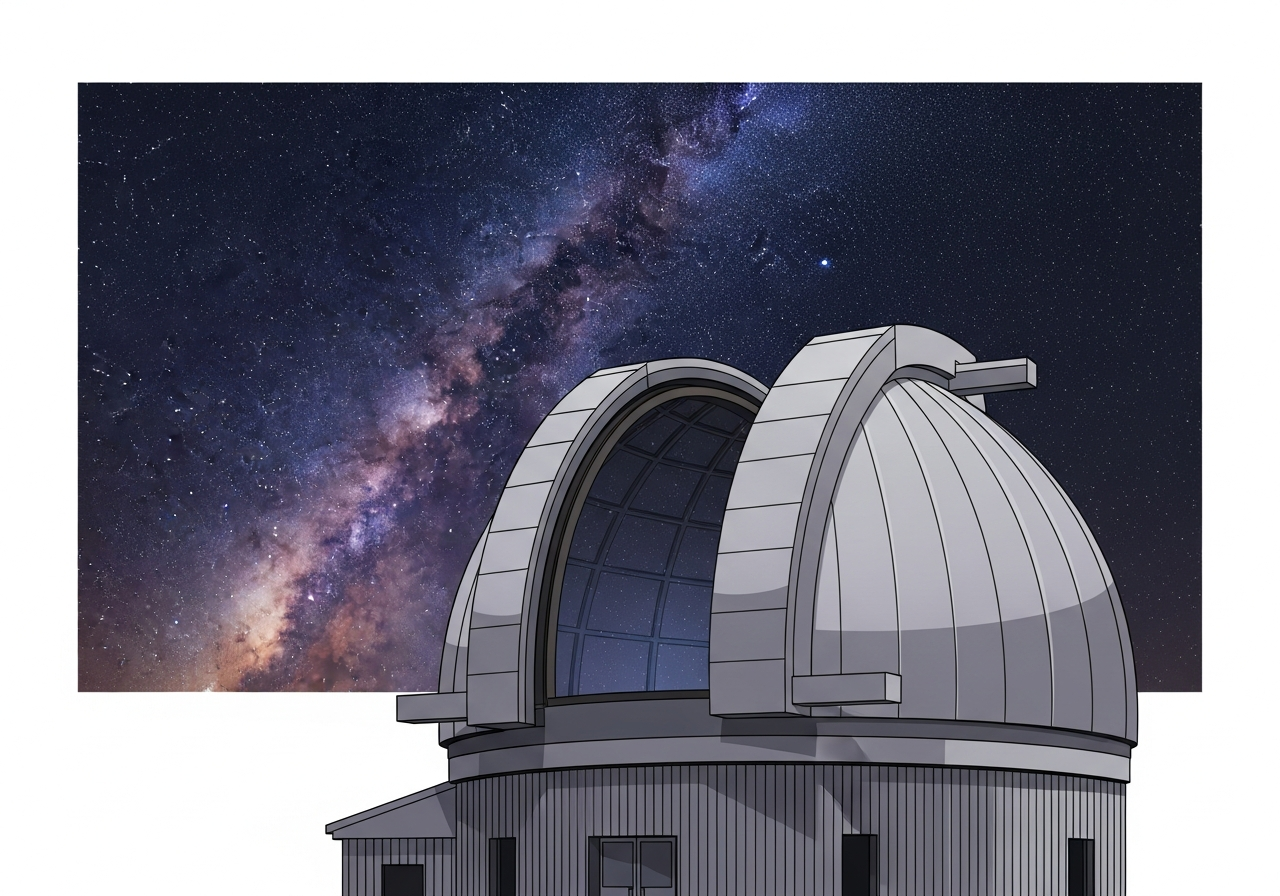
A telescope's primary purpose is to collect and focus light from distant objects in space, making them appear brighter and more detailed than the naked eye can perceive. The larger a telescope's aperture (diameter), the more light it gathers, allowing astronomers to detect fainter and more distant objects.
There are two fundamental telescope designs. Refracting telescopes use lenses to bend and focus light, while reflecting telescopes use curved mirrors. Most modern professional observatories use reflecting designs because large mirrors are easier and less expensive to construct than large lenses.
The Hubble Space Telescope orbits above Earth's atmosphere, eliminating the blurring and absorption effects that affect ground-based instruments. This gives it remarkably sharp images across visible, ultraviolet, and infrared wavelengths. Ground-based observatories are often built on mountaintops to reduce atmospheric interference and light pollution from cities.
Adaptive optics systems correct for atmospheric turbulence in real time, allowing ground-based telescopes to achieve near space-quality resolution. Radio telescopes use large parabolic dish antennas to detect radio waves emitted by celestial objects sources that may emit little or no visible light.
