TOPIC
Plate Tectonics, Continental drift theoryMY PROGRESS
Pug Score
0%
Getting Started
"Let's build your foundation!"
Best Streak
0 in a row
Study Points
+0
Overview
Practice
Watch
Read
Quiz
Next Steps
Get Started
Get unlimited access to all videos, practice problems, and study tools.
BACK TO MENU
Topic Progress
Pug Score
0%
Getting Started
"Let's build your foundation!"
Videos Watched
0/0
Best Practice
No score
Read
Not viewed
Best Quiz
No attempts
Best Streak
0 in a row
Study Points
+0
Overview
Practice
Watch
Read
Quiz
Next Steps
Read
Plate Tectonics & Continental Drift: How Earth's Surface Moves
You will learn how Earth's outer layer is broken into moving tectonic plates and how Alfred Wegener's continental drift theory explains why continents look like puzzle pieces that once fit together.
What Is Plate Tectonics?
Plate tectonics is the scientific theory that Earth's outer layer, called the lithosphere, is broken into large, rigid pieces called tectonic plates that slowly move over time. This movement explains why earthquakes, volcanoes, and mountain ranges exist where they do.
You can think of Earth's surface like a cracked eggshell each piece is a tectonic plate, and those pieces are always shifting, even if you can't feel it. Plates move only a few centimeters per year, about as fast as your fingernails grow, but over millions of years this adds up to enormous changes.
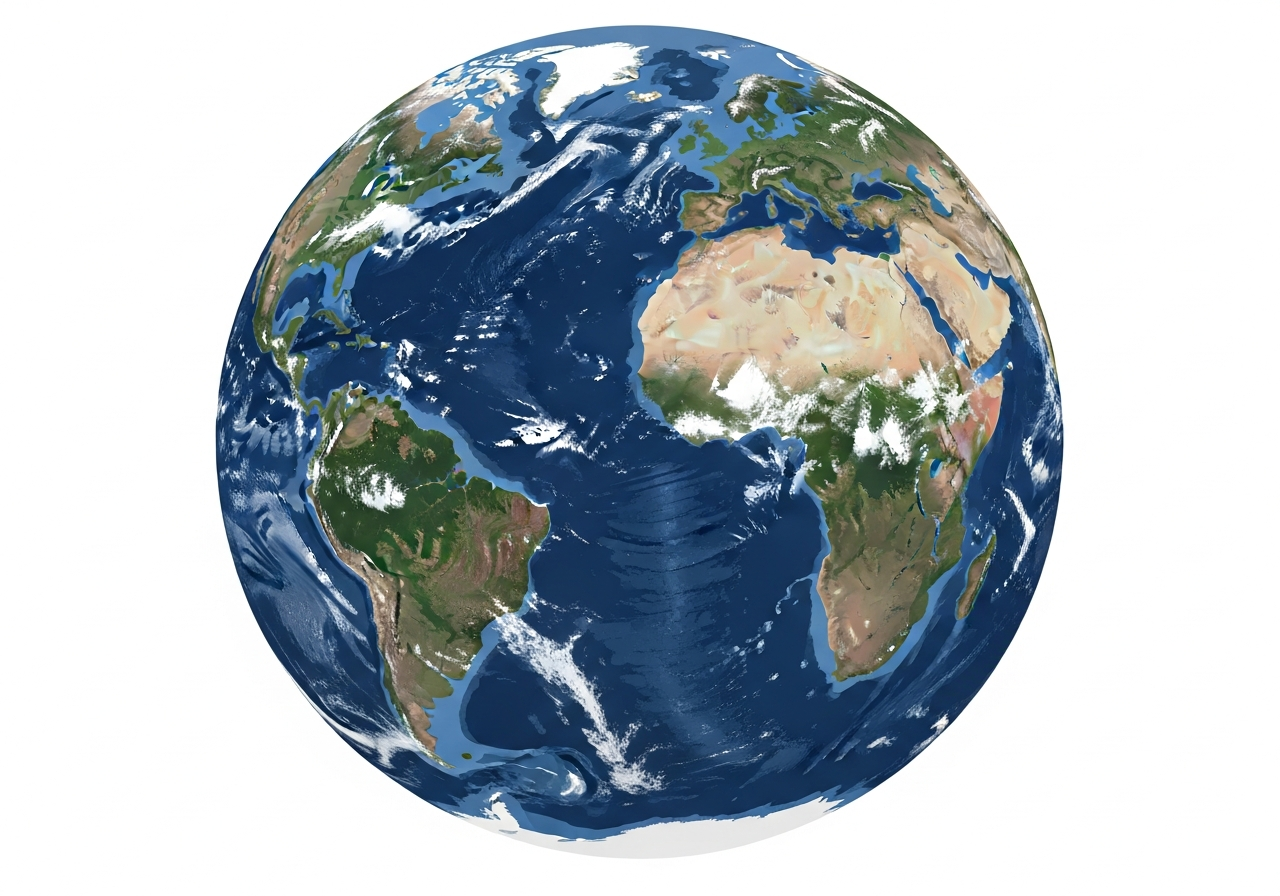
Tectonic plates rest on the asthenosphere, a semi-fluid layer of the upper mantle that flows slowly, allowing the plates above it to drift. You will explore this further when you study Plate Tectonics: Global Patterns.
Alfred Wegener and the Continental Drift Theory
In 1912, a German scientist named Alfred Wegener proposed the continental drift theory the idea that all of Earth's continents were once joined together and have since slowly drifted apart.
Wegener called this ancient supercontinent Pangaea, from Greek words meaning "all land." He used three main types of evidence to support his idea:
- Fossil evidence: Identical fossils of the same land animals, like the ancient reptile Mesosaurus, were found on continents now separated by vast oceans.
- Rock matching: Ancient mountain ranges with identical rock layers were found on opposite sides of the Atlantic Ocean, such as the Appalachian Mountains in North America and the Caledonian Mountains in Europe.
- Coastline fit: The coastlines of South America and Africa fit together like puzzle pieces, suggesting they were once connected.
Despite this evidence, many scientists initially rejected Wegener's hypothesis because he could not explain what force was powerful enough to move entire continents. It wasn't until seafloor spreading and convection currents were understood that his ideas gained wide acceptance.
What Drives Plate Movement?
Convection currents in the mantle are the primary engine that drives tectonic plate movement. Hot rock deep in the mantle rises, spreads outward, cools, and then sinks back down, creating a circular flow that drags the plates along with it.
Today, scientists use GPS satellites to precisely measure plate movement, confirming that plates shift a few centimeters per year.
Types of Plate Boundaries
Where two tectonic plates meet, you find a plate boundary. There are three main types, and each one creates different geological features.
Convergent Boundaries
A convergent boundary forms when two plates move toward each other. What happens depends on the types of plates involved:
- When an oceanic plate meets a continental plate, the denser oceanic plate sinks beneath the other in a process called subduction, forming deep ocean trenches and volcanoes.
- When two continental plates collide, neither sinks instead, the crust crumples upward to form large mountain ranges. The Himalayas formed this way when the Indian Plate collided with the Eurasian Plate.
- Subducting oceanic plates can also create curved chains of volcanic islands called volcanic island arcs, such as Japan and the Aleutian Islands.
Divergent Boundaries
A divergent boundary forms when two plates move away from each other. As the plates separate, magma rises from the mantle to fill the gap, creating new oceanic crust. On the ocean floor, this forms a mid-ocean ridge a long underwater mountain chain. On land, it creates a rift valley.
Seafloor spreading is the process by which new ocean crust forms at mid-ocean ridges as plates separate. The Atlantic Ocean is getting wider because of seafloor spreading at the Mid-Atlantic Ridge.
Transform Boundaries
A transform boundary forms when two plates slide horizontally past each other. This grinding motion builds up enormous stress that is released as powerful earthquakes. The San Andreas Fault in California is a famous example of a transform boundary.
The Ring of Fire
The Ring of Fire is a horseshoe-shaped zone surrounding the Pacific Ocean where many tectonic plates meet. About 90% of the world's earthquakes and 75% of its volcanoes occur here, making it one of the most geologically active regions on Earth.
Evidence from the Ocean Floor
One of the strongest pieces of evidence for seafloor spreading comes from magnetic stripes in ocean rocks. As magma hardens at mid-ocean ridges, iron minerals align with Earth's magnetic field. Scientists found symmetrical magnetic stripe patterns on either side of ridges, proving that new crust forms at the ridge and spreads outward.
Scientists also discovered that oceanic crust is much younger than continental crust, which supports the idea that old oceanic crust is constantly being recycled through subduction.
Key Terms & Definitions
Plate Tectonics: You use this term to describe the scientific theory that Earth's outer shell is divided into large, moving pieces called tectonic plates that cause earthquakes, volcanoes, and mountain formation.
Continental Drift: This is the theory, proposed by Alfred Wegener, that Earth's continents were once joined together and have slowly moved apart over millions of years.
Pangaea: Pangaea is the name Wegener gave to the ancient supercontinent that included all of Earth's landmasses joined together, about 300 million years ago.
Lithosphere: The lithosphere is Earth's rigid outer layer, made up of the crust and the uppermost solid part of the mantle this is what breaks into tectonic plates.
Asthenosphere: The asthenosphere is the semi-fluid, partially melted layer of the upper mantle that tectonic plates rest on and slowly move across.
Tectonic Plate: A tectonic plate is one of the large, rigid sections of Earth's lithosphere that moves slowly over the asthenosphere. There are about 15 to 20 major and minor plates.
Convergent Boundary: A convergent boundary is where two tectonic plates move toward each other and collide, creating mountains, ocean trenches, or volcanic arcs depending on the plate types involved.
Divergent Boundary: A divergent boundary is where two tectonic plates move away from each other, allowing magma to rise and form new crust, creating mid-ocean ridges or rift valleys.
Transform Boundary: A transform boundary is where two tectonic plates slide horizontally past each other, causing frequent and powerful earthquakes. The San Andreas Fault is a well-known example.
Subduction: Subduction is the process where a denser oceanic plate sinks beneath a less dense plate at a convergent boundary and melts back into the mantle, forming ocean trenches and volcanoes.
Seafloor Spreading: Seafloor spreading is the process where new oceanic crust forms at mid-ocean ridges as tectonic plates separate and magma rises and solidifies to fill the gap.
Mid-Ocean Ridge: A mid-ocean ridge is a long underwater mountain chain that forms at divergent boundaries on the ocean floor, where new seafloor crust is constantly being created.
Rift Valley: A rift valley is a long, low valley that forms on land at a divergent boundary where two plates pull apart and the ground between them sinks.
Convection Currents: Convection currents are circular movements of hot and cool material in the mantle hot rock rises, spreads, cools, and sinks and these currents are the main force that drives tectonic plate movement.
Volcanic Island Arc: A volcanic island arc is a curved chain of volcanic islands that forms above a subducting oceanic plate, such as Japan and the Aleutian Islands.
Ring of Fire: The Ring of Fire is a horseshoe-shaped zone around the Pacific Ocean where many tectonic plates meet, causing about 90% of the world's earthquakes and 75% of its volcanic eruptions.
Practice & Application
You can strengthen your understanding of plate tectonics by practicing with questions that ask you to identify boundary types from diagrams, match geological features to their boundaries, and explain the evidence for continental drift.
As you practice, focus on connecting each boundary type to its geological feature: divergent mid-ocean ridge or rift valley; convergent mountains, trenches, or volcanic arcs; transform earthquakes. You will also practice explaining why Wegener's hypothesis was initially rejected and what evidence eventually confirmed it.
When you are ready to expand your knowledge, explore Plate Tectonics: Global Patterns to see how plate movement shapes Earth's geography on a global scale.
Building Your Knowledge
This topic introduces you to the foundational concepts of plate tectonics. You do not need prior knowledge of specific geology topics to begin just a basic understanding of Earth's layers (crust, mantle, core) will help you follow along.
Once you have mastered continental drift and plate boundaries here, you will be well prepared to move on to Plate Tectonics: Global Patterns, where you will examine how these processes create the large-scale geographic features you see on world maps today.
Related Topics & Connections
Your study of plate tectonics connects directly to the next step in your geology learning journey. After mastering the continental drift theory and plate boundary types here, you will be ready to explore Plate Tectonics: Global Patterns (Topic 7981).
In that topic, you will zoom out to see how the movement of tectonic plates creates the global distribution of earthquakes, volcanoes, mountain ranges, and ocean trenches that you can observe on world maps. The concepts you learn here convergent, divergent, and transform boundaries; subduction; seafloor spreading are the essential building blocks for understanding those global patterns.
Think of it this way: here you learn what plates are and how they move; in the next topic, you discover where those movements have shaped Earth's surface at a global scale.