TOPIC
MY PROGRESS
Pug Score
0%
Getting Started
"Let's build your foundation!"
Best Streak
0 in a row
Study Points
+0
Overview
Practice
Watch
Read
Quiz
Next Steps
Get Started
Get unlimited access to all videos, practice problems, and study tools.
BACK TO MENU
Topic Progress
Pug Score
0%
Getting Started
"Let's build your foundation!"
Videos Watched
0/0
Best Practice
No score
Read
Not viewed
Best Quiz
No attempts
Best Streak
0 in a row
Study Points
+0
Overview
Practice
Watch
Read
Quiz
Next Steps
Read
Earthquakes and Volcanoes: Discover the Forces That Shape Earth
You will explore how earthquakes and volcanoes are caused by tectonic plate movement, and learn the key terms, tools, and concepts scientists use to study these powerful geological events.
Geological events are powerful natural processes that change Earth's surface. Earthquakes and volcanoes are two of the most dramatic examples, and both are closely connected to the movement of tectonic plates large sections of Earth's crust and upper mantle that slowly drift over time.
To understand these events, you should already be familiar with Earth's Structure and Internal Layers, which explains the layers beneath your feet, and Plate Tectonics and Continental Drift Theory, which describes how and why plates move.

Earthquakes: Causes and Key Concepts
An earthquake is a sudden shaking of the ground caused by movement along a fault a crack or fracture in Earth's crust where rocks on either side can slip and move. When stress builds up along a fault and is suddenly released, energy travels outward as seismic waves, shaking everything around.
The underground point where an earthquake begins is called the focus, also known as the hypocenter. Directly above it on Earth's surface is the epicenter, where shaking is usually strongest. Scientists use a seismograph to detect and record seismic waves, producing a record called a seismogram. To find an earthquake's epicenter, scientists use triangulation drawing circles from at least three seismograph stations until they intersect.
The size of an earthquake is measured using the Richter scale, which assigns a number based on the amplitude of seismic waves. Each step up on the scale represents ten times more ground motion. The two main types of seismic waves are P-waves (primary, fastest, travel through solids and liquids) and S-waves (secondary, slower, travel only through solids).
Volcanoes: Causes and Types
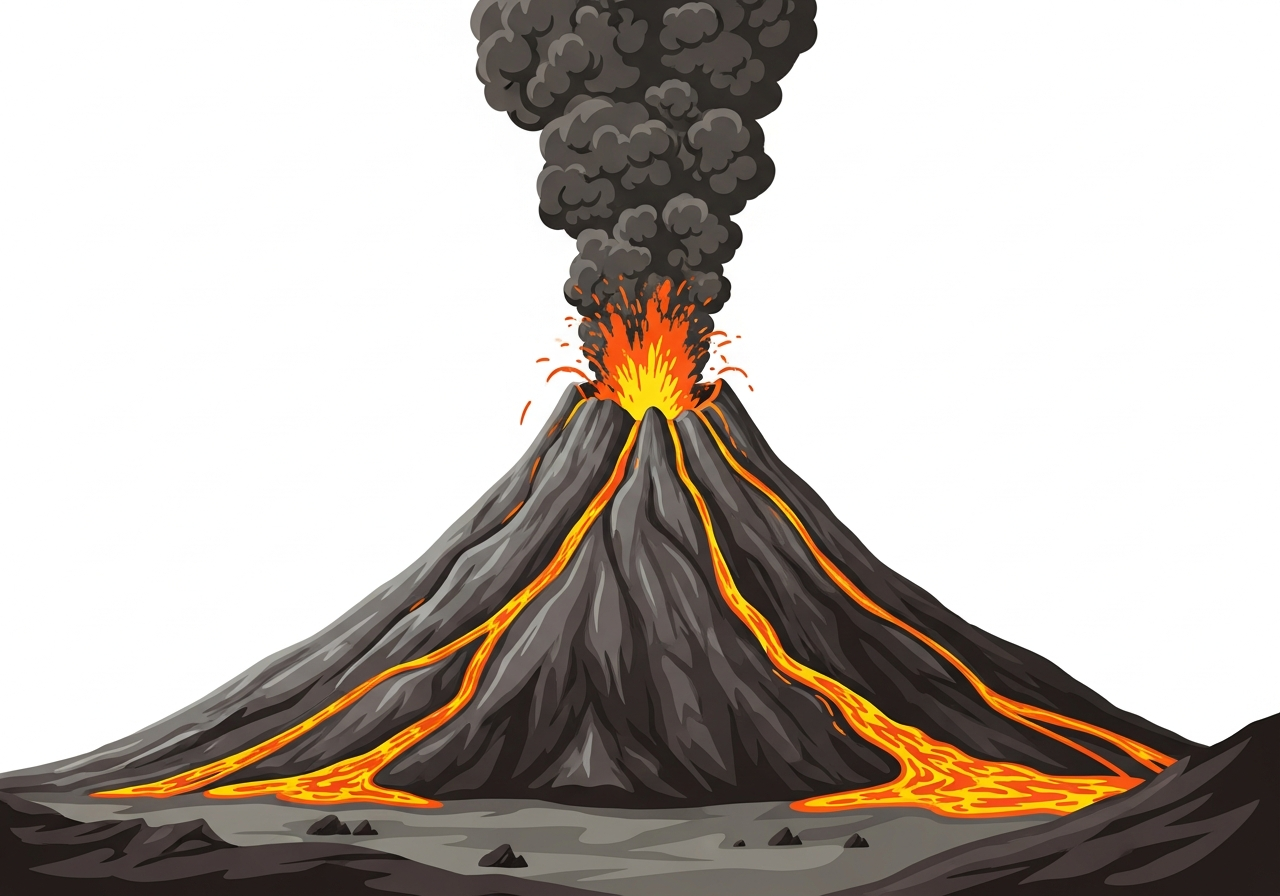
A volcano is an opening in Earth's crust through which lava, ash, and gases escape. Below the surface, molten rock is called magma. Once magma erupts and flows onto Earth's surface, it is called lava. Volcanic eruptions happen when pressure from gases and rising magma builds up until it forces its way out.
Shield volcanoes have gently sloping sides built from thin, fast-moving basaltic lava flows like those in Hawaii. Composite volcanoes (also called stratovolcanoes) are steep-sided and built from alternating layers of lava and ash. Cinder cone volcanoes are small and steep, built from pyroclastic fragments.
During explosive eruptions, volcanoes release pyroclastic material fragments of rock and ash blasted into the air. A particularly dangerous hazard is a pyroclastic flow, a fast-moving current of hot gas, ash, and rock that can reach speeds over 700 km/h. Volcanic ash consists of tiny jagged rock and glass particles that can damage lungs, collapse roofs, disrupt air travel, and even temporarily cool Earth's climate.
Tectonic Plate Boundaries
Most earthquakes and volcanoes occur at plate boundaries the edges where tectonic plates meet. There are three main types:
- Convergent boundaries: Two plates collide. One plate may be pushed beneath the other in a process called subduction, which can produce powerful earthquakes and volcanoes. This is the type of boundary most likely to produce the strongest earthquakes.
- Divergent boundaries: Two plates move apart. Magma rises through the gap, creating new oceanic crust and forming underwater volcanoes along mid-ocean ridges like the Mid-Atlantic Ridge.
- Transform boundaries: Two plates slide horizontally past each other, producing frequent earthquakes. The San Andreas Fault in California is a well-known example.
At subduction zones, the sinking oceanic plate melts in the mantle, and the resulting magma rises to form volcanoes. This explains why volcanoes often form at convergent boundaries. A hotspot volcano is different it forms above a fixed plume of heat rising through the mantle, even in the middle of a plate, like the Hawaiian Islands.
The Ring of Fire is a horseshoe-shaped zone surrounding the Pacific Ocean where about 90% of the world's earthquakes and 75% of its volcanoes occur due to active plate boundaries.
Tsunamis and Other Hazards
A tsunami is a series of giant ocean waves triggered by an underwater earthquake or volcanic eruption. When the seafloor suddenly shifts, it displaces enormous amounts of water, sending waves across entire ocean basins. Tsunamis are different from storm surges or wind-driven waves.
Earthquake damage to buildings and infrastructure is caused by seismic waves shaking the ground rapidly, stressing structures until they collapse. Understanding these hazards helps scientists and engineers design safer buildings and early warning systems.
Key Terms & Definitions
Earthquake: A sudden shaking of the ground caused by the release of stress along a fault in Earth's crust, sending seismic waves outward in all directions.
Focus (Hypocenter): The underground point inside Earth where an earthquake originates and energy is first released. You can remember it as the true starting point of the quake.
Epicenter: The point on Earth's surface located directly above the focus. This is where seismic waves first reach the surface and where shaking is usually strongest.
Fault: A crack or fracture in Earth's crust where rocks on either side can slip and move relative to each other, often causing earthquakes.
Seismic Wave: Energy that travels outward through Earth's layers from an earthquake's focus. The two main types are P-waves (primary) and S-waves (secondary).
Seismograph: An instrument scientists use to detect and record seismic waves produced during an earthquake, creating a record called a seismogram.
Richter Scale: A scale that assigns a number to an earthquake based on the amplitude of seismic waves recorded by a seismograph. Each step up represents ten times more ground motion.
Tectonic Plates: Large sections of Earth's crust and upper mantle (the lithosphere) that slowly move over the semi-fluid asthenosphere beneath them.
Convergent Boundary: A plate boundary where two tectonic plates collide and push toward each other, which can cause subduction, mountain building, and powerful earthquakes.
Divergent Boundary: A plate boundary where two tectonic plates move apart from each other, allowing magma to rise and form new oceanic crust and underwater volcanoes.
Transform Boundary: A plate boundary where two plates slide horizontally past each other, commonly producing earthquakes. The San Andreas Fault is a famous example.
Subduction: The process where one tectonic plate (usually oceanic) is forced beneath another into the mantle, where it melts and can generate magma that rises to form volcanoes.
Magma: Molten rock located beneath Earth's surface inside the mantle or crust. Once it reaches the surface, you call it lava.
Lava: Magma that has reached and flowed out onto Earth's surface through a volcanic eruption or vent. It cools and hardens to form igneous rock.
Volcano: An opening in Earth's crust through which lava, ash, and gases escape during an eruption.
Shield Volcano: A type of volcano with gently sloping sides built from many flows of thin, runny basaltic lava that spreads out over a wide area, like those in Hawaii.
Pyroclastic Material: Fragments of rock and ash that are blasted into the air during a volcanic eruption, including ash, cinders, and volcanic bombs.
Pyroclastic Flow: A fast-moving, extremely dangerous current of hot gas, ash, and rock fragments that rushes down a volcano's slopes during an explosive eruption.
Ring of Fire: A horseshoe-shaped zone surrounding the Pacific Ocean where a large concentration of Earth's earthquakes and volcanoes occur due to active tectonic plate boundaries.
Tsunami: A series of giant ocean waves triggered by an underwater earthquake or volcanic eruption that displaces large amounts of water.
Hotspot Volcano: A volcano formed above a fixed plume of unusually hot mantle material that melts through the overlying tectonic plate, even in the middle of a plate.
Lithosphere: The rigid outer layer of Earth that includes the crust and the uppermost solid part of the mantle this is the layer broken into tectonic plates.
How Scientists Study Geological Events
Scientists study rock layers, lava deposits, and fault patterns preserved in Earth's geological record to learn about past volcanic eruptions and earthquakes. This connects directly to your study of the Rock Types: Igneous, Sedimentary, and Metamorphic and the Rock Cycle: Formation and Transformation.
You can also explore how Energy Transfer through Conduction, Convection, and Radiation drives the convection currents in the mantle that move tectonic plates. Evidence of ancient plate movement like matching fossils on separate continents is covered in Evidence of Change: Fossil Record and Similarities.
Building on What You Already Know
Before diving into geological events, you should be comfortable with three foundational topics. Your knowledge of Mineral Properties: Physical and Chemical Properties helps you understand what rocks and Earth's layers are made of. Your understanding of Rock Types explains how igneous rocks form from cooled lava and magma. And the Rock Cycle shows you how rocks are continuously created and transformed by geological forces.
Related Topics and Connections
This topic connects to many other areas of science that you will explore. Understanding geological events prepares you for Geological Time and Earth's History, where you will see how billions of years of earthquakes and eruptions have shaped the planet. You will also build toward Plate Tectonics: Global Patterns and Introduction to the Rock Cycle: Formation Processes, which expand on the concepts you learn here.
Your study of geological events also connects to Resource Formation: Mineral and Fossil Fuel Formation, since volcanic and tectonic activity plays a role in creating Earth's natural resources. You can also see connections to Introduction to Mineral Resources: Formation and Extraction.
On a broader scale, geological events influence Climate Change and Human Impact, Climate Zones and Global Patterns, and Weather Patterns and Global Circulation, since large volcanic eruptions can temporarily cool Earth's climate by releasing ash into the atmosphere.