TOPIC
MY PROGRESS
Pug Score
0%
Getting Started
"Let's build your foundation!"
Best Streak
0 in a row
Study Points
+0
Overview
Practice
Watch
Read
Quiz
Next Steps
Get Started
Get unlimited access to all videos, practice problems, and study tools.
BACK TO MENU
Topic Progress
Pug Score
0%
Getting Started
"Let's build your foundation!"
Videos Watched
0/0
Best Practice
No score
Read
Not viewed
Best Quiz
No attempts
Best Streak
0 in a row
Study Points
+0
Overview
Practice
Watch
Read
Quiz
Next Steps
Read
Stay Safe with Household Electricity: Circuits, Breakers & Power
You will learn how household electricity works, how safety devices protect you from harm, and how to use electrical appliances responsibly and safely.
Key Safety Devices in Your Home
Circuit Breakers and Fuses
A circuit breaker is a resettable safety switch inside your electrical panel. When too many appliances run at once and draw more current than the circuit can handle, the breaker automatically trips cutting off power to prevent wires from overheating and causing a fire. You can reset it by flipping the switch back after fixing the problem.
A fuse works similarly but is a one-time-use device. It contains a thin wire that melts when current gets too high, permanently breaking the circuit. Unlike a circuit breaker, a blown fuse must be replaced, not reset.
Grounding and the Ground Wire
Modern outlets have three holes: one for the live wire, one for the neutral wire, and one round hole for the ground wire. The ground wire provides a low-resistance path directly to the earth. If a fault occurs for example, a live wire touching a metal appliance casing the fault current flows safely into the earth instead of through your body, protecting you from electric shock.
The three-prong plug connects an appliance's metal casing to this ground wire. The third round prong is the ground connection, not a source of extra voltage or backup power.
GFCI Outlets
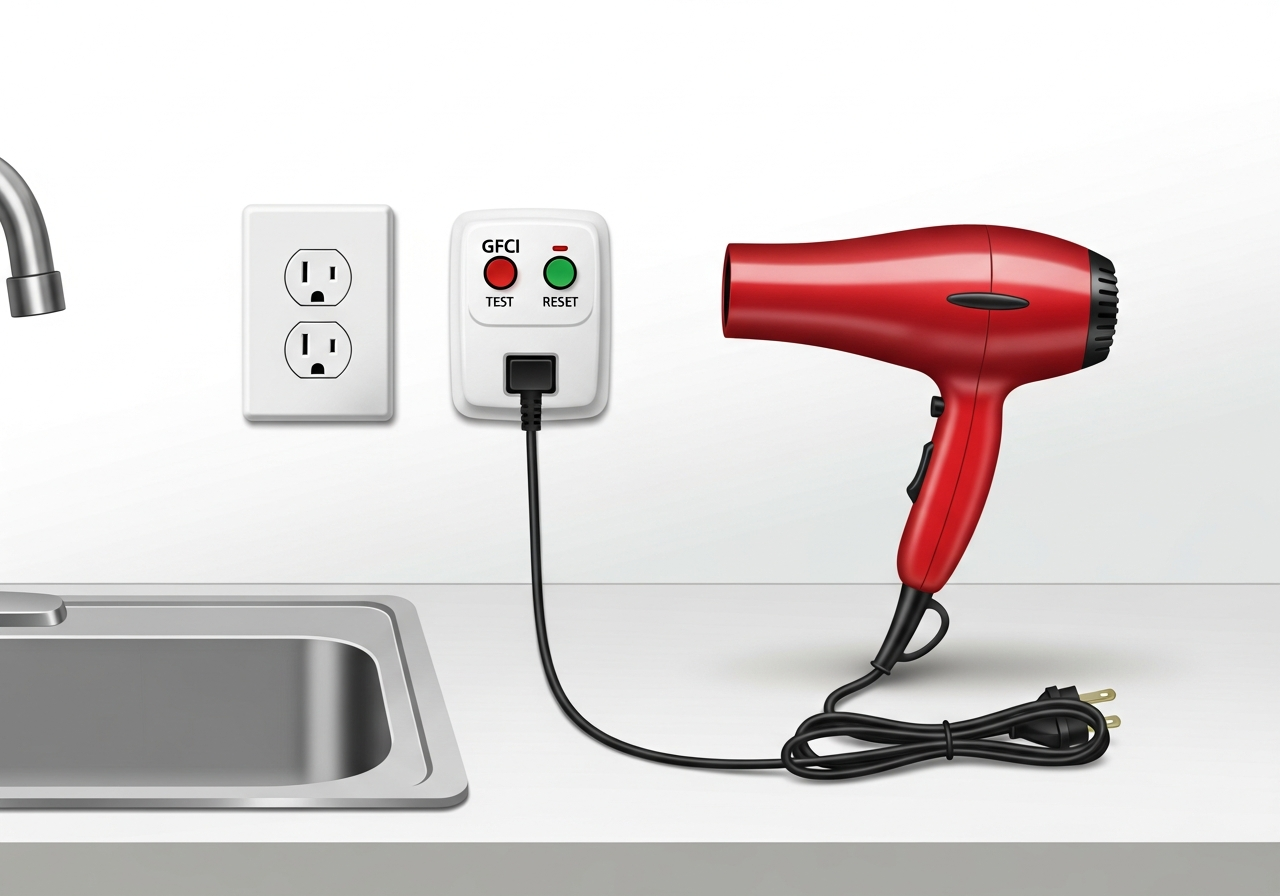
A GFCI (Ground Fault Circuit Interrupter) outlet monitors the current flowing in and out of a circuit. If it detects even a tiny imbalance meaning current is leaking through an unintended path like a person's body it shuts off power within milliseconds. GFCI outlets are required near water sources like sinks and bathtubs because water greatly increases the risk of electric shock.
Calculating Electrical Power
You can calculate how much power an appliance uses with this formula: P = V × I, where P is power in watts (W), V is voltage in volts (V), and I is current in amperes (A).
For example, a hair dryer labeled 120 V and 10 A uses P = 120 × 10 = 1,200 W. This means it converts 1,200 joules of electrical energy into heat and kinetic energy every second. A common mistake is adding the values instead of multiplying always multiply V and I to find power.
Your electricity bill is measured in kilowatt-hours (kWh), which is the amount of energy used over time. This connects to what you will explore in Energy Efficiency and Power Consumption.
Essential Electrical Safety Rules
Here are the most important safety habits you should always follow:
- Never touch outlets or appliances with wet hands water conducts electricity and dramatically increases shock risk.
- Never run electrical cords under rugs or carpets trapped heat can melt insulation and start a fire.
- Never plug too many appliances into one power strip this causes an electrical overload, where excess current overheats the wiring.
- Always grip the plug body not the cord when unplugging an appliance.
- If you see a downed power line, stay far away and call emergency services immediately.
- If someone receives a severe electric shock, cut the power at the breaker before touching them.
- For electrical fires, use a Class C (dry chemical) extinguisher never use water.
You should also look for the UL Listed label on appliances, which means the product has been tested and meets recognized electrical safety standards.
Key Terms & Definitions
Circuit Breaker: A resettable safety device in your electrical panel that automatically trips and opens the circuit when current exceeds its rated limit, preventing overheating and fires. You can reset it after fixing the problem.
Fuse: A one-time-use safety device containing a thin wire that melts and permanently breaks the circuit when current gets too high. You must replace a blown fuse it cannot be reset.
Ground Wire: A wire that provides a low-resistance path for fault current to travel safely into the earth, protecting you from electric shock if an appliance develops a fault.
GFCI (Ground Fault Circuit Interrupter): A special outlet that detects tiny current leaks and shuts off power instantly within milliseconds to protect you from electric shock, especially near water.
Neutral Wire: The wire that returns current back to the power source to complete the circuit. It carries current during normal operation and is different from the ground wire.
Voltage (V): The electrical "pressure" that pushes current through a circuit, measured in volts. It is not the same as current or resistance. Standard U.S. household outlets supply 120 volts.
Current (I): The flow rate of electric charge through a circuit, measured in amperes (A). Too much current causes overheating and triggers safety devices like fuses and circuit breakers.
Resistance: The opposition to the flow of current in a circuit, measured in ohms. High resistance in damaged wires causes dangerous heating and can start fires.
Power (P = V × I): A measure of how fast electrical energy is used, calculated by multiplying voltage by current. Power is measured in watts (W). A 60-watt bulb uses 60 joules of energy every second.
Energy (kWh): The total amount of electrical energy used over time, measured in kilowatt-hours. This is the quantity shown on your electricity bill.
Electrical Overload: A dangerous situation where too many appliances draw more current than a circuit can safely handle, causing wires to overheat and potentially start a fire.
Short Circuit: When the live wire contacts the neutral or ground wire directly, creating a path with very little resistance. This causes a sudden, massive surge of current that can melt wires and start fires.
Electrical Insulation: A non-conducting material (like plastic or rubber) that surrounds wires to keep current safely inside and prevent shock or fire. It does not speed up electrons or store charge.
Three-Prong Plug: A plug with two flat prongs (live and neutral) and one round prong (ground) that connects the appliance casing to the ground wire for added safety against electric shock.
UL Listed: A label indicating that an electrical product has been independently tested by Underwriters Laboratories and meets recognized safety standards. Always look for this label when choosing appliances.
Practice & Application
You can strengthen your understanding by applying what you have learned to real situations. Try identifying the safety devices in your home's electrical panel, and practice calculating power using P = V × I with the wattage labels on appliances in your kitchen.
Think about why Thermal Properties: Conductors and Insulators matter for electrical safety the same principles that explain heat transfer through materials also explain why plastic insulation keeps you safe and why metal wires carry current. You can also connect this to Energy Transfer: Conduction, Convection, and Radiation to understand how heat builds up in overloaded wires.
Building on What You Already Know
Before diving into electrical safety, you should be comfortable with foundational energy concepts. In Types of Energy: Mechanical, Electrical, and Chemical, you learned that electrical energy is one of many forms of energy. In Energy Conversion: Transformation Between Forms, you explored how electrical energy converts into heat, light, and motion in appliances. And in Efficiency: Energy Loss in Systems, you saw how energy is lost as heat which is exactly why overloaded circuits are so dangerous.
Related Topics & Connections
Electrical safety connects to a wide network of science concepts you are studying. Here is how each topic relates to what you are learning now:
- Circuit Components: Current, Voltage, and Resistance You need to understand voltage, current, and resistance to make sense of why circuit breakers trip and how power is calculated.
- Circuit Types: Series and Parallel Household circuits use parallel wiring so that each appliance gets full voltage independently, which is why one tripped breaker does not shut off your whole home.
- Energy Efficiency and Power Consumption Once you understand power (P = V × I) and energy in kWh, you can analyze how efficiently your home uses electricity.
- Thermal Properties: Conductors and Insulators Electrical insulation relies on the same insulating properties you study in thermal science. Materials that resist heat flow also resist electrical flow.
- Energy Transfer: Conduction, Convection, and Radiation Overloaded wires transfer dangerous heat to surrounding materials through conduction, which is why proper circuit protection matters.
- Electromagnetic Effects: Electromagnetism Principles This topic builds on your understanding of electrical current to explore how moving charges create magnetic fields.
- Generation Methods: Different Power Sources You will explore how the electricity that enters your home is generated from various energy sources.
- Emerging Technologies: Current Developments New technologies are changing how we manage and protect electrical systems in homes and cities.
- Environmental Tech: Green Solutions Understanding power consumption and efficiency prepares you to evaluate environmentally friendly electrical technologies.