TOPIC

Rock Types, Igneous, sedimentary, metamorphic

MY PROGRESS

Pug Score

0%

Getting Started

"Let's build your foundation!"

Best Streak

0 in a row

Study Points

+0

Overview

Practice

Watch

Read

Quiz

Next Steps


Get Started

Get unlimited access to all videos, practice problems, and study tools.

Unlimited practice
Full videos

BACK TO MENU

Topic Progress

Pug Score

0%

Getting Started

"Let's build your foundation!"

Videos Watched

0/0

Best Practice

No score

Read

Not viewed

Best Quiz

No attempts


Best Streak

0 in a row

Study Points

+0

Overview

Practice

Watch

Read

Quiz

Next Steps

Read

Igneous, Sedimentary, and Metamorphic Rocks: Discover How Earth's Rocks Form

You will learn how Earth's three main rock types igneous, sedimentary, and metamorphic form through different geological processes and how to identify each type by its key characteristics.

What Are the Three Main Rock Types?

You will find that all rocks on Earth belong to one of three main groups: igneous, sedimentary, and metamorphic. Scientists use this classification system to describe how each rock forms. Understanding these three rock types connects directly to your study of the Rock Cycle: Formation and Transformation, which shows how rocks continuously change from one type to another.

Rocks are not the same as minerals. Rocks are natural mixtures made up of one or more minerals, while minerals are pure substances with a specific crystal structure. For example, granite is a rock made of the minerals quartz, feldspar, and mica.

Igneous Rocks: Formed from Melted Rock

Igneous rocks form when magma (molten rock underground) or lava (molten rock at Earth's surface) cools and solidifies. Magma becomes lava the moment it erupts through a volcano or crack onto the surface.

There are two types of igneous rocks based on where cooling happens:

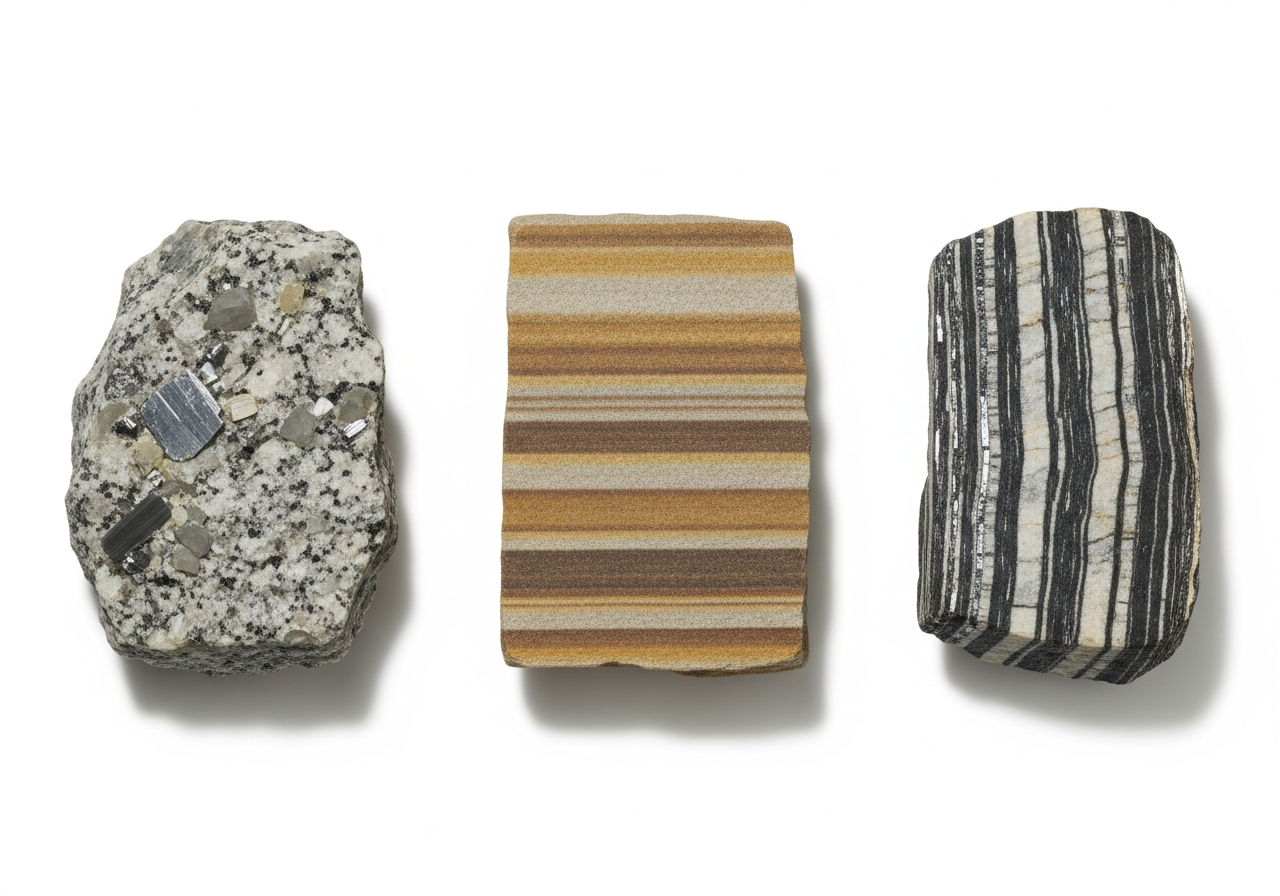
  • Intrusive igneous rock forms when magma cools slowly deep underground. Slow cooling gives crystals plenty of time to grow large and visible. Granite is a classic example.
  • Extrusive igneous rock forms when lava cools quickly at Earth's surface. Rapid cooling means crystals have almost no time to grow, so the rock has tiny or invisible crystals. Basalt and obsidian are examples. Obsidian cools so fast it looks like glass.

Sedimentary Rocks: Formed from Layers

Sedimentary rocks form when sediment small particles of rock, sand, silt, clay, or organic material is deposited in layers and slowly hardens into rock. This process is called lithification and involves two key steps:

  • Compaction: The weight of newer layers squeezes out water and air from the lower layers.
  • Cementation: Minerals dissolved in water fill the spaces between grains and harden, acting like natural glue to bind particles together.

Sedimentary rocks are famous for their visible horizontal layers called strata. These layers act like pages in a history book older layers are deeper, and fossils found inside tell you about past environments. Limestone forms from the remains of marine organisms like shells and coral. Sandstone forms from compacted sand grains held together by cementation.

Fossils are most commonly found in sedimentary rocks because organisms get buried in sediment that slowly hardens around them. Igneous and metamorphic rocks form under conditions that would destroy fossil evidence.

Metamorphic Rocks: Changed by Heat and Pressure

Metamorphic rocks form when an existing rock igneous, sedimentary, or even another metamorphic rock is subjected to extreme heat and pressure deep inside Earth's crust. The rock does not melt completely; instead, its minerals recrystallize into a new structure.

A key feature of many metamorphic rocks is foliation the arrangement of minerals into wavy or parallel bands caused by intense pressure. Rocks like slate and schist show this distinctive striped appearance. Marble is the metamorphic form of limestone heat and pressure recrystallize the calcite inside limestone, producing marble's smooth, polished texture. Metamorphic rocks are important evidence that Earth's interior is extremely hot.

Key Terms & Definitions

Igneous Rock: A rock type that you can identify as having formed when magma or lava cooled and solidified. Examples include granite, basalt, and obsidian.

Sedimentary Rock: A rock type that forms when layers of sediment are compacted and cemented together over long periods of time. Examples include limestone and sandstone.

Metamorphic Rock: A rock type that forms when an existing rock is changed by intense heat and pressure deep underground. Examples include marble and slate.

Magma: Molten (melted) rock found beneath Earth's surface, inside the mantle or crust.

Lava: The name for magma once it reaches and flows onto Earth's surface through a volcano or crack.

Intrusive Igneous Rock: Igneous rock that forms underground from slowly cooling magma, resulting in large, visible crystals. Granite is the most well-known example.

Extrusive Igneous Rock: Igneous rock that forms at Earth's surface from quickly cooling lava, resulting in small or invisible crystals. Basalt and obsidian are examples.

Sediment: Small particles of rock, sand, silt, clay, or organic material that are transported by water, wind, or ice and deposited in layers.

Compaction: The process in which the weight of upper sediment layers squeezes out water and air from lower layers, pressing them tightly together.

Cementation: The process in which minerals dissolved in water fill the spaces between sediment grains and harden, gluing the grains together to form solid rock.

Strata: The visible horizontal layers found in sedimentary rocks, where each layer represents a different period of sediment deposition.

Foliation: A defining feature of many metamorphic rocks where intense pressure causes minerals to align in parallel or wavy bands, giving rocks like slate and schist their striped appearance.

Rock Cycle: The ongoing process by which rocks continuously change from one type to another through processes like melting, cooling, weathering, erosion, and pressure.

Mineral: A naturally occurring, inorganic solid with a specific chemical composition and crystal structure. Rocks are made up of one or more minerals.

Weathering: The process by which rocks are broken down into smaller fragments called sediment through forces like wind, water, ice, and chemical reactions.

Erosion: The process by which weathered rock particles are transported by water, wind, or ice to new locations where they are deposited.

Granite: An intrusive igneous rock with large visible crystals that forms when magma cools slowly deep underground.

Basalt: An extrusive igneous rock with very small or invisible crystals that forms when lava cools quickly at Earth's surface.

Obsidian: A glassy extrusive igneous rock that forms when lava cools so rapidly that no crystals have time to grow, producing a smooth, shiny surface.

Limestone: A sedimentary rock built up from the compacted remains of marine organisms such as shells and coral.

Sandstone: A sedimentary rock made of sand grains compacted and cemented together over millions of years.

Marble: A metamorphic rock that forms when the sedimentary rock limestone is subjected to intense heat and pressure, recrystallizing its calcite minerals.
Practice What You Know

You can test your understanding by identifying rock types from their characteristics. Ask yourself: Does the rock have large crystals (intrusive igneous)? Does it have visible layers or fossils (sedimentary)? Does it show wavy color bands (metamorphic)?

You can also practice connecting rock examples to their types. Remember: granite and obsidian are igneous, limestone and sandstone are sedimentary, and marble is metamorphic. Explore Mineral Properties: Physical and Chemical Properties to deepen your understanding of what makes up each rock type.

What You Should Already Know

Before studying rock types, you should be familiar with Internal Structure: Layers of the Earth, which explains where magma forms and where metamorphic processes occur. Your knowledge of Physical Properties: Mass, Volume, Density and Chemical Properties: Reactivity, pH, Combustibility helps you understand how minerals behave inside rocks.

Understanding Surface Features: Mountains, Valleys, Oceans shows you where different rock types are commonly found. Your experience with Scientific Models: Creating and Using Models will help you interpret diagrams of rock formation processes.

Related Topics & Connections

This topic connects directly to Rock Cycle: Formation and Transformation, which shows you how igneous, sedimentary, and metamorphic rocks continuously transform into one another. Understanding rock types is the foundation you need before exploring the full cycle.

You will also connect rock types to Types of Changes: Physical vs. Chemical Changes, since weathering and cementation involve both physical and chemical processes. The topic Scientific Models: Creating and Testing Predictive Models helps you build and test models of rock formation.

After mastering rock types, you will be ready for Plate Tectonics: Continental Drift Theory and Earth's Structure: Internal Layers, which explain the forces that drive rock formation. You will also explore Geological Events: Earthquakes and Volcanoes, where igneous rock formation plays a major role. The study of Evidence of Change: Fossil Record and Similarities builds on your understanding of sedimentary rocks and the fossils preserved within them. Finally, Introduction to Mineral Resources: Formation and Extraction extends your knowledge of how rocks and minerals are used in the real world.