TOPIC
MY PROGRESS
Pug Score
0%
Best Streak
0 in a row
Study Points
+0
Overview
Practice
Watch
Read
Quiz
Next Steps
Get Started
Get unlimited access to all videos, practice problems, and study tools.
Back to Menu
Topic Progress
Pug Score
0%
Videos Watched
0/0
Best Practice
No score
Read
Not viewed
Best Quiz
No attempts
Best Streak
0 in a row
Study Points
+0
Overview
Practice
Watch
Read
Quiz
Next Steps
Read
Discover How Forces Shape the Real World Around You
You will learn how forces such as gravity, friction, magnetism, air resistance, buoyancy, tension, and elastic force are applied in real-world situations and technologies.
A force is any push or pull that acts on an object. Forces can change an object's speed, direction, or shape. You encounter forces every single day from kicking a soccer ball to sitting in a chair.
Forces are closely connected to Force Measurement, where you learn how to quantify exactly how strong a push or pull is. Understanding what a force does is your first step toward understanding how the world moves.

Types of Forces in the Real World
Contact Forces
A contact force happens when two objects physically touch. When you kick a ball, your foot applies a contact force. When brake pads press against a wheel rim, that is also a contact force friction slows the wheel down.
Non-Contact Forces
A non-contact force acts on an object without touching it. Gravity pulls you toward Earth without making contact. A magnet attracts iron filings from across a table without touching them. These are powerful forces you cannot always see but can always feel.
You will explore how these forces connect to Mechanical Advantage understanding how machines use forces to make work easier.
Balanced and Unbalanced Forces
When two equal forces act on an object in opposite directions, they are balanced forces and the object does not move. A book sitting on a desk has gravity pulling it down and the table pushing it up equally those forces are balanced.
When one force is greater than the opposing force, you have unbalanced forces. Unbalanced forces cause a change in motion the object speeds up, slows down, or changes direction. One student pushing a box harder than another student pushes from the opposite side creates an unbalanced force that moves the box.
Key Terms & Definitions
Force: A force is any push or pull that can change how an object moves, slows down, speeds up, or changes shape. For example, pushing a shopping cart is a force.
Friction: Friction is a force that acts between two surfaces in contact and opposes motion, slowing things down. It is why sliding a heavy box across a rough concrete floor is harder than across a smooth tile floor rough surfaces create more friction.
Gravity: Gravity is the force that pulls everything toward Earth's center. It is why an apple falls straight down from a tree and why a ball thrown upward always comes back down.
Inertia: Inertia describes an object's resistance to changes in motion. A ball left on the ground stays still, and a rolling ball keeps rolling both because of inertia. A seatbelt uses force to overcome your inertia during a sudden stop.
Magnetism: Magnetism is a non-contact force that works at a distance. A magnet can attract iron objects without touching them. A junkyard crane uses an electromagnet to lift scrap metal a real-world tool powered by magnetic force.
Air Resistance: Air resistance is a friction-like force between a moving object and the surrounding air. A parachute works by increasing air resistance to slow a skydiver's fall. Engineers design streamlined car and airplane shapes to reduce air resistance.
Buoyancy: Buoyancy is the upward push a liquid exerts on an object. This is why a boat floats and why objects feel lighter underwater. The liquid pushes up against the object's weight.
Tension: Tension is the force in a pulled rope or cable. When a tug-of-war team pulls a rope, tension transmits the force along the rope from one end to the other.
Elastic Force: Elastic force is stored in a stretched or compressed material. When you compress a spring and release it, the stored elastic potential energy becomes a force that launches an object. Rubber bands and trampolines also use elastic force.
Contact Force: A contact force requires direct physical interaction between two objects. Kicking a ball, pressing brake pads, and pushing a box are all contact forces.
Non-Contact Force: A non-contact force acts between objects without them physically touching. Gravity and magnetism are the most common non-contact forces you will study.
Balanced Forces: Balanced forces are equal forces acting in opposite directions on an object, resulting in no change in motion. A book sitting still on a desk is an example of balanced forces at work.
Unbalanced Forces: Unbalanced forces occur when one force is greater than the opposing force, causing a net force that changes an object's motion. A rocket launching upward has an unbalanced force pushing it off the ground.
Real-World Force Applications
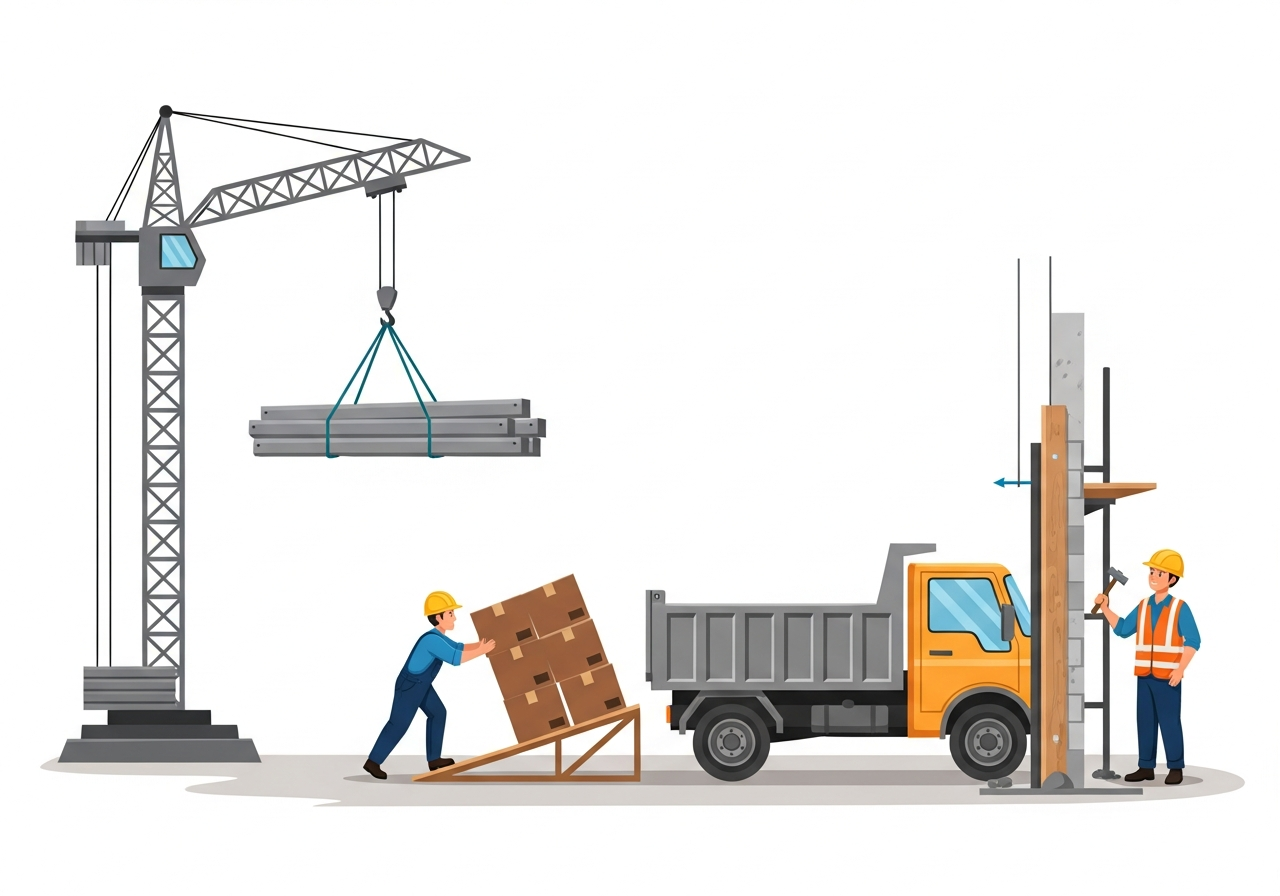
You can see forces at work everywhere. A ramp is a simple machine that spreads lifting force over a longer distance, making it easier to push heavy boxes into a truck. Cleats on a soccer player's shoes increase friction with the grass so the player can run without slipping.
Suction cups stick to glass because air pressure pushes the cup firmly against the surface. When a gardener covers part of a hose nozzle, reducing the opening increases pressure force, making water shoot out faster. These are all real applications of force concepts you are learning.
These applications connect directly to Machine Types levers, pulleys, wheels, and inclined planes and to Complex Machines, which combine simple machines to do even more useful work.
Applying Force Concepts
You can practice identifying forces in everyday situations. Think about riding a bicycle: gravity pulls you down, friction between the tires and road keeps you moving forward, and brake pads create friction to stop the wheels. Every part of that ride involves multiple forces working together.
When you analyze a swimmer pushing water backward and moving forward, you are seeing Newton's third law every action force has an equal and opposite reaction force. You will also explore Energy Conversion to understand how forces transform energy from one form to another, and Efficiency to learn how energy is sometimes lost in real systems.
Building on What You Already Know
Before diving into force applications, you should be comfortable with several foundational ideas. Your understanding of Energy Types Potential and Kinetic Energy helps you see how stored energy becomes a force in action. Your knowledge of Physical Properties Mass, Volume, and Density explains why heavier objects press down harder and create greater friction.
You also build on Materials Science Properties and Applications to understand why certain materials are chosen for tools that use force. The Design Cycle Problem-Solving Methodology and Systems Thinking Interconnected Components help you analyze how forces work together in complex systems.
Related Topics & Connections
This topic connects to a rich network of science concepts. You will use Force Measurement Quantifying Forces to put numbers on the pushes and pulls you study here. You will explore Mechanical Advantage Work and Force Relationships to see how machines multiply force to make tasks easier.
Understanding Work and Time Relationship Between Power and Energy and Efficiency Energy Loss in Systems shows you how forces do work in the real world and where energy goes. You will also connect to Types of Energy Mechanical, Electrical, Chemical and Energy Conversion Transformation Between Forms to see how forces and energy are linked.
The engineering side of forces comes alive through Design Process Engineering Methodology, Material Selection Properties and Applications, and Testing and Evaluation Performance Assessment. You will also study Gravity Effects Gravitational Forces in Space to see how gravity works beyond Earth.
This topic prepares you for exciting next steps: Forces of Flight Lift, Drag, Thrust, and Gravity and Aircraft Design Aerodynamic Principles, where you will apply everything you know about forces to understand how airplanes fly.