TOPIC

Gravity Effects, Gravitational forces in space

MY PROGRESS

Pug Score

0%

Best Streak

0 in a row

Study Points

+0

Overview

Practice

Watch

Read

Quiz

Next Steps


Get Started

Get unlimited access to all videos, practice problems, and study tools.

Unlimited practice
Full videos

Back to Menu

Topic Progress

Pug Score

0%

Videos Watched

0/0

Best Practice

No score

Read

Not viewed

Best Quiz

No attempts


Best Streak

0 in a row

Study Points

+0

Read

Discover How Gravity Controls Everything in Space

You will explore gravitational forces in space, learning how gravity holds the solar system together, keeps planets in orbit, and affects weight on different planets and moons.

What Is Gravity?

Gravity is the invisible pulling force that attracts all objects with mass toward each other. Every object in the universe from a tiny pebble to the massive Sun has gravity. The more mass an object has, the stronger its gravitational pull.

You can think of gravity like an invisible rubber band connecting every object in space. It never pushes it only pulls. This force is what keeps you on the ground, keeps the Moon orbiting Earth, and keeps Earth orbiting the Sun. As you explore Planetary Motion, Orbits and Rotations, you will see gravity at work in every orbit.

Mass, Weight, and Gravitational Pull

Mass is the amount of matter in an object, and it never changes no matter where you travel in the universe. Weight, on the other hand, is the force of gravity acting on your mass so it changes depending on where you are.

If you weigh 60 pounds on Earth, you would weigh only about 10 pounds on the Moon, because the Moon's gravity is about one-sixth as strong as Earth's. On Mars, which has about 38% of Earth's gravity, a student who weighs 80 pounds on Earth would weigh only about 30 pounds. Your mass stays the same, but your weight changes with gravity. This connects directly to what you studied in Physical Properties: Mass, Volume, and Density.

The key rule to remember: more mass = stronger gravity. Jupiter is the most massive planet in our solar system, so it has the strongest gravitational pull among all the planets about 2.4 times stronger than Earth's.

How Gravity Keeps Planets in Orbit

An orbit is the curved path an object follows as it travels around another object due to gravity. Planets orbit the Sun because the Sun contains about 99.8% of all the mass in our solar system, giving it overwhelming gravitational dominance.

Without the Sun's gravity, Earth would travel in a straight line off into deep space this is Newton's first law of motion. Gravity continuously bends Earth's path into a curved orbit. The same principle keeps the Moon orbiting Earth and Jupiter's many moons orbiting Jupiter. Jupiter's enormous mass creates such strong gravity that it has captured over 90 known moons.

Comets also follow this rule. When a comet passes near the Sun, the Sun's gravity curves its path into a long, stretched elliptical orbit, pulling it inward and then letting its speed carry it back out to the far edges of the solar system.

Free Fall, Weightlessness, and Escape Velocity

You might wonder why astronauts float inside the International Space Station (ISS) if gravity still exists there. The answer is free fall. Free fall describes motion where only gravity acts on an object. The ISS and the astronauts inside it are both falling toward Earth at the same rate, but moving sideways so fast that they keep missing Earth creating a stable orbit.

This shared free-fall condition is what causes weightlessness the floating sensation astronauts experience. There is no surface pushing back on them, so they feel no weight. Gravity at the ISS altitude is still about 90% as strong as on Earth's surface.

Escape velocity is the speed an object needs to completely overcome a planet's gravity and fly off into space. For Earth, that speed is about 11.2 km/s incredibly fast. Rockets must reach this speed to leave Earth's atmosphere and travel to other planets.

Tidal Forces and Gravity's Reach

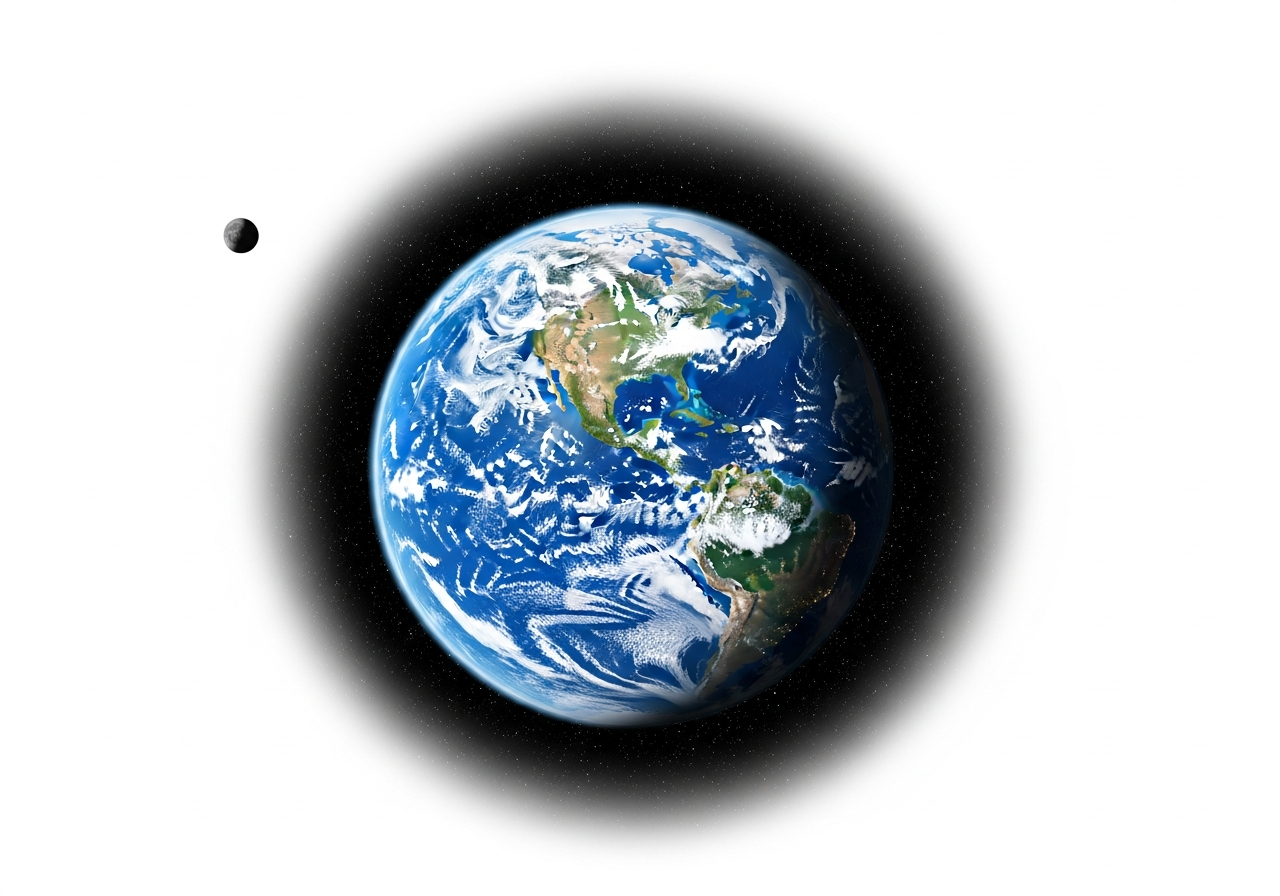
The Moon's gravity is strong enough to pull on Earth's large bodies of water, creating tidal forces. The ocean bulges on the side of Earth closest to the Moon because that side is pulled more strongly. A second bulge forms on the opposite side because that side is pulled less strongly than Earth's center. As Earth rotates, coastlines move through these bulges, creating the rise and fall of tides.

Gravity also shapes the appearance of planets and stars. When enough matter collects in space, gravity pulls it inward equally from all directions, forming a sphere. This is why planets and stars are round. Smaller objects like asteroids do not have enough mass for gravity to pull them into a sphere, which is why they have irregular, lumpy shapes.

Earth's gravity also holds our atmosphere in place by pulling air molecules downward, preventing them from escaping into space. This is why the Moon, which has very little mass, has almost no atmosphere.
Key Terms & Definitions

Gravity: Gravity is the invisible force that pulls objects with mass toward each other. You experience gravity every time you drop something and it falls to the ground Earth's gravity is pulling it downward.

Mass: Mass is the amount of matter in an object. Your mass stays exactly the same whether you are on Earth, the Moon, or Jupiter it never changes based on location.

Weight: Weight measures how strongly gravity pulls on your mass. Because gravity is different on different planets, your weight changes depending on where you are, even though your mass stays the same.

Orbit: An orbit is the curved path a moon or planet follows because gravity continuously bends its path around a larger body. Planetary orbits are shaped like ovals called ellipses, not perfect circles.

Gravitational Pull: Gravitational pull is the attractive force a large body like Earth or the Sun exerts on nearby objects. The greater the mass of the object, the stronger its gravitational pull on everything around it.

Free Fall: Free fall describes motion where only gravity acts on an object. An astronaut in orbit is in free fall constantly falling toward Earth but moving sideways fast enough to keep missing it.

Weightlessness: Weightlessness is what astronauts feel during free fall because there is no surface pushing back on them. It creates the floating sensation you see astronauts experience inside the space station.

Escape Velocity: Escape velocity is the speed an object needs to overcome a planet's gravity entirely and travel into space. For Earth, that speed is about 11.2 km/s the speed rockets must reach to leave our planet.

Tidal Force: Tidal force explains why Earth's oceans bulge on both sides of the planet. The side nearest the Moon is pulled more strongly by the Moon's gravity than the far side, creating two tidal bulges that cause high and low tides.

Practice What You Know

You can test your understanding of gravitational forces by thinking through real-world scenarios. Ask yourself: if you dropped a hammer and a feather on the Moon at the same time, what would happen? Because the Moon has no atmosphere and no air resistance, both objects would hit the ground at exactly the same time gravity accelerates all objects equally regardless of mass.

Try calculating weight changes: if you weigh 60 pounds on Earth, divide by 6 to find your Moon weight (about 10 pounds), or multiply by 2.4 to estimate your Jupiter weight. These exercises connect directly to Force Measurement: Quantifying Forces and help you understand how gravity is measured and compared across different locations in space.

You can also explore how gravity relates to Mechanical Advantage: Work and Force Relationships by thinking about how forces interact with mass and motion in different gravitational environments.

Building on What You Already Know

Before exploring gravitational forces, you should be comfortable with several foundational concepts. Your understanding of Celestial Bodies: Planets, Moons, and Asteroids gives you the background to understand which objects in space have significant gravitational pull and which do not.

Your knowledge of Orbital Patterns: Planet and Moon Movements and Revolution Effects: Seasonal Changes connects directly to how gravity shapes the paths planets travel. Understanding Rotation Effects: Day/Night Cycle also helps you see how gravity and rotation work together to create patterns on Earth.

Your earlier study of Internal Structure: Layers of the Earth and Surface Features: Mountains, Valleys, and Oceans shows you how gravity has shaped Earth itself over billions of years. The Scientific Models: Creating and Using Models skills you developed will help you visualize and reason about gravitational forces you cannot directly see.

Related Topics & Connections

Gravity connects to many other important science topics you will explore. Planetary Motion: Orbits and Rotations builds directly on your understanding of how gravity curves the paths of planets and moons into orbits. You will see exactly how gravitational force and orbital speed work together to keep every planet in its path.

As you move forward, you will explore Exploration Tools: Satellites and Space Probes and Space Research: Current Space Exploration, where you will discover how scientists use their knowledge of gravity to plan satellite orbits and send spacecraft to other planets. Understanding Space Technology: Exploration and Observation Tools will show you how telescopes and probes help us study gravitational effects across the solar system.

Gravity also connects to Force Applications: Real-World Applications and Scientific Models: Creating and Testing Predictive Models, where you apply force concepts to real situations and build models to predict how gravity will behave. These skills prepare you for advanced topics like Forces of Flight: Lift, Drag, Thrust, and Gravity, where gravity is one of four key forces that determine how aircraft and spacecraft move.

Looking further ahead, your mastery of gravitational forces prepares you for Universe Structure: Galaxies and Solar Systems and Space Technology: Satellites and Exploration, where gravity operates on the grandest scales imaginable holding entire galaxies together and guiding spacecraft across billions of kilometers of space.