TOPIC

Specialized Senses, Echolocation, UV sensing, magnetoreception

MY PROGRESS

Pug Score

0%

Getting Started

"Let's build your foundation!"

Best Streak

0 in a row

Study Points

+0

Overview

Practice

Watch

Read

Quiz

Next Steps


Get Started

Get unlimited access to all videos, practice problems, and study tools.

Unlimited practice
Full videos

BACK TO MENU

Topic Progress

Pug Score

0%

Getting Started

"Let's build your foundation!"

Videos Watched

0/0

Best Practice

No score

Read

Not viewed

Best Quiz

No attempts


Best Streak

0 in a row

Study Points

+0

Overview

Practice

Watch

Read

Quiz

Next Steps

Read

Amazing Animal Senses: Echolocation, UV Vision & Magnetoreception

You will explore specialized animal senses echolocation, UV light sensing, and magnetoreception and discover how these incredible abilities help animals navigate, find food, and survive in their environments.

What Are Specialized Animal Senses?

You already know about the five basic senses: sight, hearing, smell, taste, and touch. But did you know that some animals have specialized senses extra abilities that let them detect things you cannot see, hear, or feel? These senses give animals a unique survival advantage in their environment.

As you explore Sensory Systems, you will see how specialized senses build on the basic structure of animal senses to create truly extraordinary abilities. Three of the most fascinating specialized senses are echolocation, UV sensing, and magnetoreception.
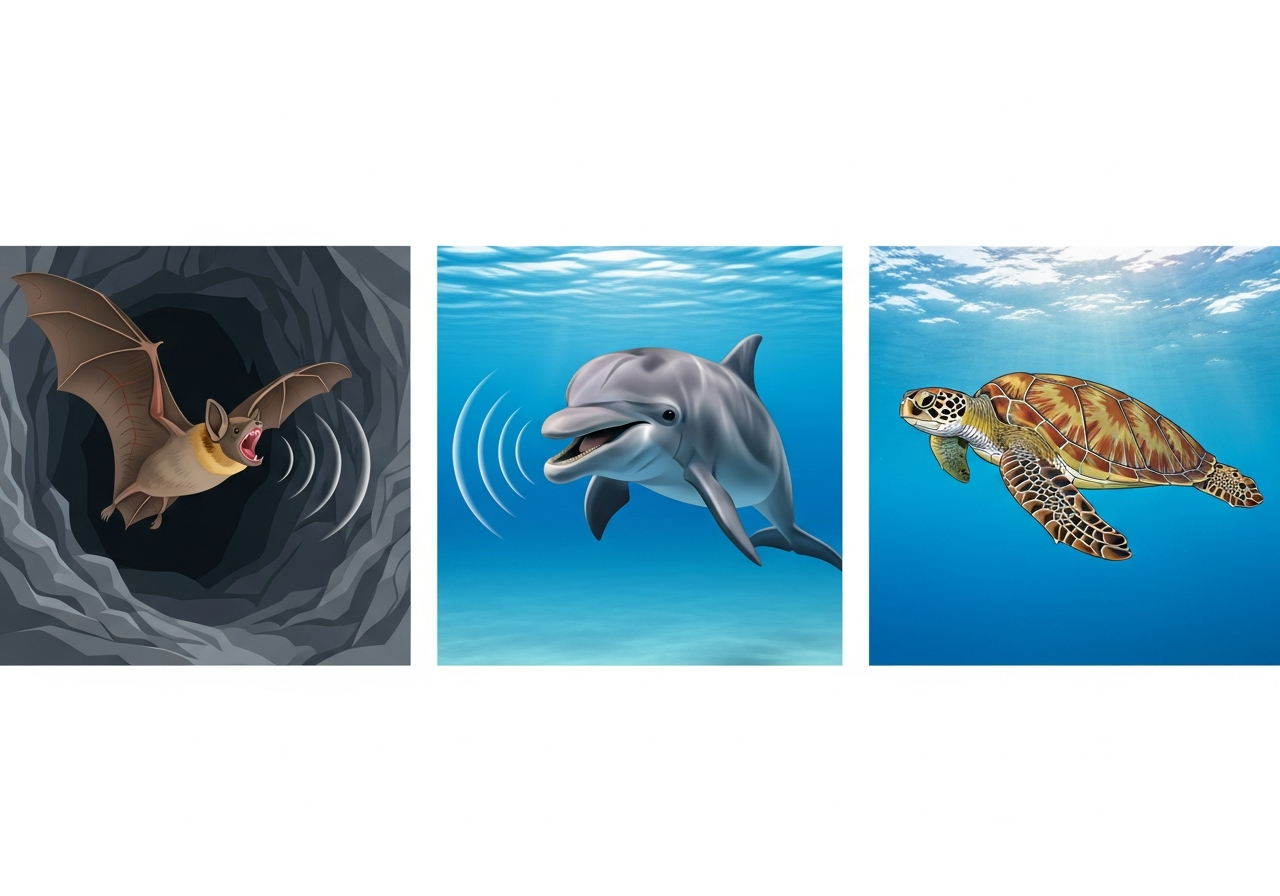
Echolocation: Finding Objects with Sound

Echolocation is the ability to send out sound waves and listen for the echoes that bounce back from nearby objects. When a sound wave hits a solid object, it reflects back as an echo. The animal's brain processes that echo to figure out where the object is, how big it is, and how far away it is.

Bats are the most famous land animals that use echolocation. They produce very high-pitched sounds through their mouth or nose sounds so high that you cannot hear them. These sounds bounce off insects and obstacles, and the echoes return to the bat's large ears. This lets bats hunt insects and navigate safely in complete darkness.

Dolphins also use echolocation underwater. They produce rapid clicking sounds that travel through the water and bounce off fish and other objects. Dolphins can detect objects as small as a golf ball from over 70 metres away! This ability is sometimes called biosonar.

UV Sensing: Seeing Invisible Light

UV stands for ultraviolet a type of light with a shorter wavelength than visible light, making it completely invisible to human eyes. Your eyes have three types of cone cells that detect red, green, and blue light, but none of them can pick up UV wavelengths.

However, bees and butterflies have special photoreceptors in their eyes that detect UV light. Many flowers have UV patterns on their petals called nectar guides these act like landing strips that point bees straight to the nectar. Without UV vision, bees would not be able to see these hidden guides.

Some birds also use UV vision. Certain birds of prey can see UV-reflective urine trails left by small rodents on the ground, helping them track prey. Some birds even have UV patterns on their feathers that help them attract a mate patterns that are invisible to you but clearly visible to other birds of the same species.

Magnetoreception: Earth's Built-In Compass

Magnetoreception is the ability to sense Earth's magnetic field and use it for navigation like having a built-in compass inside your body. Earth's magnetic field is invisible, but some animals can detect it and use it to find the right direction during long journeys.

Migratory birds, like Arctic terns, travel thousands of kilometres from the Arctic to Antarctica every year. Scientists believe these birds have special proteins called cryptochromes in their eyes that are sensitive to magnetic fields, helping them navigate even on cloudy nights when stars are not visible.

Sea turtles use magnetoreception to travel thousands of miles across open ocean and return to the exact beach where they were born to lay their eggs. Salmon also use magnetoreception to navigate across the ocean and find the river where they hatched. Once close to home, salmon also use their sense of smell to find the exact river.

Other Specialized Senses

Beyond echolocation, UV sensing, and magnetoreception, other animals have their own remarkable abilities. Some snakes, like pit vipers and pythons, have special pit organs that detect infrared radiation the heat given off by warm-blooded prey. This is called infrared sensing or thermoreception.

Cave fish navigate in total darkness using a lateral line a special organ that detects tiny changes in water pressure caused by nearby objects. Sharks and electric eels use electroreception to detect electric fields in water. Each of these is a completely separate and distinct specialized sense.

You can connect these ideas to Brain Processing the way an animal's brain interprets signals from these specialized senses is just as important as the sense itself.

Key Terms & Definitions

Echolocation: You use the word echolocation to describe the ability to send out sound waves and listen for the echoes that bounce back from nearby objects. Bats and dolphins use echolocation to find prey and navigate in the dark.

Echo: An echo is a sound that bounces back after hitting a solid object or surface. In echolocation, the animal listens for this reflected sound to gather information about its surroundings.

Magnetoreception: Magnetoreception is the ability to sense Earth's magnetic field and use it for navigation, like a built-in compass. Birds, sea turtles, and salmon all use magnetoreception during long journeys.

Ultraviolet (UV) light: Ultraviolet light is a type of light that has a shorter wavelength than visible light, making it invisible to human eyes. Bees and some birds can see UV light because their eyes have special receptors for it.

Sonar: Sonar is a technology inspired by echolocation that uses sound waves to detect the distance and location of objects. Submarines use sonar the same way dolphins use echolocation by sending out sound and listening for the echo.

Migration: Migration is the seasonal long-distance travel that animals undertake, often guided by specialized senses like magnetoreception. Arctic terns, sea turtles, and salmon are all examples of animals that migrate.

Specialized sense: A specialized sense is a sensory ability that goes beyond the standard five senses, allowing an animal to detect things like magnetic fields, UV light, or ultrasonic echoes that most other animals cannot perceive. These senses are built into the animal's biology.

Infrared sensing (thermoreception): Infrared sensing is the ability to detect heat given off by living things. Some snakes use special pit organs to sense the infrared radiation from warm-blooded prey nearby.

Electroreception: Electroreception is the ability to detect electric fields in water. Sharks and electric eels use this sense it is different from magnetoreception, which detects magnetic fields for navigation.

Lateral line: The lateral line is a specialized organ found in fish that detects tiny changes in water pressure caused by nearby objects. Cave fish use their lateral line to navigate in total darkness without hitting walls.

Biosonar: Biosonar is another name for echolocation used by dolphins. They produce clicking sounds through their foreheads and receive echoes through their lower jaws to map their surroundings.

Nectar guides: Nectar guides are UV patterns on flower petals that are invisible to humans but clearly visible to bees. They act like landing strips, directing bees straight to the nectar inside the flower.

Cryptochromes: Cryptochromes are special proteins found in the eyes of some migratory birds that are sensitive to magnetic fields. Scientists believe these proteins help birds detect Earth's magnetic field and navigate during migration.

Practice What You Know

You can test your understanding by thinking about which specialized sense matches each animal. Ask yourself: Does this animal use sound echoes, UV light, or Earth's magnetic field to survive? Try connecting each sense to a real animal example from what you have learned.

You can also explore Sound Properties to understand more about how sound waves travel and bounce this will help you understand exactly why echolocation works so well for bats and dolphins. Similarly, exploring Light Properties will help you understand why UV light is invisible to humans but visible to bees.

Building on What You Already Know

Before exploring specialized senses, you should be familiar with some important foundational topics. In Structural Adaptations, you learned how physical features help animals survive specialized sense organs are a perfect example of structural adaptations. In Behavioral Adaptations, you explored how actions like migration help animals survive, and now you can see how magnetoreception makes migration possible.

You also studied Magnetic Forces and learned how magnetic fields work. That knowledge is the foundation for understanding how magnetoreception uses Earth's magnetic field like a compass.

Related Topics & Connections

This topic connects to many other exciting areas of science. In Sensory Systems, you explore the structure and function of the five basic senses specialized senses build directly on top of that foundation. In Brain Processing, you discover how the brain interprets signals from all senses, including specialized ones like echolocation echoes and magnetic field detection.

Understanding Sound Properties including pitch, volume, and wave properties helps you understand exactly how echolocation works with high-pitched sound waves. Exploring Light Properties including reflection, refraction, and color helps you understand why UV light exists beyond the visible spectrum that your eyes can detect.

In Environmental Response, you will see how animals react to light, touch, and gravity connecting to how specialized senses help animals respond to their environment. In Energy Flow, you will explore food webs and energy transfer, and you will see how specialized senses like echolocation help predators find prey efficiently within those food webs.

After mastering specialized senses, you will be ready for Cells to Systems, where you will explore how cells, tissues, organs, and organ systems work together including the sensory organs that make echolocation, UV sensing, and magnetoreception possible.