TOPIC
Animal Classification, Major animal groups and characteristicsMY PROGRESS
Pug Score
0%
Getting Started
"Let's build your foundation!"
Best Streak
0 in a row
Study Points
+0
Overview
Practice
Watch
Read
Quiz
Next Steps
Get Started
Get unlimited access to all videos, practice problems, and study tools.
BACK TO MENU
Topic Progress
Pug Score
0%
Getting Started
"Let's build your foundation!"
Videos Watched
0/0
Best Practice
No score
Read
Not viewed
Best Quiz
No attempts
Best Streak
0 in a row
Study Points
+0
Overview
Practice
Watch
Read
Quiz
Next Steps
Read
Discover Animal Groups and Their Amazing Features!
You will learn how animals are sorted into groups based on their special body features, like fur, feathers, scales, and more.
What Is Animal Classification?
When scientists look at animals, they sort them into groups. This is called animal classification. You can sort animals by looking at their special body parts and features.
Each group of animals shares the same special features. For example, all birds have feathers. All fish have scales and gills. Learning these features helps you know which group an animal belongs to!
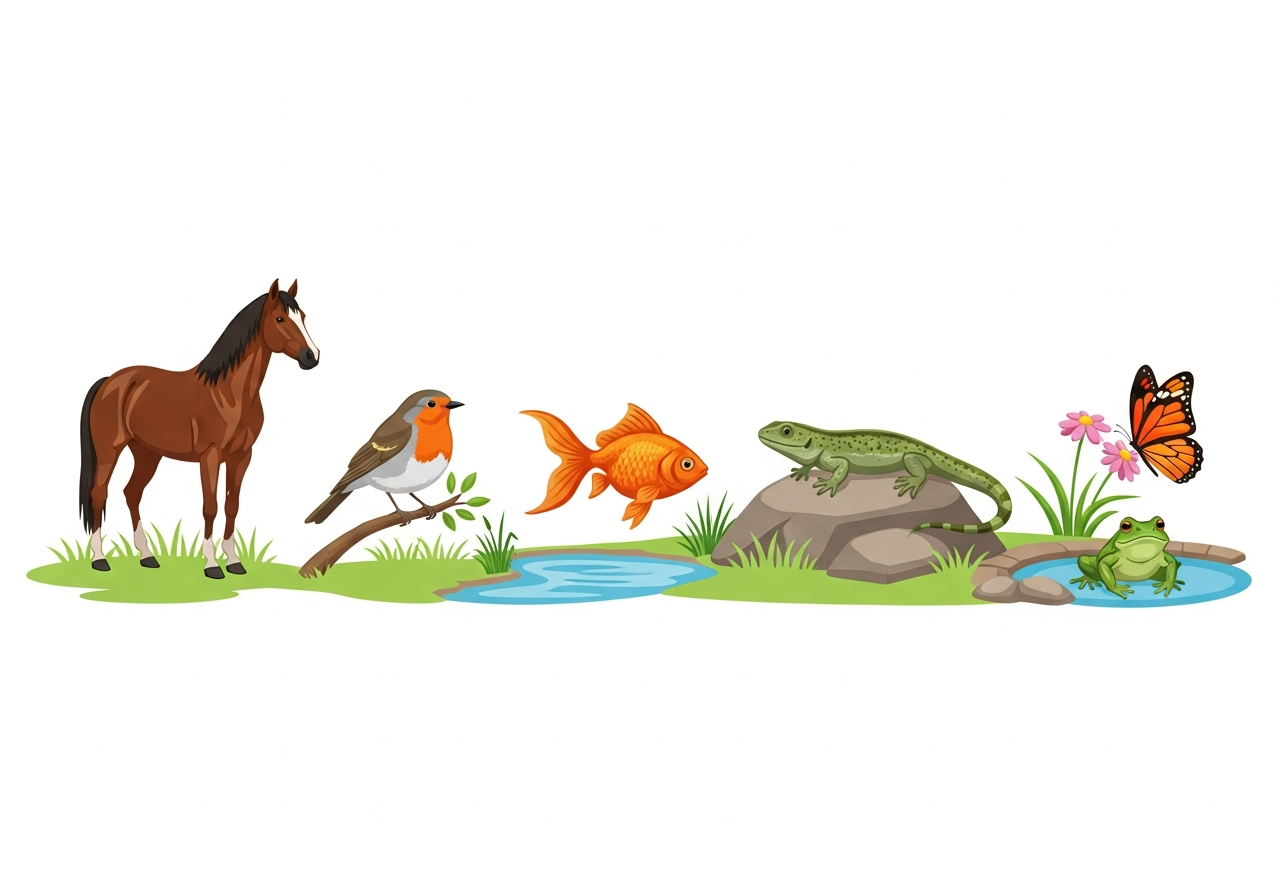
The Six Major Animal Groups
Mammals
Mammals have fur or hair on their bodies. Mother mammals feed their babies milk. You can find mammals like horses, cows, deer, rabbits, and dogs. Even you are a mammal!
Birds
Birds have feathers, two wings, and a beak. Most birds can fly. Birds lay eggs in nests. Flamingos, owls, ducks, and chickens are all birds.
Fish
Fish live in water. They have scales on their bodies and breathe through gills. Gills help fish take oxygen from the water. Salmon and goldfish are fish.
Reptiles
Reptiles have dry, scaly skin. They lay eggs and breathe with lungs on land. Lizards, snakes, and turtles are reptiles. You can spot a reptile by looking for its scaly skin.
Amphibians
Amphibians are special because they live both in water and on land. They start life in water with gills, then grow legs. Frogs and toads are amphibians. Many have webbed feet to help them swim.
Insects
Insects have six legs and three body parts. Beetles, butterflies, ants, dragonflies, and ladybugs are all insects. If you count six legs on a small creature, it is an insect!
How Do You Sort Animals?
You can sort animals by looking at their body coverings. Does the animal have fur, feathers, scales, or smooth skin? This is a great clue for finding its group.
You can also look at how an animal breathes, moves, or feeds its babies. These clues all help you classify animals correctly.
| Animal Group | Body Covering | Special Feature | Example |
|---|---|---|---|
| Mammals | Fur or hair | Feeds babies milk | Cow, horse, rabbit |
| Birds | Feathers | Has wings and beak | Owl, duck, flamingo |
| Fish | Scales | Breathes with gills | Salmon, goldfish |
| Reptiles | Dry scales | Lays eggs on land | Lizard, snake, turtle |
| Amphibians | Moist skin | Lives in water and on land | Frog, toad |
| Insects | Exoskeleton | Six legs, three body parts | Ant, butterfly, ladybug |
Key Terms and Definitions
Animal Classification: Sorting animals into groups based on their special features. You use classification to organize animals that share the same body parts or characteristics.
Mammal: An animal that has fur or hair and feeds its babies milk. You are a mammal! Horses, cows, deer, and rabbits are mammals too.
Bird: An animal that has feathers, wings, and a beak. Birds lay eggs. Owls, ducks, and flamingos are birds.
Fish: An animal that lives in water, has scales, and breathes through gills. Goldfish and salmon are fish.
Reptile: An animal with dry, scaly skin that breathes with lungs. Lizards, snakes, and turtles are reptiles.
Amphibian: An animal that lives part of its life in water and part on land. Frogs and toads are amphibians. They start life in water and grow legs later.
Insect: A small animal with six legs and three body parts. Ants, butterflies, beetles, and ladybugs are insects.
Mollusk: An animal with a soft body protected by a hard shell. Snails and clams are mollusks. You might find mollusk shells near ponds or lakes.
Body Covering: What covers the outside of an animal's body. Body coverings can be fur, feathers, scales, or smooth skin. They help you identify which group an animal belongs to.
Gills: Special body parts that help fish breathe underwater. Fish use gills to take oxygen from the water. Dolphins and turtles do not have gills they must come up for air.
Scales: Small, flat pieces that cover the skin of fish and reptiles. Scales protect the animal's body. You can see scales on a goldfish or a lizard.
Feathers: The soft covering on a bird's body. Feathers help birds fly and stay warm. All birds have feathers.
Fur or Hair: The soft, fluffy covering on a mammal's body. Fur helps keep mammals warm. Horses, sheep, and rabbits all have fur or hair.
Exoskeleton: A hard outer covering that protects an insect's body. Insects have exoskeletons instead of fur or feathers.
Vertebrate: An animal that has a backbone inside its body. Mammals, birds, fish, reptiles, and amphibians are all vertebrates. A deer is a vertebrate.
Metamorphosis: A big change in an animal's body as it grows. Amphibians go through metamorphosis they start as water animals with gills and grow into animals that can live on land.
Webbed Feet: Feet with skin between the toes that help animals swim. Frogs and ducks have webbed feet.
Fun Ways to Practice Animal Classification
You can practice sorting animals every day! When you visit a zoo, farm, or park, look at each animal carefully. Ask yourself: Does it have fur, feathers, or scales? How many legs does it have?
Try sorting pictures of animals into groups. Look for body coverings, count legs, and check if the animal has a beak or gills. You will get better and better at classifying animals the more you practice!
Getting Ready to Learn
You do not need to know anything special before starting this topic. Just look around you animals are everywhere! You already know many animals from your home, school, and neighborhood.
As you learn about animal groups, you will start to notice the special features that make each group unique. This will help you understand more about the living world around you.
Related Topics and Connections
Animal classification is a great starting point for learning about the living world. As you learn to sort animals into groups, you are building skills that scientists use every day.
You will use what you know about animal groups to explore more science topics in the future. For example, you might learn about animal habitats, life cycles, and how animals get food. Every animal group you learn about today will help you understand bigger science ideas later on.
Keep exploring and asking questions about the animals you see. The more you notice about their bodies and behaviors, the better scientist you will become!