TOPIC
Circles and circumferenceMY PROGRESS
Pug Score
0%
Getting Started
"Let's build your foundation!"
Best Streak
0 in a row
Study Points
+0
Overview
Practice
Watch
Read
Quiz
Next Steps
Get Started
Get unlimited access to all videos, practice problems, and study tools.
Back to Menu
Topic Progress
Pug Score
0%
Getting Started
"Let's build your foundation!"
Videos Watched
0/0
Best Practice
No score
Read
Not viewed
Best Quiz
No attempts
Best Streak
0 in a row
Study Points
+0
Overview
Practice
Watch
Read
Quiz
Next Steps
Read
Mastering Circles and Circumference: Formulas, Examples, and Practice
Introduction
Welcome to our exploration of circles and their circumference! In this lesson, we'll dive into the fascinating world of circular shapes and learn how to measure their outer boundaries. The circumference of a circle is a fundamental concept in geometry, and understanding it is crucial for many real-world applications. We'll start by watching an introductory video that will give you a visual grasp of these concepts. This video is essential as it lays the groundwork for our further discussions. You'll discover how the radius of a circle, which is the distance from the center to any point on the circle, relates to its circumference. We'll also explore the diameter, which is twice the length of the radius and spans the entire width of the circle. By the end of this lesson, you'll be comfortable calculating the circumference of any circle using these key measurements. Let's begin this exciting journey into circular geometry together!
Understanding Circles and Their Components
A circle is a fundamental geometric shape that has fascinated mathematicians and artists for centuries. In mathematical terms, a circle is defined as a set of points in a plane that are all at an equal distance from a central point of a circle. This central point is aptly named the center of the circle. Understanding the components of a circle, such as its radius and diameter, is crucial for grasping various mathematical concepts and real-world applications.
The Center of a Circle
The center of a circle is the fixed point from which all points on the circle's circumference are equidistant. It's like the heart of the circle, from which everything else is measured. Imagine placing the point of a compass at this center and rotating it to draw a perfect circle that's the essence of the center's role.
Radius of a Circle
The radius of a circle is a line segment that extends from the center to any point on the circle's circumference. It's a crucial measurement that defines the size of the circle. To find the radius, you simply need to measure the distance from the center to any point on the circle's edge. All radii (plural of radius) in a circle are equal in length, which is a key property of circles.
Diameter of a Circle
The diameter is a line segment that passes through the center of the circle and has its endpoints on the circle's circumference. It's essentially a line that cuts the circle into two equal halves. The diameter is always twice the length of the radius, making it the longest chord of the circle.
Relationship Between Radius and Diameter
The relationship between radius and diameter of a circle is straightforward yet fundamental. The diameter is always twice the length of the radius. Mathematically, we express this as:
Diameter = 2 × Radius
Conversely, the radius is half the length of the diameter:
Radius = Diameter ÷ 2
This relationship between radius and diameter is constant for all circles, regardless of their size. It's a key concept that plays a crucial role in many calculations involving circles.
How to Find Circumference
The circumference of a circle is the distance around its outer edge. It's directly related to both the radius and diameter. To find the circumference, we use the famous mathematical constant pi (π), which is approximately equal to 3.14159. The formula for circumference is:
Circumference = 2 × π × radius
Or, using the diameter:
Circumference = π × diameter
These formulas demonstrate how the radius and diameter are integral to calculating other properties of a circle.
Practical Applications
Understanding the components of a circle has numerous real-world applications. In architecture, the radius and diameter are crucial for designing circular structures or elements. In engineering, these concepts are used in everything from gear design to satellite orbits. Even in everyday life, we encounter circular objects where knowing about radius and diameter can be helpful, such as when measuring for a round tablecloth or calculating the area of a pizza.
Conclusion
The mathematical definition of a circle and its key components the center, radius, and diameter form the foundation for understanding this perfect shape. The relationship between these elements, particularly the radius and diameter, is crucial for various calculations and applications. Whether you're a student studying geometry, an engineer working on complex designs, or simply someone curious about the world around you, grasping these concepts opens up a world of mathematical beauty and practical utility. Remember, in the world of circles, everything revolves around these fundamental components!
Circumference: Definition and Formula
Circumference is a fundamental concept in geometry that refers to the distance around the outer edge of a circle or any curved shape. Understanding circumference is crucial for various real-world applications, from engineering and construction to everyday problem-solving. In this guide, we'll explore how to find the circumference, the circumference formula, and the role of pi in these calculations.
What is Circumference?
The circumference of a circle is the total length of its boundary. Imagine wrapping a string tightly around a circular object - the length of that string would be the circumference. This measurement is essential in many fields, including architecture, physics, and even in everyday situations like determining the size of a round table or the length of a bike tire.
The Circumference Formula
To calculate the circumference of a circle, we use two primary formulas:
- C = 2πr (where r is the radius of the circle)
- C = πd (where d is the diameter of the circle)
Both formulas involve pi (π), a mathematical constant approximately equal to 3.14159. The choice between these formulas depends on the information you have about the circle.
How to Solve Circumference: Step-by-Step Guide
Let's walk through the process of finding the circumference using both formulas:
Using C = 2πr (when you know the radius)
- Identify the radius (r) of the circle.
- Multiply the radius by 2 to get the diameter.
- Multiply the result by π (pi).
Example: If a circle has a radius of 5 cm, the circumference would be:
C = 2 × π × 5 = 10π 31.4 cm
Using C = πd (when you know the diameter)
- Identify the diameter (d) of the circle.
- Multiply the diameter by π (pi).
Example: If a circle has a diameter of 10 cm, the circumference would be:
C = π × 10 31.4 cm
The Value of Pi (π) in Circumference Calculations
Pi (π) is a mathematical constant that represents the ratio of a circle's circumference to its diameter. It's an irrational number, meaning it has an infinite number of decimal places without any repeating pattern. In calculations, we often use an approximation of π as 3.14159 or simply 3.14 for less precise measurements.
The role of pi in circumference calculations is crucial because it allows us to relate the straight-line measurement of a circle's radius or diameter to its curved circumference. This relationship is consistent for all circles, regardless of their size, making pi a universal constant in circular geometry.
Practical Applications of Circumference
Understanding how to find the circumference has numerous real-world applications:
- Determining the amount of fencing needed for a circular garden
- Calculating the length of a belt needed for machinery
- Measuring the distance traveled by a wheel in one rotation
- Designing circular structures in architecture and engineering
Tips for Accurate Circumference Calculations
To ensure accuracy when solving circumference problems:
- Always double-check your measurements of radius or diameter.
- Use a calculator for precise
Practical Applications of Circumference
Understanding how to figure out the circumference of a circle is crucial in many real-world applications. From engineering and architecture to everyday life, the ability to calculate circumference plays a vital role in problem-solving and design. Let's explore some practical examples of circumference calculations and how they're applied in various fields.
In engineering, circumference calculations are essential for designing and manufacturing circular components. For instance, when creating gears for machinery, engineers must precisely determine the circumference to ensure proper meshing and smooth operation. Similarly, in the automotive industry, calculating the circumference of tires is crucial for speedometer calibration and overall vehicle performance.
Architects frequently encounter circumference problems when designing circular or curved structures. When planning a round building or a dome, architects need to calculate the circumference to determine the amount of materials needed and to ensure structural integrity. Landscape architects also use circumference calculations when designing circular gardens, fountains, or pathways.
In everyday life, we often encounter situations where knowing how to calculate circumference is useful. For example, when installing a new above-ground swimming pool, homeowners need to determine the circumference to purchase the correct amount of liner material. Similarly, when buying a new tablecloth for a round table, knowing the circumference ensures a perfect fit.
Let's consider some specific circumference of a circle problems and their solutions:
1. A city planner is designing a circular roundabout with a radius of 15 meters. To calculate the amount of curbing needed, they must determine the circumference. Using the formula C = 2πr, where r is the radius, the circumference would be: C = 2 × π × 15 94.25 meters.
2. A watchmaker needs to create a custom watch face with a diameter of 40 mm. To calculate the circumference for the bezel, they would use the formula C = πd, where d is the diameter. The circumference would be: C = π × 40 125.66 mm.
3. A farmer wants to install a circular irrigation system for a field with a radius of 100 meters. To determine the length of pipe needed for the outermost ring, they would calculate the circumference: C = 2 × π × 100 628.32 meters.
These circumference examples demonstrate the wide-ranging applications of this fundamental geometric concept. In manufacturing, circumference calculations are crucial for producing items like pipes, tubes, and cylindrical containers. The food industry relies on circumference measurements for designing packaging for round products like cans and bottles.
In the field of sports, circumference plays a role in designing and manufacturing equipment. For instance, the circumference of a basketball or soccer ball must meet specific standards to ensure fair play. Track and field events, such as discus throwing, also involve precise circumference measurements for the throwing circle.
Environmental scientists and conservationists use circumference calculations when studying trees. By measuring the circumference of a tree trunk, they can estimate its age and monitor growth over time. This information is valuable for forest management and ecological research.
In conclusion, understanding how to calculate the circumference of a circle is a valuable skill with numerous practical applications. From engineering and architecture to everyday problem-solving, the ability to determine circumference enables us to design, build, and create with precision. By mastering this fundamental concept, we can better appreciate the circular shapes that surround us and solve real-world problems more effectively.
Relationship Between Radius and Circumference
The relationship between the radius and circumference of a circle is fundamental in geometry. Understanding how to find radius from circumference and vice versa is crucial for solving various mathematical problems. Let's explore this relationship and learn methods to calculate these measurements.
The Fundamental Relationship
The circumference of a circle is directly proportional to its radius. This relationship is expressed by the formula:
C = 2πr
Where C is the circumference, π (pi) is approximately 3.14159, and r is the radius.
How to Get Radius from Circumference
To find the radius of a circle when given its circumference, we can rearrange the formula:
r = C / (2π)
This allows us to calculate the radius by dividing the circumference by 2π.
Find Circumference with Radius
Conversely, to find the circumference when given the radius, we simply use the original formula:
C = 2πr
Multiply the radius by 2π to obtain the circumference.
Examples
Example 1: Find the radius of a circle with a circumference of 31.4 cm.
Using r = C / (2π), we get:
r = 31.4 / (2 * 3.14159) 5 cm
Example 2: Calculate the circumference of a circle with a radius of 7 m.
Using C = 2πr, we get:
C = 2 * 3.14159 * 7 43.98 m
Practice Problems
To reinforce your understanding, try these practice problems for circles:
- Find the radius of a circle with a circumference of 62.8 cm.
- Calculate the circumference of a circle with a radius of 4.5 m.
- A circular track has a circumference of 400 m. What is its radius?
- If the radius of a circular pond is 15 ft, what is its circumference?
Remember, the key to mastering these calculations is practice. By working through various practice problems for circles, you'll become more comfortable with the relationship between radius and circumference. This knowledge is not only useful in mathematics but also in real-world applications such as engineering, architecture, and design.
Advanced Concepts: Arcs and Central Angles
As we delve deeper into the world of circles, it's essential to explore more advanced concepts such as arcs and central angles. These elements play a crucial role in understanding the geometry of circles and are closely related to circumference calculations. Let's examine these concepts in detail and see how they interconnect.
Arc of a Circle
An arc is a portion of the circumference of a circle. It can be thought of as a curved line segment that lies on the circle's edge. Arcs are typically measured in degrees or radians and are classified into two types:
- Minor arc: Less than 180 degrees
- Major arc: Greater than 180 degrees
Central Angle
A central angle is an angle formed by two radii of a circle that intersect at the center. The vertex of a central angle is always at the circle's center. The measure of a central angle is directly related to the arc it subtends on the circle's circumference.
Relationship Between Arcs and Central Angles
There's a direct correlation between the measure of a central angle and the length of its corresponding arc. This relationship between arcs and central angles is fundamental to many circular calculations:
- The measure of an arc (in degrees) is equal to the measure of its central angle.
- A complete circle has 360 degrees, corresponding to a full rotation of 2π radians.
Calculating Arc Length
To calculate the length of an arc, we use the following formula:
Arc length formula: Arc Length = (θ / 360°) × Circumference
Where θ is the central angle in degrees.
Example Calculation
Let's consider a circle with a radius of 10 cm and a central angle of 45°. To find the arc length:
- Calculate the circumference: C = 2πr = 2π × 10 = 62.83 cm
- Apply the arc length formula: Arc Length = (45° / 360°) × 62.83 cm = 7.85 cm
Circumference of a Circle and Its Relation to Arcs
The circumference of a circle can be viewed as a special case of an arc it's an arc that spans the entire 360 degrees of the circle. Understanding this helps in visualizing how arc calculations relate to the overall circumference:
- A 90° arc is 1/4 of the circumference
- A 180° arc is 1/2 of the circumference
- A 360° arc is the full circumference
Practical Applications
These concepts have numerous real-world applications:
- Architecture: Designing arched doorways or windows
- Engineering: Calculating gear ratios in circular mechanisms
- Navigation: Determining distances along curved paths
- Astronomy: Measuring angular distances between celestial objects
Conclusion
Understanding arcs and central angles enhances our comprehension of circular geometry. These concepts provide a foundation for more complex calculations involving circles and are essential in various fields of study and practical applications. By mastering these advanced concepts, we gain a deeper appreciation for the elegant mathematics underlying the simple shape of a circle.
Common Mistakes and Troubleshooting
When learning how to figure circumference, students often encounter several common errors. One frequent mistake is confusing the formula for circumference with that of area. Remember, the circumference formula is C = 2πr or C = πd, where r is the radius and d is the diameter. Another error is using the wrong value for π; always use 3.14159 or the π button on your calculator for accuracy.
To avoid these mistakes when finding circumference, double-check your formula before starting calculations. Clearly label your given values and final answer, including units. It's also crucial to distinguish between radius and diameter, as using the wrong measurement can lead to incorrect results.
If your calculations go wrong, follow these troubleshooting steps:
- Verify you're using the correct formula for circumference.
- Check if you've correctly identified the radius or diameter.
- Ensure you're using the right value for π.
- Review your arithmetic for any calculation errors.
- Compare your answer to an estimated value to see if it's reasonable.
FAQ: Common Questions About Circumference
- Q: How do you find circumference without the radius?
- A: If you don't have the radius, you can use the diameter in the formula C = πd.
- Q: Can circumference be negative?
- A: No, circumference is always a positive value as it represents the distance around a circle.
- Q: What's the difference between circumference and perimeter?
- A: Circumference specifically refers to the distance around a circle, while perimeter is used for any closed shape.
- Q: How do you find circumference of an oval?
- A: For an oval, you need a more complex formula involving both the major and minor axes.
By understanding these common pitfalls and how to address them, you'll be better equipped to accurately calculate circumference. Remember, practice makes perfect when it comes to mastering the circumference formula and applying it to various problems. If you're still struggling, don't hesitate to seek help from your teacher or a tutor who can provide additional guidance on how to find circumference correctly.
Conclusion
Understanding the circumference of a circle is a fundamental concept in geometry. As we've explored, the circumference is the distance around the circle's edge, directly related to its radius. To find the circumference, we use the formula C = 2πr, where r is the radius. The introduction video provided a clear visual representation of these concepts, making it easier to grasp how radius and circumference are interconnected. Remember, π (pi) is approximately 3.14159, a crucial constant in circle calculations. Mastering how to find the circumference of a circle opens doors to more advanced geometric concepts. We encourage you to practice these calculations and explore further aspects of circle geometry. By doing so, you'll develop a deeper understanding of spatial relationships and mathematical principles. The radius and circumference of a circle are just the beginning of an exciting journey into the world of geometry.
Find the circumferences of the following circles.
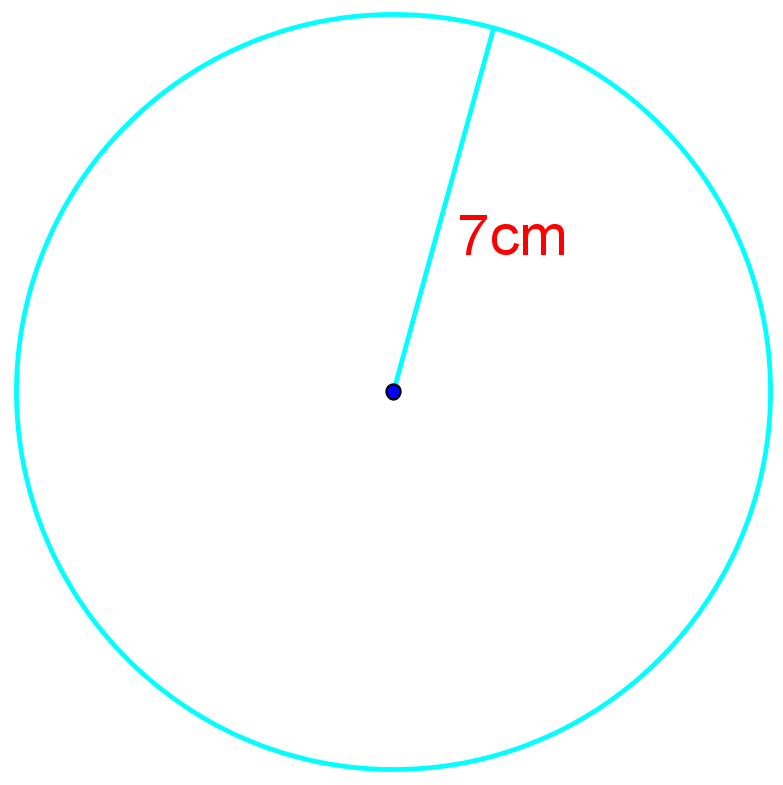
Step 1: Understand the Problem
The first step in solving any problem is to understand what is being asked. In this case, we are asked to find the circumference of the given circles. The circumference is the distance around the edge of the circle. The image provided shows a circle with a radius marked. The radius is the distance from the center of the circle to any point on its edge.
Step 2: Identify the Radius
From the image, identify the radius of the circle. The radius is a crucial part of the formula used to calculate the circumference. In the provided image, the radius is clearly marked. Make sure to note down this value as it will be used in the next steps.
Step 3: Recall the Formula for Circumference
The formula for the circumference of a circle is given by:
C = 2πr
Where:
- C is the circumference
- π (pi) is a constant approximately equal to 3.14159
- r is the radius of the circle
Step 4: Plug in the Values
Now that we have the formula and the radius, the next step is to plug in the values. Using the radius identified from the image, substitute it into the formula. For example, if the radius is 7 cm, the formula will look like this:
C = 2π(7)
Step 5: Perform the Calculation
Use a calculator to perform the multiplication. Multiply 2 by π (pi) and then by the radius. For instance:
C = 2 × π × 7
Ensure that you use the value of π provided by your calculator for the most accurate result. This will give you the circumference of the circle.
Step 6: Include the Units
After calculating the circumference, make sure to include the correct units in your answer. Since the radius was given in centimeters, the circumference will also be in centimeters. Always double-check to ensure that the units are consistent throughout your calculations.
Step 7: Verify Your Answer
Finally, verify your answer by rechecking your calculations and ensuring that all steps were followed correctly. This helps to avoid any mistakes and ensures that your final answer is accurate.
Conclusion
By following these steps, you can accurately find the circumference of any circle given its radius. Remember to always start by understanding the problem, identifying the radius, recalling the formula, plugging in the values, performing the calculation, including the units, and verifying your answer. This systematic approach will help you solve similar problems with ease.
FAQs
Here are some frequently asked questions about circles and circumference:
1. How do you calculate the circumference of a circle?
To calculate the circumference of a circle, use the formula C = 2πr, where C is the circumference, π (pi) is approximately 3.14159, and r is the radius of the circle. Alternatively, you can use C = πd, where d is the diameter of the circle.
2. What is the relationship between radius and circumference?
The circumference of a circle is directly proportional to its radius. As the radius increases, the circumference increases proportionally. The circumference is always 2π times the radius, or π times the diameter.
3. How do you find the radius if you know the circumference?
To find the radius (r) when given the circumference (C), use the formula r = C / (2π). Simply divide the circumference by 2π to obtain the radius.
4. What is the circumference of a circle with a diameter of 10 units?
For a circle with a diameter of 10 units, the circumference would be C = πd = π × 10 31.4159 units.
5. Why is π (pi) used in circumference calculations?
π (pi) is used because it represents the ratio of a circle's circumference to its diameter. This ratio is constant for all circles, making π a fundamental constant in circular geometry and essential for accurate circumference calculations.
Prerequisite Topics for Understanding Circles and Circumference
When delving into the fascinating world of circles and circumference, it's crucial to have a solid foundation in several key mathematical concepts. These prerequisite topics not only enhance your understanding but also provide the necessary tools to tackle more complex problems related to circular geometry.
One of the fundamental concepts to grasp is the relationship between two variables, particularly the relationship between radius and diameter. This algebraic understanding forms the basis for many circle-related calculations. By mastering this concept, students can easily comprehend how changes in one dimension affect the overall properties of a circle.
Another essential prerequisite is understanding the central and inscribed angles in circles. This knowledge is crucial when exploring the central point of a circle and how angles relate to arc lengths and areas. It provides insights into the geometric properties of circles that are fundamental to solving more advanced problems.
Additionally, familiarity with tangent properties is vital when studying circles and circumference. These properties of circles help in understanding how lines interact with circular shapes, which is essential for various real-world applications and more complex geometric proofs.
By mastering these prerequisite topics, students build a strong foundation for exploring circles and circumference. The relationship between variables helps in understanding how diameter and radius affect circumference calculations. Knowledge of central and inscribed angles provides insights into arc lengths and sector areas, which are closely related to circumference concepts. Tangent properties offer a deeper understanding of how circles interact with other geometric shapes and lines.
Moreover, these prerequisites are interconnected. For instance, understanding the relationship between variables aids in grasping how changes in central angles affect arc lengths. Similarly, knowledge of tangent properties complements the understanding of inscribed angles, especially when dealing with circles that intersect or touch other geometric figures.
As students progress in their study of circles and circumference, they'll find that these prerequisite topics continually resurface, reinforcing their importance. Whether calculating the area of a circular sector, determining the length of an arc, or solving real-world problems involving circular motion, the foundational knowledge from these prerequisites proves invaluable.
In conclusion, a thorough understanding of these prerequisite topics not only facilitates learning about circles and circumference but also enhances problem-solving skills and geometric intuition. It prepares students for more advanced concepts in geometry and provides a solid base for practical applications in fields such as engineering, physics, and architecture. By investing time in mastering these fundamental concepts, students set themselves up for success in their mathematical journey.