TOPIC
Calendar datesMY PROGRESS
Pug Score
0%
Getting Started
"Let's build your foundation!"
Best Streak
0 in a row
Study Points
+0
Overview
Practice
Watch
Read
Quiz
Next Steps
Get Started
Get unlimited access to all videos, practice problems, and study tools.
Back to Menu
Topic Progress
Pug Score
0%
Getting Started
"Let's build your foundation!"
Videos Watched
0/0
Best Practice
No score
Read
Not viewed
Best Quiz
No attempts
Best Streak
0 in a row
Study Points
+0
Overview
Practice
Watch
Read
Quiz
Next Steps
Read
Mastering Calendar Dates: Your Key to Effective Time Management
In this lesson, we will learn:
- How to write calendar dates in written form (words, ordinals, and numbers)
- How to write calendar dates in metric notation (numbers only, in the format: yyyy/mm/dd)
- Writing calendar dates using numbers in a variety of formats (mm/dd/yyyy OR mm/dd/yy OR dd/mm/yy)
Notes:
- Calendars and dates keep track of time! A date is a reference to a specific day in time, and we can tell how much time passes between two dates.
- Calendar dates use the units of time for: month, day, and year
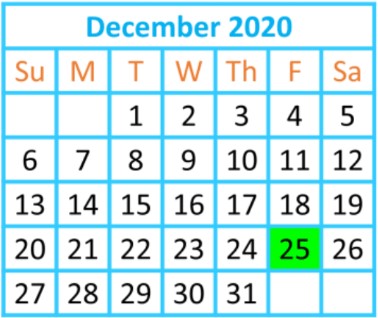
- The written form of a calendar date is in the format: [month] [day]ordinal, [year]
- Ex. December 25th, 2020
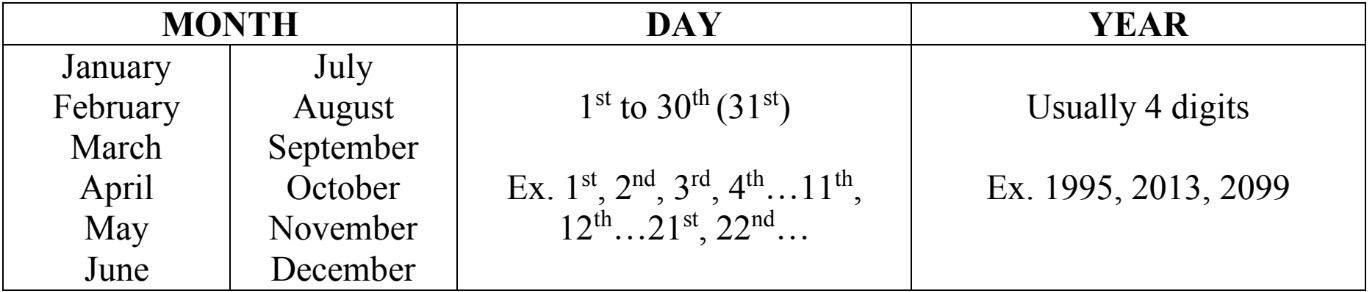
- The metric notation of a calendar date is in the order: year / month / date
- i.e. yyyy / mm / dd (sometimes it is seen with dashes or spaces instead)
- this orders the time units from longest to shortest durations
- Ex. 2020 / 12 / 25 is December 25th, 2020
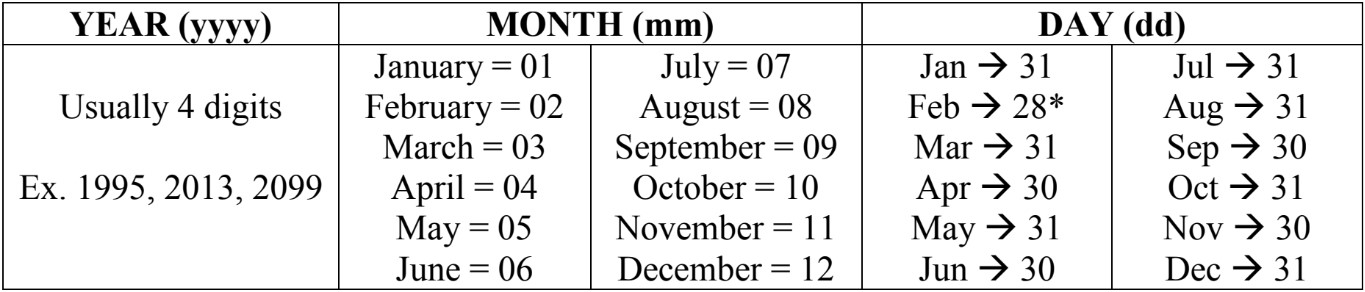
- *A special exception is that February has 29 days (instead of 28 days) during a leap year (every 4 years).
- Dates in metric notation are used often when filling in paperwork!
- There are other formats of writing out the date using numbers:
- mm/dd/yyyy (different order)
- mm/dd/yy (only the last 2 digits of the year)
- dd/mm/yy (different order)
Introduction to Calendar Dates
Calendar dates play a crucial role in our daily lives, serving as the foundation for tracking time and organizing our schedules. These numerical representations of days, months, and years allow us to navigate through time efficiently. Our introduction video provides a comprehensive overview of calendar dates, offering valuable insights into their significance and practical applications. Throughout this article, we'll explore the fundamental components of calendar dates, including their structure, various formats used worldwide, and the historical development of different calendar systems. We'll also discuss the importance of calendar dates in various fields such as history, business, and personal planning. Additionally, we'll delve into the relationship between calendar dates and time zones, leap years, and the challenges of maintaining accurate timekeeping across different cultures and regions. By understanding calendar dates, you'll gain a deeper appreciation for the intricate system that helps us measure and manage time in our interconnected world.
Understanding Written Form of Calendar Dates
Writing calendar dates in written form is an essential skill that enhances clarity in communication and formal documents. This guide will explore various methods of expressing dates using words, ordinals, and numbers, providing you with the knowledge to confidently format dates in different contexts.
When writing dates in written form, it's crucial to understand the components: the month, day, and year. The most common format in English-speaking countries is Month Day, Year. For example, "December 25th, 2020." Let's break down each element:
1. Months: Always capitalize the first letter of the month when writing it out (e.g., January, February, March). You can also use abbreviations (Jan., Feb., Mar.) in less formal contexts.
2. Days: When writing the day, use ordinal numbers. For example, 1st, 2nd, 3rd, 4th, etc. In formal writing, it's preferable to spell out ordinals up to tenth (e.g., first, second, third). After that, you can use numerals with ordinal suffixes (11th, 12th, 23rd).
3. Years: Write years as cardinal numbers (e.g., 2020, 2021, 2022). In very formal contexts, you might spell out years (e.g., two thousand twenty), but this is less common.
Here are some examples of dates in written form:
- January 1st, 2023
- The twenty-fifth of December, 2020
- March 15, 2024 (note: omitting the ordinal is acceptable in some styles)
- July Fourth, 1776 (for well-known dates, capitalizing the day is common)
The importance of proper date formatting cannot be overstated. In legal documents, business correspondence, and academic papers, consistent and correct date formatting demonstrates attention to detail and professionalism. It also prevents misunderstandings, especially in international communications where date formats may differ (e.g., DD/MM/YYYY vs. MM/DD/YYYY).
To remember the order of months and their corresponding number of days, here's a friendly mnemonic device: use your knuckles! Make fists with both hands and place them side by side. Starting from the left, each knuckle represents a 31-day month, while the dips between knuckles represent shorter months. The only exception is February, which has 28 days (29 in leap years).
Left hand: January (knuckle, 31), February (dip, 28/29), March (knuckle, 31), April (dip, 30)
Right hand: May (knuckle, 31), June (dip, 30), July (knuckle, 31), August (knuckle, 31)
Then, start over on the left hand for the remaining months:
September (knuckle, 30), October (dip, 31), November (knuckle, 30), December (dip, 31)
This visual aid makes it easy to recall which months have 30 or 31 days. As for February, just remember it's the odd one out with 28 days, except in leap years when it has 29.
When writing dates in different contexts, be aware of regional variations. For instance, in the United States, the month typically comes first (MM/DD/YYYY), while in many other countries, the day comes first (DD/MM/YYYY). In formal or international settings, it's often best to write out the month to avoid confusion.
In conclusion, mastering the written form of calendar dates is a valuable skill that enhances your communication abilities. By understanding the proper use of words, ordinals, and numbers in date formatting, you'll be well-equipped to express dates clearly and professionally in various contexts. Remember to consider your audience and the formality of the situation when choosing how to write dates, and don't hesitate to spell out dates fully when clarity is paramount. With practice, you'll find that writing dates becomes second nature, allowing you to
Metric Notation for Calendar Dates
The metric notation for calendar dates, commonly known as yyyy/mm/dd or ISO 8601 format, is a standardized way of representing dates that offers numerous benefits for sorting and organizing information. This format arranges date components from the largest unit (year) to the smallest (day), making it an efficient and logical system for date representation.
In the yyyy/mm/dd format, 'yyyy' represents the four-digit year, 'mm' denotes the two-digit month, and 'dd' indicates the two-digit day. For example, July 4, 2023, would be written as 2023/07/04 in metric notation. This format eliminates ambiguity and confusion that can arise from different regional date formats, such as mm/dd/yyyy used in the United States or dd/mm/yyyy common in many European countries.
One of the primary advantages of the metric notation is its superiority in sorting and organizing dates. When dates are written in this format, they can be easily sorted in chronological order using standard alphabetical or numerical sorting methods. This is particularly useful in digital systems, databases, and file naming conventions, where automatic sorting is often employed.
Converting dates to metric notation is straightforward. To convert a date like "September 15, 2024" to metric notation, simply arrange the components in the order of year, month, and day: 2024/09/15. Conversely, to convert from metric notation to written form, reverse the process by identifying the year, month, and day from the given string of numbers.
When working with metric notation, it's important to understand the concept of leap years, which affects the number of days in February. In most years, February has 28 days, but in leap years, it has 29. This extra day, known as a leap day, is added to keep our calendar year synchronized with the Earth's orbit around the sun.
Leap years occur every four years, with some exceptions. Generally, a year is a leap year if it's divisible by 4. However, years divisible by 100 are not leap years unless they are also divisible by 400. For example, the year 2000 was a leap year, but 1900 was not. This system ensures long-term accuracy in our calendar.
The reason for February's unique treatment dates back to ancient Roman times. The Roman calendar originally had only ten months, with winter being a monthless period. When January and February were added, February was given the shortest length. This tradition persisted even as calendar systems evolved.
In metric notation, leap years are easily identifiable. For instance, 2024/02/29 is a valid date in a leap year, while 2023/02/29 would be invalid as 2023 is not a leap year. This consistency in representation makes the metric notation particularly useful for date calculations and data processing in various fields, from finance to scientific research.
The adoption of metric notation for dates has been growing globally, especially in international business, scientific communities, and technology sectors. Its unambiguous nature reduces errors in date interpretation across different cultures and systems. Moreover, this format aligns well with computer systems, making it ideal for digital record-keeping and data exchange.
While the metric notation may seem less intuitive at first for those accustomed to other date formats, its logical structure and practical benefits make it an excellent choice for standardized date representation. As our world becomes increasingly interconnected, having a universal date format like yyyy/mm/dd becomes more crucial for clear communication and efficient data management across borders and cultures. Converting dates to metric notation is a key skill in this context.
Alternative Numeric Formats for Calendar Dates
When it comes to writing calendar dates in numeric format, there are several conventions used around the world. Understanding these different formats is crucial to avoid confusion and ensure clear communication, especially in our increasingly globalized world. Let's explore the most common numeric date formats, their differences, and how to navigate potential misunderstandings.
The most widely recognized numeric date formats include:
- mm/dd/yyyy (Month/Day/Year)
- dd/mm/yyyy (Day/Month/Year)
- yyyy/mm/dd (Year/Month/Day)
- yy/mm/dd (Year/Month/Day with two-digit year)
The mm/dd/yyyy format is predominantly used in the United States. For example, July 4, 2023, would be written as 07/04/2023. This format can be confusing for people from other countries, as it places the month before the day.
In contrast, most of Europe, Australia, and many other parts of the world use the dd/mm/yyyy format. Using the same date as above, it would be written as 04/07/2023. This format is often considered more logical, as it arranges the units from smallest (day) to largest (year).
The yyyy/mm/dd format, also known as the ISO 8601 standard, is widely used in computing and international business. It offers the advantage of easy chronological sorting. In this format, our example date would be 2023/07/04.
Some regions use variations like yy/mm/dd, where only the last two digits of the year are used. While this can save space, it may lead to ambiguity, especially when dealing with dates from different centuries.
The diversity of these formats can lead to significant confusion. For instance, the date 02/03/04 could be interpreted as:
- February 3, 2004 (mm/dd/yy)
- March 2, 2004 (dd/mm/yy)
- April 3, 2002 (yy/mm/dd)
This ambiguity can cause misunderstandings in international communication, potentially leading to missed appointments, incorrect record-keeping, or even legal issues.
To determine which format is being used when presented with a numeric date, consider the following tips:
- Check the context: If the date is from a specific country or organization, research their standard date format.
- Look for impossible dates: If you see 13/05/2023, it must be dd/mm/yyyy, as there is no 13th month.
- Consider the range of numbers: If the first number is always 12 or less, it's likely mm/dd/yyyy. If the second number is always 12 or less, it's probably dd/mm/yyyy.
- Check for four-digit years: If the year is written in full, it's easier to identify the format.
- Look for separators: Some formats use different separators (e.g., 2023.07.04 or 2023-07-04) which can indicate the intended order.
To avoid confusion, it's best to use clear, unambiguous date formats in international communications. Writing out the month name (e.g., 4 July 2023 or July 4, 2023) eliminates most ambiguity. In formal or technical documents, using the ISO 8601 standard (yyyy-mm-dd) is often recommended.
Understanding these various numeric formats for calendar dates is essential in our interconnected world. Whether you're scheduling international meetings, booking travel, or simply communicating with people from different countries, being aware of these differences can prevent misunderstandings and ensure smooth interactions. Remember, when in doubt, it's always better to clarify the date format being used or opt for a more explicit representation of the date.2026 StudyPug Inc. All rights reserved.