Microeconomics Help: Video Lessons & Practice
Step-by-step lessons on supply, demand, and markets — so you're ready for midterms and finals.
Value vs. Private Tutor
Get expert tutoring at low prices.
Multi-Subject
Switch from Microeconomics to any subject.
Build Mastery
Master each concept before the next test.
Microeconomics Topics
1. Introduction to Economics
2. Problems of Economics
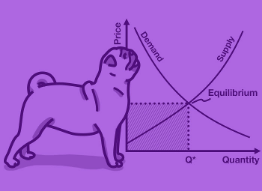
3. Demand and Supply
4. Elasticity
5. Welfare Economics
6. Consumer Choice
7. Output and Costs
8. Perfect Competition
9. Monopoly
11. Government & Inequalities
11 Chapters · 42 Topics · 453 Videos
Discover Our Learning Areas
Explore key subjects and start learning with interactive content.





What is Microeconomics?
Microeconomics is the branch of economics that studies how individual agents — consumers, households, firms, and industries — make decisions when resources are scarce. It answers questions like: Why does the price of a product rise when supply falls? How does a monopoly set its price differently from a competitive firm? What happens to consumer welfare when a government imposes a tax? At university level, microeconomics builds formal models that let you predict and analyse these outcomes with precision. It is the foundation for intermediate economics, finance, and many policy-focused courses.
What topics are covered in a university Microeconomics course?
A standard Canadian university microeconomics course moves through six major areas. First, supply and demand: market equilibrium, shifts in curves, and price controls. Second, elasticity: price elasticity of demand and supply, cross-price elasticity, and income elasticity — all essential for policy and business analysis. Third, consumer theory: utility functions, budget constraints, indifference curves, and the utility-maximising choice. Fourth, producer theory: production functions, cost curves (TC, AVC, ATC, MC), and profit maximisation. Fifth, market structures: perfect competition, monopoly, monopolistic competition, and oligopoly, including basic game theory (Nash equilibrium, dominant strategies). Sixth, market failures: externalities, public goods, and an introduction to government intervention. Many courses also cover welfare economics — consumer surplus, producer surplus, and deadweight loss — which ties the earlier topics together into a policy framework.
Is Microeconomics harder than other first-year university courses?
Microeconomics sits in the middle of the difficulty range for first-year university courses. The concepts are logical and intuitive — most students quickly grasp why demand curves slope downward. The challenge comes when those concepts are formalised mathematically. Calculus-based sections on cost minimisation and utility maximisation catch many students off guard, especially if their high school background was light on functions and derivatives. The other common difficulty is exam technique: microeconomics exam questions present novel scenarios and ask you to apply a model you have never seen before. Students who practise with varied problem sets — not just re-read notes — adapt much more quickly to that format. Consistent weekly practice, not cramming before midterms, is the pattern that leads to strong final grades.
How does Microeconomics connect to other economics and business courses?
Microeconomics is a gateway course. Its models underpin Macroeconomics (aggregate supply and demand draw directly on micro foundations), Intermediate Microeconomics (which extends utility and cost theory with more calculus), Industrial Organisation (which deepens market structure analysis), and Public Economics (which applies welfare analysis to taxation and regulation). Business students use micro in Managerial Economics, Corporate Finance, and Marketing Strategy. Even Econometrics relies on micro theory to frame the hypotheses being tested with data. Completing introductory micro with a solid conceptual and practical foundation gives you a significant advantage in every subsequent economics and business course.
Why StudyPug for Microeconomics?
StudyPug is built for university students who need to understand material deeply — not just pass one exam, but carry that understanding into the next course. Three things set it apart for microeconomics.
Certified-teacher concept videos that teach the method. Every microeconomics lesson is taught by an experienced instructor, not generated by AI. The videos walk through the reasoning behind each step — why you set MRS equal to the price ratio, why marginal cost crosses average total cost at its minimum — so you can reconstruct the logic on any exam question, not just the ones you have seen before. Watch each video as many times as you need until it clicks.
Diagnostic assessment that targets your gaps. Before you spend hours re-studying material you already know, StudyPug's diagnostic identifies precisely which microeconomics topics need work. That means your study time is spent efficiently — fixing real weaknesses rather than reinforcing existing strengths.
Adaptive practice that grows with you. Once you know where to focus, adaptive practice adjusts difficulty to your current level. Work through supply and demand problems, cost curve exercises, and game theory scenarios — each set calibrated so you are always practising at the edge of your understanding, which is where learning happens fastest.
One subscription also covers Macroeconomics, Calculus I–III, Linear Algebra, Statistics, and every other university course on the platform. No need to pay separately for each subject.
What you learn: Microeconomics topic coverage on StudyPug
StudyPug's microeconomics content covers the full scope of a Canadian university introductory course. Key topic areas include:
- Supply, demand, and market equilibrium — including price floors, price ceilings, and comparative statics
- Elasticity — price, income, and cross-price elasticity with applications to revenue and policy
- Consumer theory — utility maximisation, indifference curves, budget constraints, and income and substitution effects
- Producer theory — short-run and long-run production, cost curves, and profit maximisation under competition
- Market structures — perfect competition, monopoly (including price discrimination), monopolistic competition, and oligopoly
- Game theory — simultaneous and sequential games, Nash equilibrium, and dominant strategies
- Welfare economics — consumer and producer surplus, deadweight loss, taxation, and subsidies
- Market failures — externalities, Coase theorem, public goods, and information asymmetry
Each topic is broken into focused lessons so you can jump directly to the concept your next assignment or exam covers, rather than working through the entire course linearly.
Using StudyPug for Microeconomics: how to get the most out of it
The most effective pattern for university microeconomics students is to combine concept videos with immediate practice. After a lecture introduces a new topic — say, monopoly pricing — watch the StudyPug lesson on that topic the same day. The certified-teacher video reinforces the reasoning your professor introduced and fills in steps the lecture may have moved through quickly. Then work through the associated practice problems while the concept is fresh. The adaptive system will adjust difficulty as you go, so you are not stuck on problems that are too easy or overwhelmed by ones that are too hard.
Before midterms and finals, use the practice tests and mock exams. These are built around the format and difficulty of real microeconomics assessments, so they are the best preparation for exam conditions. Work through a full mock exam under timed conditions, review the step-by-step solutions for every question you missed, then repeat. Most students find two or three full practice-test cycles before a major exam is enough to move their performance meaningfully.
If you get stuck on a specific problem type — a tricky game theory matrix, or a multi-step cost minimisation — use Photo Search to find the matching lesson instantly. Take a photo of the problem and StudyPug identifies the relevant lesson, so you spend time learning rather than searching.
Start with the free daily practice to explore the platform, then subscribe when you are ready for full access. All plans include the 30-day money-back guarantee — so there is no risk in getting started before your next midterm.
Microeconomics FAQ
Unsure how StudyPug works? Need help with setting up? Check our frequently asked questions or contact us for help.
What do you learn in Microeconomics, and what topics does it cover?
Microeconomics studies how individual consumers, firms, and markets make decisions about allocating scarce resources. Core topics include supply and demand, elasticity, consumer and producer theory, cost curves, market structures (perfect competition, monopoly, oligopoly, monopolistic competition), game theory, externalities, and public goods. Most university microeconomics courses also introduce welfare economics and basic general equilibrium. By the end, you can model and predict how price changes, policy shifts, and firm decisions ripple through markets.
What is the difference between Microeconomics and Macroeconomics?
Microeconomics focuses on individual decision-making — how a single consumer chooses between goods, or how a firm sets its price. Macroeconomics zooms out to economy-wide aggregates: GDP, inflation, unemployment, and monetary policy. Think of micro as studying a single tree and macro as studying the forest. Students typically take Introductory Microeconomics before Macroeconomics, since micro tools (supply, demand, equilibrium) underpin many macro models. Both courses are usually required for economics and business degrees.
What are the prerequisites for Microeconomics, and what course comes after it?
Most Canadian universities require only high school math (functions, basic algebra, sometimes introductory calculus) for Introductory Microeconomics. Intermediate Microeconomics, the natural next step, typically requires calculus and the intro course. After intermediate micro, students often take Industrial Organization, Public Economics, International Trade, or Econometrics. Completing micro also satisfies prerequisites for many finance and business courses. If your program requires calculus-based micro, brush up on derivatives and optimization before the semester starts.
Is Microeconomics hard, and where do students struggle most?
Microeconomics is conceptually accessible but mathematically demanding. Students most often struggle with indifference curves and utility maximization, cost curve analysis (distinguishing ATC, AVC, MC), game theory payoff matrices, and the welfare analysis of market failures. The challenge is not memorizing definitions — it is applying models to new scenarios under exam pressure. Consistent practice with worked problems, not just re-reading notes, is what separates students who struggle from those who perform well on midterms and finals.
How is Microeconomics assessed — midterms, finals, and assignments?
At most Canadian universities, Microeconomics is assessed through two midterms (worth roughly 20–35% each), a final exam (35–50%), and problem sets or assignments. Some courses add short quizzes or participation marks. Final exams are typically three hours and cover the full course, so cumulative exam prep matters. Provincial university formats vary slightly — check your course outline — but the problem-set-and-exam structure is standard across Ontario, BC, Quebec, and Alberta institutions.
What is one of the hardest topics in Microeconomics, and how do you approach it?
Consumer theory — specifically utility maximization with budget constraints and indifference curve analysis — is consistently rated the most difficult topic in introductory micro. The key is to treat it as a three-step process: (1) understand what the indifference curve represents graphically, (2) set up the tangency condition (MRS = price ratio), and (3) solve algebraically. Practice drawing the graph before touching the algebra. Working through five to ten varied problems, checking each step against a clear solution, builds the pattern recognition you need to handle any exam variant.





Written by the StudyPug Team
Last updated June 5, 2026
3 M+
students
★★★★★
4.8 average
K–12
all grades