Overview
Watch
Read
Next Steps
Read
Surface area and volume of cones
We just learned how to calculate the surface area and volume of pyramids and cylinders in the previous lessons. Now, we will look at cones - objects that have circle bases like cylinders and pointy tops like pyramids. Just like pyramids and cylinders, there are formulas for surface area and volume of cones. We will also try out some questions on composite solids that consist of cones too.
How to find the surface area of a cone
The surface area of a cone calculates the area surrounding the cone, and the surface of the circular base. We can easily find it with the following formula:
How would this work in a math problem?
Question:
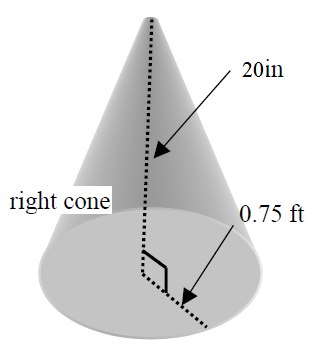
Find the surface area of the following cone.
Solution:
Surface area of cone
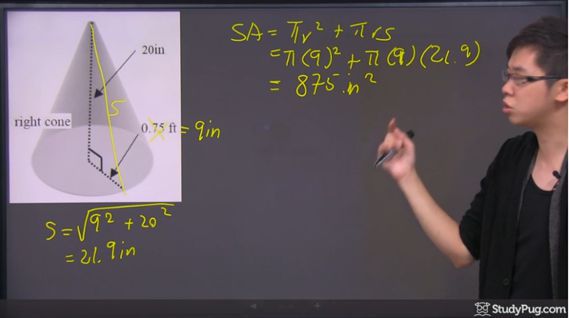
From the graph, we know the height (h) = 20in, radius (r) = 0.75ft. We need to find the slant (s) to calculate the surface area using the Pythagorean Theorem. But in order for us to do proper calculations, we'll have to convert the (h) and (s) into the same unit (inches) first. You can notice that one of the measurements is in feet, and one of them is in inches. To convert it, you'll get the following:
So we have height (h) = 20in, radius (r) = 9in. The slant is actually the hypotenuse of the right angle inside the cone. To find its length, we can now apply the Pythagorean Theorem:
Lastly, we can plug in the numbers into the formula:
The cone surface area is roughly \(875in^2\)
How to find the volume of a cone
So how do we find the volume of a cone? The cone volume is a measurement of how much space there is inside a cone. There is a volume of a cone formula to help you find this:
Let's try it out on an example. It's the same cone as the previous walkthrough, so you should be quite familiar with it already.
Question
Find the volume of the following cone:
Surface area of cone
Solution
Volume of cone
First, we need to calculate the area of the cone's base
Now, we can plug apply the numbers into the formula for volume of a cone
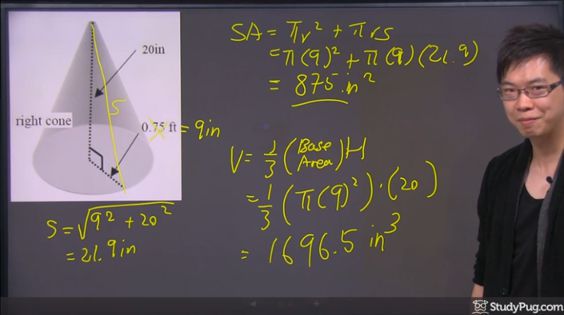
In this example, we didn't have to find an unknown for the volume, but there may be times where you'll be required to do so, such as when the slant is given, but we don't know the height. Always work on finding the unknowns you'll need for the different formulas first, whether it's for the volume or surface area of a cone.
You can take a look at more examples that illustrate a cone and its volume and surface area with this online click and drag cone resizer. This cone calculator can also help you double check your calculations.