Topic
My Progress
Pug Score
0%
Study Points
+0
Overview
Watch
Read
Next Steps
Adaptive practice
Video lessons
Overview
Watch
Read
Next Steps
Watch
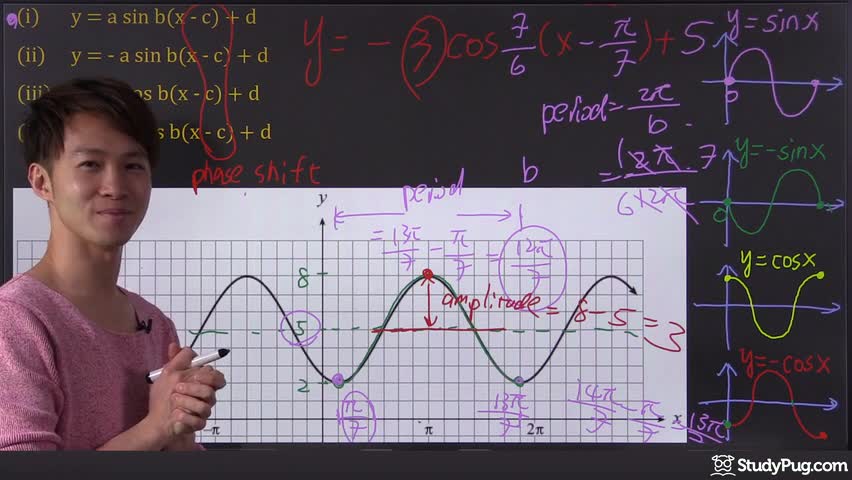
Modeling a periodic graph with sine, negative sine, cosine, and negative cosine
📝 My Notes
Auto-saves the current timestamp
Modeling a periodic graph with sine, negative sine, cosine, and negative cosine
37:46
About this lesson
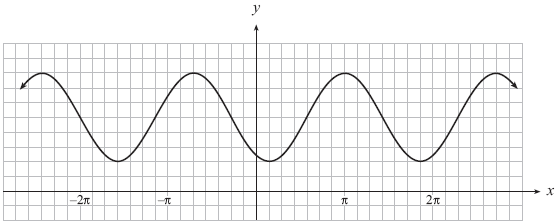
For the following graph, write an equation (with the smallest phase shift) in the form of:
(i) y = a sin b(x - c) + d
(ii) y = - a sin b(x - c) + d
(iii) y = a cos b(x - c) + d
(iv) y = - a cos b(x - c) + d
(i) y = a sin b(x - c) + d
(ii) y = - a sin b(x - c) + d
(iii) y = a cos b(x - c) + d
(iv) y = - a cos b(x - c) + d
Key Moments
No key moments available.
Video 1 of 3
Modeling a periodic graph with sine, negative sine, cosine, and negative cosine
38 min
• Selected
Modeling a periodic curve with cosine, negative cosine, sine, and negative sine
14 min
Modeling a sinusoidal curve using negative cosine from min and max points
13 min