TOPIC

Central and inscribed angles in circles

MY PROGRESS

Pug Score

0%

Study Points

+0

Overview

Watch

Read

Next Steps


Get Started

Get unlimited access to all videos, practice problems, and study tools.

Unlimited practice
Full videos

Back to Menu

Topic Progress

Pug Score

0%

Videos Watched

0/0

Read

Not viewed


Study Points

+0

Read

Mastering Central and Inscribed Angles in Circles

Introduction

Circle geometry and inscribed angles are fundamental concepts in circle geometry, playing a crucial role in understanding the relationships between angles and arcs within circles. Our introduction video provides a comprehensive overview of these essential topics, serving as a valuable starting point for students and enthusiasts alike. This article delves into the key concepts, properties of inscribed angles, and relationships between angles and arcs, offering a deeper understanding of their significance in circular geometry. We'll explore how central angles, which have their vertex at the circle's center, differ from inscribed angles, which have their vertex on the circle's circumference. By examining these angles and their properties of inscribed angles, we'll uncover important theorems and practical applications in mathematics and real-world scenarios. Whether you're a student preparing for exams or simply curious about circle geometry, this exploration of central and inscribed angles will enhance your understanding of these fascinating mathematical concepts.

Understanding Inscribed Angles

Inscribed angles are a fundamental concept in geometry, playing a crucial role in understanding circular relationships. An inscribed angle is formed when two chords of a circle intersect on the circle's circumference. The vertex of this angle lies on the circle, while its sides are chords that extend to other points on the circumference. This unique positioning gives inscribed angles special properties that make them invaluable in geometric proofs with circles.

One of the most important properties of inscribed angles is their relationship to the central angle that subtends the same arc. An inscribed angle is always half the measure of the central angle that subtends the same arc. This relationship is key to solving many geometric problems involving circles. For example, if a central angle measures 120 degrees, any inscribed angle that subtends the same arc will measure 60 degrees.

Inscribed angles are closely related to arcs and chords. The arc intercepted by an inscribed angle is the portion of the circle's circumference that lies between the two points where the angle's sides intersect the circle. This arc is said to be subtended by the inscribed angle. The chord that connects these two points forms the base of the inscribed angle. Understanding these relationships is crucial for solving problems involving inscribed angles.

A fascinating property of inscribed angles is that all inscribed angles subtending the same arc or chord are equal in measure. This means that if you draw multiple inscribed angles that intercept the same arc, they will all have the same measure, regardless of where their vertices are located on the circle's circumference. This property is particularly useful in proving congruence and similarity in geometric proofs with circles.

When discussing arcs, it's important to distinguish between minor and major arcs. A minor arc is the smaller of the two arcs created by two points on a circle's circumference. It's always less than or equal to a semicircle. Conversely, a major arc is the larger of the two arcs and is always greater than a semicircle. The sum of a minor arc and its corresponding major arc always equals the full circumference of the circle.

Inscribed angles can be used to measure both minor and major arcs. An inscribed angle that subtends a minor arc is equal to half the measure of the central angle that subtends the same arc. For major arcs, the inscribed angle is equal to 180 degrees minus half the measure of the central angle that subtends the same arc. This relationship allows for easy arc measure calculation when given inscribed angle measurements, and vice versa.

The properties of inscribed angles have numerous practical applications in fields such as architecture, engineering, and navigation. For instance, architects use inscribed angles to design circular structures and calculate sight lines. In navigation, inscribed angles are used in techniques like triangulation to determine position. Understanding these concepts not only enhances problem-solving skills in geometry but also provides valuable tools for real-world applications of inscribed angles.

In conclusion, inscribed angles are a powerful geometric concept with unique properties that relate them to arcs, chords, and central angles. Their consistent relationship to the arcs they subtend, regardless of vertex position, makes them invaluable in geometric proofs and calculations. By understanding the distinctions between minor and major arcs and how inscribed angles relate to each, students and professionals alike can tackle a wide range of geometric problems and apply these principles in various real-world applications of inscribed angles.

Properties of Inscribed Angles

Inscribed angles are fundamental concepts in geometry that offer fascinating insights into the relationships between angles and arcs in circles. These angles, formed by two chords intersecting on the circle's circumference, possess unique properties that make them invaluable in various geometric proofs and real-world applications.

One of the most important properties of inscribed angles is that those inscribed on the same arc or equal arcs are congruent. This means that if two angles are inscribed in a circle and intercept the same arc, they will have equal measures, regardless of where their vertices are located on the circle's circumference. This property is particularly useful in solving complex geometric problems and constructing proofs.

To visualize this, imagine drawing two chords from different points on a circle's circumference to the endpoints of an arc. The angles formed at the intersection of these chords with the circle will be congruent, despite potentially having different positions on the circle. This principle holds true even if one of the angles has its vertex at one of the arc's endpoints.

Another intriguing aspect of inscribed angles is the special case of those inscribed in a semicircle. An inscribed angle in a semicircle always forms a right angle, measuring exactly 90 degrees. This phenomenon occurs because the angle is inscribed in half of the circle, and its measure is always half of the central angle that subtends the same arc. Since a semicircle corresponds to a central angle of 180 degrees, the inscribed angle must be 90 degrees.

This property of inscribed angles in semicircles has numerous practical applications in architecture, engineering, and design. For instance, architects often use this principle to ensure right angles in curved structures or to create visually appealing circular designs with perpendicular elements.

To further illustrate these concepts, consider a circle with an inscribed angle ABC, where B is on the circle's circumference and AC is a diameter. Regardless of where point B is placed on the semicircle formed by AC, angle ABC will always be a right angle. This demonstrates the consistency and reliability of this geometric principle.

Understanding these properties of inscribed angles enhances our ability to analyze and solve geometric problems. Whether dealing with congruent angles on equal arcs or right angles in semicircles, these principles provide powerful tools for mathematical reasoning and practical applications in various fields.

In conclusion, the properties of inscribed angles, including their congruence when inscribed on the same or equal arcs and the formation of right angles in semicircles, are essential concepts in geometry. These principles not only facilitate geometric proofs but also find applications in real-world scenarios, making them valuable knowledge for students, mathematicians, and professionals alike.

Central Angles: Definition and Properties

Central angles are a fundamental concept in geometry, playing a crucial role in understanding circles and their properties. A central angle is an angle formed by two radii of a circle that intersect at the center. This unique positioning gives central angles several important characteristics that distinguish them from other types of angles, such as inscribed angles.

Unlike inscribed angles, which have their vertex on the circle's circumference, central angles always have their vertex at the circle's center. This key difference affects how these angles relate to arcs and chords within the circle. Central angles have a direct relationship with the arcs they intercept: the measure of a central angle is always equal to the measure of the arc it intercepts. This one-to-one correspondence makes central angles particularly useful in calculating arc lengths and sector areas.

One of the most important properties of central angles is their relationship to chords. A chord is a line segment that connects two points on a circle's circumference. Central angles that intercept the same chord or arc are always congruent, regardless of their position within the circle. This property is essential for proving many geometric theorems and solving complex problems involving circles.

To illustrate these concepts, consider a pizza cut into equal slices. Each slice represents a central angle, with the point of the slice at the center of the pizza (the circle's center) and the crust forming part of the circumference. All these slices (central angles) are congruent because they intercept equal arcs along the pizza's edge. If we were to draw lines connecting the ends of each slice across the pizza, these would represent chords, all subtended by congruent central angles.

Another example can be seen in a bicycle wheel. The spokes of the wheel represent radii, and any angle formed by two spokes at the hub is a central angle. The arc of the wheel's rim between two spoke ends is directly proportional to the central angle formed by those spokes. This relationship is used in engineering to ensure proper wheel balance and spoke tension.

Understanding central angles and their properties is crucial for various applications, from basic geometry to advanced mathematics and real-world engineering problems. Their consistent relationship with arcs and chords makes them invaluable tools for calculating and reasoning about circular objects and rotational symmetry in many fields of study and practical applications.

Relationship Between Central and Inscribed Angles

In geometry, understanding the relationship between central angles and inscribed angles is crucial for solving problems involving circles. A central angle is an angle formed by two radii of a circle, with its vertex at the center of the circle. An inscribed angle, on the other hand, is an angle formed by two chords of a circle, with its vertex on the circle's circumference. When these angles intercept the same arc, a fascinating relationship emerges.

The key principle to remember is that a central angle is always twice the measure of a central angle that intercepts the same arc. This relationship is fundamental in circle geometry and has numerous applications in problem-solving. Let's explore this concept in more detail.

Consider a circle with a central angle θ and an inscribed angle φ, both intercepting the same arc. The relationship between these angles can be expressed mathematically as:

θ = 2φ

This means that if you know the measure of an inscribed angle, you can easily find the measure of a central angle by doubling it. Conversely, if you know the measure of a central angle, you can find the measure of the inscribed angle by halving it.

Let's look at an example to illustrate this relationship. Imagine a circle with a central angle of 120°. If an inscribed angle intercepts the same arc as this central angle, its measure would be 60°. We can verify this:

Central angle = 120°
Inscribed angle = 120° ÷ 2 = 60°

Conversely, if we start with an inscribed angle of 45°, the corresponding central angle would be 90°:

Inscribed angle = 45°
Central angle = 45° × 2 = 90°

This relationship holds true regardless of where the inscribed angle is positioned on the circle, as long as it intercepts the same arc as the central angle. This property is particularly useful when solving problems involving circles, especially when some angle measures are unknown.

For instance, if you're given the measure of an inscribed angle and asked to find the measure of the central angle intercepting the same arc, you can simply double the inscribed angle's measure. Similarly, if you're given a central angle and need to find the measure of an inscribed angle intercepting the same arc, you can halve the central angle's measure.

This relationship also extends to other circle theorems. For example, inscribed angles that intercept the same arc are always equal, regardless of where their vertices are located on the circle. This is because they are all half the measure of the same central angle.

In practical applications, this principle is used in various fields such as architecture, engineering, and navigation. For example, in surveying, understanding the relationship between central and inscribed angles can help in accurately measuring distances and angles on curved surfaces.

To solve problems using this relationship, follow these steps:

  1. Identify whether you're dealing with a central angle or an inscribed angle.
  2. Determine if you need to find the measure of the other type of angle.
  3. If you have a central angle and need the inscribed angle, divide by 2.
  4. If you have an inscribed angle and need the central angle, multiply by 2.
  5. Apply the result to solve the problem at hand.

By mastering this fundamental relationship between central and inscribed angles, you'll be well-equipped to tackle a wide range of geometric problems involving circles. Remember, the key is to recognize when this principle can be applied and to use it effectively in your calculations.

Applications and Problem-Solving

Central and inscribed angles play crucial roles in various real-world applications, from architecture to navigation. Understanding these concepts is essential for problem-solving in geometry and practical scenarios. Let's explore some practical applications and work through problem-solving examples to demonstrate the properties and relationships of these angles.

1. Architecture and Design: Architects often use central and inscribed angles when designing circular structures or elements. For example, in creating a circular amphitheater, they might need to calculate the angle between seating sections or determine the size of arches.

Problem: An architect is designing a circular fountain with 8 equally spaced water jets around the edge. What is the central angle between each jet?

Solution:
Step 1: Recall that a circle has 360°
Step 2: Divide 360° by the number of jets
Central angle = 360° ÷ 8 = 45°
Therefore, the central angle between each water jet is 45°.

2. Navigation and Surveying: Sailors and surveyors use inscribed angles to determine distances and positions. The inscribed angle theorem is particularly useful in these fields.

Problem: A surveyor stands at point A and measures an inscribed angle of 30° to two landmarks, B and C, on the edge of a circular lake. If the distance between B and C is 100 meters, what is the diameter of the lake?

Solution:
Step 1: Recall that an inscribed angle is half the central angle
Step 2: The central angle is 2 × 30° = 60°
Step 3: The arc BC subtends 60° of the circle's circumference
Step 4: Set up the proportion: 60°/360° = 100m/circumference
Step 5: Solve for circumference: circumference = (360° × 100m) ÷ 60° = 600m
Step 6: Use C = πd to find diameter: 600m = π × d
d 191 meters (rounded to nearest meter)

3. Astronomy: Astronomers use central and inscribed angles to measure celestial distances and positions.

Problem: An astronomer observes two stars from Earth. The angle between them is 40°, and they appear to be on the edge of a circular constellation. What is the inscribed angle formed by these stars from the center of the constellation?

Solution:
Step 1: The observed angle of 40° is a central angle
Step 2: Apply the inscribed angle theorem: inscribed angle = ½ × central angle
Inscribed angle = ½ × 40° = 20°
The inscribed angle formed by the stars from the center of the constellation is 20°.

4. Engineering: Engineers use these concepts in designing circular components or structures.

Problem: A circular gear has a radius of 10 cm. An arc on its circumference subtends a central angle of 75°. What is the length of this arc?

Solution:
Step 1: Recall the formula for arc length: L = (θ/360°) × 2πr, where θ is the central angle
Step 2: Substitute known values: L = (75°/360°) × 2π × 10 cm
Step 3: Simplify: L = 0.2083 × 62.83 cm 13.09 cm

5. Sports: In sports like track and field or cycling, understanding circular geometry is crucial for designing tracks and calculating distances.

Problem: A running track consists of two semicircular ends connected by straight sides. If the straight sides are 100m long and the width of the track is 10m, what is the total length of the inside lane?

Common Misconceptions and Tips

Central and inscribed angles are fundamental concepts in geometry, yet they often lead to misconceptions among students. One common misunderstanding is that central and inscribed angles are always equal. In reality, a central angle is twice the measure of an inscribed angle that intercepts the same arc. This relationship is crucial for solving many geometric problems involving circles.

Another misconception is that inscribed angles can only be formed at the circumference of a circle. While this is the most common representation, inscribed angles can also be formed by chords within the circle. Understanding this broader definition helps in recognizing inscribed angles in more complex geometric configurations.

To effectively work with central and inscribed angles, it's essential to develop strategies for identification and problem-solving. When approaching a geometric figure, first identify the circle or potential circular arcs. Look for angles formed at the center of the circle (central angles) and those formed by intersecting chords or tangents (inscribed angles). Pay attention to the position of the vertex central angles have their vertex at the circle's center, while inscribed angles have their vertex on the circle's circumference.

A helpful tip is to always draw auxiliary lines when working with these angles. Extending radii or chords can reveal hidden relationships and make the problem easier to solve. For inscribed angles, try connecting the vertex to the center of the circle to create isosceles triangles, which can simplify calculations.

Memory aids can be invaluable for retaining key concepts. Remember the "pizza slice" analogy: a central angle is like a slice of pizza (larger), while the corresponding inscribed angle is like taking a bite from the crust (smaller). The "2:1 rule" is crucial: the central angle is always twice the inscribed angle that subtends the same arc.

When dealing with inscribed angles in various configurations, use the "same arc, same angle" principle. This states that inscribed angles intercepting the same arc are equal, regardless of where their vertices are on the circle. This principle is particularly useful when solving problems involving cyclic quadrilaterals.

For more complex geometric configurations, break down the figure into simpler components. Look for familiar shapes like isosceles triangles or right angles formed by tangent-radius relationships. Remember that an angle inscribed in a semicircle is always a right angle a powerful tool for identifying 90-degree angles in circular figures.

By addressing these misconceptions and applying these strategies, you'll be better equipped to tackle a wide range of geometric problems involving central and inscribed angles. Practice regularly with diverse problem types to reinforce your understanding and develop intuition for these important geometric relationships.

Conclusion

In this article, we've explored the fundamental concepts of central and inscribed angles in circles, highlighting their crucial role in geometry. We began with an introduction video that visually demonstrated these concepts, providing a solid foundation for understanding. Key points covered include the definition and properties of central angles, the relationship between angles central and inscribed angles, and how to calculate their measures. We also discussed the importance of inscribed angles in various geometric proofs and real-world applications. As you continue your journey in geometry, remember that mastering these concepts is essential for tackling more advanced topics. We encourage you to apply your newfound knowledge by practicing with sample problems and seeking out real-world examples where central and inscribed angles play a role. By doing so, you'll reinforce your understanding and develop a deeper appreciation for the elegance of circular geometry. Don't hesitate to revisit the introduction video for a refresher on these vital concepts.

Find x
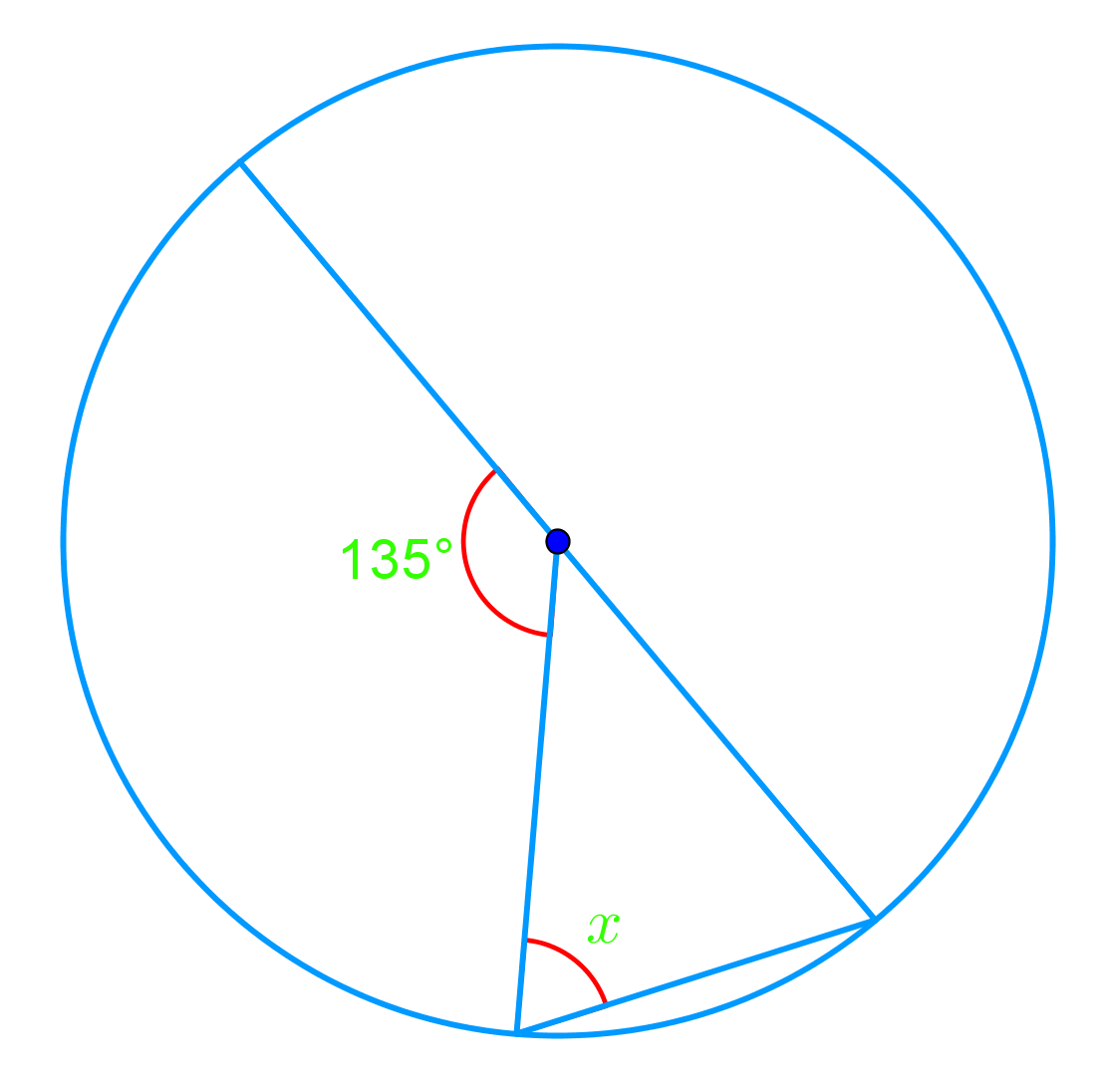
Using central angle to find inscribed angles in circles

Step 1: Identify the Given Information

In the given diagram, we have a central angle of 135 degrees. This is the key piece of information that will help us find the value of x. The central angle is the angle formed at the center of the circle by two radii.

Step 2: Calculate the Supplementary Angle

Since the sum of angles on a straight line is 180 degrees, we can find the supplementary angle to the 135-degree angle. To do this, subtract 135 degrees from 180 degrees:
180 degrees - 135 degrees = 45 degrees
This 45-degree angle is the angle adjacent to the 135-degree angle on the straight line.

Step 3: Recognize the Isosceles Triangle

In the diagram, the radii of the circle are equal. This means that the triangle formed by the two radii and the chord is an isosceles triangle. In an isosceles triangle, the base angles are equal. Therefore, the two angles at the base of the triangle are both x degrees.

Step 4: Use the Triangle Angle Sum Property

The sum of the angles in any triangle is 180 degrees. In this isosceles triangle, we have one angle of 45 degrees (calculated in Step 2) and two equal angles of x degrees. Therefore, we can set up the following equation:
45 degrees + x + x = 180 degrees

Step 5: Solve for x

Simplify the equation from Step 4 to find the value of x:
45 degrees + 2x = 180 degrees
Subtract 45 degrees from both sides:
2x = 135 degrees
Divide both sides by 2:
x = 67.5 degrees

Conclusion

By following these steps, we have determined that the value of x is 67.5 degrees. This solution involves understanding the properties of central and inscribed angles in circles, as well as the properties of isosceles triangles and the sum of angles in a triangle.

FAQs

Here are some frequently asked questions about central and inscribed angles:

1. How do you know if an angle is inscribed?

An angle is inscribed if its vertex lies on the circumference of a circle and its sides are chords of the circle. In other words, the angle is formed by two chords that intersect on the circle's edge.

2. Are central angles and inscribed angles measured the same way?

No, central angles and inscribed angles are not measured the same way. A central angle is measured directly as the angle formed at the center of the circle. An inscribed angle is measured as half the measure of the central angle that subtends the same arc.

3. What is the formula for inscribed angle?

The formula for an inscribed angle is: Inscribed Angle = (1/2) × Central Angle. This means that an inscribed angle is always half the measure of the central angle that subtends the same arc.

4. What is an example of a central angle?

A central angle is an angle whose vertex is at the center of a circle and whose sides are radii of the circle. For example, imagine a pizza cut into 8 equal slices. The angle formed at the center by any two adjacent slices is a central angle of 45° (360° ÷ 8).

5. How do you solve inscribed angles problems?

To solve inscribed angles problems: 1. Identify the inscribed angle and the arc it intercepts. 2. Remember that the inscribed angle is half the central angle subtending the same arc. 3. If given the central angle, divide by 2 to find the inscribed angle. 4. If given the inscribed angle, multiply by 2 to find the central angle. 5. Use the relationships between inscribed angles and arcs to solve for unknown angles or arc measures.

Prerequisite Topics for Central and Inscribed Angles in Circles

Understanding central and inscribed angles in circles is a crucial concept in geometry, but to fully grasp this topic, it's essential to have a solid foundation in several prerequisite areas. One of the fundamental concepts to master is angles in a circle. This knowledge forms the basis for understanding how different types of angles relate to circular geometry.

Another important prerequisite is chord properties. Chords play a significant role in the study of central and inscribed angles, as they often form the basis for these angles within a circle. Understanding how chords behave and their relationships to angles is crucial for solving problems involving central and inscribed angles.

To delve deeper into the topic, familiarity with inscribed angles and proofs is essential. This knowledge helps in understanding the relationships between inscribed angles and the arcs they intercept, which is a key aspect of the main topic.

Additionally, knowledge of isosceles and equilateral triangles can be beneficial, as these shapes often appear when working with central and inscribed angles in circles. The properties of these special triangles can simplify many calculations and proofs related to circular geometry.

For a more advanced understanding, radian measure and arc length concepts are valuable. These topics provide alternative ways to measure angles and arcs in circles, which can be particularly useful in more complex problems involving central and inscribed angles.

When dealing with calculations, the ability to use tangent ratio to calculate angles and sides can be incredibly helpful. This trigonometric skill often comes into play when solving problems related to central and inscribed angles, especially when dealing with right triangles inscribed in circles.

For those looking to explore more advanced applications, understanding double-angle identities can be beneficial. These trigonometric identities sometimes appear in complex problems involving central and inscribed angles, particularly when dealing with angles that are twice the measure of others.

Lastly, recognizing the relationship between two variables is a valuable skill that applies to many aspects of mathematics, including the study of central and inscribed angles. This algebraic concept helps in understanding how changes in one angle or measurement affect others within a circle.

By mastering these prerequisite topics, students will be well-equipped to tackle the complexities of central and inscribed angles in circles, enabling them to solve a wide range of geometric problems with confidence and precision.