Topic
My Progress
Pug Score
0%
Study Points
+0
Overview
Watch
Read
Next Steps
Overview
Watch
Read
Next Steps
Watch
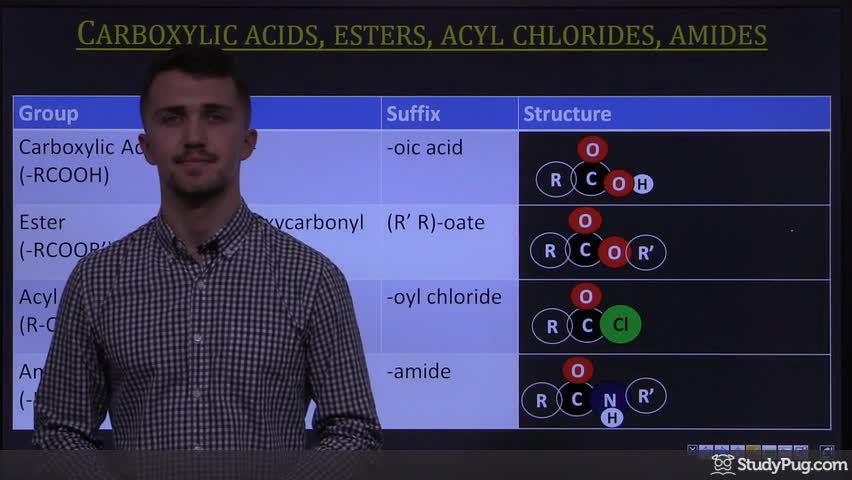
Intro to systematic naming of organic functional groups
📝 My Notes
Auto-saves the current timestamp
Intro to systematic naming of organic functional groups
5:57
About this lesson
Key Moments
No key moments available.
Video 1 of 13
Intro to systematic naming of organic functional groups
6 min
• Selected
Naming high-priority functional groups: acids, esters, acyl chlorides, and amides
9 min
Naming nitriles, aldehydes, and ketones as functional groups
5 min
Naming alcohols, amines, alkenes, alkynes, and lowest order groups
4 min
Naming ethers, halides, and nitro functional groups
3 min
Guide to naming aromatic compounds and their inconsistencies
4 min
Naming a compound with nitrile, ketone, and alcohol groups
3 min
Naming a compound with an amide as the highest order group
3 min
Naming an aromatic compound with ethyl groups and a carboxylic acid
4 min
Naming an ester: identifying R groups and applying ester naming rules
3 min
Naming a dibromo-substituted carboxylic acid (butanoic acid)
1 min
Naming a substituted benzaldehyde with systematic and common names
4 min
Naming a compound with amine and carboxylic acid groups (alanine)
3 min